Custom Concrete Tree Stump Plastic Mold
OEM Plastic Mold Manufacturer for Decorative Concrete Products — Landscape, Garden & Architectural Applications
✓ Wood Grain Texture
✓ Easy Demolding
✓ 300–1000 Reuse Cycles
✓ OEM Design Service
✓ Injection Mold Mfg
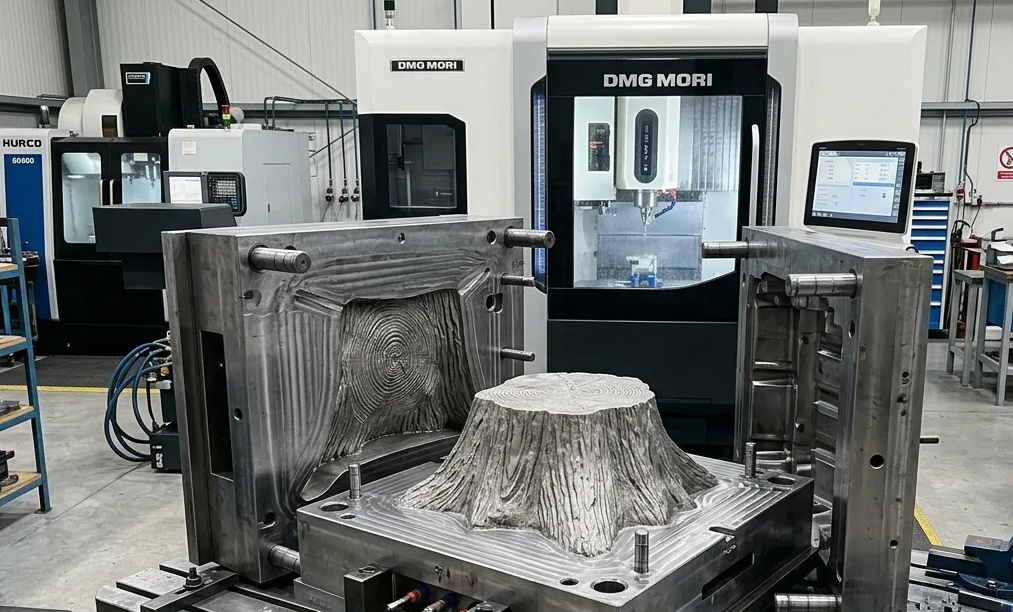
What Is a Concrete Tree Stump Plastic Mold?
A concrete tree stump plastic mold is a reusable injection-molded tool designed to manufacture decorative concrete products with realistic wood textures. It is widely used for landscape architecture, garden decoration, parks, residential projects, and commercial outdoor spaces. The mold cavity replicates bark grain, knots, and natural wood features, allowing rapid production of faux-wood concrete elements without hand carving.

Plastic Molds for Decorative Concrete Production
Xiamen Goldcattle designs and manufactures custom plastic injection molds for a full range of decorative concrete products — from tree stumps and fence panels to planters, benches, retaining wall blocks, and architectural ornament pieces. Each mold is engineered for consistent surface reproduction, long service life, and efficient demolding across hundreds of production cycles.
Our in-house capability covers the entire value chain: DFM analysis, mold design, CNC machining, injection molding, texture development, prototype testing, and volume production. Whether you need a single prototype mold or a batch of 200+ production molds, we deliver complete OEM service from drawing to finished tooling.
Core capability: We do not sell finished concrete stumps — we provide the mold manufacturing service that enables you to produce them at scale. Tree stump molds are one application within our broader decorative concrete mold portfolio.
Applications & Use Cases
Plastic molds for decorative concrete serve diverse outdoor and architectural markets
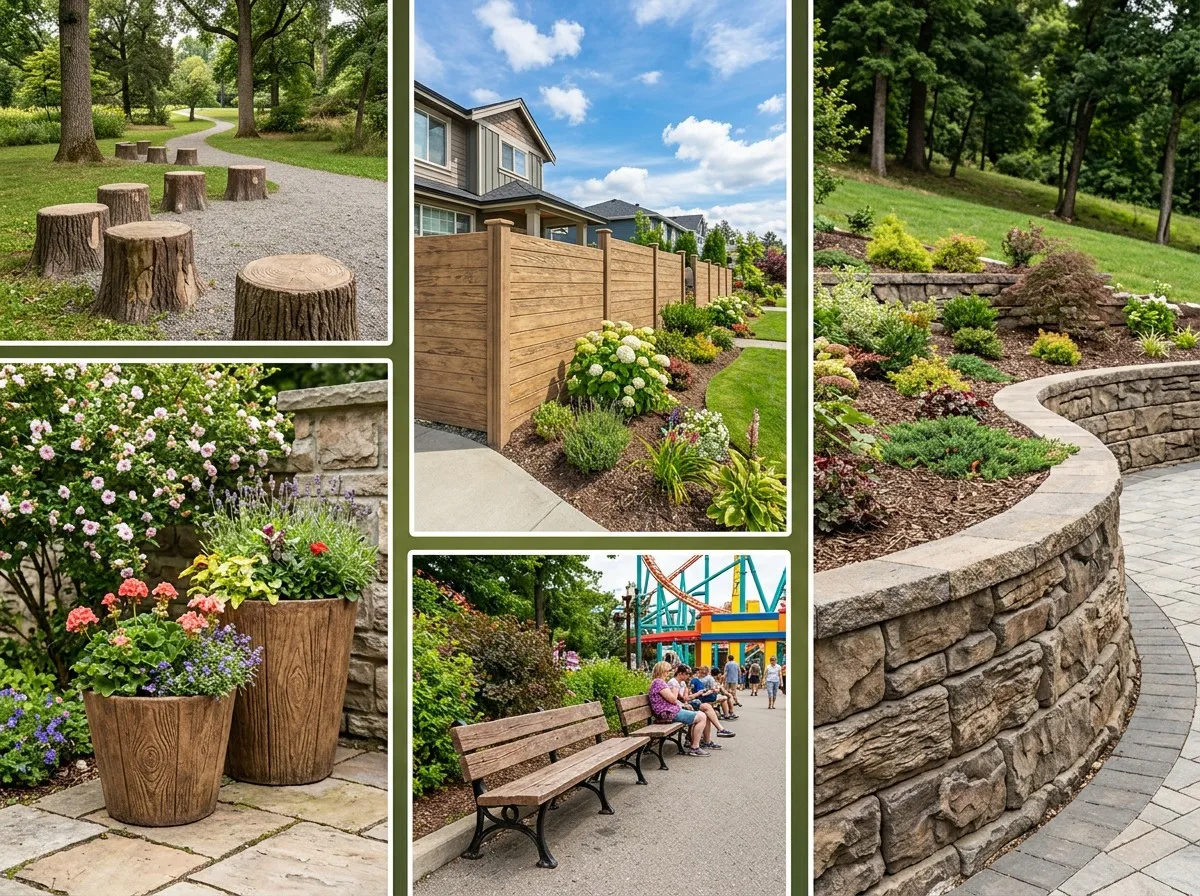
Landscape Parks
Garden Decoration
Residential Communities
Theme Parks
Outdoor Furniture
Decorative Fences
Concrete Benches
Garden Planters
Retaining Walls
Architectural Elements
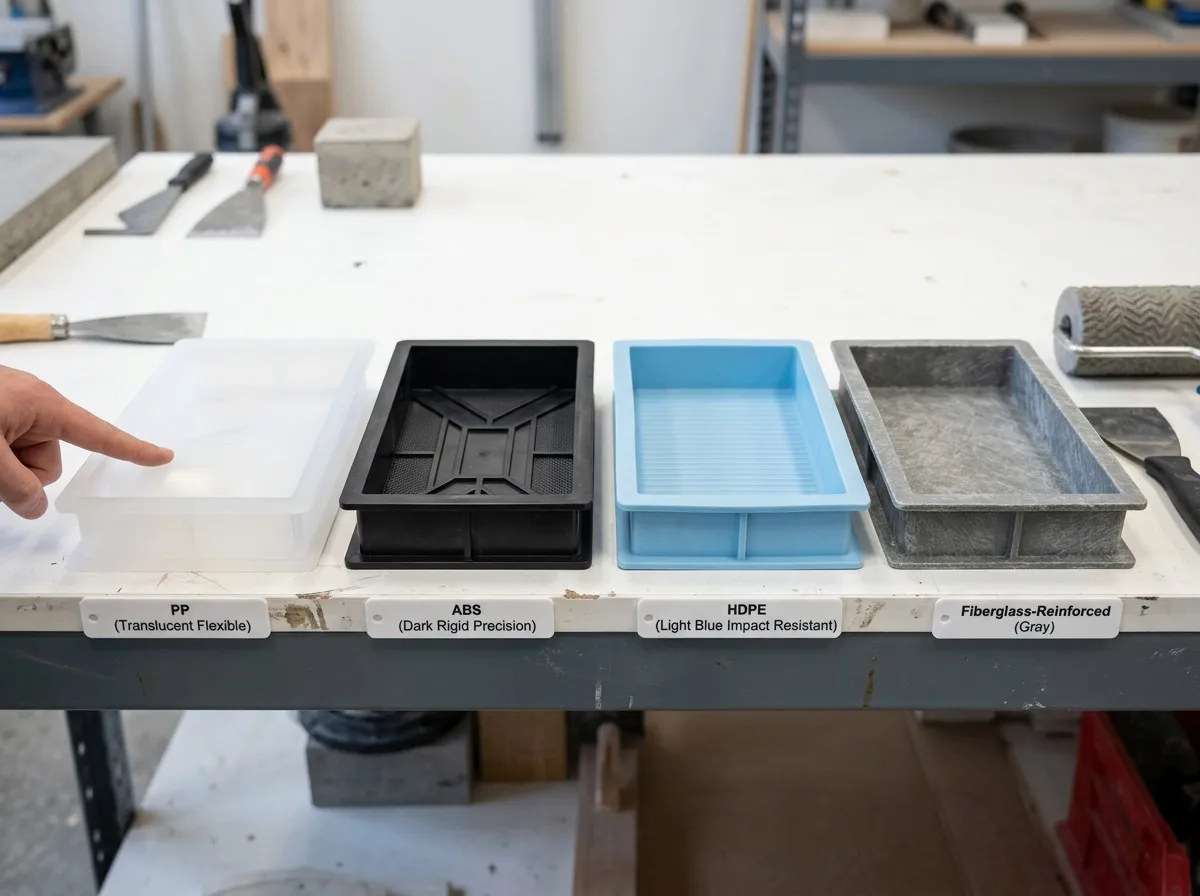
Mold Material Options
Select the right polymer for your concrete product application, texture requirements, and production volume
| Material | Key Advantages | Best Suited For |
|---|---|---|
| PP (Polypropylene) | Flexible, lightweight, cost-effective, good chemical resistance | Large landscape molds, fence panels, retaining wall blocks |
| ABS | High dimensional precision, rigid structure, smooth surface | Injection-molded detail pieces, small decorative elements |
| HDPE | Impact resistant, UV stable, excellent outdoor durability | Outdoor production molds exposed to weather and repeated handling |
| Fiberglass-Reinforced | Extended service life, structural rigidity for large volumes | Large concrete products, GFRC panels, high-cycle production |
| PU (Polyurethane) | High detail reproduction, elastic demolding | Fine decorative mold, ornamental pieces with intricate relief |
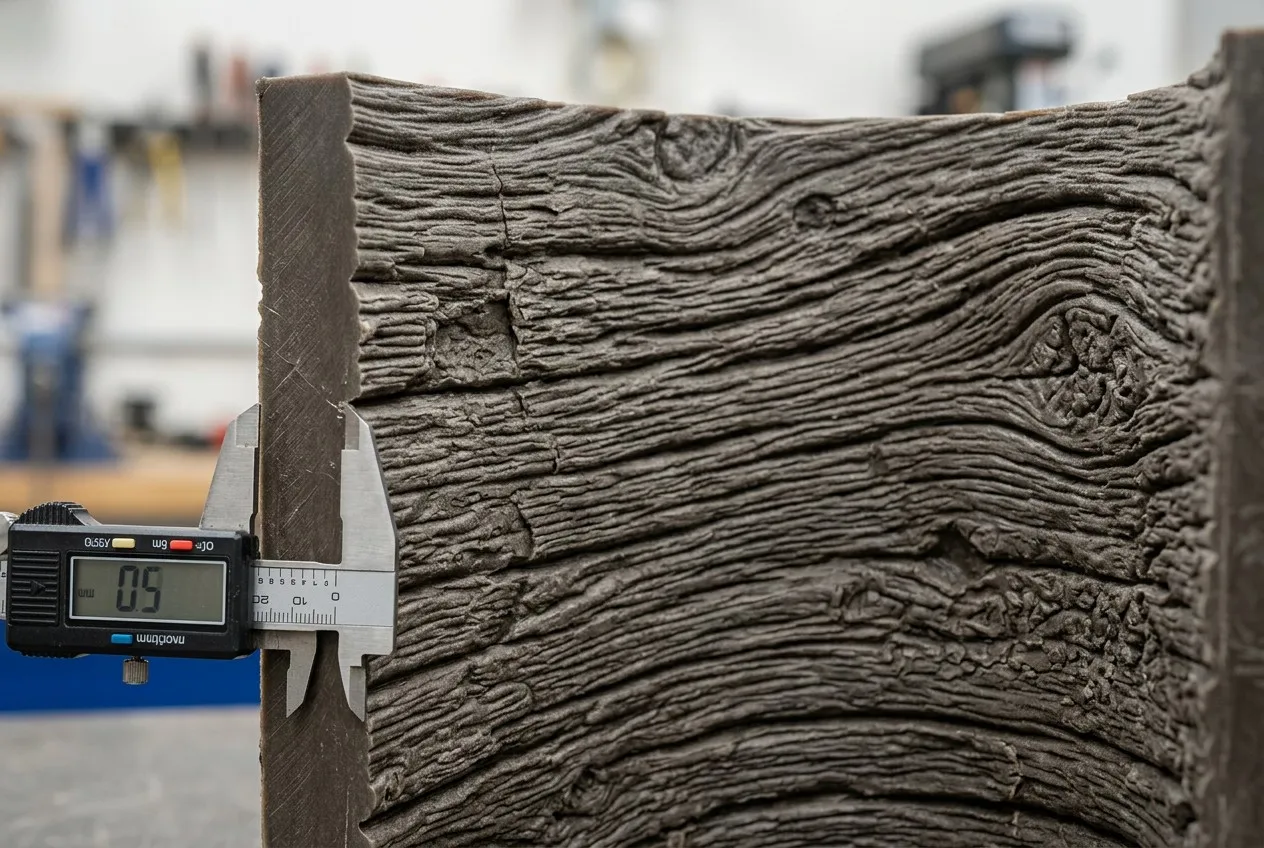
Mold cavity cross-section showing wall thickness and bark grain depth
Technical Specifications
Key parameters for mold design, production capability, and concrete compatibility
| Wall Thickness | 2–8 mm (varies by product size and material) |
| Surface Texture | Wood grain, bark, stone, brick, bamboo, river rock |
| Concrete Compatibility | GFRC, ordinary concrete, UHPC, lightweight aggregate |
| Demolding | Easy — flexible cavity walls, no mechanical release required |
| Reusable Cycle Life | 300–1,000 cycles depending on material and handling |
| Customization | Full OEM — dimensions, texture, shape, logo engraving |
| Accepted Drawing Formats | STEP, IGS, STL, PDF, 2D DWG |
Manufacturing Process
From drawing submission to finished mold delivery — 9-step OEM workflow
1
Drawing
2
DFM Review
3
Mold Design
4
CNC Cut
5
Injection
6
Sample
7
Texture QC
8
Production
9
Packaging
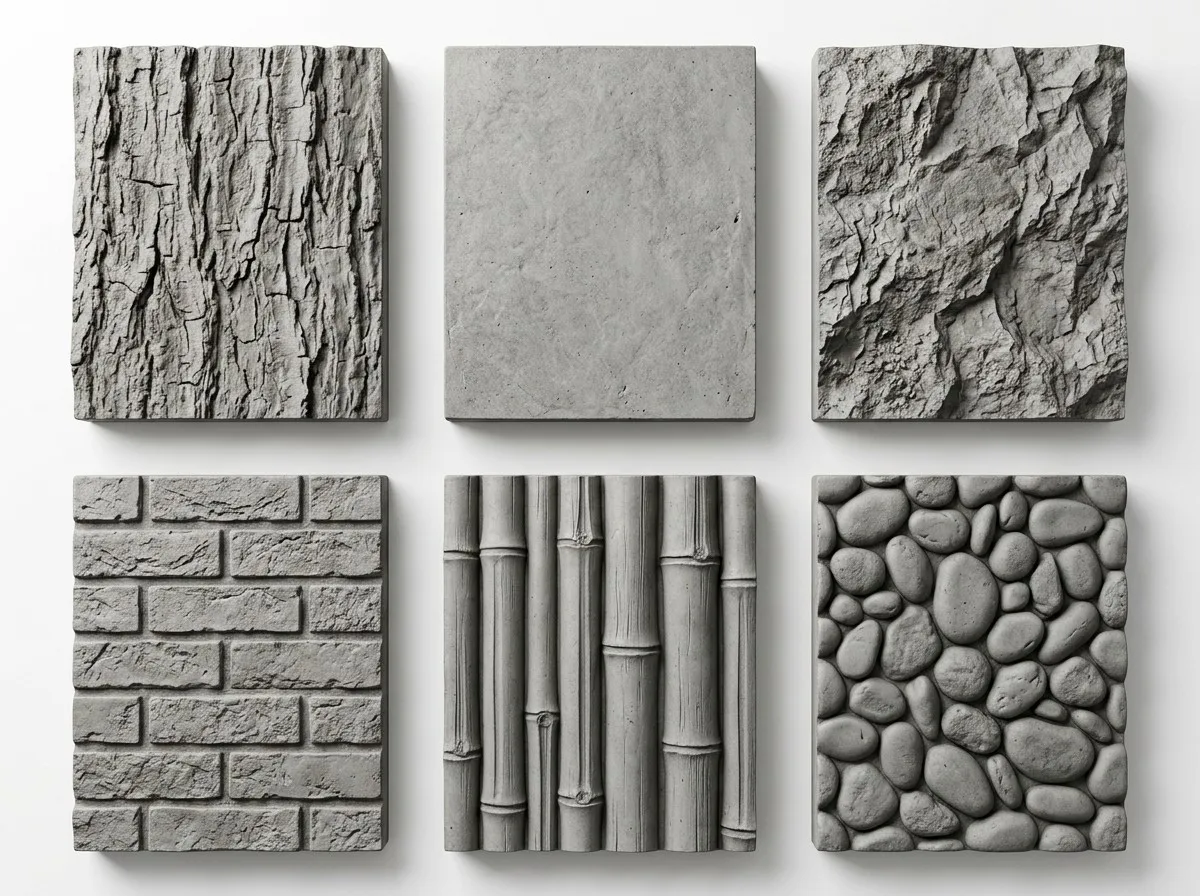
Surface Texture Options
Every mold cavity is engineered to reproduce a specific natural surface pattern. Available textures include realistic bark grain, smooth and rough stone, brick, bamboo, and river rock — each with controlled depth for concrete casting fidelity.
Texture depth ranges from 0.5 mm (light surface hint) to 4 mm (deep relief for GFRC and architectural panels). Pattern fidelity is verified by casting a sample and comparing against the reference model.
- Wood Bark Grain — most popular for tree stump and fence molds
- Smooth Stone — for planters, retaining wall caps
- Rough Stone — for rustic landscape elements
- Brick Pattern — for wall panel and column molds
- Bamboo Texture — for Asian-style garden features
- River Rock — for natural water-feature surrounds
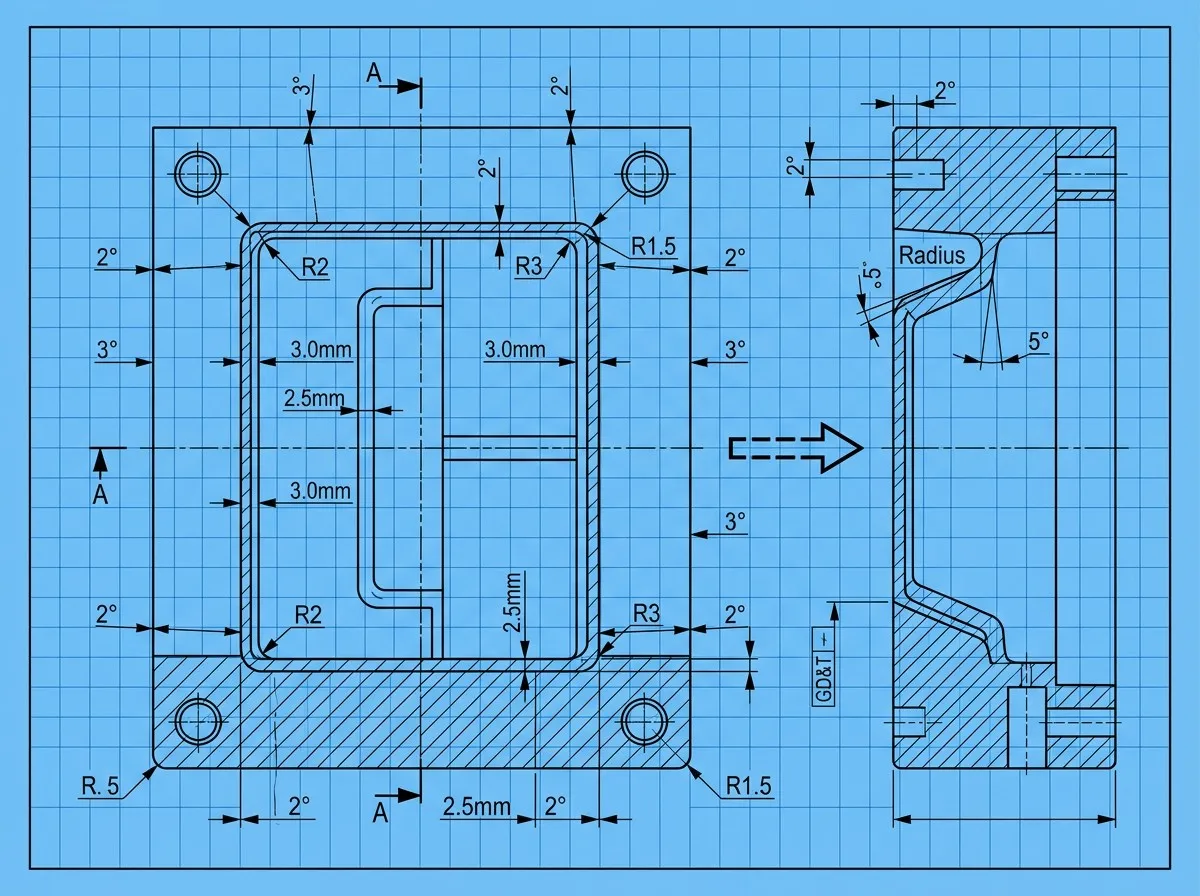
Draft angle, wall thickness, rib, and corner radius design parameters
Mold Design Guidelines
Practical parameters for effective mold geometry, smooth demolding, and long service life
| Parameter | Recommendation |
|---|---|
| Draft Angle | 1–3° minimum; 2–5° for textured surfaces to assist release |
| Texture Depth | 0.5–4 mm; deeper relief requires proportionally larger draft |
| Wall Thickness | 2–8 mm; uniform thickness avoids warpage and stress concentration |
| Reinforcement Rib | 0.5–0.8× wall thickness; base radius ≥ 0.5 mm to prevent sink marks |
| Corner Radius | ≥ 1 mm on all internal corners; eliminates stress cracking during use |
| Concrete Shrinkage Allowance | +1–2% on cavity dimensions depending on mix design |
| Demolding Direction | Single-direction pull preferred; avoid undercuts unless PU/flexible material |
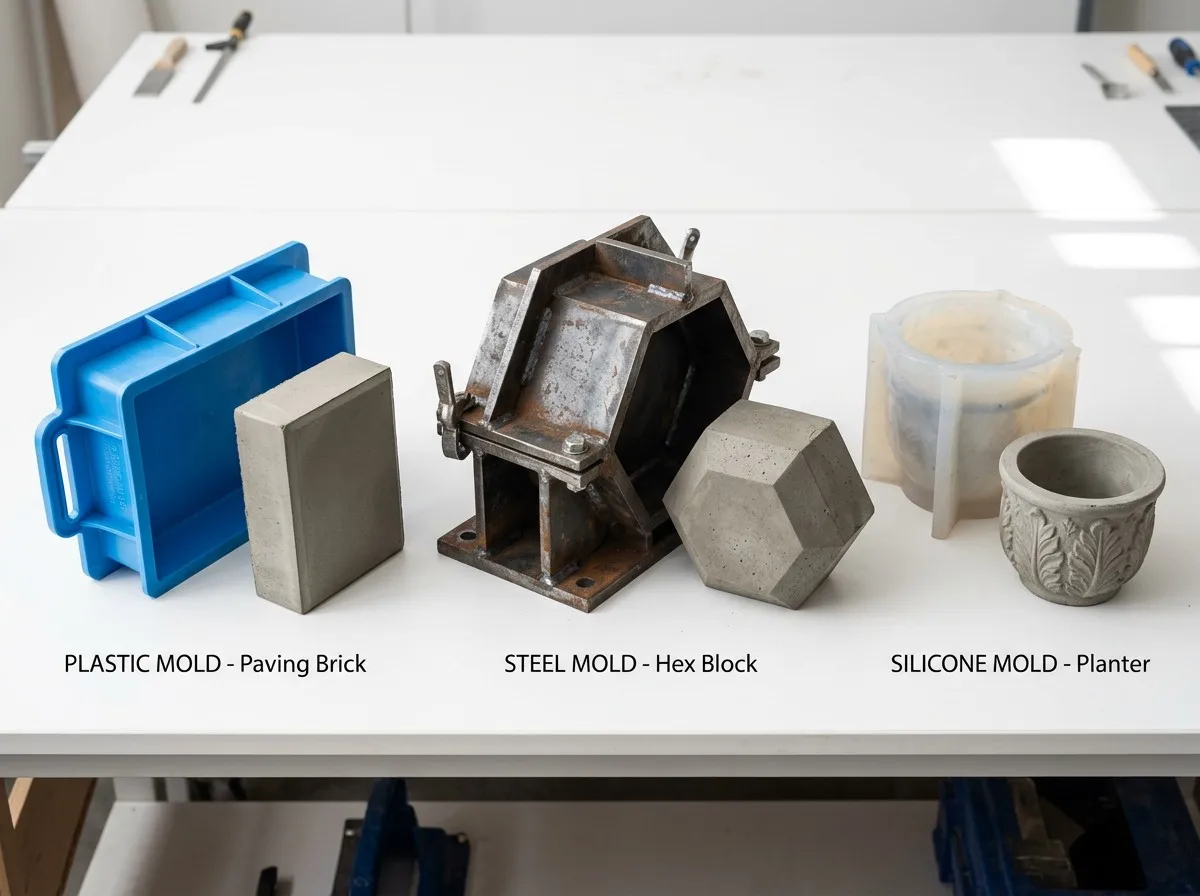
Why Choose Plastic Molds?
Comparing plastic injection molds against steel, silicone, and rubber alternatives for decorative concrete production
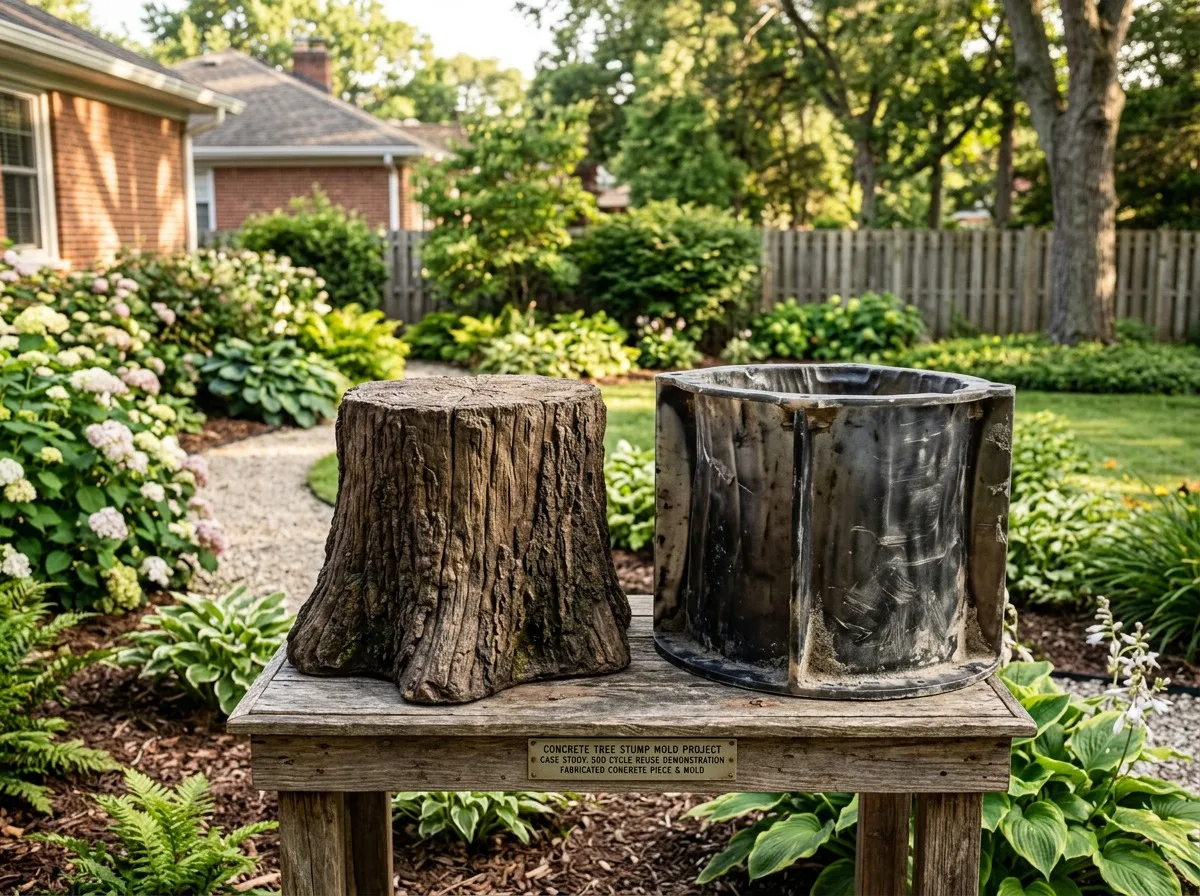
Project Case: Landscape Tree Stump Mold
| Project Type | Landscape Tree Stump Mold |
| Material | PP (Polypropylene) |
| Surface Texture | Realistic bark grain (2.5 mm depth) |
| Order Quantity | 150 production molds |
| Destination | USA — Midwest landscape contractor |
| Tooling Time | 18 business days |
| Result | Service life verified at 500+ casting cycles; consistent bark reproduction throughout |
The client supplied reference photos of local oak bark. Our engineering team developed a custom texture pattern via CNC engraving on the mold core, achieving 2.5 mm relief depth with full draft compliance. After initial sample approval, the full batch was produced and shipped within the committed timeline.
Quality Control & Assurance
Every mold undergoes a structured inspection protocol before shipment. Our QC process covers dimensional accuracy, surface texture fidelity, wall thickness uniformity, and functional demolding tests.
- Dimensional check — CMM and digital gauge verify cavity dimensions against design tolerance
- Texture fidelity — first cast sample compared against reference model for pattern accuracy
- Wall thickness mapping — ultrasound probe scans critical sections for uniformity
- Demolding cycle test — minimum 10 consecutive casts to confirm smooth release and surface retention
- ISO 9001 certified — process documentation, traceability, and continuous improvement framework

Frequently Asked Questions
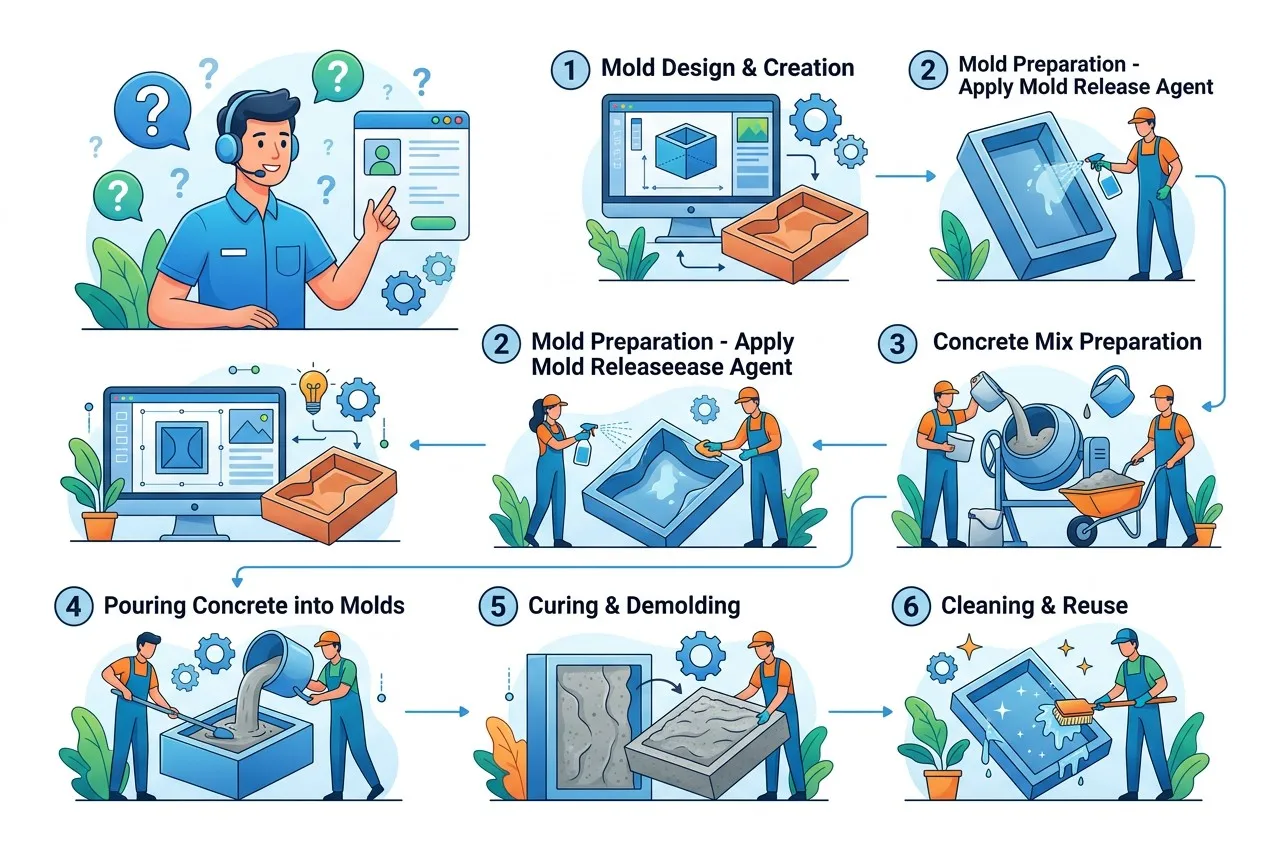
What material is best for decorative concrete molds?
PP is the most cost-effective for large landscape molds; ABS provides highest dimensional precision for small intricate pieces; HDPE offers the best outdoor durability. Material selection depends on product size, texture complexity, and target production volume.
How many times can a plastic mold be reused?
PP and HDPE molds typically achieve 300–500 casting cycles with proper handling. Fiberglass-reinforced molds can reach 800–1,000 cycles. Cycle life depends on concrete mix aggressiveness, demolding technique, and storage conditions.
Can plastic molds reproduce realistic wood grain textures?
Yes. Our CNC-engraved mold cores replicate bark patterns at 0.5–4 mm relief depth. Each texture is verified by casting a test sample and comparing against the reference model before volume production begins.
Can you customize a mold from my drawing or reference sample?
Yes. We accept STEP, IGS, STL, DWG, and PDF formats. If you have a physical sample or reference photo, our engineers reverse-engineer the geometry and texture to create a custom mold design. DFM analysis is included at no extra charge.
How long does tooling take from drawing to first sample?
Standard timeline is 15–25 business days depending on mold complexity and texture requirements. Simple molds without deep texture can ship within 12 days. Expedited service is available for urgent projects.
Can molds be shipped worldwide?
Yes. We export to North America, Europe, the Middle East, and Southeast Asia. Standard packaging protects molds during transit. Sea freight and air cargo options available.
Are these molds suitable for GFRC concrete?
Yes. PP and HDPE molds are compatible with GFRC, ordinary concrete, UHPC, and lightweight aggregate mixes. GFRC’s thinner profile (10–15 mm) works well with our standard wall thickness range.
How do you clean and maintain the mold?
Rinse with water after each cast. Avoid abrasive scrubbing on textured surfaces. Store flat, out of direct sunlight. PP and HDPE are UV-stable but prolonged exposure can reduce flexibility over time.
How to prevent concrete sticking inside the mold?
Apply a thin mold-release agent (vegetable oil or commercial concrete release spray) before each cast. Proper draft angle design (2–5° on textured walls) ensures the concrete element separates cleanly without mechanical force.
What concrete mix works best with plastic molds?
A mix with low water-to-cement ratio (0.35–0.45) produces the best surface detail. GFRC with alkali-resistant glass fiber gives the highest texture reproduction. Avoid overly wet mixes that can erode fine relief over multiple casts.
Can you engrave a company logo into the mold?
Yes. Logo and brand engraving is included in our customization service. We CNC-engrave text, symbols, or monograms into the mold core at specified locations and depths.
Do you provide mold testing before mass production?
Yes. Every custom mold undergoes at least 10 consecutive demolding tests before the production batch is released. Test casts are documented and shared with the client for approval.
Can you manufacture large-format molds for retaining walls?
Yes. We produce molds up to 1,200 mm × 800 mm × 400 mm for retaining wall blocks and large landscape elements. Fiberglass-reinforced PP or HDPE is recommended for large-format applications requiring structural rigidity.

About Xiamen Goldcattle
Xiamen Goldcattle Plastic & Metal Products Co., Ltd. is an ISO 9001 certified OEM/ODM manufacturer based in Xiamen, China. Our core capability spans plastic injection mold design, CNC machining, injection molding production, and surface texture development for decorative, architectural, and industrial applications.
We serve landscape product manufacturers, concrete casting companies, and architectural suppliers across North America, Europe, and the Middle East. From a single prototype mold to a 500-piece production run, we deliver the complete manufacturing service — DFM analysis, mold engineering, tooling, sample verification, and volume delivery.
✓ CNC Machining
✓ Injection Molding
✓ Texture Development
✓ ISO 9001
✓ OEM Service
✓ Worldwide Shipping
Need a Custom Decorative Concrete Mold?
Upload your drawing or reference sample, and our engineering team will provide DFM analysis, mold design suggestions, tooling quotation, and production recommendations within 24 hours.
Xiamen Goldcattle Plastic & Metal Products Co., Ltd. — ISO 9001 Certified OEM/ODM Manufacturer — Xiamen, China