8. Safety Operation Procedures
8.1 Equipment Safety
Injection Molding Machine Safety
- Safety door: Must be closed to start
- Emergency stop button: Prominent position, easy to operate
- Protective covers: Moving parts, high-temperature parts
- Ground protection: Prevent electric shock
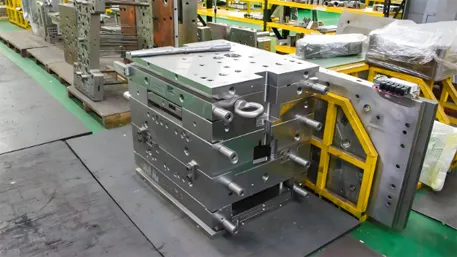
Mold Safety
- Lifting safety: Use appropriate slings, check lifting eyes
- Installation safety: Correct alignment, tighten bolts
- Operation safety: Avoid hand insertion into mold
- Maintenance safety: Operate after power off, cooling
8.2 Operation Safety
Pre-start Inspection
- Power voltage: Meet requirements
- Hydraulic system: Normal pressure, no leakage
- Cooling system: Normal water flow, appropriate temperature
- Safety devices: Normal function
In-process Safety
- Strictly follow operating procedures
- Prohibit adjustments during equipment operation
- Pay attention to high-temperature, high-pressure, high-speed components
- Correct use of personal protective equipment
Post-operation Handling
- Turn off power, water, air sources
- Clean equipment, molds
- Lubricate moving parts
- Record operation conditions
8.3 Emergency Response
Equipment Failure
- Immediately press emergency stop button
- Cut off power, water sources
- Notify maintenance personnel
- Take safety measures
Mold Damage
- Stop production
- Check damage conditions
- Assess impact scope
- Develop repair plan
Personnel Injury
- Immediately stop equipment
- Provide first aid treatment
- Send to hospital for treatment
- Investigate and analyze accident
9. Technology Improvement and Innovation
9.1 New Technology Applications
Intelligent Technology
- Smart molds: Sensors, controllers, actuators
- Adaptive control: Real-time adjustment of process parameters
- Predictive maintenance: Data analysis-based maintenance plans
- Remote monitoring: Mobile APP, cloud platform
Digital Technology
- Digital design: CAD/CAE/CAM integration
- Virtual mold testing: Simulation of molding process
- Digital twin: Virtual and real synchronization
- Big data analysis: Process optimization, quality prediction
9.2 Green Manufacturing Technology
Energy-saving Technology
- Servo motors: Energy saving 30-50%
- Waste heat recovery: Utilize waste heat for heating
- Process optimization: Shorten cycle, reduce energy consumption
- Light source energy saving: LED lighting, intelligent control
Environmental Protection Technology
- Material recycling: Crushing, cleaning, pelletizing
- Waste gas treatment: Filtration, adsorption, catalysis
- Waste water treatment: Sedimentation, filtration, disinfection
- Noise control: Sound insulation, vibration reduction, silencing
9.3 Future Development Trends
Technology Trends
- Miniaturization: Precision molds, micro-injection
- Integration: Multi-function, integration
- Intelligence: Self-adaptation, self-diagnosis
- Greenization: Environmental protection, energy saving, sustainability
Market Trends
- Customization: Personalized design, small batch production
- High-endization: High quality, high added value
- Servitization: Total solutions, technical services
- Globalization: International cooperation, technical exchange
10. Appendix
10.1 Common Standards
National Standards
- GB/T 12554-2006 Plastic injection molds
- GB/T 1031-2009 Surface roughness parameters and their values
- GB/T 1800.1-2009 Geometrical product specifications
Industry Standards
- JB/T 7648.1-2008 Plastic injection mold components
- JB/T 8071-2008 Technical conditions for plastic injection molds
- QB/T 2460-2009 Plastic water cups
International Standards
- ISO 294-1:2017 Injection molds for plastics
- ISO 4287:1997 Surface roughness parameters
- FDA 21 CFR 177.1520 Food contact plastics
10.2 Common Data
Material Performance Data
- PP plastic performance parameter table
- Mold steel performance parameter table
- Standard component dimension specification table
Process Parameter Data
- Injection molding process parameter table
- Heat treatment process parameter table
- Machining process parameter table
Equipment Parameter Data
- Injection molding machine technical parameter table
- Machining equipment technical parameter table
- Testing equipment technical parameter table
10.3 Common Calculation Formulas
Mold Design Formulas
- Cavity dimension calculation: L = Ls × (1 + S)
- Clamping force calculation: F = P × A × K
- Shot volume calculation: V = W / ρ
Process Calculations
- Cooling time calculation: t = (s² × ρ × c × ΔT) / (2 × α × Δθ)
- Injection pressure calculation: P = K × σ × A / a
- Cycle time calculation: T = t1 + t2 + t3 + t4
10.4 References
- Plastic Mold Design Handbook. Mechanical Industry Press, 2020
- Injection Molding Technology Handbook. Chemical Industry Press, 2019
- Mold Material Application Handbook. Metallurgical Industry Press, 2018
- Plastic Molding Technology. Higher Education Press, 2017
- Mold Manufacturing Technology. Mechanical Industry Press, 2016
Technical Consultation: For further technical support, please contact professional mold technical service teams, we will provide you with comprehensive technical solutions.