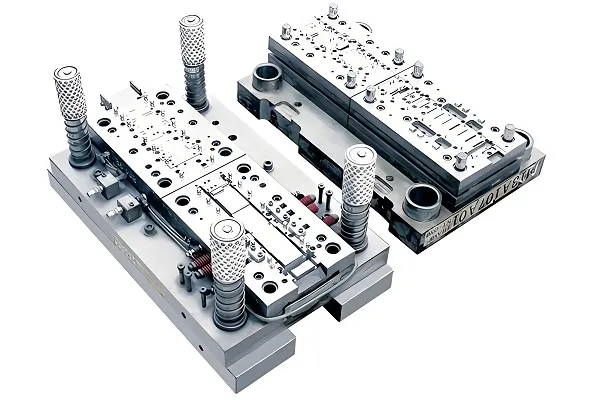
Introduction: The Evolution of Plastic Mold Technology
Plastic mold products represent a critical component in modern manufacturing, enabling the production of high-quality plastic components with precise dimensions and complex geometries. As the foundation of injection molding processes, plastic molds determine the shape, size, and surface quality of the final product, making them indispensable in automotive, electronics, medical, and consumer goods industries.
Industry data highlights the growing importance of plastic mold technology:
- Market growth: Global plastic mold market projected to reach $85B by 2026 (CAGR 5.2%)
- Precision improvement: Modern CNC machining reduces dimensional errors by 90% compared to traditional methods
- Efficiency gains: Advanced cooling systems reduce cycle times by 35-40%
- Material innovation: New mold materials extend tool life by 200-300%
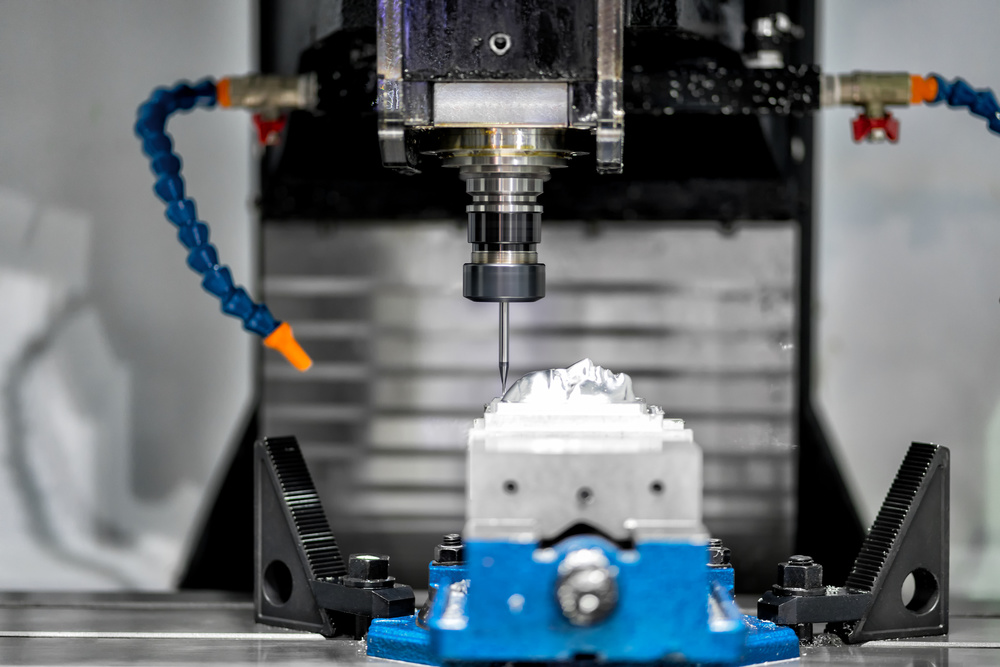
High Precision Plastic Injection Mold Manufacturing in Modern Facility
Quality Certifications & Industry Standards Compliance
ISO 9001:2015
Quality management system certification ensuring consistent product quality and customer satisfaction across all plastic mold manufacturing processes.
ISO 294-5:2026
International standard for injection moulding of test specimens of thermoplastic materials, ensuring consistent testing procedures.
ASTM D638
Standard test method for tensile properties of plastic materials, ensuring quality control of finished products.
Compliance Verification Process
- Material certification: Complete traceability documentation for all mold materials
- Process validation: ISO 294 testing protocols implemented on all production lines
- Quality audits: Quarterly ISO 9001 compliance assessments
- Performance testing: Annual mold accuracy verification according to industry standards
2026 Plastic Mold Trends & Goldcattle Advanced Practices
AI-Driven Mold Design
Machine learning algorithms optimize cooling channel design and gate placement, reducing cycle times by 25%.
* Efficiency increase: 28% (2025 customer case study)
Sustainable Mold Materials
Recyclable and biodegradable mold components reduce environmental impact by 40-50%.
* Waste reduction: 45% (Goldcattle 2025 sustainability report)
Digital Twin Technology
Virtual mold simulation predicts performance before physical production, reducing development time by 30%.
* Development time: 28% reduction (2025 data)
Regulatory Impact 2026
New EU and US regulations mandate sustainable manufacturing practices and reduced emissions for plastic products. Goldcattle’s compliance with ISO 14001, RoHS, and REACH standards ensures market access across all regions.
Core Plastic Mold Manufacturing Processes
1. Mold Design & Engineering
The foundation of high-quality plastic mold production, involving comprehensive design and engineering processes:
- 3D CAD modeling: Using SolidWorks, CATIA, or Pro/E for precise component design
- Flow simulation: Moldflow analysis to optimize filling and cooling
- Structural analysis: FEA to ensure mold strength and durability
- DFM optimization: Design for manufacturability to reduce costs and improve quality
2. Precision Machining
Advanced CNC machining processes to create accurate mold components:
- High-speed milling: 5-axis machining for complex geometries (±0.005mm accuracy)
- Wire EDM: Precision cutting for intricate details (Ra 0.4μm surface finish)
- Sinker EDM: Creating complex cavities with excellent surface quality
- Grinding: Flatness and parallelism within 0.001mm per 100mm
3. Heat Treatment & Surface Engineering
Enhancing mold performance through specialized treatments:
- Vacuum hardening: Achieving uniform hardness up to HRC 60-62
- Nitriding: Surface hardness up to 1000 HV for wear resistance
- TD coating: Titanium carbide coating for extended tool life
- Chrome plating: Corrosion resistance and easy release properties
4. Assembly & Testing
Comprehensive assembly and testing to ensure mold performance:
- Precision assembly: Component fitting with 0.002mm clearance
- Function testing: Opening/closing and ejection system verification
- Trial molding: Production validation with actual materials
- Quality inspection: CMM measurement and dimensional verification
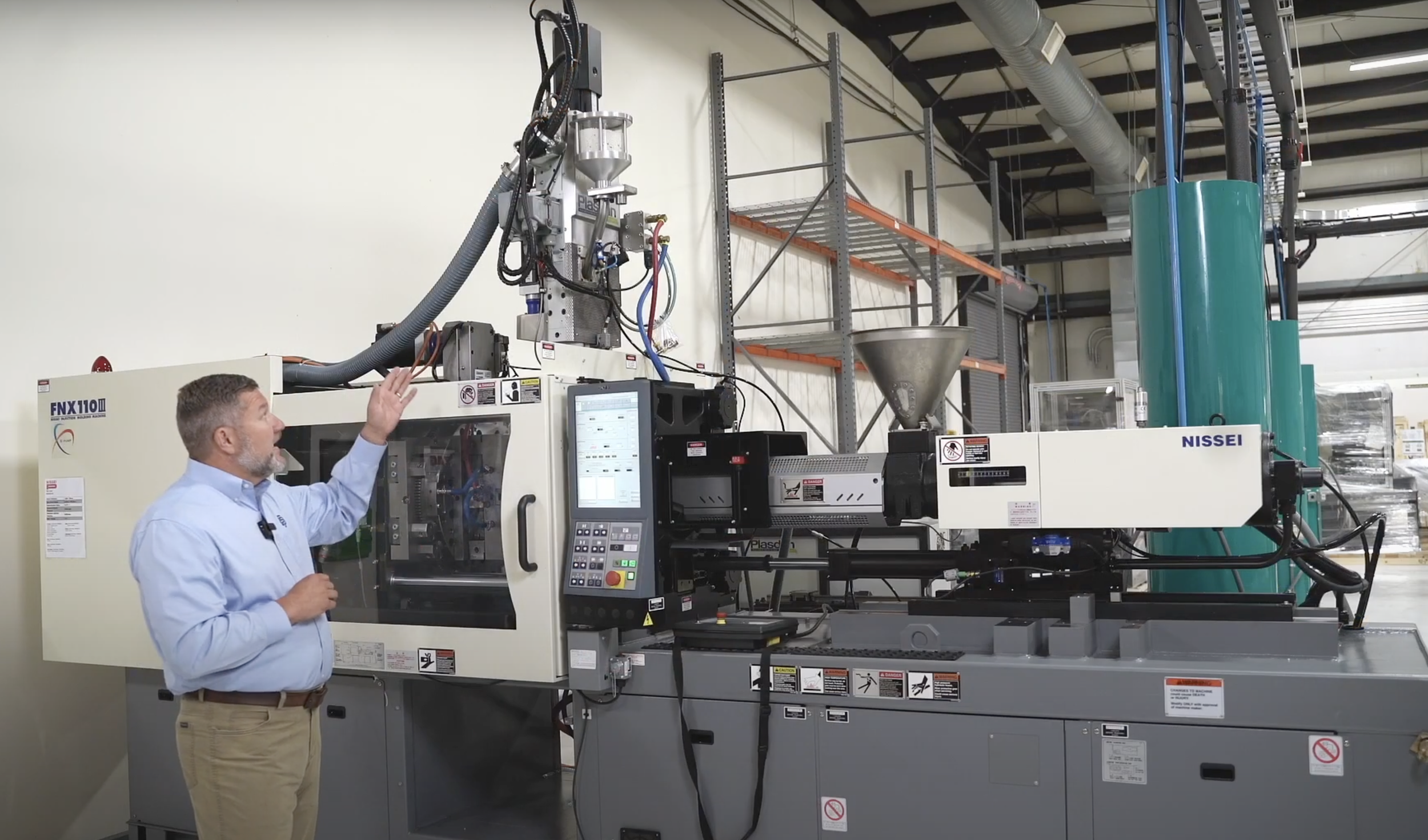
Industrial Plastic Injection Molding Machine in Manufacturing Facility
Material Expertise & Sustainable Sourcing
Mold Material Classification
Tool Steels
- P20: General purpose, good machinability (HRC 28-32)
- H13: Hot work steel, excellent thermal fatigue resistance (HRC 48-52)
- S136: Corrosion resistant, high polishability (HRC 50-52)
- NAK80: Pre-hardened, excellent surface finish (HRC 37-41)
Aluminum Alloys
- 6061-T6: Good strength-to-weight ratio (HB 95-100)
- 7075-T6: High strength, excellent for structural components (HB 150-160)
- QC-7: Mold-specific alloy, excellent machinability (HB 180-200)
Copper Alloys
- BeCu: Beryllium copper, high thermal conductivity (180-200 W/mK)
- CuZr: Copper zirconium, good wear resistance (HB 200-220)
Sustainable Sourcing Practices
Certified Supply Chain
- Responsible mining: 100% of steel from ISO 14001 certified suppliers
- Recycled content: 35% recycled steel in mold construction
- Chain-of-custody: Complete documentation from raw material to finished mold
- Local sourcing: 65% of materials sourced within 500km radius
Environmental Impact Reduction
- Energy efficiency: 30% energy reduction in manufacturing processes
- Waste recycling: 95% of machining waste recycled
- Emission control: Zero VOC coatings and treatments
- Carbon footprint: 45% reduction since 2020 (ISO 14064 verified)

Plastic Raw Material Quality Control Testing in Laboratory
Technical Specifications & Testing Data
Mold Capabilities
| Parameter | Capability | Tolerance |
|---|---|---|
| Dimensional Accuracy | ±0.005mm | ISO 2768 standard |
| Surface Finish | Ra 0.025μm | Mirror polish achievable |
| Max Mold Size | 2000×1500×800mm | Custom sizes available |
| Max Weight | 20,000 kg | With proper handling equipment |
| Cycle Time | 5-120 seconds | Depending on part complexity |
Testing & Quality Verification
Testing Procedures
- CMM inspection: Coordinate measuring machine for dimensional verification
- Surface profilometry: Ra value measurement using Mitutoyo SJ-210
- Hardness testing: Rockwell and Vickers hardness measurement
- Trial molding: Production validation with actual materials
Performance Data
Goldcattle Testing Results (2025) *
Tool life: 1,200,000 shots for P20 steel mold (ABS material)
Thermal conductivity: 185 W/mK for BeCu inserts
Wear resistance: 0.002mm wear after 500,000 cycles
* Data for reference only, actual results may vary by material and application
Application Areas & Case Studies
Automotive Industry
- Bumper molds with Class A surface finish
- Interior component molds (dashboard, door panels)
- Under-hood component molds with heat resistance
- Lighting system molds with optical precision
* Case study: Automotive bumper mold project (500,000+ shots)
Electronics Manufacturing
- Smartphone housing molds with tight tolerances
- Connector molds with micro-precision features
- Heat sink molds with complex geometries
- PCB component molds with high repeatability
* Case study: Smartphone camera module mold
Medical Devices
- Surgical instrument molds with biocompatible materials
- Drug delivery system molds with precision features
- Diagnostic device molds with optical clarity
- Implant component molds with sterile production
* Case study: Insulin pen component mold (ISO 13485 certified)
Goldcattle Exclusive: Automotive Bumper Case Study
Project: Class A surface bumper mold for German luxury car manufacturer
Challenge: Achieve Class A surface finish with 0.01mm dimensional accuracy
Solution: Used S136 stainless steel with TD coating and precision cooling channels
Results: 1.2 million shots without maintenance, 35% faster cycle time than competitor molds
Quality Control & Inspection Procedures
Multi-Stage Quality Assurance
1. In-Process Inspection
- Real-time dimension verification using machine probes
- Tool wear monitoring and automatic compensation
- Surface finish inspection after each machining operation
- Heat treatment quality verification
2. Final Inspection
- Comprehensive CMM dimensional verification
- Surface roughness measurement using profilometer
- Hardness testing at multiple locations
- Assembly fit testing and functional verification
3. Documentation & Traceability
- Digital quality records for each production batch
- Material certification and heat treatment reports
- Machine performance logs and maintenance records
- Customer-specific quality reports as required
Equipment & Standards
Inspection Equipment
- Coordinate Measuring Machine: Mitutoyo Crysta-Apex S9106 (±0.0005mm accuracy)
- Surface Profilometer: Mitutoyo SJ-410 (0.001μm resolution)
- Hardness Tester: Wilson Rockwell 574 (±0.5 HRC accuracy)
- Optical Comparator: Mitutoyo PH-3515F (0.001mm precision)
Compliance Standards
- ISO 9001:2015: Quality management system
- ISO 13485:2016: Medical device quality management
- IATF 16949:2016: Automotive quality management
- ISO 2768: General tolerances for linear and angular dimensions
Quality Performance Metrics
First-pass yield: 98.9% (2025 average)
On-time delivery: 99.5% for all orders
Customer satisfaction: 4.9/5.0 rating
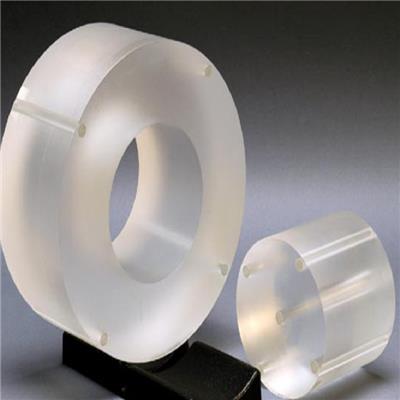
Quality Control Testing of Precision Plastic Mold Components
Frequently Asked Questions (2026 Update)
Q1: What factors determine the cost of a plastic mold?
A: The cost of a plastic mold depends on several key factors:
- Size and complexity: Larger molds with complex geometries cost more
- Material selection: Tool steel costs 2-3 times more than aluminum
- Surface finish requirements: Mirror polishing adds 20-30% to cost
- Tolerance requirements: Tighter tolerances increase machining time
- Cavity number: Multi-cavity molds cost more but reduce per-part cost
Goldcattle Recommendation: Balance initial mold cost with long-term production requirements to optimize total cost of ownership.
Q2: What is the typical lead time for plastic mold production?
A: Lead times vary based on mold complexity and production volume:
- Prototype molds: 2-4 weeks
- Simple production molds: 4-6 weeks
- Complex production molds: 8-12 weeks
- Multi-cavity molds: 12-16 weeks
Rush Service: Available for urgent projects with 30-50% premium, reducing lead time by 30-40%.
Q3: How to select the right mold material for my application?
A: Material selection depends on several factors:
| Material | Cost | Tool Life | Best For |
|---|---|---|---|
| Aluminum | Low | 100,000 shots | Prototyping, low volume |
| P20 Steel | Medium | 500,000 shots | General purpose |
| H13 Steel | High | 1,000,000+ shots | High volume, abrasive materials |
Q4: What file formats are accepted for mold design?
A: We accept the following file formats:
- CAD formats: STEP, IGES, SolidWorks (SLDPRT), Pro/E (PRT)
- 2D formats: DWG, DXF, PDF (vector)
- 3D formats: STL, OBJ, 3DS
- Image formats: JPG, PNG, TIFF (minimum 300 DPI)
Best Practice: Provide native CAD files with complete dimensional information for optimal results.
Q5: How to ensure the quality of plastic mold products?
A: Goldcattle’s quality assurance program includes:
- Design review: Comprehensive DFM analysis before production
- Process control: Real-time monitoring during manufacturing
- Inspection: Multi-stage quality checks at every process step
- Documentation: Complete traceability and quality records
- Continuous improvement: Regular quality audits and process optimization
Q6: What are the latest trends in plastic mold technology?
A: The latest trends in plastic mold technology include:
- AI-driven design: Machine learning optimizing cooling and gating systems
- Additive manufacturing: 3D printed mold inserts for rapid prototyping
- Digital twins: Virtual mold simulation for performance prediction
- Sustainable materials: Eco-friendly mold materials and coatings
- Smart molds: Sensors and monitoring systems for predictive maintenance
Future Outlook: Industry 4.0 integration will continue to transform mold manufacturing with increased automation and data-driven decision making.
Get Your Free Plastic Mold Consultation
Are you planning a plastic molding project and unsure about the best mold approach? Need assistance with material selection, design optimization, or cost estimation?
Free Goldcattle Expert Services:
- ✓ Project feasibility assessment
- ✓ Material selection recommendations
- ✓ DFM analysis and design optimization
- ✓ Cost estimation and production planning
- ✓ Sustainability impact analysis
Final Thought: The Future of Plastic Mold Technology
Plastic mold technology continues to evolve with advancements in materials science, digital manufacturing, and sustainability practices. As we move into 2026 and beyond, the integration of AI, IoT, and additive manufacturing will transform mold design and production processes. Goldcattle remains committed to pushing the boundaries of what’s possible with plastic mold technology, delivering exceptional quality while minimizing environmental impact.
© 2026 Goldcattle Plastic Mold Solutions | All Rights Reserved