Custom CNC-machined titanium parts from prototypes to production, including Grade 5 Ti-6Al-4V components for aerospace, medical and high-performance applications. We machine to your CAD model and engineering drawing, with controlled workholding, toolpath review and dimensional inspection.
At a Glance
Titanium CNC machining is the right choice when strength-to-weight ratio, corrosion resistance or biocompatibility matters more than raw material cost. Titanium machines more slowly than aluminum, generates heat at the cutting edge and wears tools faster, so the process depends on rigid setup, controlled feeds and sharp tooling. Goldcattle machines Grade 2, Grade 5 Ti-6Al-4V and Grade 23 ELI from customer drawings, with CMM inspection on qualified features.
Why Titanium for CNC-Machined Parts
Titanium is selected for parts that must be light yet strong, resist corrosion, or survive cyclic loads and hostile environments. Its density is roughly 56% of steel, while Grade 5 tensile strength reaches roughly 900–1000 MPa depending on product form and condition. That strength-to-weight combination is why titanium appears in airframe structures, fluid systems, medical implants and motorsport components.
The trade-off is manufacturability. Titanium does not machine like aluminum. It has low thermal conductivity, a strong tendency to work-harden, and it reacts with tool materials at elevated temperatures. A part that is straightforward in 6061 aluminum may require a planned toolpath, rigid workholding and the right insert grade in titanium. The sections below explain where those decisions are made.
Titanium Grades We Machine
We machine the grades we can actually source and process. If your drawing calls out a grade not listed below, send the drawing — we will confirm material availability before quoting.
| Grade | Common name | Typical use |
|---|---|---|
| Grade 2 | Commercially pure titanium | Chemical processing, marine components, housings where corrosion resistance matters more than strength |
| Grade 5 | Ti-6Al-4V | Aerospace structural parts, brackets, manifolds, mechanical components — the most widely used titanium alloy |
| Grade 23 | Ti-6Al-4V ELI | Medical implants and cryogenic/specialized applications where fracture toughness and ductility are specified |
Ti-6Al-4V / Grade 5: The Commercial Core
Grade 5 is the alloy most buyers mean when they say "titanium part." It is heat-treatable, offers the best balance of strength, toughness and machinability among common titanium grades, and is the default choice for aerospace and motorsport components. It is also the grade we see most often on incoming RFQs.
High strength-to-weight
Grade 5 delivers roughly twice the yield strength of commercially pure titanium at about 60% of steel density.
Good environmental resistance
Resists atmospheric, seawater and many chemical environments, reducing long-term maintenance on exposed components.
Machinable with process control
Not as free-cutting as aluminum, but well understood by CNC shops that plan tooling, rigidity and chip evacuation.
Titanium CNC Milling
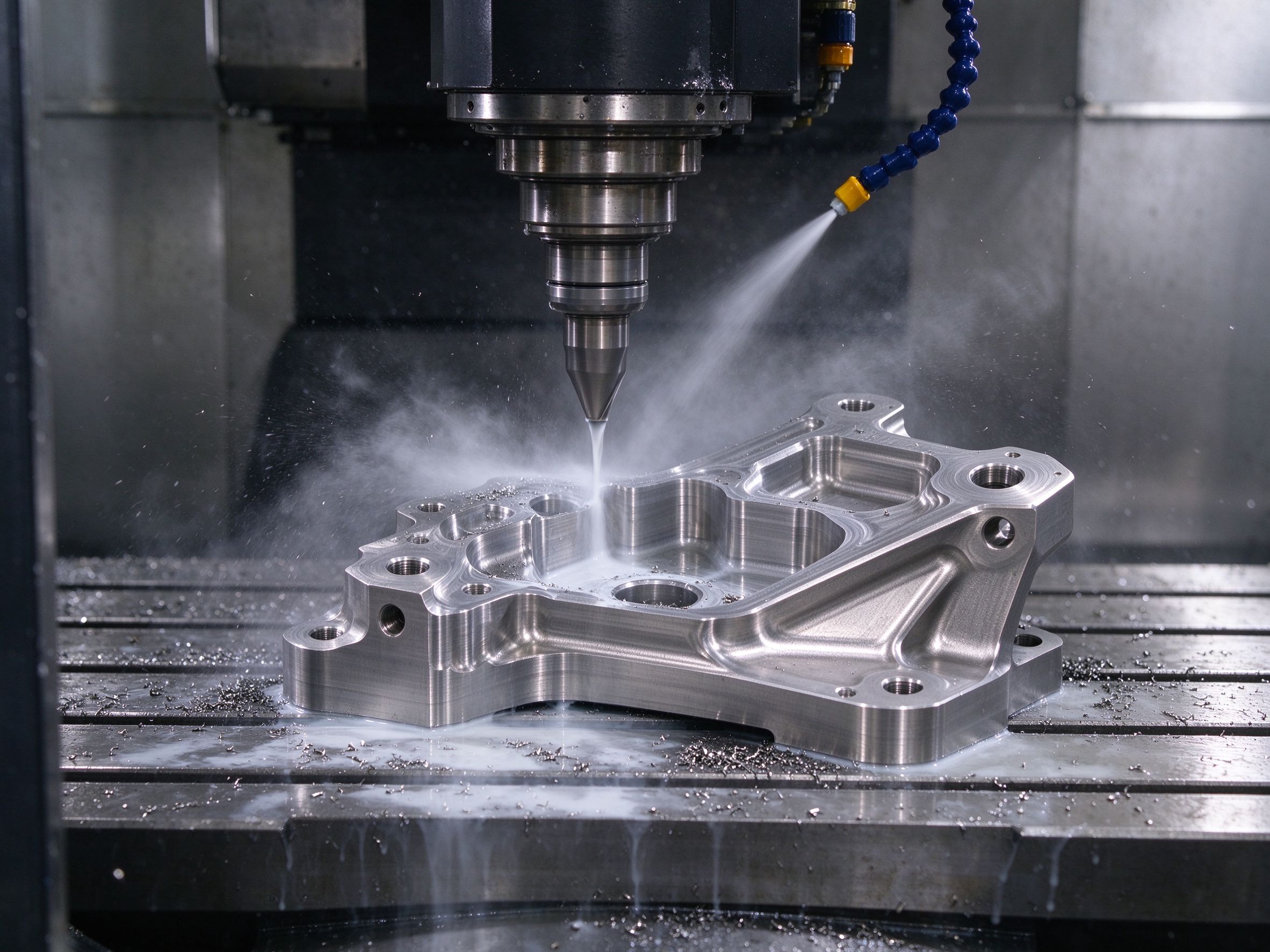
Titanium milling favors radial engagement over axial depth, sharp cutting edges, and copious coolant. Light radial cuts with sufficient speed and feed keep the heat in the chip rather than in the tool or workpiece. We plan toolpaths to avoid rubbing, minimize dwell at corners, and keep the cutter engaged consistently — rubbing is what accelerates built-up edge and flank wear in titanium.
- Roughing: moderate radial engagement, robust end mills, through-tool coolant where the spindle supports it.
- Semi-finishing: controlled stock left for finish passes to avoid chatter and tool deflection.
- Finishing: fresh tool, consistent engagement, programmed lead-in/lead-out to avoid witness marks on visible surfaces.
Titanium CNC Turning
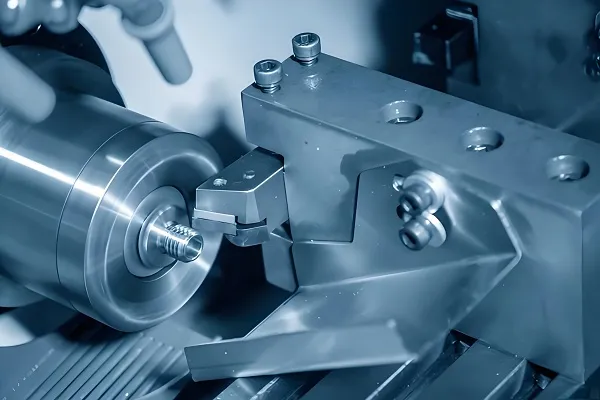
Turning titanium is about edge preparation and chip control. A sharp, honed insert with positive geometry reduces cutting forces and work-hardening, while the right nose radius balances surface finish against chatter risk. Deep bores and thin-walled tubes in titanium deflect easily, so jaw pressure and support are specified before the first cut.
- Swiss-type or conventional turning for shafts, bushes, threaded fittings and tubular components.
- Live tooling available where the part requires cross-holes, flats or milled features after turning.
- Threading and grooving use tailored insert grades to avoid notch wear at the depth-of-cut line.
5-Axis Titanium Machining
5-axis is not a marketing word for titanium parts — it is the way to reach complex curved surfaces, multi-sided brackets and deep pockets without re-fixturing. On a contoured titanium aerospace bracket, tilting the tool keeps a shorter, stiffer cutter engaged, reduces overhang, and improves surface quality on steep walls.
Long reach in titanium amplifies deflection, chatter and tool pressure. A shorter tool held at a favorable angle cuts more predictably and holds tighter geometry.
Contoured brackets, impeller-style geometry, multi-face housings and parts with angled hole patterns where re-fixturing would move the datum.
Machining Challenges & Process Control
Titanium punishes a sloppy setup more visibly than aluminum. The table below maps the real failure modes to how we control them before cutting.
Heat stays at the cutting edge instead of dissipating into the chip.
Light cuts that dwell can work-harden the surface and shorten tool life on the next pass.
Titanium cuts with high radial force; long tools deflect and produce tapered walls or chatter.
Stress relief after roughing matters when tight tolerances are held on thin or asymmetric parts.
Thin-Wall Sections & Deep Cavities
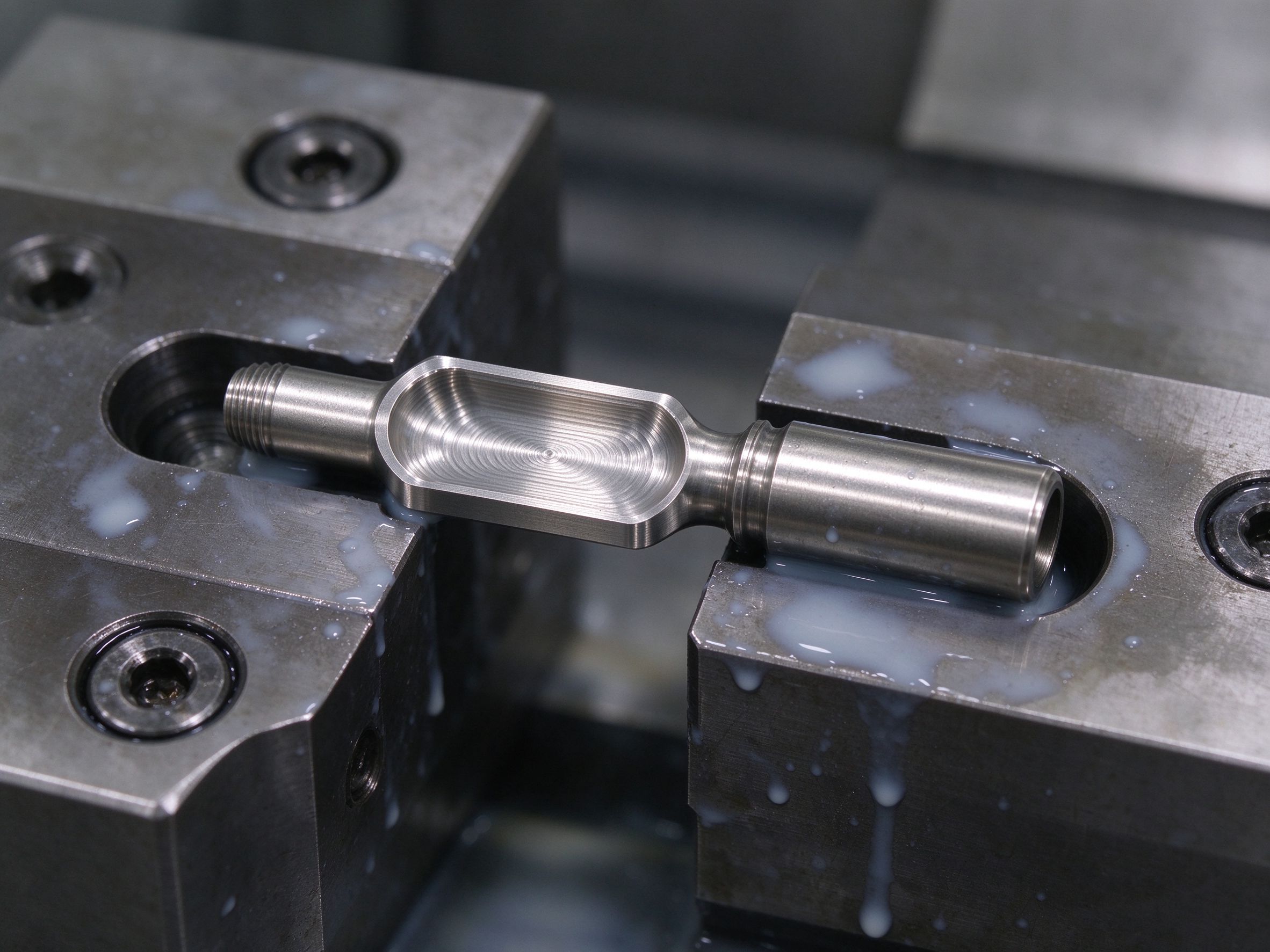
Thin-wall titanium is where process knowledge shows. The wall deflects under clamping and cutting force, and because titanium is springy, it can move back after the cutter passes — leaving the bore out of round or the wall thinner than planned. We address this in three steps:
- Workholding: soft jaws or custom support matched to the part, not generic hard jaws that crush thin sections.
- Toolpath: light finishing passes, climb milling, and symmetric stock removal so residual stresses release evenly.
- Deep cavities: tool length chosen for reach with minimum overhang; coolant directed to the bottom of the pocket to evacuate chips and avoid recutting.
Surface Finishing
As-machined titanium can be left with visible tool marks, or bead-blasted, anodized or tumbled for a controlled cosmetic finish. Titanium anodizing (often Type II) produces a range of colors and a harder surface, but coating acceptance depends on the application. We do not promise a universal Ra — surface finish is specified per face on the drawing and verified against that requirement.
| Finish | Typical reason |
|---|---|
| As machined | Functional parts where tool marks are acceptable and cost matters |
| Bead blasted | Uniform matte cosmetic surface on visible titanium components |
| Anodized (Type II) | Color identification, scratch resistance, cosmetic finishing |
| Polished / tumbled | Decorative or reduced-friction surfaces |
Inspection & Documentation
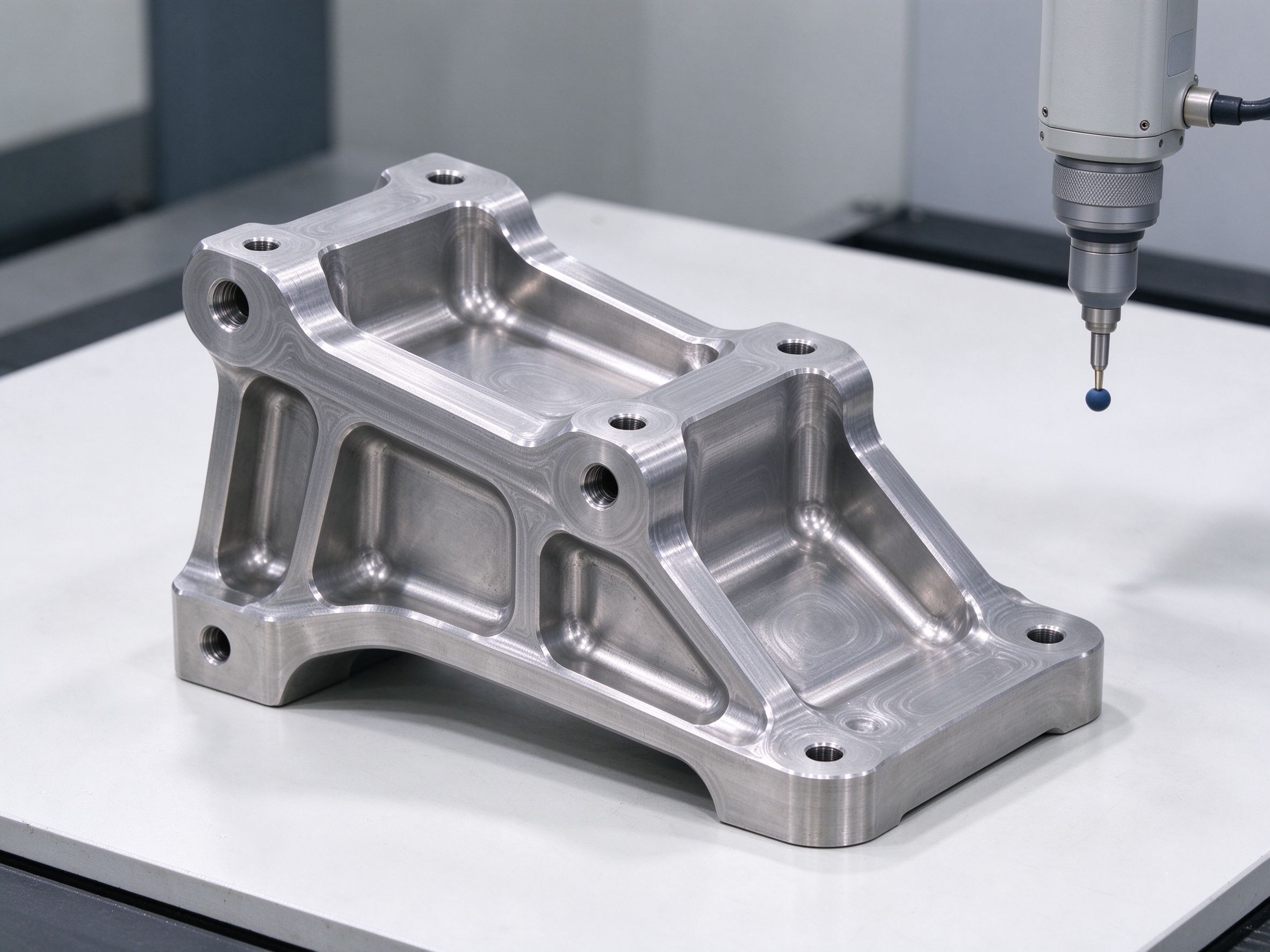
Titanium parts rarely go out the door on visual inspection alone. We measure qualified features on a Zeiss CMM, check critical bores and positional tolerances against the drawing, and provide a dimensional report with approved parts. Material traceability is kept with the heat when supplied.
- In-process: first-article checks on critical datums after setup, before full batch runs.
- Final: CMM report on specified dimensions, GD&T and thread callouts as required.
- Material: mill certificates available when the stock is supplied with traceability; confirm on the RFQ.
Prototype to Repeat Production
Titanium parts rarely start at high volume. We are set up for the typical titanium workflow:
1–20 pcs
DFM review, first article, quick feedback on geometry and fixturability.
20–500 pcs
Stable process, documented setup, repeatable inspection on critical features.
Repeat orders
Same drawing, same process, retained tooling and fixture notes for continuity.
Aerospace & Medical Titanium Components
Titanium is specified where weight and corrosion drive the design. We machine titanium components for aerospace-related structures, fluid systems, medical device housings and motorsport parts. We do not claim certifications we cannot show — material traceability, CMM reports and FAI documentation are provided when the drawing or customer quality system requires them.
Brackets, manifolds, structural pieces
Contoured brackets, lightweight housings and fluid components where strength-to-weight and corrosion resistance are specified.
Housings, fittings, custom components
Grade 23 ELI and Grade 5 components for device housings and mechanical parts where biocompatibility or corrosion is relevant.
Case Study: Titanium Structural Bracket
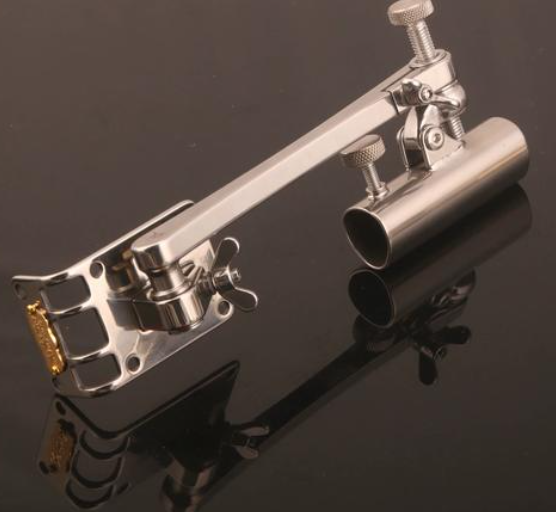
- MaterialTi-6Al-4V (Grade 5), mill annealed
- Process5-axis milling, drilled/tapped features
- ChallengeThin walls, contoured pockets, tight positional holes
- InspectionCMM on critical bores and datum faces
- VolumePrototype → low-volume repeat
The part required holding thin walls and closely located bolt holes on a contoured titanium bracket. We programmed a 5-axis approach to keep tool overhang short, added light finishing passes on the walls, and verified the datum faces and hole positions on the CMM before release. Final dimensions matched the approved drawing.
What to Send for a Titanium CNC Quote
The more completely the RFQ describes the part, the faster the quote and the fewer surprises later.
Must include
- 3D CAD (STEP / IGES) and 2D drawing (PDF)
- Material grade — e.g. Ti-6Al-4V / Grade 5 / Grade 23
- Quantity (prototype, annual, per batch)
Helpful to include
- Critical dimensions and GD&T callouts
- Required surface finish per face
- Heat-treated / annealed condition
- Coating or anodizing requirements
- Inspection level (CMM report, FAI, mill cert)
Frequently Asked Questions
Is titanium more expensive to machine than aluminum?
What titanium grade do you machine most often?
Can you 5-axis machine titanium parts?
What tolerance can titanium parts hold?
Do you provide material certificates?
Can you machine a titanium part from a sample or reverse-engineered drawing?
Request a Titanium CNC Machining Quote
Send your CAD model, drawing and required titanium grade. We will review geometry, fixturing and critical features, and come back with a machining approach and lead time.
Xiamen Goldcattle · Manufacturing since 1998 · Prototype to repeat production · CMM inspection on qualified features