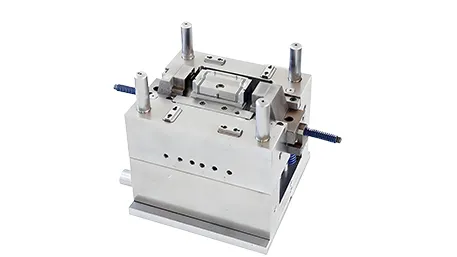
Custom automotive interior door trim components manufactured from your CAD, drawings or existing samples. We support DFM review, injection molding, tooling development, secondary operations and dimensional inspection for prototype and production programs.
At a Glance
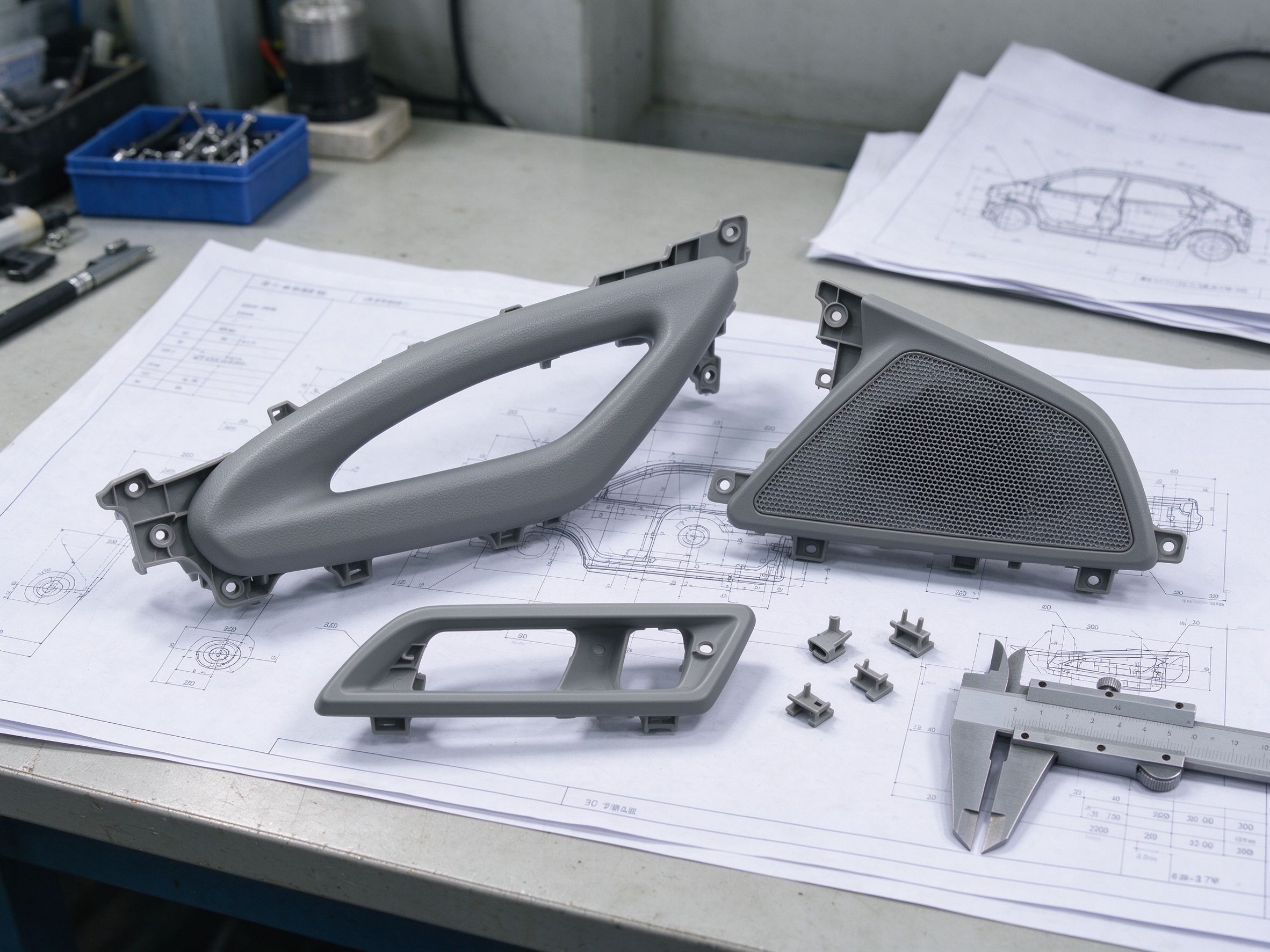
An automotive door trim panel is the interior trim system attached to the vehicle door, combining appearance, structural support and interfaces for handles, switches, speakers and storage. It is not a single molded part — it is an engineered assembly of substrates, decorative surfaces, bezels, grilles, brackets and mounting features, developed through DFM, tooling and injection molding.
What Are You Sourcing?
Door trim work comes in different scopes. Tell us which one your project fits and we route it correctly from the start:
Panel + tooling + production
Where the program needs full engineering and production management. Depending on panel size, manufacturing may combine our in-house molding with qualified large-format resources — confirmed during DFM review.
Individual molded parts
Armrest frames, speaker grilles, switch bezels, map pockets, decorative trim panels, brackets, housings, clips and mounting features — the parts most often sourced as custom molded components.
Mold design + build + trial
For customers with their own molding capacity who need injection molds developed, tried and qualified against the part drawing.
Fit, appearance and function
Prototype components to validate fit, appearance, assembly, material and functional interfaces before production tooling.
Door Trim Panel Architecture
A modern door trim is not simply a plastic panel. It is a multi-functional interior system:
| Layer | What it carries | Typical features |
|---|---|---|
| Appearance surface | What occupants see and touch | Texture, gloss, color, soft-touch, wrapped or painted surfaces |
| Structural substrate | Rigidity and crash/retention performance | Ribs, bosses, wall sections, reinforcement, mounting points |
| Functional interfaces | Where components attach | Switch bezel, speaker grille, armrest, map pocket, clips, fasteners, wiring routes |
Materials for Automotive Door Trim
Material selection affects shrinkage, warpage, cooling layout, gate placement and mold-flow behavior — not just the final look. The resins we most often run for door trim work:
| Material | Typical role | Buyer consideration |
|---|---|---|
| PP | Large interior substrates | Low density, cost, chemical resistance |
| PP-T20 (talc-filled PP) | Structural trim components | Stiffness, shrinkage/warpage balance |
| PP+EPDM-T20 | Impact-sensitive trim | Toughness plus dimensional performance |
| ABS | Visible trim, smaller components | Surface quality, processing window |
| PC/ABS | Visible functional components | Impact, heat and appearance balance |
| TPO / TPE / TPU | Soft-touch and sealing features | Elasticity, tactile properties, grade-dependent weathering |
Automotive Door Trim DFM
The drawing defines the part; DFM decides whether it can be molded, textured and assembled reliably. The points we review on every door trim program:
Appearance surface
- Sink marks behind ribs and bosses
- Weld lines in cosmetic zones
- Flow marks, gate marks, ejector marks
- Flash at the parting line
Structure
- Wall thickness consistency
- Rib and boss proportions
- Clips and mounting points
- Speaker grille and local reinforcement
Moldability
- Draft on textured surfaces
- Undercuts needing sliders/lifters
- Parting line placement
- Gate and cooling layout
Dimensional risk
- Warpage on large thin sections
- Shrinkage compensation per resin
- Datum consistency for assembly
Door Trim Quality Is Both Cosmetic and Dimensional
Large interior parts are rarely controlled by one global tolerance. The CTQs split into two groups:
| Appearance CTQs | Assembly CTQs |
|---|---|
| Texture and gloss consistency | Mounting hole position |
| Color match | Clip location and retention |
| Weld line / sink / flow mark limits | Speaker and switch interface |
| Gate and ejector mark limits | Armrest interface and gap/flush |
| Flash limits on visible edges | Adjacent component fit, deformation |
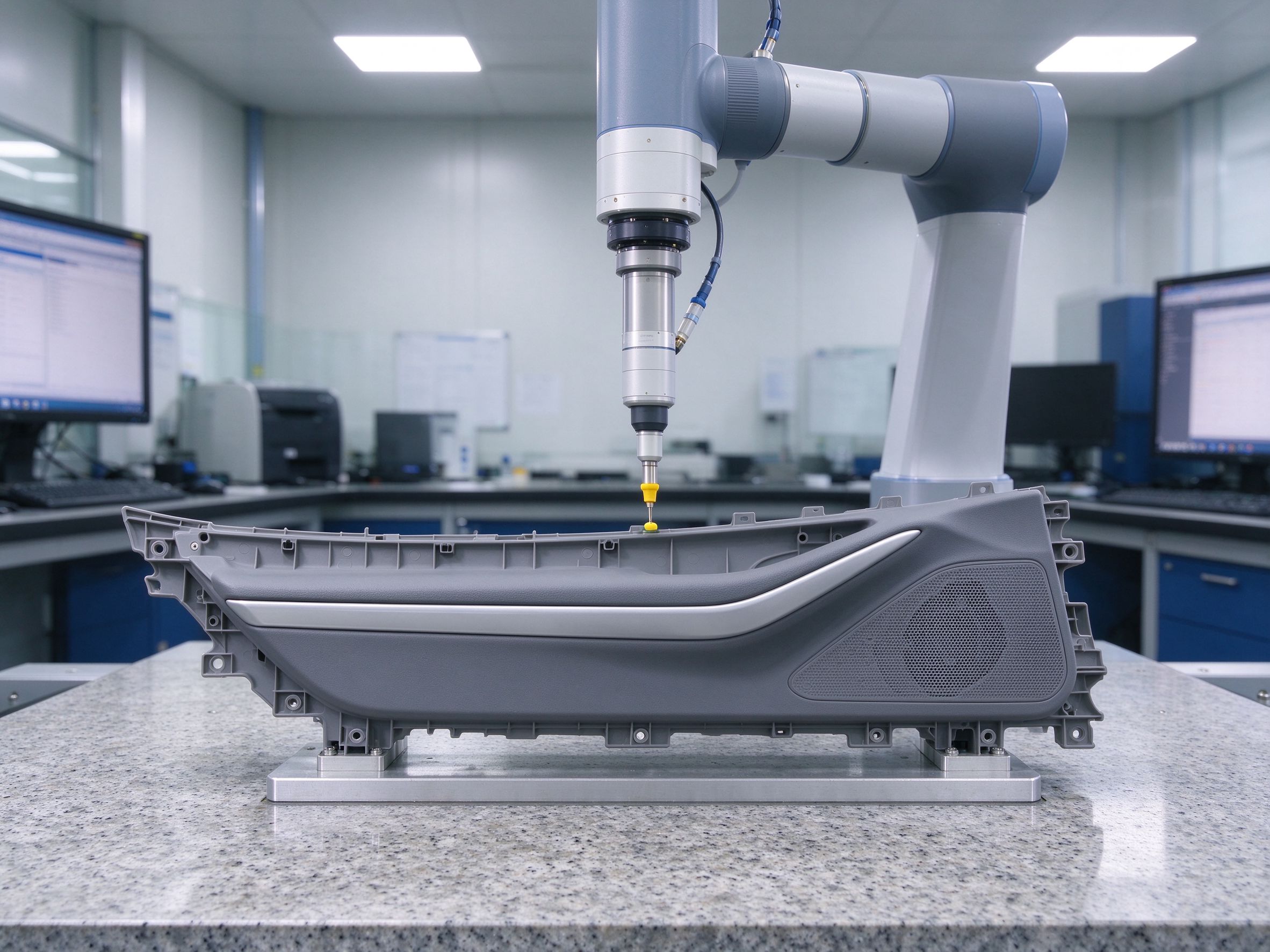
Critical dimensions and interfaces are inspected against the approved drawing and the CTQ list — not against a single advertised tolerance.
Door Trim Tooling Strategy
Tooling is chosen by program stage and volume, not by one rule:
For concept validation, low volume and fit checking before committing to production steel.
For stable designs and repeat production, with the mold engineered for the expected program life.
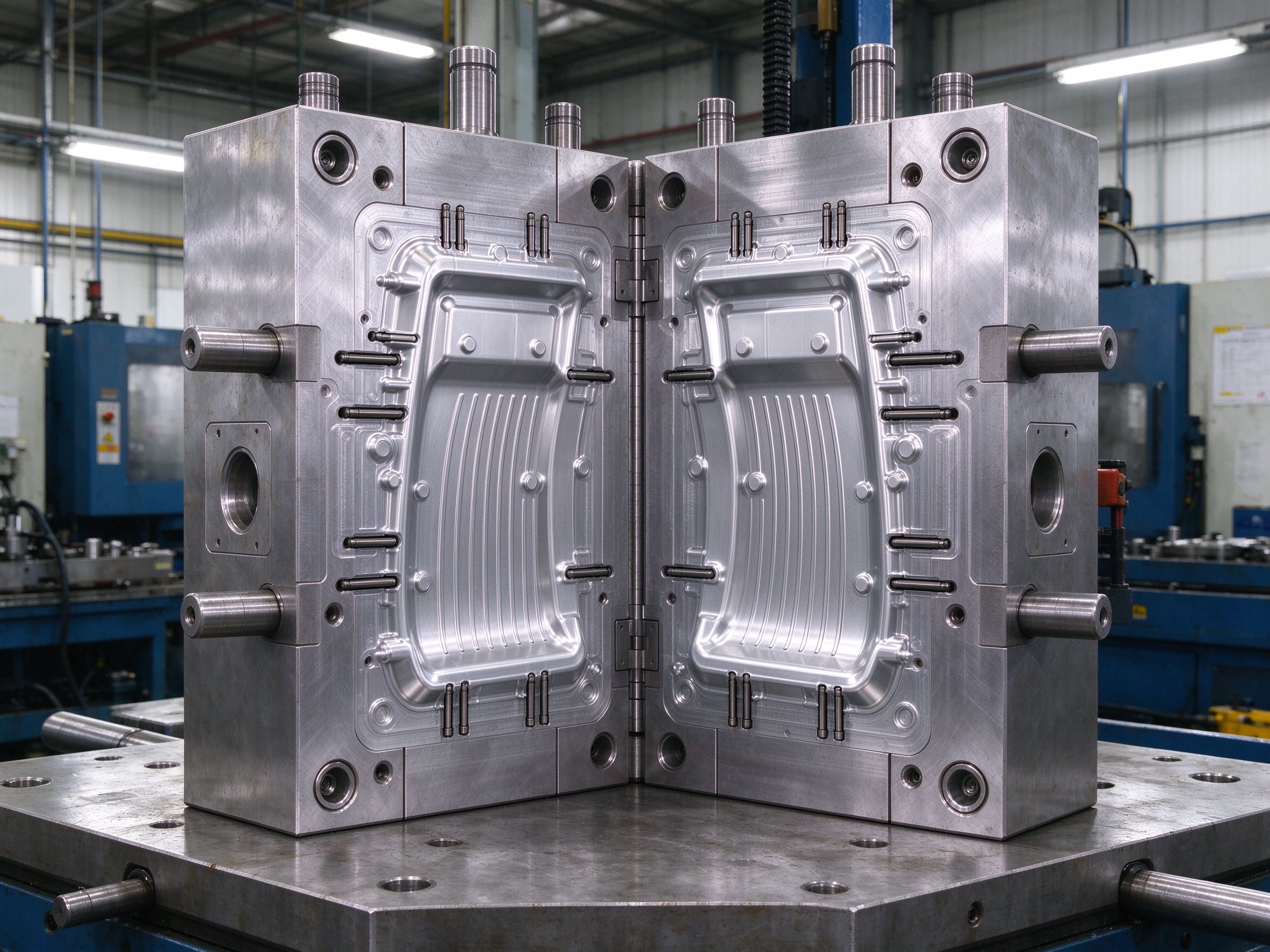
Key tooling decisions on door trim molds: mold steel, cavity count, hot runner, gate layout, cooling circuit placement, ejection system, sliders/lifters for undercuts, texture application and parting line location. Each one trades cost, cycle time and part quality.
Injection Molding & Manufacturing Route
Our in-house molding range is 50–650 T clamp with a maximum part envelope of approximately 400 × 400 × 300 mm. Most door trim components — bezels, grilles, armrest frames, map pockets, brackets and clips — fit comfortably inside that range.
Where a program calls for a full-size door trim panel above this envelope, the manufacturing route is confirmed during DFM review: we manage the project, and large-format molding is placed through qualified manufacturing resources with the same drawing control and inspection requirements. The capability we claim is the capability we can show.
Surface & Appearance Requirements
Interior trim appearance is defined on the drawing — texture, grain, gloss level, color and soft-touch behavior. State the surface requirement and the visible zones explicitly:
| Requirement | Where it is controlled |
|---|---|
| Texture / grain | Mold texture on the cavity, draft adjusted for textured surfaces |
| Gloss level | Material, mold surface finish, process settings |
| Color | Resin, masterbatch, UV/weathering requirements per spec |
| Soft-touch | TPE/TPU overmold or coating where specified |
| Painted / plated surfaces | Confirmed per program — secondary process, handled through qualified partners where applicable |
Assembly & Functional Interfaces
Door trim parts are judged by how they assemble, not only how they look. Interfaces we review on every program: switch openings and bezel seats, speaker mounting and grille alignment, armrest attachments, clips and retainers, wiring routes and fastener bosses, and gap/flush relationships with adjacent panels.
Quality Control & Documentation
Documentation follows the project scope. Commonly supported items:
Manufacturing quality
- Drawing revision control
- Dimensional inspection against CTQs
- Appearance approval on visible surfaces
- FAI where the program requires it
Program documentation
- Resin grade / material documentation
- Control plan, process flow, PFMEA where required
- PPAP support per customer request
- IMDS or material declarations coordinated where the customer requires them
U.S. & European Market Requirements
Automotive interior requirements are set by the final vehicle application, material construction and the customer's program. We do not claim a blanket "automotive certification"; we review the applicable requirements per project:
Applicable FMVSS requirements
For U.S. vehicle programs, applicable interior material requirements such as FMVSS 302 should be evaluated according to the final vehicle application, material construction and customer requirements. Certification responsibility sits with the vehicle manufacturer; we support material documentation and testing coordination where specified.
Market-specific requirements
Applicable UNECE or market-specific requirements are evaluated per vehicle category and material usage. Where a customer material spec references flammability or burning-behavior tests, the applicable standard is confirmed against the final application before quoting.
What to Send in a Door Trim RFQ
A complete RFQ moves the program straight into DFM instead of a round of clarifying questions:
Part & design
- 3D CAD + 2D drawing, revision noted
- Appearance zones and texture/gloss requirements
- Critical dimensions, GD&T, CTQ list
- Assembly interfaces (switches, speakers, clips)
Program & quality
- Material grade and any customer spec
- Quantity (prototype / annual / per batch)
- Required documentation (FAI, PPAP, material data)
- Target timing and delivery destination
Frequently Asked Questions
What is an automotive door trim panel?
What materials are used for door trim components?
What is the difference between PP-T20 and PP+EPDM-T20?
Can a full-size door trim panel be injection molded?
How is warpage controlled on a large trim panel?
Can you build the injection mold for a door trim component?
Can you provide PPAP or material documentation?
Can you work from an existing sample?
What do you need for a door trim quote?

Request a Door Trim DFM Review
Send your CAD, drawing or sample. We will review the geometry, material, tooling approach, appearance requirements and inspection scope, and come back with a manufacturing route and lead time.
Xiamen Goldcattle · Manufacturing since 1998 · Injection molding 50–650 T · Tooling development · CMM / FAI · PPAP and material documentation where required