What Is a Custom ABS Plastic Shell Cover?
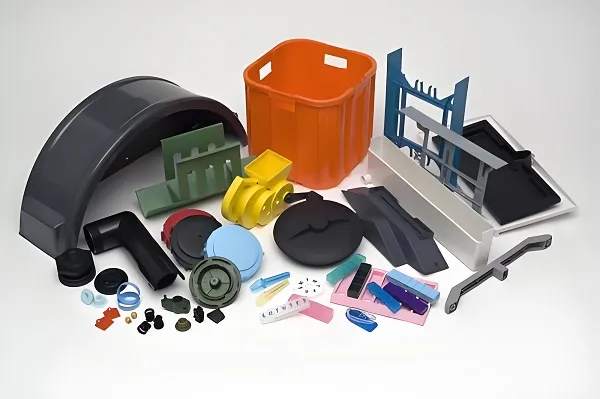
A custom ABS plastic shell cover is an injection-molded enclosure manufactured according to customer drawings or 3D files. It protects internal components while providing structural strength, impact resistance, and an attractive surface finish. These parts are widely used in furniture, consumer electronics, medical devices, industrial equipment, and home appliances.
Product Types
Housing, Cover, Enclosure, Panel
ABS housing, covers, enclosures, panels — furniture, appliance, equipment shells
Production Scale
Prototype to Mass Production
Low-volume prototyping, mid-range validation, and high-volume mass production runs
Service Mode
OEM & ODM Available
Full OEM from your drawings or ODM with our design assistance and mold engineering
| Item | Capability |
|---|---|
| Material | ABS, PC, PC+ABS, PP, Nylon, POM |
| Process | Injection Molding |
| Tolerance | ±0.02 mm |
| Mold Life | Up to 1,000,000 shots |
| Surface Finish | SPI, VDI, MT Texture, Painting, Plating |
| MOQ | Prototype & Mass Production |
| Drawing Formats | STEP, IGES, STL, DWG, PDF, SolidWorks |
| Certifications | ISO 9001:2015 |
Custom ABS Plastic Shell Cover Manufacturing Service
XiaMen Goldcattle provides full-cycle injection molding for ABS plastic housings, covers, enclosures, and panels. From initial DFM review through mold design, sampling, and mass production, we deliver parts that meet your dimensional, surface, and regulatory requirements.
We manufacture:
ABS Covers
ABS Enclosures
ABS Panels
Furniture Plastic Covers
Appliance Shells
Equipment Housings
Support scale:
Low-volume
Mass Production
Service mode:
ODM
Accepted file formats:
IGS
STP
DWG
Typical Applications
ABS plastic shell covers serve diverse industries requiring impact resistance, surface quality, and cost-effective mass production.
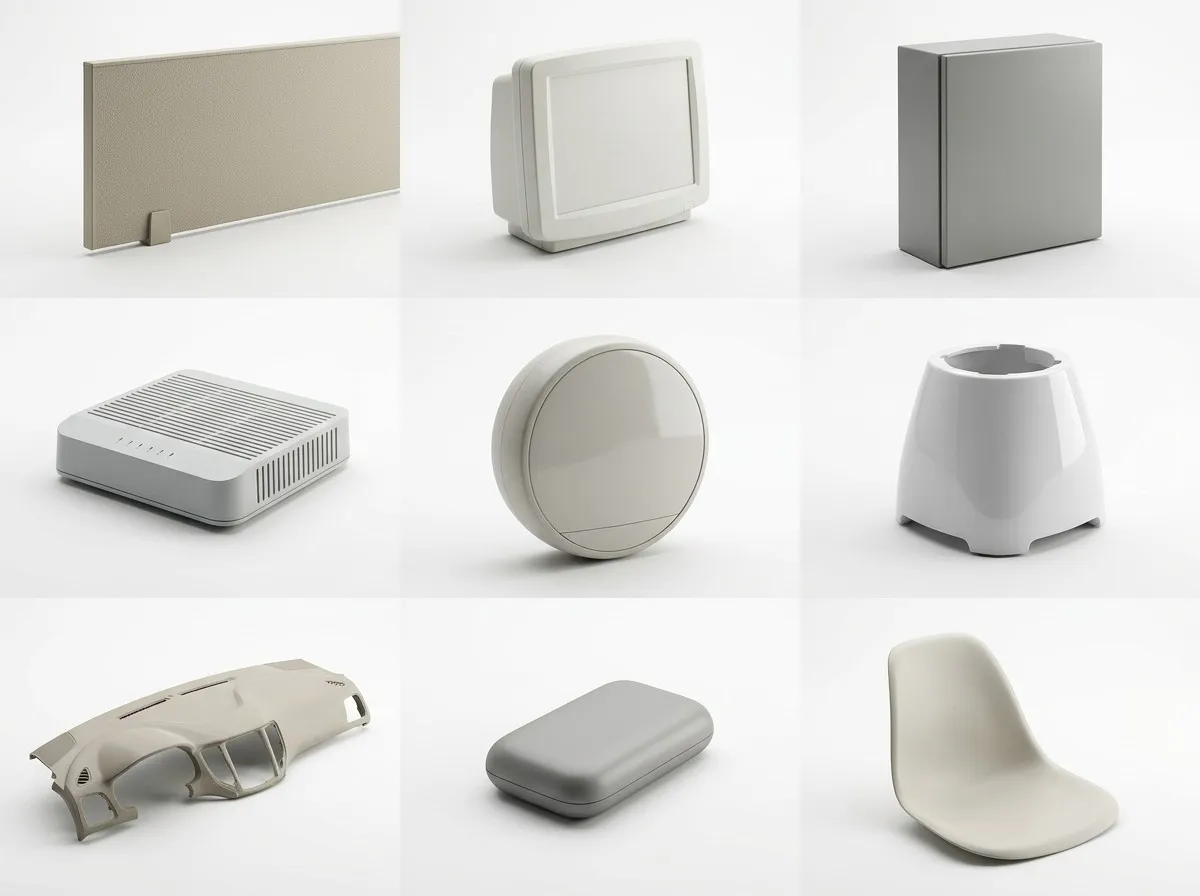
Furniture
Decorative covers, chair shells, desk panels, cabinet trim, and office furniture components
Medical Devices
Monitor housings, handheld device enclosures, diagnostic equipment shells
Industrial Equipment
Control panel enclosures, sensor housings, machine guards, junction box covers
Electronic Enclosures
Router shells, switch housings, power supply covers, PCB enclosures
Smart Home
Thermostat shells, smart speaker enclosures, IoT device housings
Home Appliances
Blender covers, vacuum housings, coffee machine panels, kitchen device shells
Automotive Interior
Dashboard trim, door panel covers, center console enclosures, seat adjuster housings
Consumer Products
Power bank cases, remote control shells, headphone housings, toy enclosures
Office Furniture
Desk organizer shells, cable management covers, partition panels, drawer fronts
Material Options
Selecting the right resin is critical for housing performance. Goldcattle stocks common enclosure alloys with full material certification and traceability.
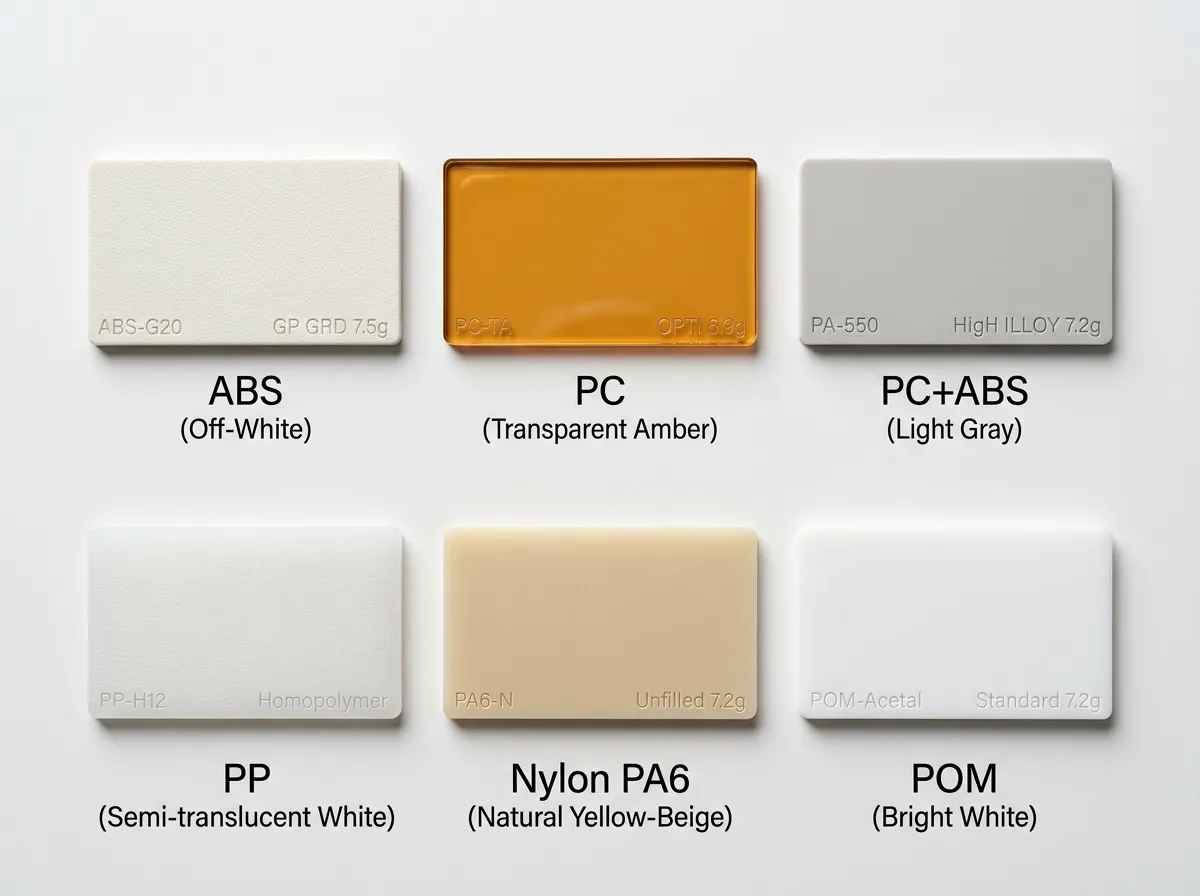
| Material | Key Features | Typical Applications |
|---|---|---|
| ABS | High impact resistance, easy molding, good surface finish | Furniture, appliance covers, consumer enclosures |
| PC | High strength, transparency option, heat resistance | Electronics, lighting covers, medical housings |
| PC+ABS | Balanced toughness and heat resistance, good flow | Automotive interior, laptop shells, chargers |
| PP | Chemical resistance, lightweight, low cost | Containers, battery housings, chemical equipment |
| Nylon (PA6/PA66) | Wear resistance, mechanical strength, self-lubricating | Mechanical parts, gears, structural brackets |
| POM | Dimensional stability, creep resistance, precision fits | Precision clips, snap-fit enclosures, valve housings |
Injection Molding Capabilities
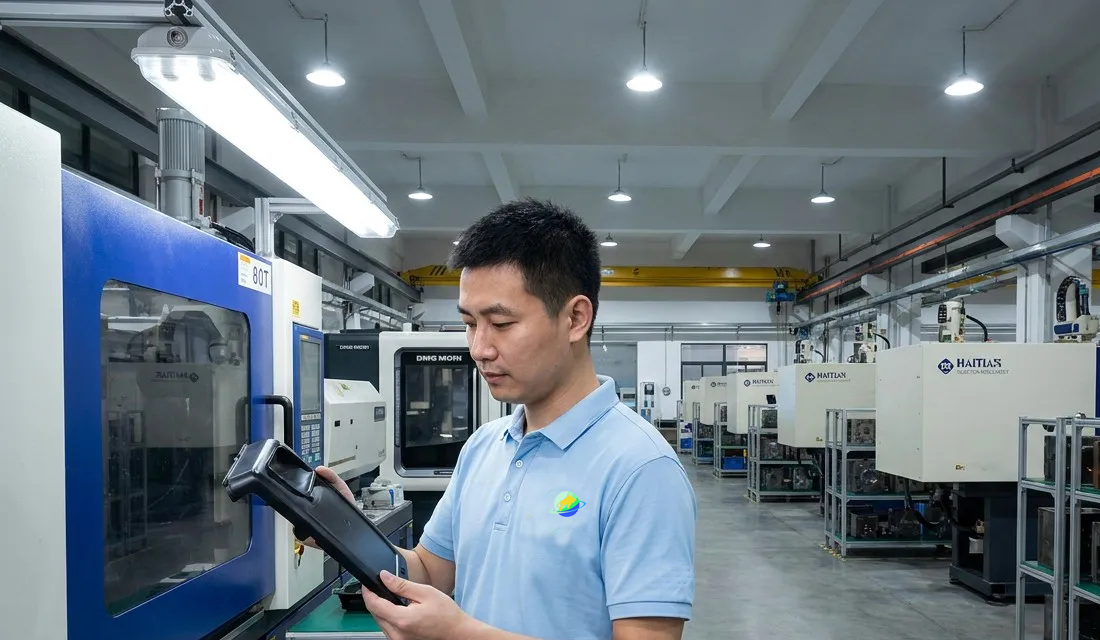
Goldcattle operates injection machines from 80T to 650T clamping force, with in-house mold making, Moldflow simulation, and CMM validation. Every part undergoes dimensional and visual inspection before shipment.
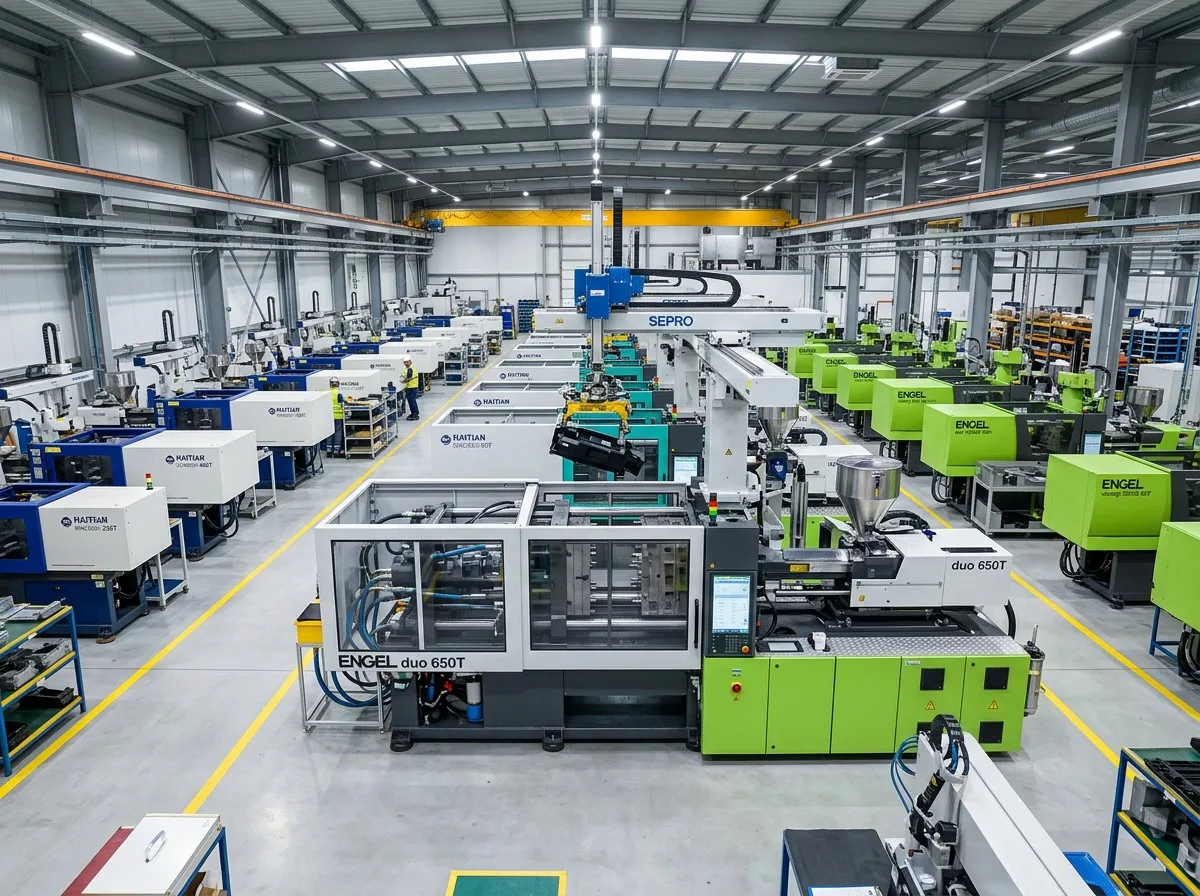
| Parameter | Specification | Notes |
|---|---|---|
| Mold Life | 50K / 100K / 500K / 1M shots | Steel mold grades: P20, 718H, H13, S136 |
| Machine Range | 80T, 120T, 250T, 450T, 650T | Haitian & Engel machines, robotic extraction |
| Tolerance | ±0.02 mm standard | ±0.01 mm for critical features after inspection |
| Part Weight | 5 g – 3 kg | Small clips to large panel covers |
| Maximum Size | 1200 mm | Large furniture panels and appliance shells |
| Cavities | 1–32 cavities per mold | Multi-cavity for high-volume efficiency |
| Tooling Lead Time | 15–30 days | Standard P20 mold; H13/insert mold +7 days |
| Production Lead Time | 7–20 days | After T1 sample approval, per order quantity |
In-House Mold Making
Complete mold design, CNC electrode machining, EDM, and polishing under one roof.
Moldflow Simulation
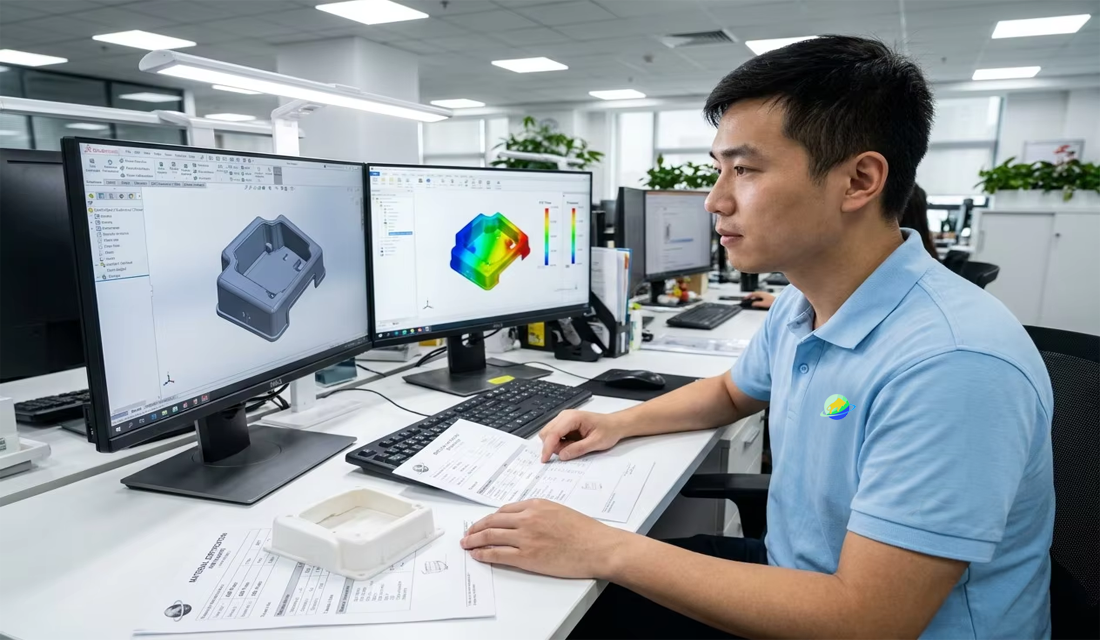
Fill time, pressure, weld line, and shrinkage analysis before steel cutting begins.
Robotic Extraction
Automated part removal and gate separation for consistent quality in volume runs.
CMM Validation
Zeiss CMM dimensional verification on first article and periodic production samples.
Injection Molding Process
Every custom ABS housing project follows a structured workflow from inquiry through delivery, ensuring transparency and quality at every stage.
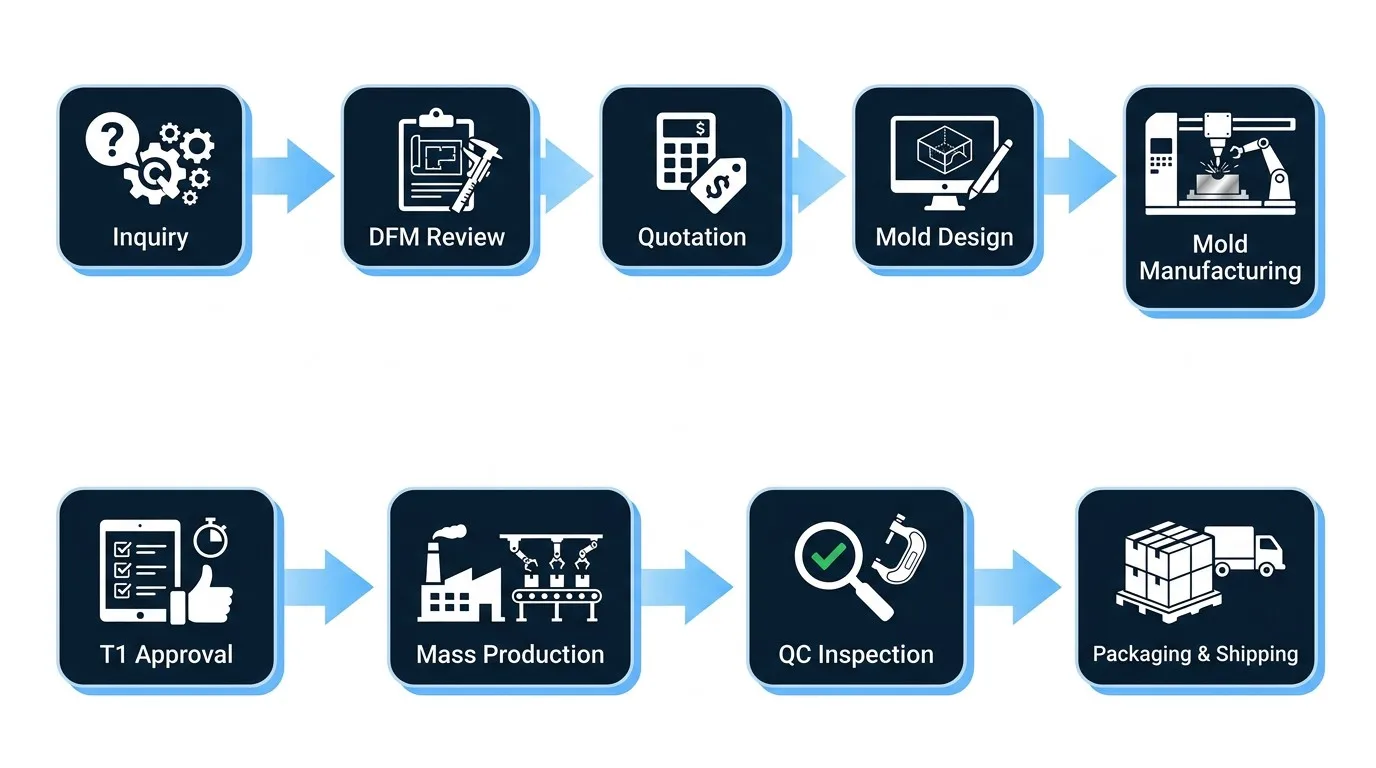
Step 1–2
Inquiry & DFM
Submit 3D files. Our engineers review wall thickness, draft angles, and potential sink marks.
Step 3–4
Quote & Mold Design
Detailed quotation within 24 hours. Mold design with Moldflow fill analysis validation.
Step 5–6
Mold Mfg & T0
CNC electrode, EDM, polishing. First sample (T0) within 15–30 days from mold start.
Step 7–8
T1 & Production
Customer approves T1 sample. Mass production begins with robotic extraction and inline checks.
Step 9–10
QC & Shipping
CMM + visual inspection. AQL sampling per ISO 2859. Custom packaging and global shipping.
Design Guidelines for ABS Plastic Housing
Following these guidelines reduces tooling cost, cycle time, and defect rates. Our DFM team reviews every submission against these parameters.
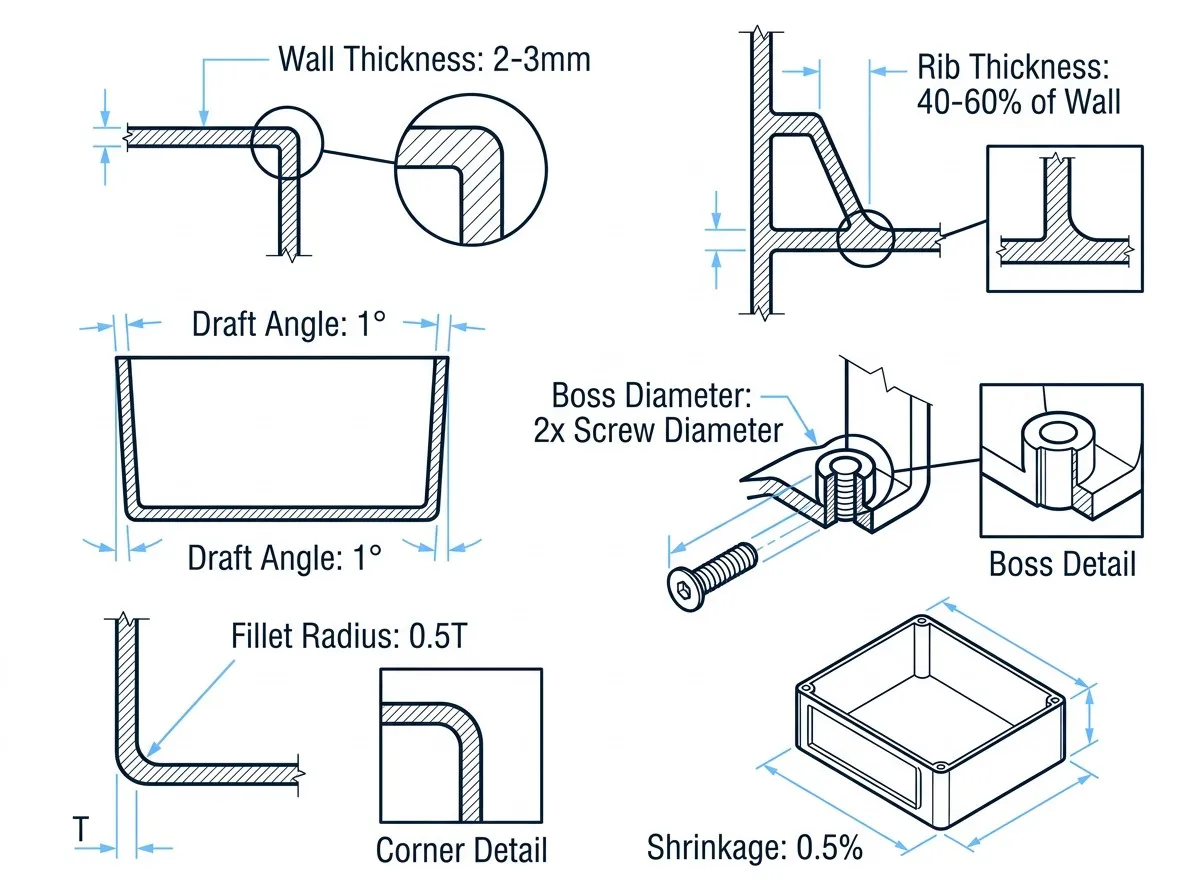
| Parameter | Recommended Value | Why It Matters |
|---|---|---|
| Wall Thickness | 2–3 mm (uniform) | Prevents sink marks and uneven cooling shrinkage |
| Draft Angle | 1° minimum (textured: 2°–3°) | Enables clean ejection without drag marks or part sticking |
| Rib Thickness | 40–60% of wall thickness | Adds stiffness without causing visible sink on opposite face |
| Boss Diameter | 2x screw OD | Ensures sufficient material for self-tapping screw engagement |
| Fillet Radius | 0.5T (T = wall thickness) | Reduces stress concentration and improves mold fill flow |
| Shrinkage Rate | 0.4–0.7% (ABS) | Mold dimensions compensated for predictable final part size |
Common Defects to Avoid
- Sink Mark — rib or boss too thick vs. wall
- Warping — uneven wall thickness or cooling
- Short Shot — insufficient fill pressure or thin section
- Flash — mold parting line gap or excessive injection pressure
Goldcattle DFM Support
- Wall uniformity — we flag thickness variation >30%
- Draft check — we verify all vertical faces have adequate draft
- Rib/boss ratio — we adjust dimensions before mold steel cutting
- Moldflow — fill simulation prevents short shots and weld line issues
Surface Finishes
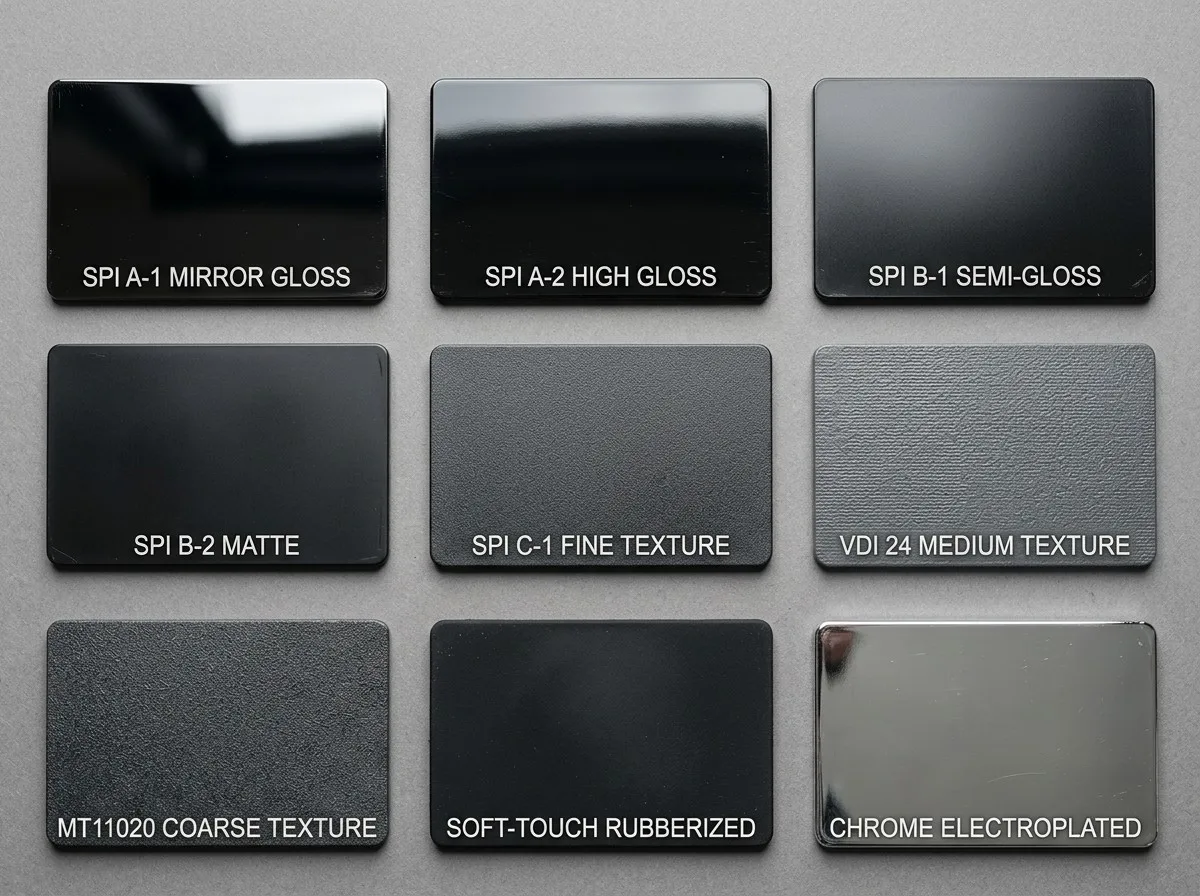
ABS plastic housings support a wide range of surface treatments, from functional textures to decorative coatings. Goldcattle provides in-house and partner capabilities for all finish types listed below.
SPI Finish
A-1 mirror, A-2 high gloss, B-1 semi-gloss, B-2 fine matte, C-1 medium matte
VDI Standard
VDI 12–45 graded textures for industrial equipment enclosures
MT Texture
Mold Tech series (MT11010–MT11050) for furniture and consumer product aesthetics
Painting
Solid color, metallic, matte, and custom Pantone match spray coating
Soft Touch
Rubberized overcoat for consumer electronics and handheld device housings
Chrome Plating
Electroplated chrome for automotive trim and premium furniture accents
Laser Texture
Laser-etched micro-texture patterns for anti-slip and branding surfaces
Printing & Assembly
Silk screen, pad printing, hot stamping, UV printing + sub-assembly service
Quality Control
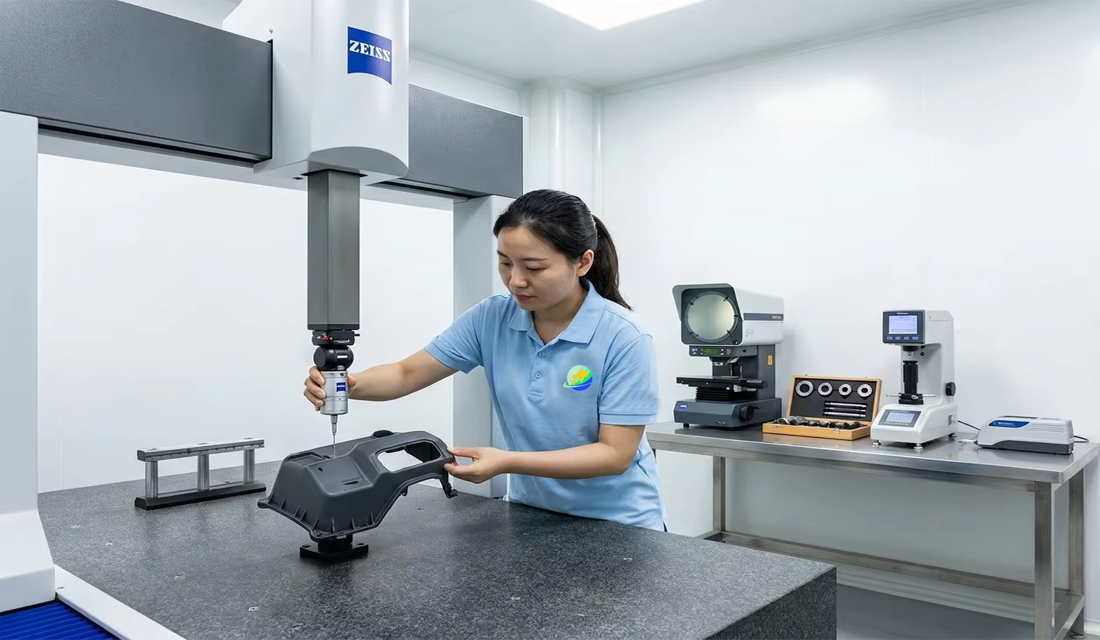
Goldcattle maintains ISO 9001:2015 certified quality management across every production stage. From incoming material inspection to final packaging checks, every step is documented and traceable.
Incoming Material
Material certification review, melt flow index test, visual and dimensional check on raw resin.
First Article (FAI)
Full dimensional report on T0/T1 sample using CMM, projector, and surface roughness tester.
IPQC
In-process quality checks: cavity weight, visual inspection, go/no-go gauge every 2 hours.
CMM & Projector
Zeiss CMM for critical dimensions, optical projector for thread and profile verification.
Go/No-Go Gauge
Quick pass/fail check on bore diameter, keyway width, and snap-fit feature dimensions.
Hardness & Roughness
Rockwell hardness verification and surface roughness (Ra) measurement on critical faces.
Final & Packaging
100% visual inspection, AQL sampling per ISO 2859-1, packaging integrity verification.
Full Inspection Report
Detailed report with CMM data, surface photos, and material certification with every shipment.
Engineering Support
Our engineering team provides hands-on support at every stage, from initial concept review through production optimization. This is what sets Goldcattle apart from standard injection molding suppliers.
DFM Optimization
We review wall thickness, draft, rib/boss ratios, and gate placement before mold steel cutting begins.
Mold Flow Analysis
Moldflow simulation predicts fill time, pressure distribution, weld lines, and potential air traps.
Material Recommendation
We recommend the optimal resin grade based on impact, UV, flame retardancy, and cost requirements.
Tolerance Analysis
Critical feature tolerance stack-up review to ensure assembly fit and functional compliance.
Prototype Optimization
CNC-milled or 3D-printed prototype validation before committing to production mold investment.
Assembly Advice
Snap-fit, screw boss, ultrasonic weld, and adhesive bonding recommendations for multi-part enclosures.
Case Study
Real project examples demonstrating how Goldcattle solves molding challenges and delivers measurable results for OEM customers.
CASE 1
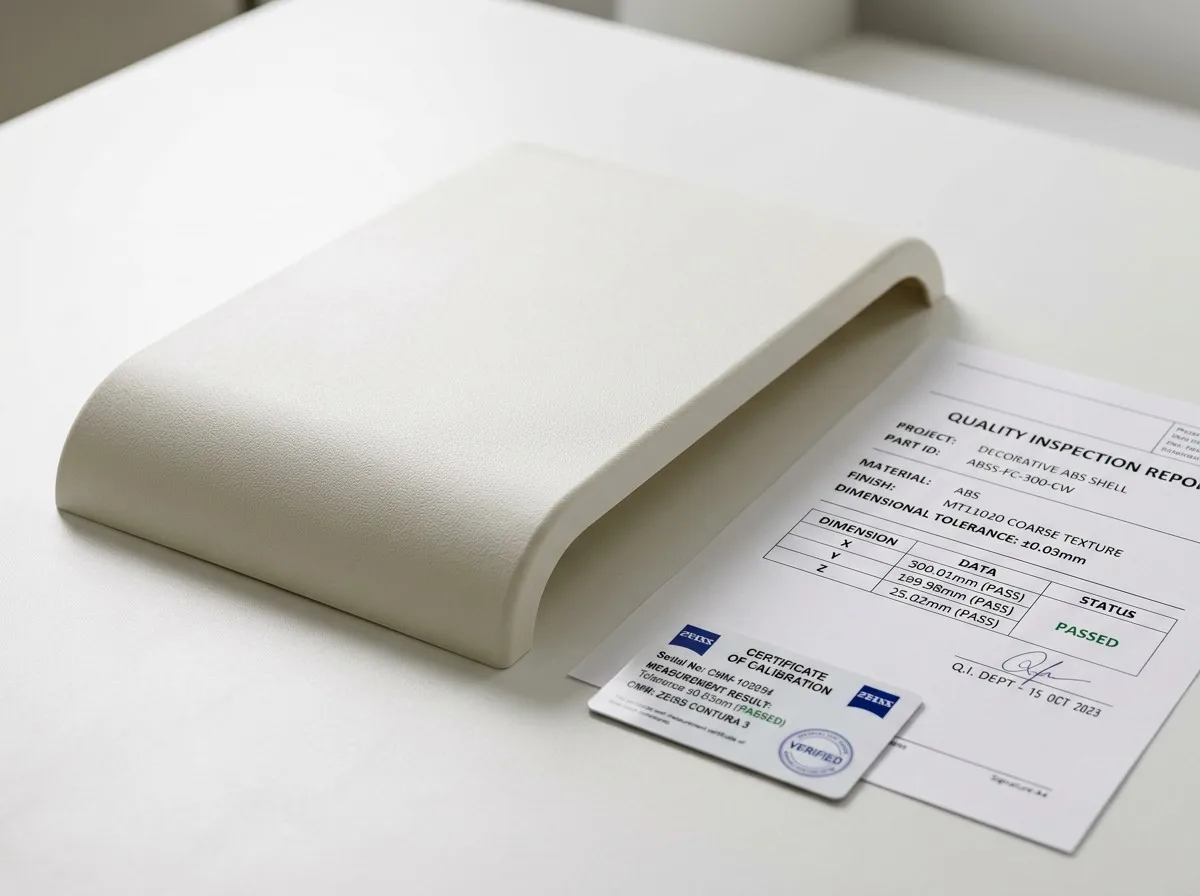
Furniture Decorative Cover
| Material | ABS (LG 8390) |
| Tool | 2-cavity, P20 steel |
| Tolerance | ±0.03 mm |
| Surface | MT11020 texture |
| Quantity | 200,000 pcs/year |
| Result | 15% cost reduction via gate optimization |
CASE 2
Electronic Device Enclosure
| Material | PC+ABS (Bayblend T85) |
| Tool | 1+1 family mold, 718H |
| Tolerance | ±0.02 mm (snap-fit) |
| Surface | SPI B-2 + silk screen |
| Quantity | 500,000 pcs/year |
| Result | Snap-fit assembly >98% pass rate |
CASE 3
Medical Monitor Housing
| Material | ABS (UL94 V-0 rated) |
| Tool | 4-cavity, S136 stainless |
| Tolerance | ±0.01 mm (LCD fit) |
| Surface | SPI A-2 + soft-touch coat |
| Quantity | 80,000 pcs/year |
| Result | Zero rejection rate over 18 months |
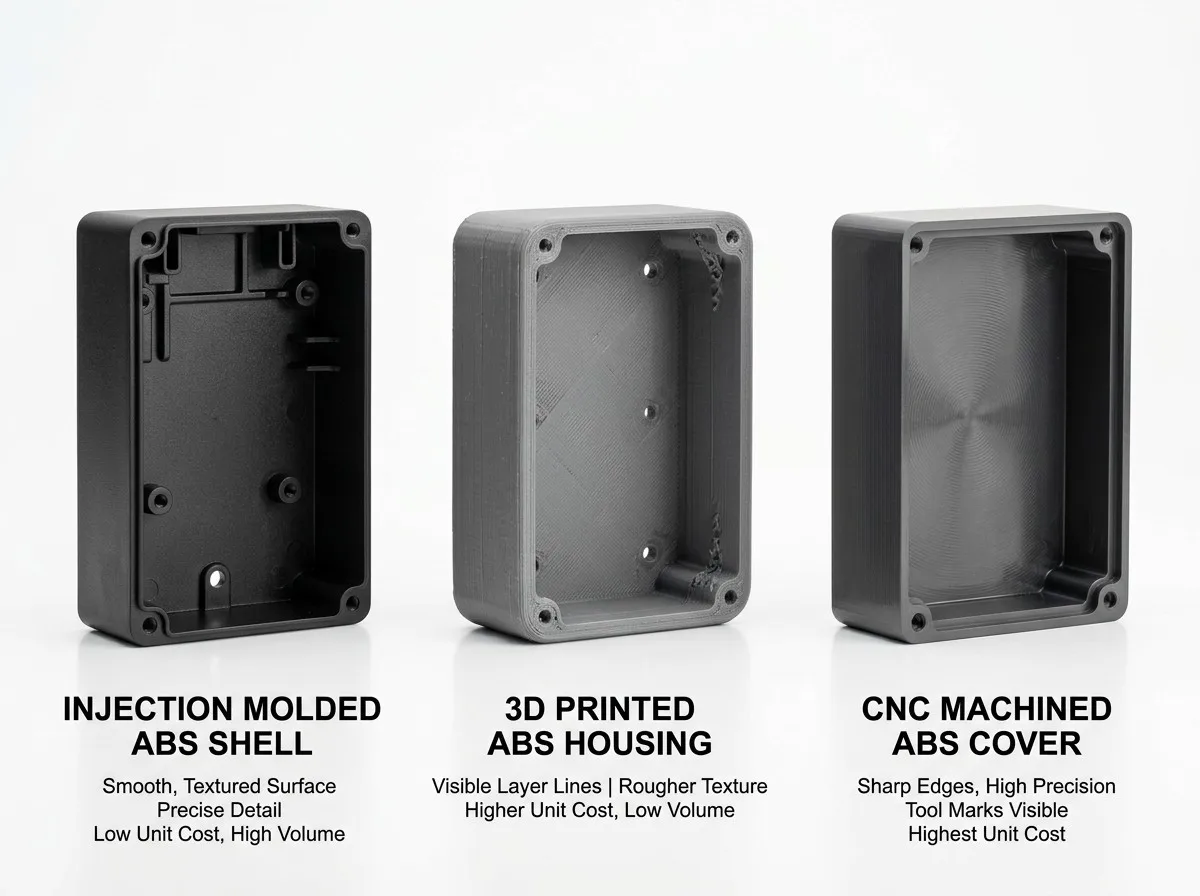
Manufacturing Method Comparison
When evaluating how to produce ABS plastic housing, understanding the trade-offs between injection molding, 3D printing, and CNC machining helps inform the right production strategy.
| Method | Surface Quality | Unit Cost (100+) | Lead Time | Tolerance | Best For |
|---|---|---|---|---|---|
| Injection Molding | ★★★★★ | Lowest | 15–30 days (tool) | ±0.02 mm | Mass production, consistent quality |
| 3D Printing (FDM) | ★★ | High | 1–3 days | ±0.1 mm | Prototype only, low volume |
| CNC Machining | ★★★ | Highest | 3–7 days | ±0.01 mm | High-precision, low-volume bridge |
Why Choose Goldcattle
XiaMen Goldcattle Plastic & Metal Products Co., Ltd. combines in-house mold making with injection molding production, delivering full-cycle manufacturing service from DFM review through mass production and global shipping. Our ISO 9001:2015 certified facility serves OEM customers across furniture, electronics, medical, automotive, and industrial equipment sectors.
DFM Optimization
Wall thickness, draft, rib/boss ratio review before mold steel cutting. Saves tooling cost and cycle time.
Mold Flow Analysis
Moldflow simulation predicts fill, pressure, weld lines. Prevents short shots and air traps before production.
In-House Mold Making
Complete mold under one roof: design, CNC electrode, EDM, polishing. No third-party dependency.
Injection Machines 80T–650T
Wide tonnage range covers 5 g clips to 3 kg large panels. Robotic extraction for volume consistency.
ISO 9001 Certified
FAI, IPQC, CMM, and AQL inspection at every stage. Full report with material certification per shipment.
Material Traceability
Full resin certification, lot tracking, and incoming inspection. Every part traceable to material batch.
Fast Sampling
T0 sample within 15–30 days from mold start. T1 approval within 3–5 days after T0 review.
Assembly Service
Sub-assembly, ultrasonic welding, insert placement, and multi-component integration available in-house.
Global Shipping
DHL, FedEx, sea freight. Custom packaging, fumigation-certified wooden cases, and door-to-door delivery.
Frequently Asked Questions
Common questions from OEM buyers about ABS plastic shell cover manufacturing and injection molding service at Goldcattle.
How much does ABS injection molding cost?
Cost depends on part size, cavity count, material grade, and surface finish. Tooling investment ranges from \$3,000–\$25,000 depending on mold complexity and steel grade. Unit part cost decreases significantly with volume — a 2-cavity mold producing 100K+ parts typically achieves under \$1 per piece for small housings. Request a quotation with your 3D files for an exact price.
What is ABS shrinkage rate?
ABS shrinkage is typically 0.4–0.7%, depending on flow direction, wall thickness, and gate location. Mold dimensions are compensated for this shrinkage during design. Glass-filled ABS grades have lower shrinkage (~0.2–0.4%).
How thick should ABS walls be?
Recommended wall thickness for ABS is 2–3 mm with uniform distribution. Variations greater than 30% between thick and thin sections cause sink marks and uneven cooling. Our DFM team reviews every submission for wall uniformity.
Can ABS parts be painted?
Yes. ABS accepts spray painting well, including solid colors, metallic finishes, matte coatings, and custom Pantone matches. Surface preparation (light sanding or primer) ensures adhesion. We provide in-house painting service.
Can ABS parts be chrome plated?
Yes. ABS is one of the best plastics for electroplating due to its etchability. Chrome, nickel, and copper plating are all available. Plated ABS achieves a premium metallic appearance for automotive trim and decorative furniture accents.
ABS vs PC — which is better for enclosures?
ABS offers better impact resistance and easier molding at lower cost. PC offers higher heat resistance, transparency option, and greater structural strength. For most furniture and consumer enclosures, ABS is the cost-effective choice. For electronics requiring higher operating temperature, PC or PC+ABS blend is recommended.
Can ABS be UV resistant or flame retardant?
UV-stabilized ABS grades are available for outdoor applications (furniture, garden equipment). Flame-retardant ABS (UL94 V-0 rated) is stocked for medical, electronics, and appliance enclosures requiring fire safety compliance.
Can you overmold rubber on ABS?
Yes. Two-shot overmolding with TPU or TPE on ABS provides soft-touch grip zones, seals, and gaskets on enclosure surfaces. This requires a two-color injection machine (250T+). Goldcattle offers overmolding capability.
What tolerance can you achieve on injection molded parts?
Standard tolerance is ±0.02 mm for commercial-grade molded parts. Critical features (snap-fit bosses, alignment pins, LCD window openings) can achieve ±0.01 mm with optimized mold design and post-mold CMM verification.
How long does tooling take?
Standard P20 mold: 15–20 days. Hardened H13/718H mold with inserts: 20–30 days. Stainless S136 for medical/optical: 25–30 days. T0 sample is included. Rush scheduling available for urgent projects.
Can you assemble parts after molding?
Yes. We provide sub-assembly services including ultrasonic welding, screw insertion, snap-fit joining, hot-staking, adhesive bonding, and insert placement (threaded brass inserts). Multi-component enclosures can be assembled and tested before shipment.
Can you sign NDA before receiving my drawings?
Yes. Goldcattle signs NDA agreements before reviewing any customer design files. We respect intellectual property and maintain strict confidentiality. Standard NDA template available, or we can sign your company’s NDA form.
Related Products & Services
Explore our full injection molding and manufacturing capabilities for housing, enclosure, and cover production across multiple materials and industries.
ABS Plastic Enclosure
Consumer and industrial enclosures in impact-resistant ABS resin
PC Plastic Housing
Transparent and high-strength housings for electronics and lighting
PC+ABS Cover
Balanced toughness and heat resistance for automotive and charger shells
Plastic Battery Housing
Chemical-resistant PP and ABS enclosures for energy storage systems
Injection Mold Tooling
P20, 718H, H13, S136 mold making with Moldflow validation
Overmolding Parts
Two-shot TPU/TPE over ABS for grip, seal, and gasket features
Plastic Appliance Shell
Large-format panels and covers for home and commercial appliances
Plastic Electronic Housing
Snap-fit, screw-joined, and ultrasonic-welded enclosures for PCBs
Prototype Injection Molding
Low-cost aluminum mold for 100–500 piece prototype validation runs