
Custom ABS CNC Machining for Plastic Prototypes and Precision Parts
ABS is the plastic most product teams reach for first, and it is one of the easier thermoplastics to cut. That is exactly why ABS parts rarely fail at the cutter. They fail on a grade nobody confirmed, on a tolerance copied from a metal drawing, on a finish agreed in words instead of on a sample, or on a wall that was never going to survive the fixture. Four decisions decide whether the part arrives usable: grade, geometry, tolerance, finish. This page is about those four.
At a Glance
ABS machines easily; a drawing written for metal does not survive it. Three things decide whether the part arrives usable. The grade must be named and the property that matters confirmed against the resin — UL 94 rating and test thickness for FR, surface resistivity for ESD, HDT rather than one headline temperature for heat-resistant grades. The geometry must be machinable, which in practice means walls of 1.5 mm or more and pockets no deeper than about three times the cutter width. And the tolerance must be written feature by feature and measured in a stated condition, because on ABS the error budget is set by elastic recovery and clamping, not by the machine's positioning accuracy.
Where This Page Fits
The site already carries five pages that touch ABS. Repeating any of them would give a buyer two half-answers instead of one clear one, so this page covers only what changes when ABS is cut rather than moulded.
| Page | What it answers | What this page does about it |
|---|---|---|
| This page | How an ABS part becomes a machined, finished, inspected part that fits what it was designed for | — |
| CNC machining services | The general service: machines, processes, metals, tolerances across all work | No machine list here; machine envelopes stay on that page |
| Custom ABS plastic molding | Grades for moulding, mould DFM, drying, tooling, moulded shrinkage, moulding defects, tooling cost and lead time | Not repeated. This page covers the machined route and hands the buyer over when volume justifies a tool |
| Engineering plastic CNC machining | The full plastic selector: PEEK, POM, PA, PTFE, PEI, PC and ABS side by side | ABS only, with the grade confirmation detail that a multi-material page cannot carry |
| CNC plastic machining technology | Why plastic behaves differently at the cutter: heat, deflection, released stress, moisture, chip formation | Assumed, not re-taught. The DFM chapter here states the drawing decision, not the physics behind it |
| When to switch to injection molding | Break-even modelling, the four-stage transition, what must be validated before a production tool is cut | One short chapter on the ABS-specific signals; the maths lives on that page |
| Material library | Grades, properties and stock across the site | Only the properties that change a machining decision |
What We Machine in ABS
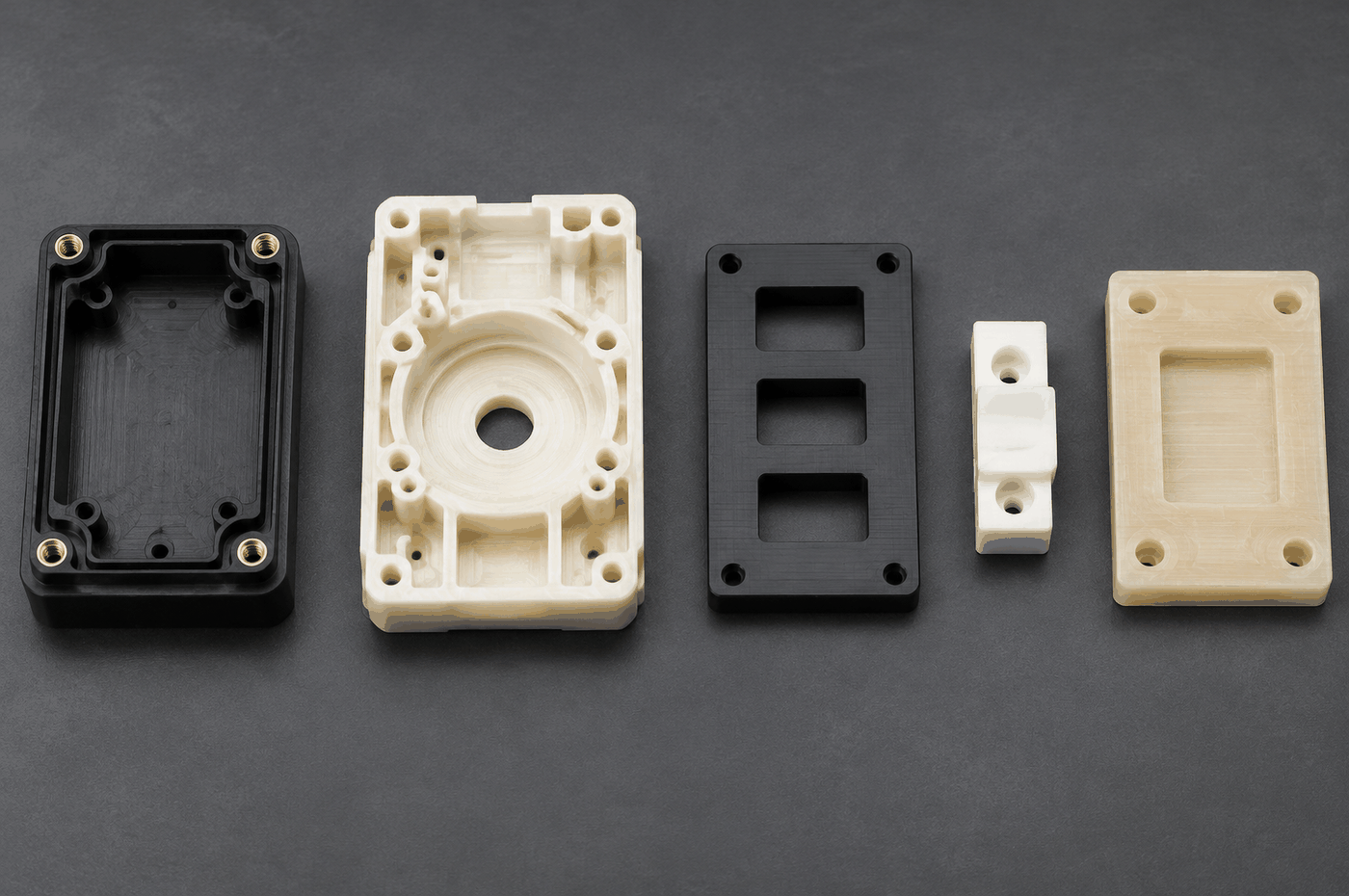
ABS is bought for three reasons: it takes a finish well, it survives a drop, and it is inexpensive enough to iterate with. The part types below cover most of what arrives as an ABS enquiry, and the last column is the route we would normally quote first.
| Part type | What the drawing usually has to carry | Route we quote first |
|---|---|---|
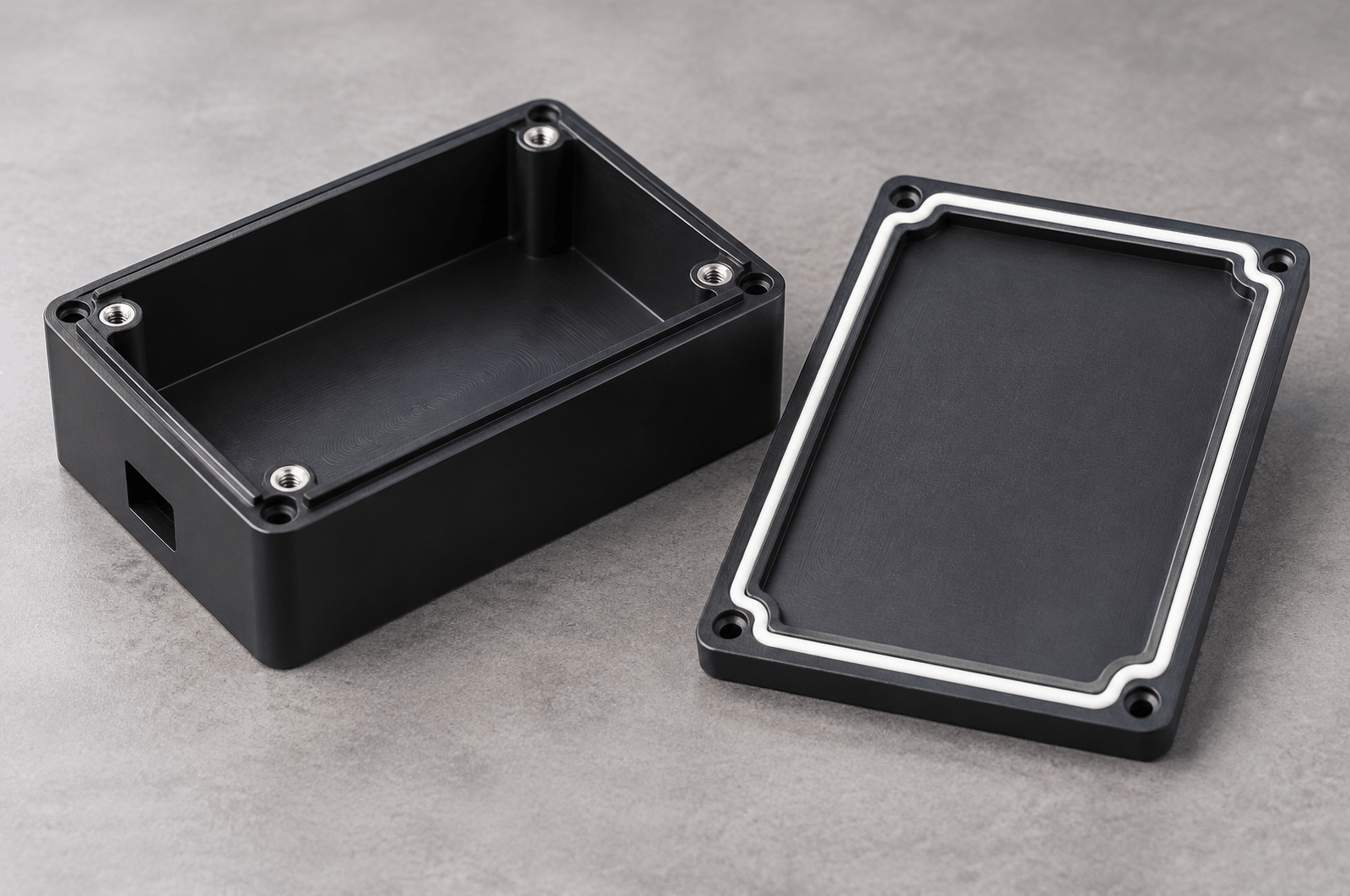
| Electronic enclosure, base and lid | Wall thickness, internal mounting bosses, connector cut-outs, a clean outside face, a lid that closes without a gap | CNC for prototypes and low volume; mould from a few hundred pieces upward |
| Control panel and faceplate | Window openings, button apertures, engraved or printed legend, painted or textured face | CNC, because the openings and the printing are easier to change than a tool |
| Bracket, mount and internal support | Hole pattern, load direction, no cosmetic requirement, sometimes a metal insert | CNC at any quantity a bracket is normally ordered in |
| Prototype housing | Shape that is still changing, snap-fit that has to be tried, a finish that has to be shown to a customer | CNC, or 3D printing where the surfaces do not need to represent the production part |
| Protective cover and guard | Large flat area, corner radii, mounting holes, flatness that survives the fixings | CNC in small quantity; the same cover is usually a moulded or formed part at volume |
| Jig, fixture and test nest | Locator bores, an ESD-safe grade, dimensional stability over repeated use | CNC, ESD-modified grade confirmed before the blank is ordered |
| Automotive interior trim, development stage | Grain and colour for a design review, fitment checks, a small build series | CNC for development parts only — see the note below |
Choosing the Grade, and What Has to Be Confirmed
"ABS" on a drawing is a family, not a specification. Every modifier in the table below changes something a machined part depends on — impact strength, heat resistance, how the chip forms, whether the part can legally carry a flame rating, or what the surface does under a clamp. The middle column is what actually changes at the machine. The right-hand column is what we need from you before a blank is ordered.
| Grade | What changes for a machined part | Confirm before cutting |
|---|---|---|
| General purpose ABS | The easiest of the family to cut and to paint. Chips form cleanly, the surface sands flat, and a painted finish is predictable | Colour and lot. Nothing else normally decides the part |
| High-impact ABS | Higher butadiene content buys notched impact and costs some stiffness. The chip turns gummier and the cut edge smears more easily when the tool rubs | The impact figure the part has to meet, and whether stiffness can give way to it |
| Heat-resistant ABS | HDT raised by roughly 10–20 °C over general purpose. Machines much like GP but creeps sooner above its glass transition | The real working temperature and the load at that temperature, not a single maximum |
| Flame-retardant ABS (FR) | Additive-loaded, so slightly denser and more abrasive on the edge. The rating belongs to the resin, the colour and the test thickness together | Grade name, UL file reference, the UL 94 level and the thickness it was tested at |
| ESD-modified ABS | Conductive filler changes chip behaviour and can leave a faint mark on a cut face. The property is electrical, so it cannot be judged by eye | Target surface or volume resistivity, the test method, and whether the requirement covers the machined face |
| PC/ABS blend | Better impact and heat than ABS, harder and notch-sensitive at the cutter. It machines more like polycarbonate than like ABS | The blend and its ratio, because "PC/ABS" alone describes a range wide enough to quote two different parts |
ABS or PC/ABS, in the terms a buyer actually uses
The comparison below is about choosing between the two for a machined part, so it is written as trade-offs rather than property values. Neither column is better; they cost differently and fail differently.
| Decision | General purpose ABS | PC/ABS |
|---|---|---|
| Material cost | Lower. The cheapest way into a rigid, paintable housing | Higher, and the gap widens on small orders because stock is thinner |
| Impact | Good for a housing that is handled, dropped or knocked in service | Noticeably better, and it holds more of it at low temperature |
| Heat | Fine for electronics that run warm; marginal near a heat source or in a hot enclosure | Comfortable where ABS would creep, at the cost of a harder cut |
| Machining behaviour | Forgiving: clean chips, tolerant of a slightly dull tool, sands easily | Less forgiving: sharper edges, a greater tendency to craze around a tapped hole |
| Painting and printing | Excellent and predictable with a standard primer and a compatible topcoat | Good, but solvent choice matters more and adhesion should be tested |
| When it wins | Enclosures, panels, covers and brackets where cost and finish lead | Handheld devices, outdoor or hot environments, parts that take a knock |
What ABS Gives You, and What It Does Not
The values below are for general purpose ABS and are the ones that change a design decision. Treat them as the band the family sits in, and take the exact figure from the datasheet of the grade you buy — that is the number your drawing should be checked against.
| Property | Typical value, general purpose ABS | What it means on a machined part |
|---|---|---|
| Density | 1.04 g/cm³ | About 38% of the weight of the same part in aluminium, which is why a machined ABS housing is often chosen for a handheld product |
| Tensile strength at yield | 40–45 MPa | Roughly a tenth of mild steel. Design for stiffness and section, not for strength |
| Flexural modulus | 2.0–2.4 GPa | Around one hundredth of steel. A 2 mm ABS wall is a flexible wall, not a rigid one |
| Notched Izod impact, 23 °C | 100–400 J/m, grade dependent | The single number that separates GP from high-impact, and the one to quote when a drop test is in the specification |
| Heat deflection temperature, 1.82 MPa | 80–100 °C | The band the familiar "80 °C" comes from — it is the bottom of the range, not the family value |
| Continuous service under load | 70–80 °C | Ten to twenty degrees below HDT, because a loaded part creeps before it deflects |
| Glass transition | 100–115 °C | Above it the material softens quickly, and stiffness stops being a design assumption |
| Water absorption, 24 h | 0.2–0.3% | Small next to nylon, still enough to change a press fit on a large part that ships humid |
| Coefficient of thermal expansion | 7–9 × 10⁻⁵/K | Three to four times aluminium: a 200 mm part moves about 0.16 mm over a 10 °C swing, which is why a measured size carries a temperature |
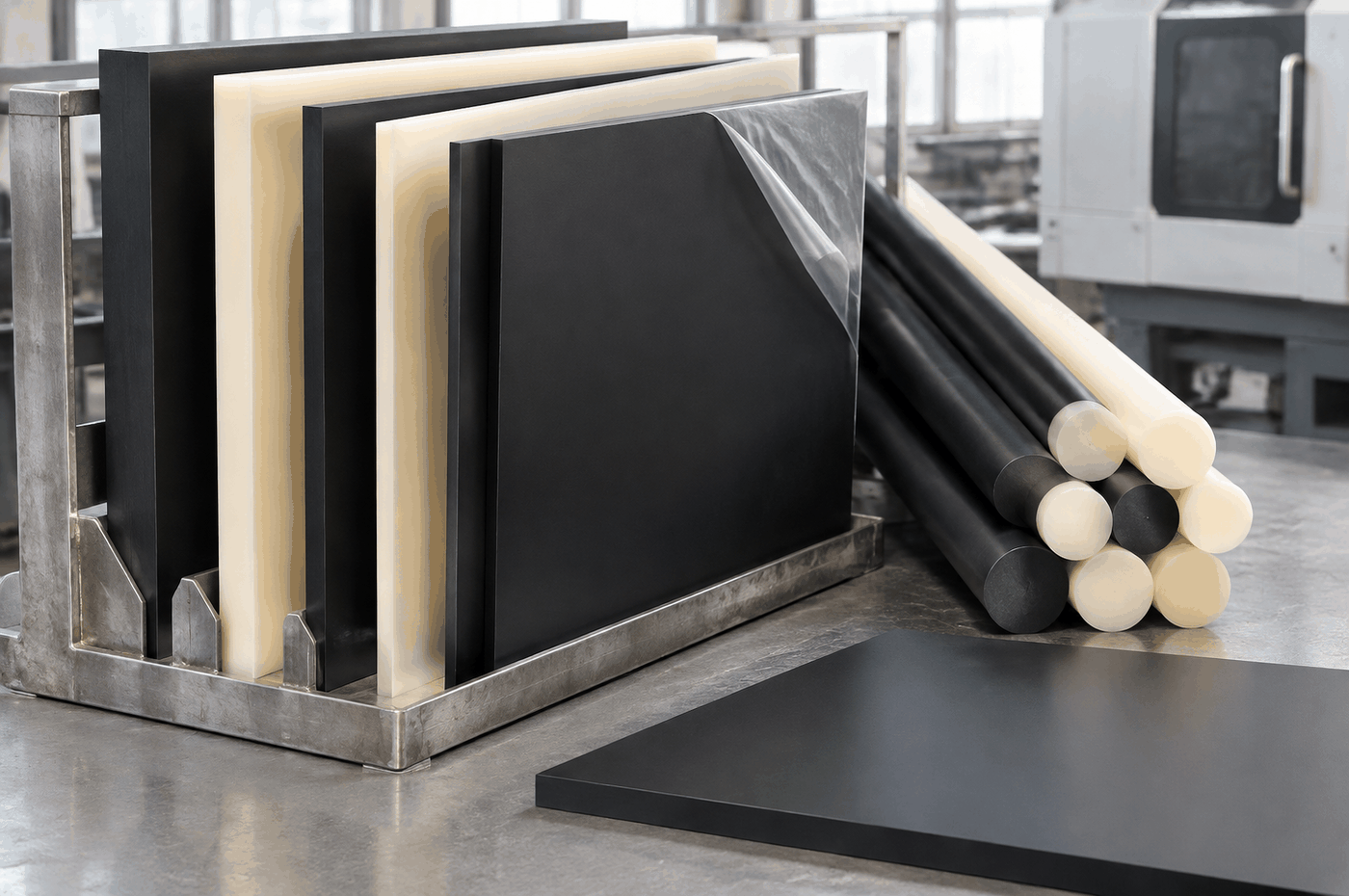
| Machinable stock | Plate from about 6 to 100 mm, rod from about 10 to 150 mm diameter | Thicker or wider sections are quoted on request; the blank often sets the limit before the machine does |
Three temperatures that are not the same number
Most ABS specification arguments come from one number being used where another was meant. The three below answer three different questions, and only one of them belongs on a drawing that a buyer will check.
| Number | The question it answers | How to use it |
|---|---|---|
| Heat deflection temperature (HDT) | At what temperature does a loaded test bar deflect by a stated amount, at a stated stress | The comparison figure between grades. Always quote the stress it was measured at, because 0.45 MPa and 1.82 MPa give very different answers |
| Continuous service temperature | What temperature can the part live at for years without losing shape under its working load | The design figure. It sits below HDT, and it sits further below it as the load rises |
| Vicat softening temperature | At what temperature does a small loaded needle penetrate the surface | A process and quality figure, useful for incoming inspection, not a service limit |
Machining Capability, Read as Part Features
A capability list is only useful if it maps onto something on the drawing. The table below reads each operation as the feature it produces, and the limit that usually applies when the material is ABS.
| Operation | Feature it produces | What limits it on ABS |
|---|---|---|
| 3-axis milling | Flat faces, pockets, windows, stepped openings, outside profiles | Wall stiffness and chip evacuation; most enclosure work never needs more than three axes |
| Drilling | Mounting holes, connector openings, cable entries, dowel holes | Hole position rather than hole size; a drilled hole in ABS can be reamed for a bearing fit |
| Tapping | Threaded holes for fasteners and threaded inserts | Wall thickness around the hole and the number of assembly cycles the thread has to survive |
| Pocketing | Internal cavities, component recesses, potting pockets | Depth to width ratio, because a long slender tool deflects and the corner goes oversize |
| Contour and profile milling | Outside shape, corner radii, drafted edges if the drawing asks for them | The finish on a vertical wall, which shows every pass mark once the part is painted |
| Multi-side machining | Features on four or five faces of the same block | Refixturing error. One setup and a fourth axis usually beat three setups and three datums |
| 5-axis machining | Faces and ports that cannot be reached from three directions | Quoted only when the geometry demands it, because the rate on a 5-axis machine is not what an ABS housing needs |
Design for Machining: Seven Numbers to Put on the Drawing
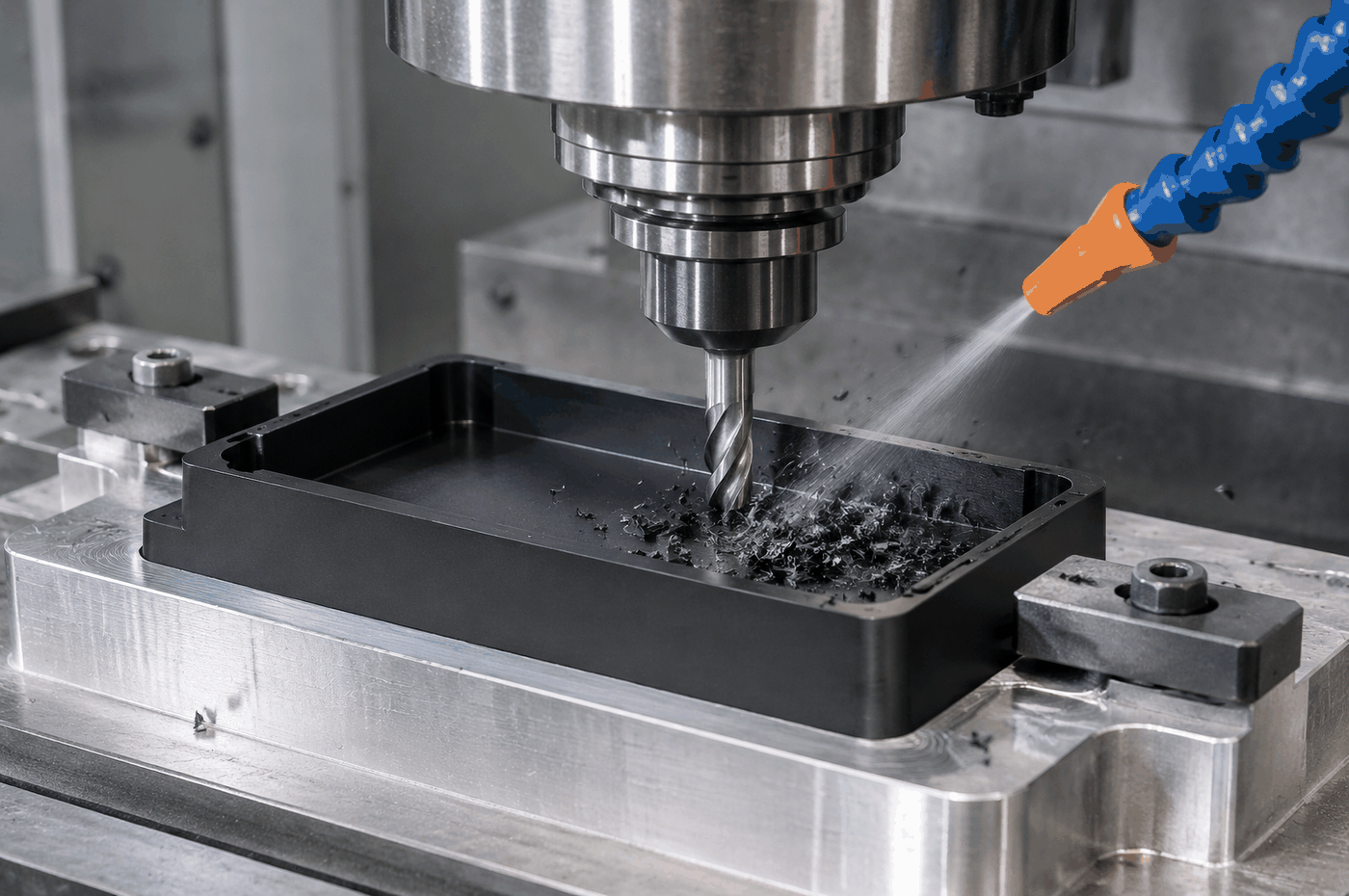
The existing plastic-machining guide explains why ABS deflects, heats and moves. This chapter does something different: it states the value to write on the drawing, and what happens at the machine when it is missing. Every row is a decision an engineer can make in five minutes and a buyer can check in one.
| Feature | Working value | What happens when it is not there |
|---|---|---|
| Wall thickness | 1.5 mm minimum for a structural housing; 1.0 mm possible on a short span that is supported | A 1 mm wall on a 100 mm span pushes away from the cutter, so the wall tapers and the outside face shows a witness mark |
| Pocket depth | Up to about three times the cutter diameter at full depth | Deeper than that needs a smaller tool, which deflects: corners go oversize and the floor is not flat |
| Internal corner radius | 3 mm or larger on pockets up to about 30 mm deep | A sharp internal corner cannot be milled. It is either left as a radius anyway, or it becomes a second operation |
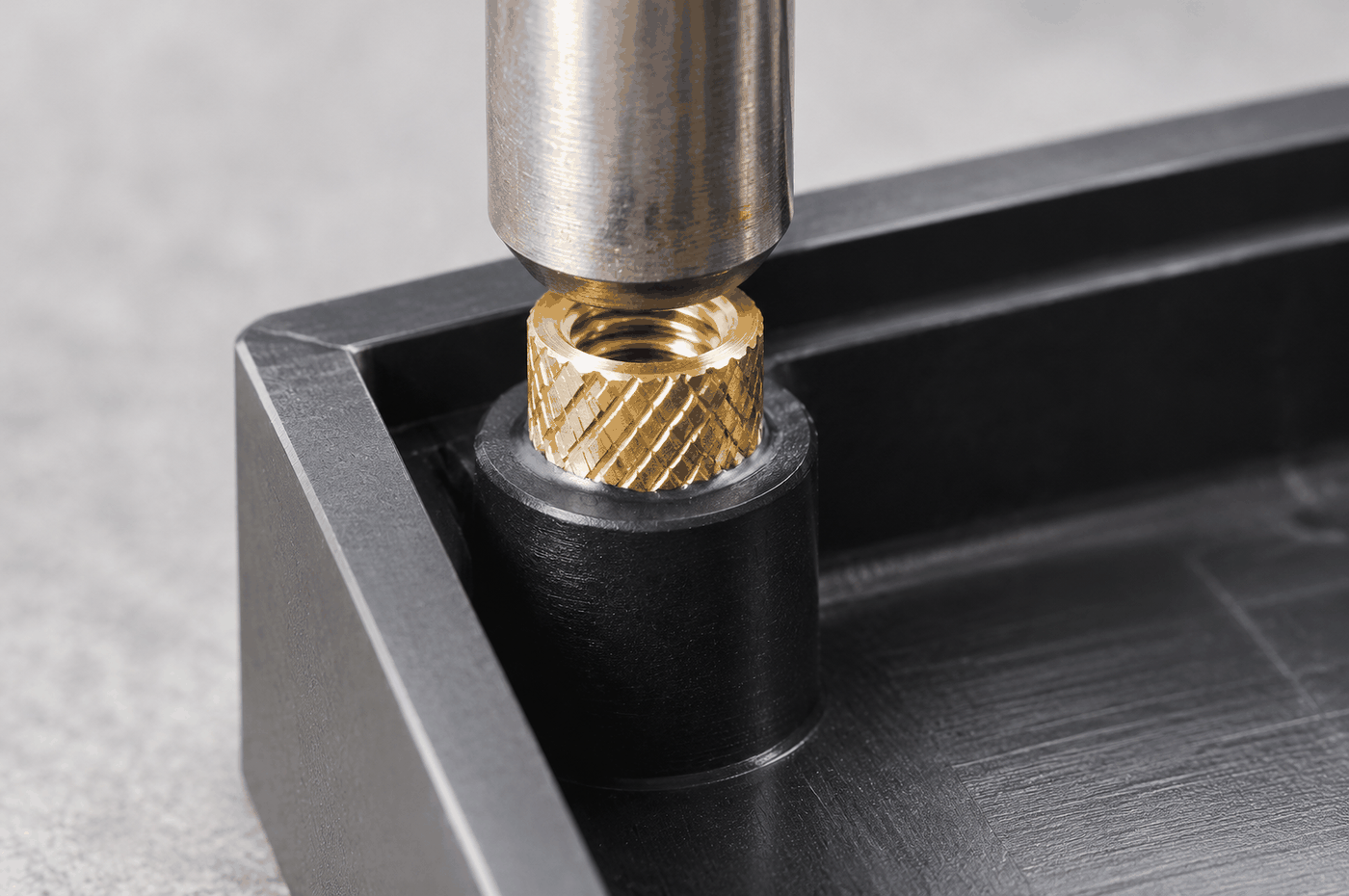
| Threaded holes | M3 minimum; engagement at least 1.5 × diameter | Thin threads strip on the second assembly, and the repair is a larger hole, not a new thread |
| Repeated assembly | Heat-set insert rather than a cut thread | A machine-cut thread in ABS survives a handful of cycles; an insert is a design decision, not a workshop one |
| Flatness on a panel | 0.1 mm per 100 mm, measured free of the fixture | Stated without the measuring condition, a flatness callout is unenforceable: it is flat under the clamps and not flat on the bench |
| Datum | A face that exists after machining, not a raw edge of the blank | Refixturing error appears as a mismatch between two features that were correct individually |
Tolerance, in Plastic Terms
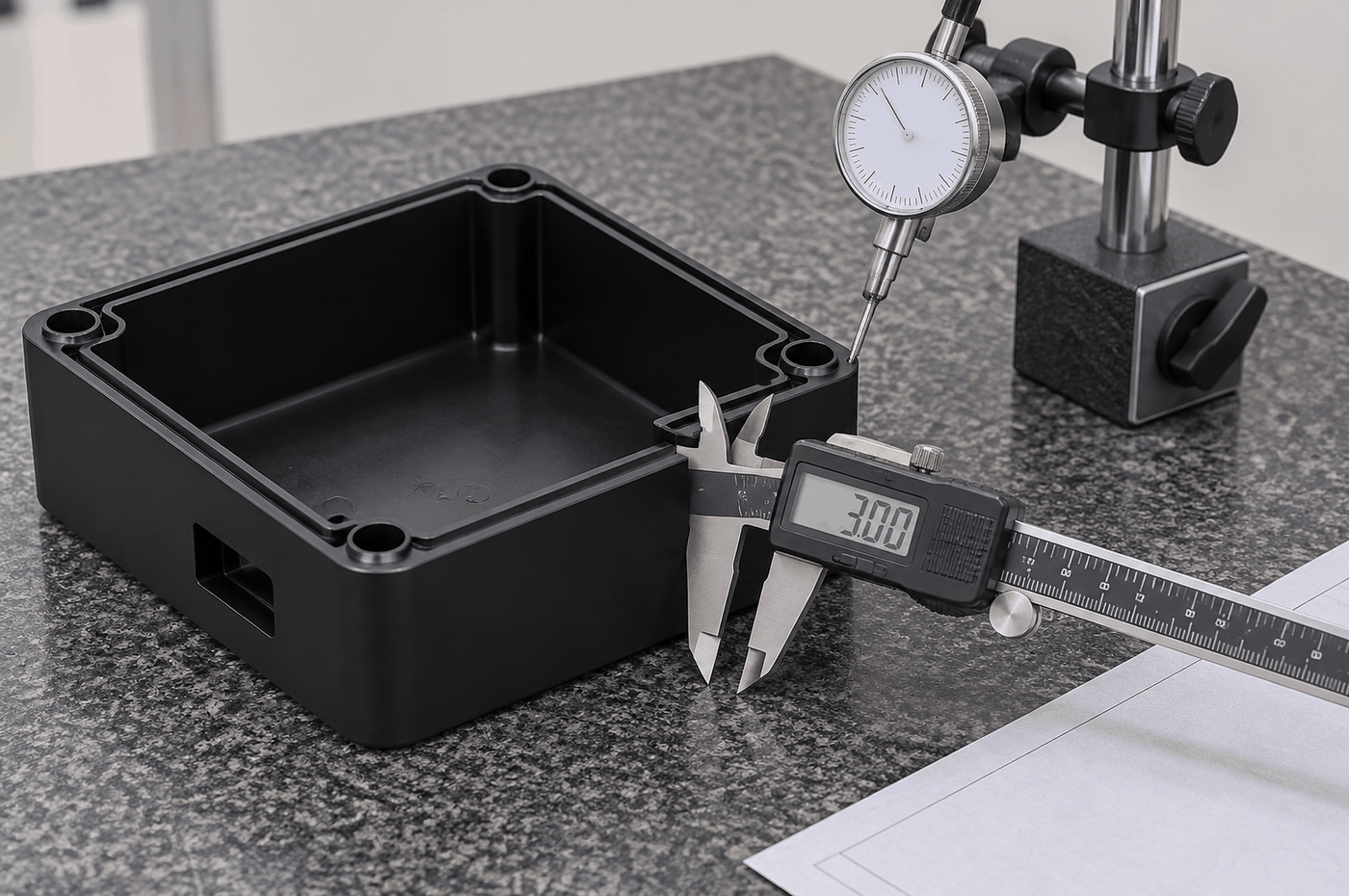
The CNC services page publishes ±0.005 mm across its metal processes. That figure describes a machine and a tool, and it does not transfer to ABS. On a plastic part the error budget is dominated by elastic recovery after the cut, clamping deformation, cutting heat, and the fact that the part is normally measured after it has relaxed — not by the positioning accuracy of the machine. Publishing one number for every ABS part would be a claim we could not check on your part.
| Feature | Standard | Held on request, stated features |
|---|---|---|
| Critical length, overall size up to 150 mm | ±0.10 mm | ±0.05 mm |
| Critical length, 150 to 400 mm | ±0.15 mm | ±0.08 mm |
| Critical length, over 400 mm | ±0.20 mm | ±0.10 mm |
| Hole position | ±0.10 mm | ±0.05 mm |
| Flatness on a machined face | 0.1 mm per 100 mm, free | 0.05 mm per 100 mm, free |
| Unspecified dimensions | ISO 2768-m | — |
| As-machined surface | Ra 1.6 µm typical | Ra 0.8 µm with finishing passes |
Two conventions make those numbers enforceable. First, a tight value applies to the features named on the drawing, not to the part as a whole. Second, the measuring condition is part of the specification: a size confirmed at 20 °C on a relaxed part is a different claim from a size taken at the machine while the fixture is still closed. Where a fit is critical, the drawing should say which condition the acceptance applies to.
What gets checked, and what ships with the parts
Inspection on a machined ABS part is less about proving the machine and more about proving the assembly. Each line below is a check that either protects the fit or protects the appearance — anything that protects neither is measuring time.
| Check | What it protects | Method |
|---|---|---|
| Critical dimensions to drawing | The features named as functional | Caliper and micrometer, or CMM for position and profile |
| Hole position and spacing | Whether the board, the lid or the mating part actually lands | CMM, or a checking fixture for a repeat pattern |
| Flatness of a large face | Gasket sealing and panel gaps | Surface plate, free of the fixture, as specified |
| Profile and corner radii | Whether the part matches the model a customer already approved | CMM profile, or a template on a simple contour |
| Threads and inserts | Assembly torque and the number of cycles | Go/no-go gauge; pull-out check on a sample where an insert is specified |
| Surface and appearance | Whether the part passes the cosmetic standard that was agreed | Comparison against a signed golden sample under stated lighting |
| Assembly fit | The only check that proves the design, not just the drawing | Trial assembly of base and lid, or part onto its mating component |
| Document | When it applies |
|---|---|
| Resin technical data sheet | Every order, for the grade actually supplied |
| Lot or batch traceability | When the part is going into a product with a quality file |
| Certificate of analysis from the resin supplier | Where the supplier issues one for that grade |
| RoHS and REACH declaration | Electrical, consumer and EU-bound projects |
| UL yellow card reference | Flame-retardant grades only, matched to grade, colour and thickness |
| Dimensional inspection report | When critical dimensions are specified on the drawing |
| Certificate of conformance | When the purchase order requires a formal statement |
Surface Finishing: Where ABS Earns Its Place
Most ABS parts are bought for how they look after finishing, not for how they cut. The table reads each option as a decision with a condition attached, because a finish agreed in words is the most common source of a rejected batch.
| Finish | What it does | Condition to agree first |
|---|---|---|
| As-machined | Leaves the tool path visible, Ra 1.6–3.2 µm | Acceptable for internal brackets and functional parts; not for a face a customer will see |
| Sanding and deburring | Removes the pass marks and softens every edge | Whether edges are broken 0.2 or 0.5 mm, and whether the sanded surface is a final finish or a preparation for paint |
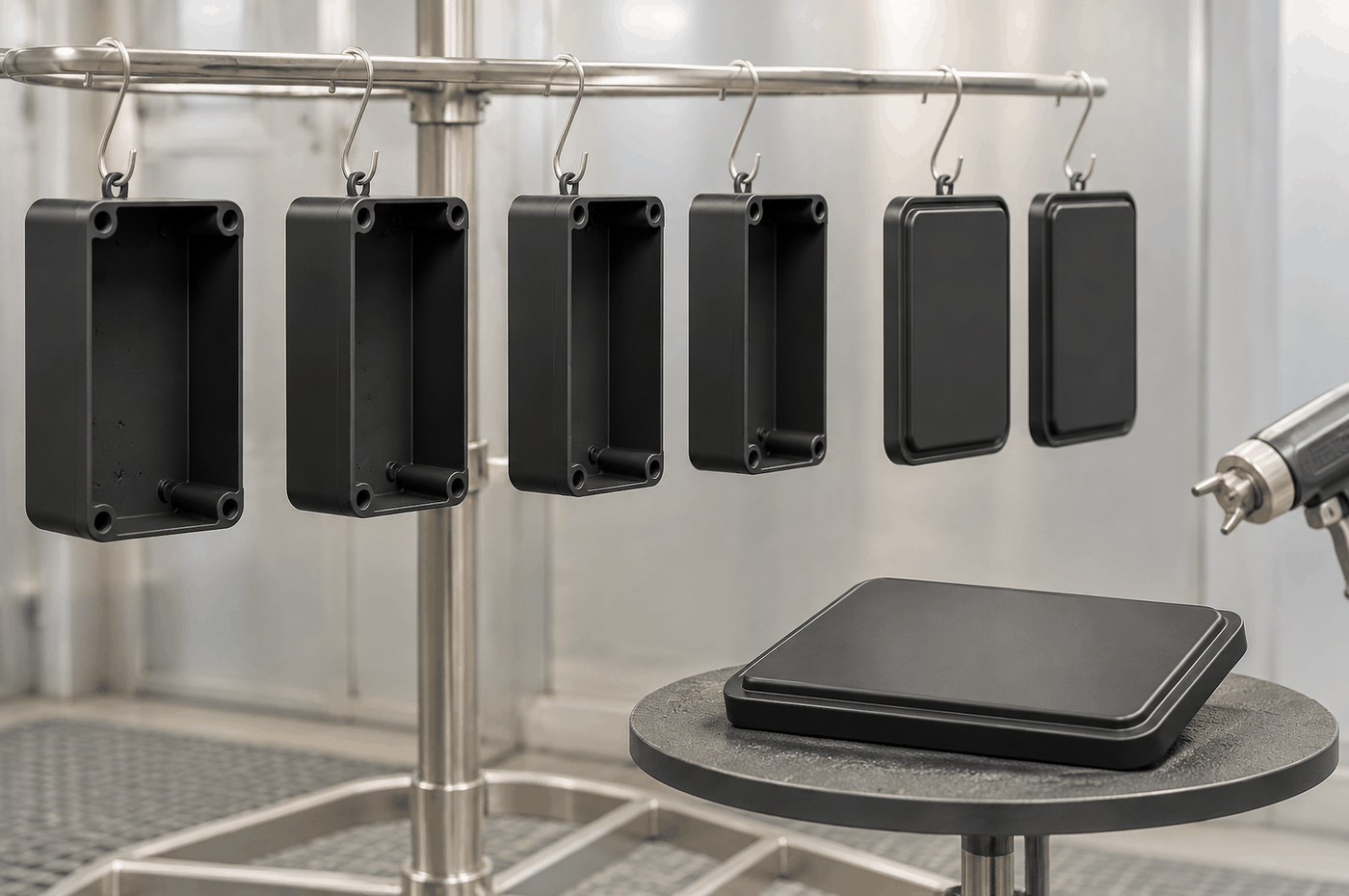
| Spray painting | Colour, gloss level and a uniform face over the machining marks | Colour reference (RAL or Pantone), gloss unit, dry-film thickness and the acceptance sample. Painted parts are measured before painting, not after |
| Protective coating | Matte, anti-scratch or chemical resistance without changing colour | The property being bought, because a "coating" that only changes sheen is a different product from one that resists a solvent |
| Silk screen or pad printing | Legends, symbols and product marks | Ink type, minimum line width of about 0.2 mm, and an adhesion check on the first batch |
| Laser engraving | Permanent marking into the surface, no ink | Depth and whether the engraved area stays a consistent colour against the base |
| Electroplating | A chrome-look or metallic decorative face | Treated as a project, not a catalogue option: plating grades of ABS are specific resins, and a machined surface has to be polished before it will accept a plate |
| Vapour or solvent smoothing | Gloss and a closed surface on some grades | Solvent exposure can stress-crack machined ABS and move dimensions, so it is quoted after a trial on your geometry, never as a default polish |
Colour is handled the same way. Natural, off-white and black are normally available from stock; white depends on the grade; a matched colour is confirmed against a sprayed sample rather than a screen reference. Available colours follow the grade and the stock lot, which is why colour is confirmed after the grade, not before it.
CNC, Moulding or Printing: the ABS Version of the Question
The general break-even model sits on its own page and does not need repeating. What is specific to ABS is where the three routes actually differ on the same part.
| On this part | CNC machining | Injection moulding | 3D printing |
|---|---|---|---|
| Up-front tooling | None beyond fixture and program | A mould, sized to the part and the cavitation | None |
| Design changes | Edit the model and recut | Usually a mould modification, sometimes a new insert | Edit the model and reprint |
| Wall and feature fidelity | True to the model, with machinable corners | True to the model, with draft and radius rules | Layer and process dependent |
| Surface as delivered | Tool marks, or sanded and painted | Mould-defined texture, consistent across a run | Layer lines, usually needing finishing |
| Where the material matters | You get the real grade, so a drop test means something | You get the real grade, and shrinkage becomes a design input at 0.4–0.7% for ABS | The printed material is not necessarily the specified ABS |
Three signals usually settle it. Machining while the geometry is still moving, while only a handful of parts are needed, or when the housing has to prove itself against real hardware before a tool is cut. Moulding once the drawing is frozen and the annual volume carries the tool, especially where ribs, snap-fits and bosses would be expensive to machine. Printing when the shape is the question and the surface is not.
Cost, Lead Time and What to Send
ABS resin is inexpensive, and that is where the misleading comparison starts. On a machined ABS part the resin is rarely the largest line: the cost sits in the blank size, the machining time, the fixture, the finishing and the inspection. A buyer comparing two quotes on material price alone is comparing the smallest number in the job.
| Cost driver | Why it moves the price |
|---|---|
| Grade | General purpose stock is common; flame-retardant, ESD and heat-resistant grades are thinner on the shelf and priced accordingly |
| Blank size and utilisation | Thick plate or large rod is bought by volume and the offcut is paid for. A part redesigned to nest in a standard sheet can drop a step in cost |
| Part geometry | Deep pockets, thin walls and long slender tools all add passes. A box with four openings is a different job from a box with forty |
| Number of setups | Each refixturing adds time and a chance of mismatch. Designing features onto one reachable side is a real saving |
| Tolerance and inspection | Every named critical dimension is measured and recorded. A drawing that tightens everything costs money at the bench, not at the machine |
| Finishing | Painting, printing and coating are quoted as operations with their own setup, and a colour match needs a sample run |
| Quantity | Program and fixture are amortised across the batch; small runs carry a larger share of the fixed work |
| Assembly content | Inserts, hardware and part-to-part assembly are separate from machining and should be quoted as such |
Typical planning lead time is 7–10 business days after drawing approval, subject to stock availability for the grade, part complexity and the finishing route. A painted, printed part with a matched colour is not a ten-day part; the sample has to be approved first. The confirmed date is given with the quotation, not before it.
What to send for an ABS CNC quotation
Nine fields cover almost every ABS enquiry. When one is missing, the quotation either stalls or comes back with an assumption written into it — and an assumption about the grade or the finish is the one that gets discovered after delivery.
| Field | What to send |
|---|---|
| 3D model | STEP or IGES, the model the part will be checked against |
| 2D drawing | PDF, with critical dimensions and the datums marked |
| Grade | GP, high-impact, heat-resistant, FR, ESD or PC/ABS, named by grade where one is already specified |
| Quantity | Sample quantity plus the expected repeat volume, because that answer decides the route recommendation |
| Critical dimensions | The features that carry the fit, and the tolerance on each |
| Wall and thin sections | The minimum wall and where it occurs |
| Finish | As-machined, sanded, painted, coated or printed, with the acceptance sample or reference |
| Colour | RAL or Pantone, or a physical sample if the match is critical |
| Application | What the part does, indoors or out, and the temperature and chemicals it meets |
Two questions we ask during review are worth answering in advance. Whether an injection-moulded version is also acceptable, because it changes both the route and the price. And whether the part will be assembled in your plant or shipped as a set, because it decides what has to be inspected together.
Frequently Asked Questions
Can ABS plastic be CNC machined?
What ABS grades can you machine?
Should I choose ABS or PC/ABS for a machined part?
What tolerance can you hold on machined ABS?
Is CNC machining or injection moulding better for ABS parts?
Can machined ABS parts be painted?
Can you machine flame-retardant ABS?
What is the maximum service temperature of ABS?
What files are needed for an ABS CNC machining quotation?
How long does ABS CNC machining take?
Send the ABS Part, and What It Has to Fit
A 3D model, a 2D drawing, the grade if it is already fixed, and the features that carry the assembly. The review comes back with the grade question answered, the machinable risks named, the finish route and a project-specific price — and, where the volume suggests it, a moulded comparison on the same drawing.
Request an ABS CNC Machining QuoteSTEP · IGES · X_T · DWG · DXF · PDF · NDA on request
Where to Read Next
ABS injection molding
Mould DFM, tooling, drying, moulded shrinkage and defects, and the volume case for a tool. ABS moulding
Engineering plastic CNC machining
The wider selector: PEEK, POM, PA, PTFE and PEI alongside ABS. Plastic machining
CNC plastic machining technology
Why plastic heats, deflects and moves at the cutter. The physics
When to switch to injection molding
Break-even modelling and what must be validated before a tool is cut. Break-even
CNC machining services
Processes, machine envelopes and the full materials centre. General capability
Material library
Grades, properties and stock across the site. Materials