How to Choose a Reliable CNC Machining Supplier in China
You are not comparing brochures — you are betting your product, your intellectual property, and your delivery date on a factory you may never visit. This guide gives you the exact checklist professional procurement teams use to separate a real precision manufacturer from a trader with a good website.
The 7 failures that sink China CNC sourcing
Most "bad supplier" stories are not bad luck. They are predictable failure modes that a 30-minute due-diligence call would have caught. Before you ask for a quote, know what you are actually protecting against.
Trading company in factory clothing
A broker with a rented showroom. You pay a markup, lose engineering access, and absorb the risk when the real workshop cuts corners.
IP leakage
Your drawings forwarded to three cheaper shops, or quietly re-produced and sold. Weak NDAs and no access controls turn your design into everyone's.
Perfect sample, drifting mass run
The first article is hand-finished by the best machinist. Production runs on autopilot with no SPC — and your tolerance band walks out of spec by batch 5.
Silent material substitution
"Equivalent" alloy that fails certification, corrosion, or load. Without mill certs and incoming inspection, you will find out in the field.
Communication black hole
Quoting is fast; engineering questions go unanswered; a timezone gap becomes a two-week silence exactly when a tooling decision is due.
No recourse
Non-conformance arrives, the contact goes quiet, and there is no contract entity, no quality agreement, and no corrective-action process to enforce.
CNC supplier selection checklist
Tick each item as you verify it. Every line links to the section that tells you exactly what "pass" looks like and what to ask. A supplier that clears all 23 is rare — and worth the premium over the one that only clears the first five.
- 1. Entity: Is it a factory or a trading company? Verify the registered business license.
- 2. Machines: Machine capability — count, age, controller, in-house ownership.
- 3. Axis coverage: 3 / 4 / 5-axis coverage matches your geometry.
- 4. Tolerance: Tolerance capability & repeatability, CMM-verified.
- 5. Materials: Material capability & mill certificates (MTC).
- 6. Finishing: Surface finishing in-house or audited partner.
- 7. Inspection plan: Quality inspection plan & equipment.
- 8. CMM: CMM reporting on GD&T, not just key dims.
- 9. FAI: FAI (First Article Inspection) on new parts.
- 10. Certs: Material certificates (RoHS / REACH / MTC).
- 11. ISO: ISO 9001 (verify the cert number).
- 12. DFM: DFM support — real manufacturability feedback.
- 13. MOQ: MOQ fits prototype → mass.
- 14. Lead time: Lead time realistic & protected.
- 15. Capacity: Production capacity for your volume.
- 16. Communication: Communication — English engineering, response SLA.
- 17. IP: NDA / IP protection signed by legal entity.
- 18. Sample gate: Sample approval before mass production.
- 19. Consistency: Mass-production consistency (SPC / Ppk).
- 20. Shipping: Shipping & Incoterms handled clearly.
- 21. After-sales: After-sales & non-conformance process.
- 22. RFQ ready: RFQ package prepared (drawing, qty, spec).
Factory vs trading company
Neither is automatically "bad" — but you must know which you are dealing with, because it changes your price, your engineering access, and your risk. A trader can be a useful single point of contact; a factory gives you direct control.
| Dimension | Factory (OEM/ODM) | Trading company |
|---|---|---|
| Business license scope | Manufacturing / processing | Trading / import-export |
| Machine ownership | Owns & operates the CNC floor | Subcontracts to third parties |
| Engineering access | Direct to process engineers | Relayed through a salesperson |
| Pricing | Material + machining cost, transparent | Factory cost + markup |
| MOQ flexibility | Can often start at 1 pc | Tied to sub-supplier minimums |
| Quality recourse | Direct accountability | Blames the workshop it can't control |
- "Can you show a live video walkthrough of your machining floor right now?" A factory can; a broker stalls.
- "What is your business license scope?" Request the registered entity name and verify it.
- "Who programs the CAM — your staff or an outside shop?"
- "Can I speak to the engineer who will run my part, not just sales?"
- Refuses a video call of the workshop, or only shows a generic "factory" video.
- Can't name the machines or controllers they run.
- Quotes instantly on complex geometry with no engineering question.
- Business license says "trade" but they claim to be a manufacturer.
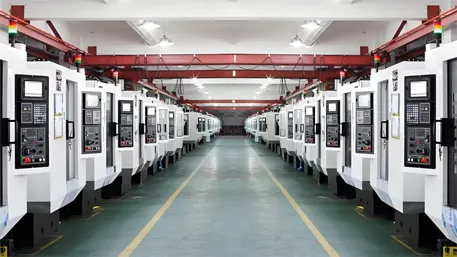
A national high-tech enterprise with 100+ in-house machines and no outsourcing. The machining floor, CAM programming, inspection, and finishing are all under one roof — so the engineer who quotes your part is the one who makes it.
Machine & axis capability (3 / 4 / 5-axis)
"We do CNC" tells you nothing. What matters is whether their machine park can hold your tolerance, reach your geometry, and scale to your volume without subcontracting.
What each axis configuration actually unlocks
| Config | What it does | Best for | Buyer benefit |
|---|---|---|---|
| 3-axis | Tool moves in X/Y/Z | Prismatic parts, brackets, housings | Lowest cost, fastest setup |
| 4-axis (3+1) | Rotary index on one axis | Parts with features on 4 faces | Fewer setups than 3-axis |
| 3+2 | Two rotary axes index & lock | Angled holes, tilted faces | Fewer setups, less re-clamp error |
| 5-axis simultaneous | Tool tilts & rotates while cutting | Free-form surfaces, impellers, deep cavities | One datum across faces, no re-fixturing |
- "How many machines do you own, and what brands/controllers?" (DMG MORI, Mazak, Haas, Brother are industry-standard names.)
- "Do you have 5-axis simultaneous, or only 3+2?" They are not the same — simultaneous matters for contoured geometry.
- "What's your spindle speed and the smallest tool you can reliably run?"
- "If my volume triples, can you absorb it in-house?"
5-axis coverage via DMG MORI DMU 50 and Mazak 5-axis machining centers, plus a full 3/4-axis fleet — so process choice is driven by your geometry and tolerance, not by what's booked. (Exact Mazak model/travel to be confirmed at quotation.)
Tolerance capability
"High precision" is an adjective; "±0.005 mm, CMM-verified, repeatable across 5,000 pcs" is evidence. Know the difference — and know what your part actually requires.
| Class | Typical claim | What it really requires |
|---|---|---|
| Standard | ±0.05 – ±0.10 mm | Good 3-axis, basic inspection |
| Tight | ±0.01 – ±0.02 mm | Stiff machines, qualified tooling, temperature control |
| Precision | ±0.005 mm & finer | 5-axis/ground capability, CMM correlation, SPC |
- "What's your demonstrated repeatability, not just your best single part?"
- "How do you correlate machine output to the CMM?" (A machine that 'holds ±0.005' unverified by CMM is a claim, not a capability.)
- "What's your datum strategy for my GD&T callouts?"
- "Do you machine and measure at the same temperature?" Thermal drift silently eats tight tolerances.
CNC tolerance down to ±0.005 mm with Ra0.4 μm achievable surface, each batch backed by full dimensional reports from in-house CMM — so the number on the drawing is the number you receive.
Material capability
Machining the right alloy is half the job; proving it is the other half. A supplier should both run your material well and document its origin.
Aluminum
6061 / 7075 / 2024 / 5083 — the workhorse for prototypes and lightweight structural parts.
Stainless & steel
304 / 316, 17-4PH, 4140, 1045, tool steels — corrosion, strength, and wear applications.
Titanium
Grade 2 / Grade 5 (Ti-6Al-4V) — aerospace and medical, low thermal conductivity needs care.
Brass & copper
C3604 / C2720 — electrical and plumbing, excellent machinability.
Engineering plastics
PEEK, POM, Nylon, PTFE, PC, ABS — insulators, wear parts, prototypes.
Exotics
Inconel, Hastelloy, magnesium — high-temp and specialty, verify experience first.
- "Can you provide a Mill Test Certificate (MTC / EN 10204 3.1) for the heat we receive?"
- "Do you run incoming material inspection, or trust the vendor's cert?"
- "What's your experience with [my alloy] — can you show a similar part?"
Runs the full range above with 100% raw-material traceability and material certificates on request — so a substitution can be caught before it ships, not after it fails.
Surface finishing
Finishing protects, beautifies, or prepares the part — and it's where many suppliers quietly subcontract. Know what they do in-house versus what they farm out (and how they audit it).
As-machined
Default; specify Ra target (e.g. Ra1.6 / Ra0.8).
Anodizing
Type II / III for aluminum; color + corrosion.
Plating
Zinc / nickel / chrome; wear & appearance.
Powder coat
Durable color for structural/cosmetic parts.
Passivation
Stainless corrosion resistance (ASTM A967).
Bead blast
Uniform matte texture before anodize.
Polishing
Up to mirror; medical & cosmetic.
Black oxide
Steel mild corrosion + low-glare look.
- "Which finishes are done in-house vs by a partner?" Partners need an audit trail.
- "Can you meet spec [e.g. anodize 20µm, salt-spray 480h] and certify it?"
- "How do you mask critical features during finishing?"
Quality inspection, CMM, FAI, certificates & ISO
This is the block where "trust me" becomes "here's the data." A reliable supplier's quality system is visible: equipment, documents, and certifications you can verify independently.
CMM — Coordinate Measuring Machine
A CMM touches the part with a probe and returns true 3D coordinates against your CAD. It is the only honest way to confirm GD&T (true position, profile, runout), not just a few linear dimensions.
- "Will I get a full dimensional report mapped to my drawing, including GD&T — not just 5 'key' dimensions?"
- "What's the CMM's accuracy grade and calibration date?"
FAI — First Article Inspection
FAI is a full, documented verification of the first production part against every requirement before you approve the run. In regulated industries (aerospace AS9102, medical) it's mandatory; for everyone else it's the single best hedge against "perfect sample, bad mass run."
- "Do you run FAI on new parts, and will you share the FAI report for sign-off?"
- "Is FAI repeated after any tooling, setup, or supplier change?"
Material certificates
Mill Test Certificates (MTC / EN 10204 3.1), RoHS, and REACH declarations prove the metal is what the datasheet claims. Without them, "304 stainless" is a hope.
ISO certification & audits
ISO 9001 is the baseline for a documented quality system. Industry-specific adds matter if you're regulated: IATF 16949 (automotive), AS9100 (aerospace), ISO 13485 (medical). Always verify the certificate number on the issuer's registry — a logo in a footer is not a cert.
- Certificate number that doesn't resolve on the registrar's public database.
- "We're ISO-certified" with no document, scope, or issue date.
- Quality "by experience," with no measuring equipment on site.
ISO 9001 certified, plus SGS (SZIN2409001808ML09_EN), RoHS (TQT7737B1373EC), and Rmbond (XMML24030283_EN). In-house CMM and full-size reports with material certificates — every batch is 100% traceable.
DFM support (Design for Manufacturability)
A quoting service just prices your drawing. A manufacturing partner improves it. Real DFM feedback reduces cost and risk before a chip is cut — and it's a strong signal you're talking to engineers, not order-takers.
Cost-down suggestions
"If we relax this tolerance to ±0.02, cost drops 18% with no function loss." That's DFM.
Manufacturability flags
"This 0.3 mm wall will chatter; here's a geometry that holds." Caught in review, not in scrap.
Tooling & setup strategy
Fixture and datum plan that protects your true-position callouts across the run.
Material substitution advice
Equivalent alloy that machines better or certifies cleaner for your use case.
Offers a free DFM review on every inquiry — you get manufacturability feedback and a realistic cost picture before committing to a sample order.
MOQ, lead time & production capacity
MOQ
A true factory can often start at 1 piece for prototypes. Beware high minimums — they signal subcontracting or a rigid production line.
Lead time
Realistic sample windows are ~7–15 days; mass production ~15–25 days. "3 days for everything" usually means quality shortcuts.
Capacity
Ask machine count, shifts, and monthly output. Can they hold your volume and your tolerance at scale?
- "What's your minimum order, and is it different for prototype vs production?"
- "Walk me through the timeline: quote → sample → approval → mass. Where are the real bottlenecks?"
- "If I order 10,000/mo, what's your on-time delivery rate over the last 12 months?"
- "Do you run multiple shifts, and is capacity reserved or shared across clients?"
No minimum order, samples in 7–15 days, mass in 15–25 days, with a 99.8% on-time delivery rate across 100+ in-house machines — capacity and schedule you can plan a launch around.
Communication & NDA / IP protection
The cheapest supplier is the most expensive if you can't reach them when it matters. And your design is only safe if IP protection is contractual, not promised.
Communication
- "Who is my single point of contact, and do they have engineering English — not just sales English?"
- "What's your response SLA? (Gold-standard: within 24h, often same business day.)"
- "Do you use a shared project space / regular update cadence for ongoing orders?"
NDA & IP protection
A credible IP stance has three layers: a signed NDA from the legal entity (not a personal email), watermarked/controlled drawing access, and internal access controls so your files aren't floating across a broker's contact list. Note that China IP law is enforceable for registered designs and contracts — the protection is the disciplined supplier, not the jurisdiction alone.
- "We don't usually sign NDAs, trust us."
- NDA offered only from a Gmail/Yahoo address, not the company entity.
- They ask for your full CAD before any agreement is in place.
NDA available and signed by the company entity, with controlled drawing handling and a track record serving clients in 100+ countries — your IP treated as a contract, not a courtesy.
Sample approval & mass-production consistency
Approving a sample is not the finish line — it's the gate. The question that separates suppliers is whether the 500th part equals the 1st.
Sample approval
- "What's your sample policy — free, paid, or credited against the first order?"
- "What should I evaluate on the sample, and will you supply the measurement data alongside it?"
- "Is sample sign-off required before any mass production begins?"
Mass-production consistency
Consistency comes from process control, not luck: incoming material inspection, in-process SPC, control plans, and traceability. Ask for Ppk/Cpk data on critical dimensions — a supplier who measures and controls will happily share it.
- No inspection plan between sample and shipment.
- "We check visually" as the quality system for tight-tolerance parts.
- No batch traceability if a non-conformance appears later.
Single-datum, in-house production means every batch carries the same quality — long-term partners report consistent parts across years of repeat orders, with full-size reports and material certs on every shipment.
Shipping, Incoterms & after-sales
A part that's perfect but arrives late — or wrong and unrecoverable — is a failed order. Close the loop on how it ships and what happens if it doesn't go right.
Shipping & Incoterms
Know your terms: EXW (you arrange everything) vs FOB (they handle to port) vs DAP/DDP (they deliver to your door, duties handled). Clarify packaging for machined surfaces and export documentation.
After-sales
A real partner has a non-conformance process: documented 8D corrective action, replacement terms, and a reorder path. Ask what happens when a batch is wrong — the answer tells you everything.
- "Which Incoterm do you normally quote, and can you do DDP to my country?"
- "How do you package precision surfaces for international transit?"
- "What is your non-conformance / corrective-action process (8D)?"
- "Who owns the problem if a shipment arrives out of spec?"
The Chinese CNC supplier landscape — and who you'll meet
China hosts thousands of CNC shops, from one-machine workshops to large integrated manufacturers. Below: one supplier profiled in depth, plus brief, neutral profiles of representative peers you will encounter. Treat every profile — including ours — as a claim to be verified with the 23-point checklist, not a verdict.
Xiamen Goldcattle Industrial & Trade Co., Ltd.
National High-Tech Enterprise · Xiamen, ChinaCapabilities & equipment
- Six integrated processes: CNC precision machining, injection molding, mold making, 3D printing, die casting, and sheet metal — one-stop OEM/ODM from drawing to mass production.
- 3 / 4 / 5-axis CNC, including DMG MORI DMU 50 and Mazak 5-axis machining centers (Mazak model/travel confirmed at quotation).
- Materials: aluminum, stainless steel, titanium, PEEK, brass and engineering plastics.
- Tolerance down to ±0.005 mm with Ra0.4 μm achievable surface.
Quality & compliance
- ISO 9001 certified, plus SGS (SZIN2409001808ML09_EN), RoHS (TQT7737B1373EC), and Rmbond (XMML24030283_EN).
- In-house CMM and full-size dimensional reports on every batch.
- 100% raw-material traceability with material certificates (MTC) on request.
- DFM review and NDA available before any drawing is shared.
Engagement & speed
- Samples in 7–15 days, mass production in 15–25 days after sample approval.
- No minimum order — prototype (1 pc) through production.
- Response within 24 hours; free DFM review on every inquiry.
- 100+ in-house machines means capacity and schedule you can plan around.
Why it matters for your selection
- Direct factory, not a trader — you reach the engineer who makes the part, with full accountability.
- Single-datum in-house production — the 1st and 5,000th part hold the same quality.
- Certified quality system — verifiable evidence (reports, certs, traceability), not adjectives.
Other representative suppliers (brief, neutral profiles)
HLH Prototypes
Full-service rapid manufacturing and low-volume production — CNC, 3D printing, vacuum casting, injection molding, sheet metal. Serves automotive, aerospace, medical and consumer goods. ISO 9001:2015, IATF 16949, ISO 14001, ISO/IEC 27001.
Runsom Precision
Precision CNC machining and rapid manufacturing (3/4/5-axis), plus 3D printing, sheet metal and die casting. Serves automotive, aerospace, medical and electronics with broad global export.
3ERP
Rapid prototyping and low-volume manufacturing: CNC (3/4/5-axis), vacuum casting, injection molding, sheet metal, extrusion. Known for fast quotes (often within hours) and ~3-day lead times. ISO 9001:2015.
RFQ checklist — what to send for an accurate quote
A vague inquiry gets a vague (and risky) quote. Send a complete package and you'll get a real number, a real lead time, and real DFM feedback — sometimes in the same day.
- 3D model — STEP / IGES (never only a PDF; a quote from a flat drawing hides manufacturability risk).
- 2D drawing — PDF with dimensions, tolerances, and GD&T callouts.
- Material specification — exact grade (e.g. Al 6061-T6, SS 316L), or "recommend one."
- Quantity & schedule — prototype count + annual/monthly volume and required dates.
- Critical tolerances — flag the ones that are truly function-critical vs nice-to-have.
- Surface finish — Ra target and any post-processing (anodize, plating, passivation).
- Certification needs — ISO/IATF/AS9100/ISO13485, RoHS/REACH, MTC.
- Application & environment — what the part does, loads, temperature, exposure.
- Target price (optional but helpful) — helps the supplier propose the right process.
- IP terms — note if an NDA is required before sharing the full CAD.
Buyer FAQ
Is it cheaper to buy CNC parts from China?
How do I verify a supplier is a real factory?
Do I need 5-axis machining?
How do I protect my IP when sourcing from China?
What's a realistic lead time?
Send Your Drawing for Supplier Evaluation
Put this checklist to work on your own part. Get a free DFM review, real tolerance/lead-time feedback, and an honest process recommendation — from a factory, not a broker.