How Much Does Custom CNC Machining Cost?
Custom CNC prices are built from a fixed job cost and a variable cost per part — not from a rate card. This page shows how a quote is assembled line by line, what moves the number, why two suppliers differ, how to normalise a comparison, and where cost can be removed without weakening the part.
At a Glance
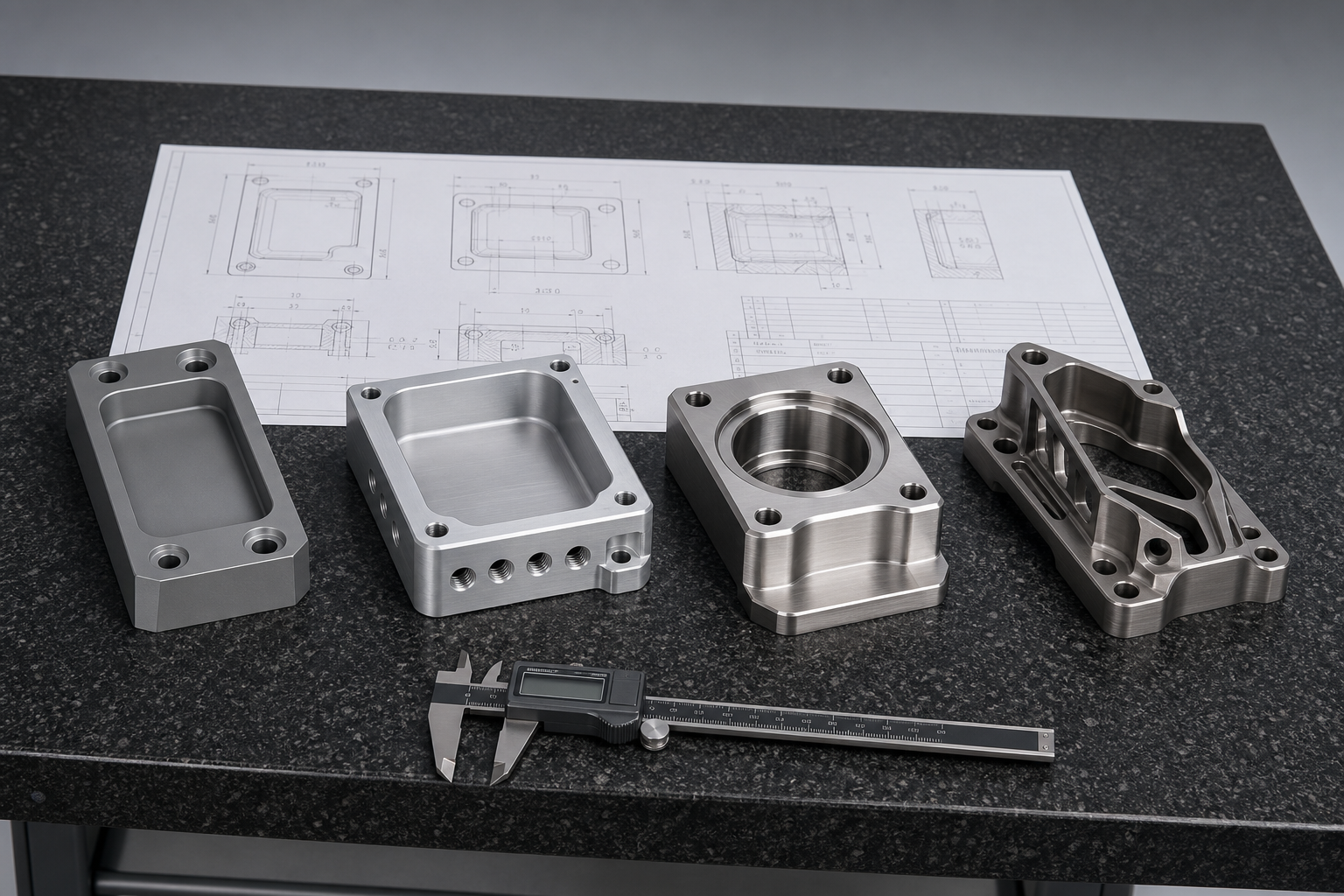
There is no universal price per CNC part. A custom machined part is priced as a fixed job cost divided by the quantity ordered, plus a variable cost per part. The fixed part — programming, setup and often fixturing — does not change with volume. The variable part — material, machine time, tool consumption, finishing, inspection and packaging — is what the part actually costs to make once the job is running.
That is why a simple aluminium plate and a tight-tolerance stainless housing of the same size can differ by a multiple, and why the same part quoted at 1 piece and at 100 pieces is not quoted at the same unit price. Both effects come from the same equation, not from supplier goodwill.
Cost by Part Profile: Where a Part Sits Before You Get a Quote
Before any supplier quotes, an experienced estimator can already place a part in a cost band by reading the drawing. The band is not a price — it is the profile of manufacturing effort the part will demand. Use it to sanity-check the quotes you receive.
| Part profile | Budget position | What puts it there | Volume where the band moves most |
|---|---|---|---|
| Simple aluminium prototype | Lowest | One setup, prismatic features, standard tooling, general tolerance, no secondary operation | 1 → 50 pcs (fixed cost dominates) |
| Standard metal housing or bracket | Low–medium | Two or three setups, pocket depth, tapped holes, one protective finish | 10 → 100 pcs |
| Tight-tolerance stainless part | Medium–high | Slower cutting on work-hardening alloy, controlled datums, CMM verification on critical features | 50 → 500 pcs |
| Complex multi-face 5-axis component | High | CAM complexity, long cycle time, dedicated workholding, fewer setups but more engineering up front | 10 → 100 pcs (fixture amortisation) |
| Titanium, Inconel or PEEK precision part | Highest | Stock price, low material removal rate, tool wear, scrap risk, tighter process control | 100 → 1,000 pcs |
How Quantity Changes the Price of a Part
Short answer: quantity changes the price because part of a job is fixed. Programming, setup and often a fixture are paid once, then spread across the order. More parts do not make the machine faster or the material cheaper — they only dilute the fixed block.
Part price = ( fixed job cost ÷ quantity ) + variable cost per part
Fixed = programming/CAM, setup, workholding or fixture, first-article proving. Variable = material, machine time, tool consumption, finishing, inspection, packaging.
The arithmetic below is illustrative: it demonstrates how a quote behaves, not a price and not a market average. It assumes a fixed job cost of $240 (programming, setup, fixture) and a variable cost of $28 per part (material, machining, finishing, inspection).
Where the curve can flatten earlier or later than expected
| Effect | What happens to the curve | Reason |
|---|---|---|
| Finishing batch minimum | Flattens early, then drops at a step | Anodising or plating is usually priced per batch with a minimum load, not per piece |
| Material price break | Step down at a specific quantity | Stock is bought in bars, plates or mill lots; the buy quantity changes the stock price |
| Fixture investment | Higher fixed block, steeper early curve | A dedicated fixture is justified at volume but raises the fixed cost at low volume |
| Process change at volume | Discontinuity in the curve | High volume may justify a different process — see process choice |
| Machine capacity | Lead time grows instead of price falling | Once a machine class or a finishing line is saturated, the constraint becomes scheduling, not unit cost |
Which Parts of a Quote Are Fixed — and Which Repeat on Reorder
Buyers usually focus on the unit price. Procurement teams that manage cost over a programme focus instead on which lines are one-time and which recur, because that decides the price of every future order.
Program, setup plan, fixture
Once the part is proven, the CAM program, the workholding approach and a dedicated fixture normally carry forward to reorders of the same revision. Ask whether these are billed once or per order.
Material, machine time, tooling, finishing, inspection
These scale with quantity. They are the right place to look for engineering savings, because a change there reduces every future order.
Program and sometimes fixture
A revision that changes the geometry, datums or stock size invalidates the program and can invalidate the fixture. Engineering-change cost is a real cost — budget for it.
Tooling and fixture investment
Tooling bought for a low-volume, complex part is amortised into the first order. If repeat volume is planned, state it — tooling and process can be planned for the total requirement instead of the first batch.
What Is Included in a Custom CNC Machining Quote?
Short answer: a professional quote is a list, not a number. Nine line items cover the work between receiving your drawing and delivering a conforming part. Being able to see them is what lets you compare two suppliers honestly — and challenge a line you believe is over-scoped.
Total = Programming + Setup + Workholding / fixture + Material + Machine time + Tool consumption + Secondary operations + Inspection & documentation + Packaging & freight
| Quote line | What it covers | What makes it bigger | What to ask |
|---|---|---|---|
| Programming / CAM | Toolpath strategy, simulation, post-processing, program proving and first-off checks | Simultaneous 5-axis geometry, complex 3D surfaces, many operations, new geometry with no reusable program | Is programming one-time or repeated per order? Are there previous similar parts the program can be adapted from? |
| Setup | Workholding plan, part orientation, datum establishment, tool setting, first-off measurement | Number of faces or operations, hard-to-clamp geometry, proving a first article | How many setups are quoted? Can the part be redesigned for fewer faces? |
| Workholding / fixture | Soft jaws, dedicated fixture, vacuum or magnetic plate, dovetail blank, tombstone | Low volume with high complexity, thin walls needing support, repeatable location requirements | Is the fixture billed once? Does it stay with the part for reorders? Can a standard clamp replace it? |
| Material | Stock grade, form and size, cut-to-size, buy-to-fly allowance, mill certificate | Alloy choice, oversized stock, non-standard sizes, supplier minimum order quantity, certification level | Which grade and stock form? How much material is bought against finished part weight? Is the certificate included? |
| Machine time | Cycle time multiplied by the machine-class rate, including tool changes and idling | Feature depth, limited tool access, low removal rate, tolerance-driven re-cutting, finish passes | What is the estimated cycle time and on which machine class? Not just the hourly rate. |
| Tool consumption | Cutters consumed or worn per part, inserts, special-profile cutters | Titanium and Inconel wear, deep pockets needing long small-diameter tools, small internal radii, hard material | Is tooling amortised inside the unit price or shown separately? Does a radius change reduce it? |
| Secondary operations | Heat treatment, anodising, plating, passivation, polishing, laser marking, grinding | Required specification, masking complexity, the finisher’s batch minimum, per-piece handling | Who performs the finishing? Is the finisher’s minimum batch charge included? Is masking quoted? |
| Inspection & documentation | In-process checks, dimensional report, CMM inspection, first-article inspection, material certificate, certificate of conformity | Number of toleranced features, GD&T, documentation level, sampling rate, traceability requirements | Which features appear on the report, at what sampling rate, and what documentation is included as standard? |
| Packaging & freight | Protective packaging, moisture barrier, custom crates, Incoterm, mode of transport | Part weight and volume, fragile or cosmetic surfaces, protective finish, delivery speed | Which Incoterm is quoted? Is packaging included? What changes if the delivery date moves? |
Why the Machine Hourly Rate Does Not Tell You the Part Price
Short answer: a machine-hour rate is one multiplier in one line of the quote. The other multiplier — cycle time — moves far more, and the fixed block moves with the process plan. Two shops can quote the same part with different rates and produce the opposite price ranking.
Lower rate, longer cycle
$40/hour × 3.0 hours of cycle time = $120 of machine time. The lower rate produced the higher machine-time line.
Higher rate, shorter cycle
$60/hour × 1.6 hours of cycle time = $96 of machine time, because a more capable machine removes material faster and cuts in fewer passes.
Illustrative arithmetic again — but the mechanism is real and common: a higher-class machine earns its rate back in cycle time, and sometimes also by removing a setup, a fixture or a secondary operation from the fixed block.
What a machine-hour rate actually contains
Machine purchase or lease, depreciation, financing, floor space and services.
Operator attention, which is not the same per machine class — a 5-axis cell may run with one operator across several machines while a manual operation needs one-to-one attendance.
Tooling, coolant, filters, inserts, way oil and disposal.
Programming and engineering support, quality, scheduling, maintenance and administration.
Some shops fold programming and tooling into the rate; others bill them as separate lines. The rate is not defined the same way between suppliers.
Pallet changers, lights-out running and unmanned shifts change what an hour of machine time really costs.
What a buyer is actually purchasing is a finished part that meets the drawing: a defined cycle time, a controlled process, verified dimensions and the documentation to prove it. An hourly rate is an input to that, not the product.
What Makes a CNC Part Expensive? Cost Drivers, Ranked
Short answer: eight factors decide most quotes. They are listed below in the order they usually decide the outcome — not in the order buyers usually ask about them.
Why Two Parts of the Same Size Cost Very Differently
Short answer: cost follows manufacturing effort, not physical size. Take two parts with an identical envelope of 100 × 60 × 40 mm and the same nominal weight. The quote can differ by a multiple, because almost everything that costs money is different.
| Variable | Part A | Part B |
|---|---|---|
| Material | 6061-T6 aluminium | 316L stainless steel |
| Geometry | One open pocket, four through holes | Two deep narrow cavities, 2 mm walls, an undercut, twelve toleranced characteristics |
| Tolerance | ±0.1 mm general | ±0.01 mm on two bores, position tolerance on a hole pattern |
| Process | 3-axis milling, one setup | 5-axis milling, contoured surfaces, one datum |
| Tooling | Three standard end mills | Long small-diameter tools, a special-profile cutter, accelerated wear |
| Finish | As machined, deburred | Passivation plus a controlled finish on the sealing face |
| Inspection | Visual and caliper check | CMM dimensional report on the toleranced characteristics |
| Result | Low effort — low band | High effort — high band |
How Design Features Move the Price
The features below are the ones that most often decide a quote. Each row states which direction the cost moves and the mechanism behind it — the mechanism is what you can act on.
| Design feature | Cost effect | Mechanism |
|---|---|---|
| Tolerance tighter than the function needs | ↑ | Slower finishing passes, more in-process measurement, more scrap risk, CMM verification |
| Deep pocket or deep cavity | ↑ | Longer tools with reduced stiffness, smaller radial engagement, slower cutting, more chatter risk |
| Thin wall | ↑ | Cutting parameters must be reduced to control deflection and distortion; support may be needed |
| Small internal radius | ↑ | Forces a smaller cutter, which needs more passes at lower feed to remove the same volume |
| Undercut or reverse-angle feature | ↑ | Special tooling, an extra operation, or an extra setup to reach the feature |
| Many faces requiring machining | ↑ | Additional setups, each with its own datum transfer, clamp time and stack-up risk |
| Complex 3D contour or blended surface | ↑ | CAM programming time and machine time both increase; usually needs simultaneous multi-axis |
| Large material removal from a solid block | ↑ | Long roughing cycles plus the material bought and turned into chips (buy-to-fly ratio) |
| Unspecified critical feature | ↑ | Ambiguity forces the supplier to protect itself — usually by quoting the tighter interpretation or an inspection step |
| Standard hole and thread sizes only | ↓ | Standard drills, taps and reamers are on the shelf; no special tooling and no extra setup |
| Generous internal radii | ↓ | A larger cutter can be used, with fewer passes and better rigidity |
| Features on common faces or one datum | ↓ | Fewer setups, no datum transfer, less handling and less stack-up error |
| Geometry that suits standard stock | ↓ | Less material bought, less roughing, less waste — and often a cheaper stock form |
| Tolerance applied only to critical characteristics | ↓ | General tolerance everywhere else; process control and inspection effort stay concentrated |
How Tolerance and GD&T Affect the Price
Short answer: tolerance is priced per characteristic, not per part. A part with two toleranced features and a part with twenty toleranced features are different jobs, even when they look similar on a drawing.
| Requirement | Relative cost position | Typical application |
|---|---|---|
| General tolerance (e.g. ISO 2768-m) | Lowest | Non-functional dimensions, cosmetic and clearance features |
| ±0.05 mm | Low–moderate | Mating faces, general fits, most housings |
| ±0.02 mm | Moderate | Precision fits, bearing seats on smaller geometries |
| ±0.01 mm | Higher | Critical bores, locating features, mating accuracy |
| ±0.005 mm on qualified features | Highest | Selected characteristics only, verified on a CMM under controlled conditions |
How Surface Finish and Secondary Operations Affect the Price
Short answer: finishing is a second manufacturing operation, not a cosmetic extra. At low volume the batch minimum and the masking usually cost more than the finish layer itself.
| Operation | What it does | Where the cost comes from |
|---|---|---|
| Deburring | Removes sharp edges and machining burrs | Hand or robotic time; edge quality specification drives the method |
| Vibratory or bead-blast finishing | Uniform matte texture, blended tool marks | Batch processing time; masking of protected faces |
| Brushing / satin grain | Directional cosmetic finish on visible faces | Hand finishing time; consistency across a batch |
| Anodising (Type II / Type III) | Corrosion and wear protection on aluminium, colour options | Per-batch load with a minimum charge, racking, masking of threads and bores, dimensional growth allowance |
| Passivation | Removes free iron from stainless surfaces | Batch chemistry; a specification requirement, not usually a large per-part cost |
| Plating (electroless nickel, zinc, chrome) | Wear, corrosion or conductivity | Per-part handling and racking, thickness control, masking, more controlled dimensional change |
| Powder coating / painting | Cosmetic and protective coating | Surface prep, masking, cure cycle, cosmetic acceptance criteria |
| Polishing | Low roughness on specified surfaces | Direct hand or mechanical time per part; hard to scale with volume |
| Heat treatment | Hardness, stress relief, condition change | Outside process batch minimum; distortion control and post-treatment machining if required |
| Laser marking / engraving | Part numbers, traceability, branding | Per-part laser time, artwork setup and position tolerance |
How Inspection and Documentation Affect the Price
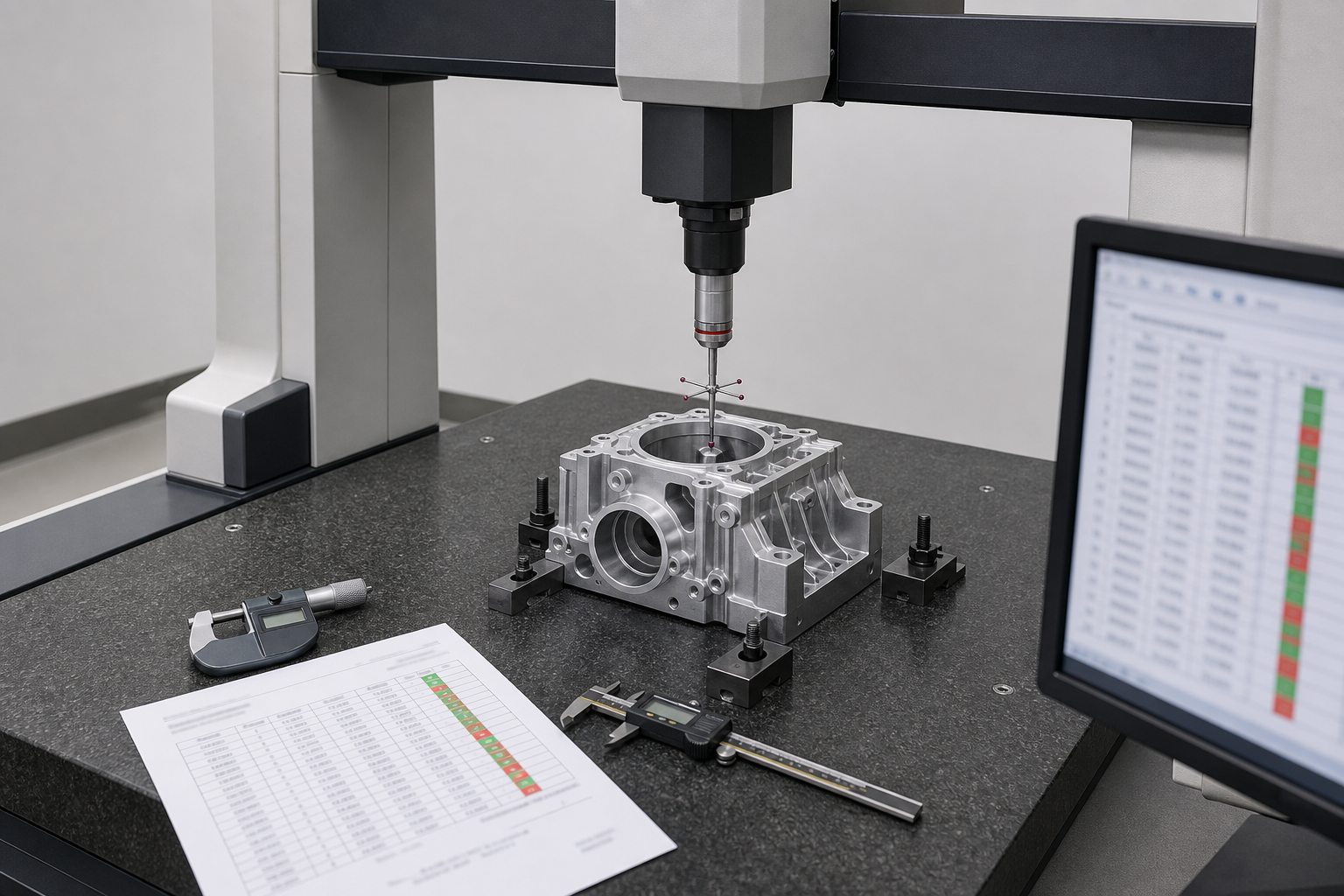
Short answer: inspection scope is a decision the buyer makes, and it is quoted. The governing rule is that the measurement method must match the tolerance being claimed — a caliper cannot verify a ±0.005 mm characteristic.
| Level | What is verified | Cost mechanism |
|---|---|---|
| Operator in-process check | Dimensions checked during the run against the drawing | Absorbed into machining time; no formal report |
| Final manual inspection | Nominal dimensions with calipers, micrometers, bore gauges, thread gauges | Per-part or sampled measurement time, recorded on a dimensional report |
| Surface roughness check | Ra on specified surfaces | Roughness tester time plus potential re-work on rejected surfaces |
| CMM dimensional report | Toleranced and geometric characteristics against the drawing and datum frame | Programming or recalling the measurement program, part setup, run time, report preparation — per part or per sampling interval |
| First-article inspection (e.g. AS9102) | Every characteristic on a new part, with a documented form | A one-time engineering and metrology effort on the first part, proportional to the number of characteristics |
| Material certification | Grade, condition and heat/lot traceability | Mill certificate administration per material lot |
| Certificate of conformity | Statement that the parts meet the drawing and specification | Documentation and quality sign-off time |
How Lead Time Affects the Price
Short answer: a normal schedule uses the shop’s existing sequence. A compressed schedule makes the shop break that sequence, and breaking it costs money in four places.
Expedited stock
Small quantities bought from a distributor instead of in the planned mill lot, or air-freighted stock, carry a premium against the normal buy.
Overtime and extra shifts
Work moved to evenings, weekends or a second shift, and other jobs re-sequenced around yours.
Expedited outside processing
Anodising, plating or heat treatment pulled out of the normal batch cycle, or sent to a higher-cost processor.
Expedited freight
A faster transport mode, and sometimes a higher Incoterm than the standard quotation assumes.
How Material Choice Affects the Price
Short answer: material cost has five layers, and only the first one is the price per kilogram. A cheap alloy that machines slowly can produce a more expensive part than an expensive alloy that cuts cleanly.
Stock price — the price of the grade, form and size you specify.
Machinability — how fast the material can be cut and how much tool wear it causes.
Stock form — plate, bar, tube, near-net forging or casting changes both the price and the roughing time.
Buy-to-fly ratio — the share of purchased material that ends up as chips. Thin ribs and deep pockets raise it.
Certification and condition — mill certificate, heat/lot traceability, heat-treated condition and any additional testing.
Choose the material the application requires, and no more. Over-specifying the grade is one of the most common and most expensive avoidable decisions on a drawing.
| Material | Machinability | Stock price | Where the cost comes from |
|---|---|---|---|
| Aluminium 6061-T6 | High | Low | Fast cutting and low tool wear — the cost-effective default for housings, brackets and plates |
| Aluminium 7075-T6 | Good | Higher than 6061 | Higher strength properties and a higher stock price; still efficient to machine |
| Stainless 304 / 316L | Lower than aluminium | Moderate | Work-hardening behaviour, slower feeds and greater tool wear |
| Brass | High | Moderate | Excellent cutting behaviour; cost sits mostly in the material |
| Titanium Ti-6Al-4V | Demanding | High | Stock price plus low removal rates, heat concentration at the edge and tool wear — see Ti-6Al-4V machining |
| Inconel and nickel alloys | Demanding | High | Tool wear, low cutting speeds and a narrow process window |
| Engineering plastics (PEEK, POM, PA) | Grade-dependent | Low to premium | Material price varies widely by grade; stress relief and thermal control matter |
Material-specific cost behaviour is covered in more depth on the alloy pages, for example 7075-T6 aluminium machining and the Grade 5 titanium page.
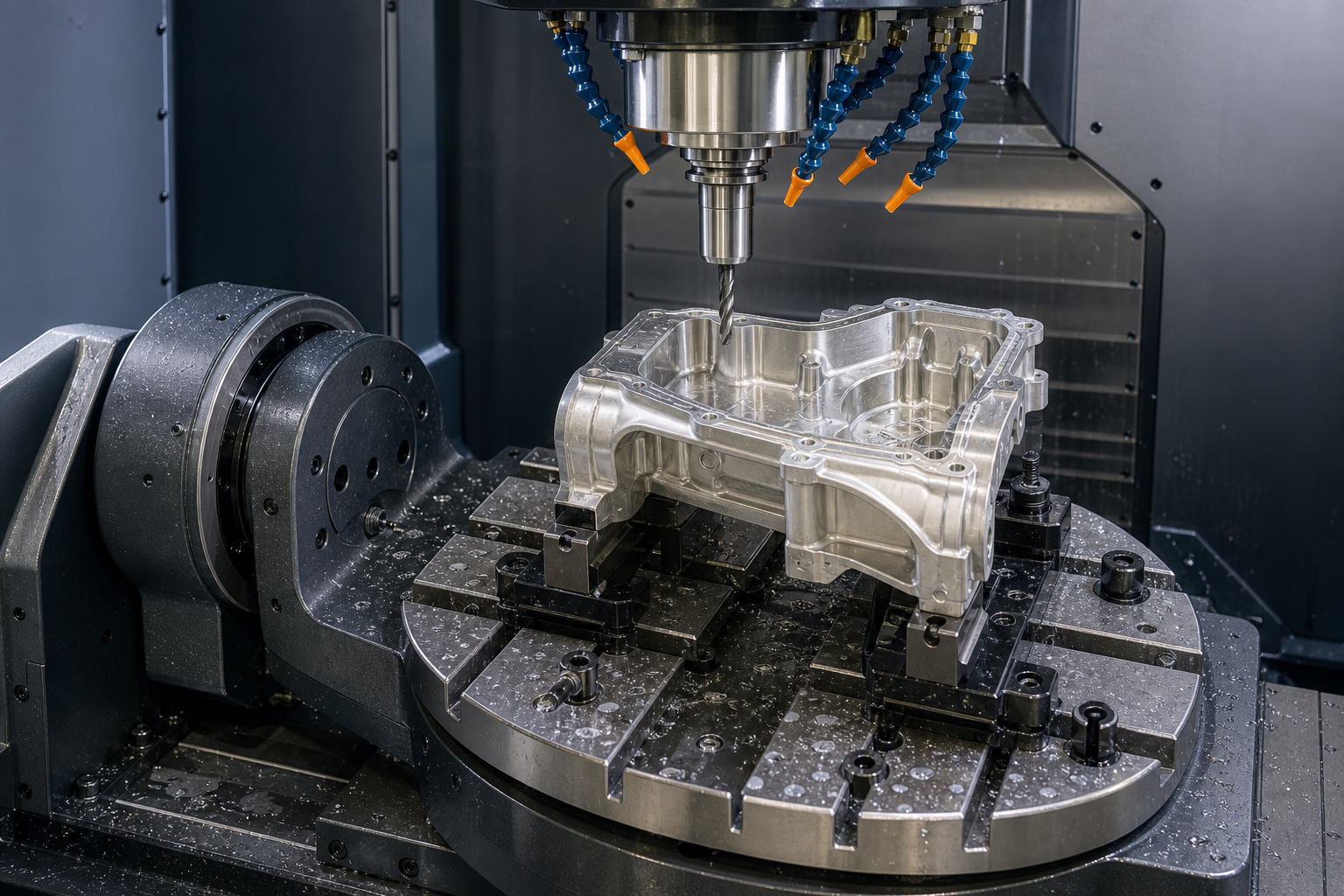
Does 5-Axis CNC Machining Cost More?
Short answer: the machine class generally carries a higher rate, but the total part cost depends on whether the extra axis removes other cost — setups, fixtures, repositioning, secondary operations, scrap and handling.
Where it does not pay: simple prismatic parts with all features on one or two faces, single-face work, and volumes where a dedicated fixture on a 3-axis machine or a turning centre already produces the part efficiently. For those jobs a 5-axis rate is simply a higher rate.
| Process | Typical use | Cost logic |
|---|---|---|
| 3-axis milling | Prismatic parts, plates, brackets, housings | Lowest machine class; cost is driven by the number of setups and the pocket depth |
| 4-axis / 3+2 indexed | Multi-side features on a single part | Removes repositioning between faces; a middle step between 3-axis and simultaneous 5-axis |
| Simultaneous 5-axis | Contoured surfaces, multi-face features, deep angled features | Higher rate, but can remove setups, special tooling and secondary operations on suitable parts |
| CNC turning | Shafts, bushings, round and rotationally symmetric parts | Efficient for rotational geometry; usually the lowest-cost route for round work |
| Mill-turn | Complex rotational parts with milled features | Combines operations in one platform; avoids a second setup and re-datum |
| Swiss-type turning | Small, slender, high-precision parts | Efficient for the right geometry at volume; poor fit for large parts |
| EDM / wire EDM | Sharp internal corners, hardened material, fine profiles | A secondary or special process; slow per part but removes operations milling cannot reach |
How Much Does CNC Machining Cost in China?
Short answer: the question has no single number, for the same reason it has none anywhere else — but the cost structure is different, and that is what a buyer can actually evaluate. Rather than accepting or rejecting a country-level claim, price the stack below and check each element.
| Cost element | What it consists of | What a buyer should check |
|---|---|---|
| Manufacturing | Machine time, labour, tooling, programming, setup and fixture | Cycle time estimate, machine class, how many setups, whether the fixture is billed once |
| Material | Grade, stock form, buy quantity, certification | Which grade and stock form, whether the mill certificate is included, how much is bought against finished weight |
| Finishing | Anodising, plating, passivation, coating, heat treatment | In-house or subcontracted, batch minimum, masking, dimensional allowances |
| Inspection | In-process checks, CMM report, first-article inspection, certificates | Which characteristics, sampling rate, documentation level |
| Packaging | Protection, moisture barrier, crates, labelling | Whether packaging is included and whether it protects a finished surface |
| Freight | Mode, weight and volume, transit time | Which Incoterm, and what the cost is to your door rather than to the port |
| Duty and taxes | Import duty, VAT or sales tax, clearance and brokerage | The applicable rate for the HS code and origin, and who handles clearance |
| Risk | Rework, replacement, expediting, production downtime | How non-conformance is handled, and what a replacement batch costs in time |
China is often cost-competitive on the manufacturing element for structural reasons rather than a single rate difference: a deep local supply chain for stock, tooling, fasteners and finishing vendors; a high density of machining capacity that keeps utilisation high; and factories that integrate several processes under one quality system, which removes hand-offs between suppliers.
Machining Price vs Total Landed Cost
Short answer: a unit price is a line, not a total. The number that affects your programme is what a conforming part costs delivered, including everything you paid to have it available for assembly.
Landed cost = ( part price × quantity + finishing + inspection + packaging + freight + duty + clearance ) ÷ conforming parts received
Non-conforming parts and rework do not get divided out — they are paid for and then paid for again in time. Track them separately and add them back.
| Cost that competes with a cheaper quote | How it appears |
|---|---|
| Rework or replacement batch | Second production run, second freight charge, second inspection, and the schedule lost while it happens |
| Receiving inspection | Your own inspection effort because the documentation does not let you accept the batch on paper |
| Engineering time | Drawing clarifications, non-conformance reports and corrective-action follow-up |
| Expedited freight | Air freight on the replacement batch, plus expedited handling and clearance |
| Production disruption | Line downtime, rescheduling, or short-shipping to a customer |
Why Do Two Suppliers Quote Different Prices?
Short answer: usually because the two quotes are not for the same thing. Price differences come from scope and assumptions far more often than from efficiency.
One quote includes finishing, inspection and packaging; the other prices machining only.
Different readings of an ambiguous tolerance, a blanket tolerance note, or an undefined finish.
Different grade, different stock form, different buy quantity, or a certificate included on one quote and optional on the other.
Two setups against four, a dedicated fixture against soft jaws, in-house finishing against subcontracted finishing.
Different Incoterms, different lead times, and different assumptions about who pays freight and duty.
Current capacity, whether the shop wants the job, whether it expects repeat volume, and how it prices risk on an unfamiliar part.
| Scope item | Supplier A | Supplier B | Supplier C |
|---|---|---|---|
| Unit price index (lowest = 100) | 100 | 128 | 165 |
| Material grade stated | — | ✓ | ✓ |
| Mill certificate included | — | ✓ | ✓ |
| Setup count stated | — | ✓ | ✓ |
| Fixture billed once, stated | ? | ✓ | ✓ |
| Surface finish included | ? | ✓ | ✓ |
| CMM report | — | — | ✓ |
| Packaging included | ? | ✓ | ✓ |
| Freight | Excluded | Included | Included |
| Quoted lead time | 5 working days | 12 working days | 10 working days |
Read the table as a buyer: A is cheapest and states the least, so its price cannot yet be compared with the others; C is the most expensive and is the only one that includes CMM verification. The honest comparison is A’s price after you have forced it to state the same scope as B and C — not A’s price as written.
How to Compare CNC Quotes on an Equal Basis
Short answer: standardise the request, then compare. Two quotes built from different inputs produce a price difference that means nothing.
Send one identical package
The same revision of the 3D model and drawing, the same material grade and condition, the same quantity and quantity breaks, the same tolerance requirement and the same finish and inspection specification to every supplier — on the same day.
Freeze the commercial terms
Same Incoterm, same target delivery window, same packaging requirement, same documentation list, same currency and price validity.
Force the scope into writing
Ask each supplier to state the setup count, the machine class, whether the fixture is one-time, what finishing is included, and which characteristics are inspected.
Compare the lines, then the number
Build one comparison sheet with the nine quote lines as rows. Where a line is blank, it is a question, not a saving.
How to Reduce CNC Cost Without Compromising Function
Short answer: the recoverable cost is in the specification, not in the supplier’s margin. Seven areas carry almost all of it.
Design
- Use standard internal radii that match an available cutter instead of a nominal small radius.
- Remove pockets and cavities that add cycle time without adding function.
- Avoid walls thinner than the function needs; thin walls force reduced cutting parameters.
- Keep as many features as possible on the faces that a single setup can reach.
Specification
- Tolerance only the characteristics that function requires; use a general tolerance for the rest.
- Mark reference-only dimensions so they are not priced as controlled features.
- State the finish on the surfaces that need it, with the acceptance method.
Material
- Choose the alloy the application requires, then check whether one grade lower meets the same requirement.
- Match the stock form to the part: near-net stock reduces both the material bought and the roughing cycle.
- Confirm the condition you need (as-supplied, heat-treated, stress-relieved) instead of assuming it.
Process
- Use 3-axis where the geometry allows it; use multi-axis where it removes setups.
- Reduce the number of setups before negotiating the rate.
- Remove secondary operations by designing the feature so the primary process can produce it.
Quantity
- Request several quantity breaks on the same drawing and read the real curve.
- Validate at low volume, then order at the break where the fixed cost is no longer material.
- Consolidate similar parts so one setup and one fixture serve a family.
Finish
- Specify the finish the application needs rather than the best available one.
- Finish the visible or functional surfaces only; mask the rest.
- Check the finisher’s batch minimum before choosing a finish at low volume.
Inspection
- Inspect the critical characteristics, not every dimension.
- Use sampling at volume where the process is proven, instead of 100% inspection.
- Match the method to the tolerance: a CMM is not needed to confirm a general tolerance.
Which Cost-Cutting Changes Are Safe — and Which Are Not
Not every saving is free. The table below separates engineering changes that are normally reviewable from those that move function, safety or compliance risk onto your product.
| Cost-reduction change | Usually reviewable? | Risk |
|---|---|---|
| Relax tolerance on non-functional dimensions | Yes | Low, provided the function is genuinely unaffected and interfaces stay controlled |
| Increase non-functional internal radii | Yes | Low; check it does not reduce a section that carries load |
| Use standard tooling and standard hole sizes | Yes | Low; confirm the mating part accepts the standard size |
| Increase the order quantity | Yes | Commercial, not technical; inventory and obsolescence risk sit with you |
| Remove a cosmetic finish from hidden surfaces | Yes | Low if the surface is not exposed to corrosion, wear or cleaning |
| Consolidate similar parts into one setup and fixture | Yes | Low; requires the parts to share datums and material |
| Change the material grade | Review | Functional: strength, corrosion, temperature, weight and coating compatibility all change together |
| Reduce the inspection scope | Review | Quality: less evidence per batch, and defects surface later at a higher cost |
| Reduce wall thickness | Review | Structural: stiffness, fatigue behaviour and distortion in machining can all change |
| Remove a tolerance from a functional characteristic | No | Function and fit may fail in assembly or in service |
| Substitute a grade with different properties | No | May break interchangeability, strength or regulatory compliance (for example medical or pressure applications) |
| Remove a surface treatment required by the environment or a standard | No | Corrosion, wear or compliance failure that appears after the parts are in service |
Is CNC the Most Cost-Effective Process for Your Volume?
Short answer: CNC wins where precision, low-to-medium volume and material properties matter. Tooling-based processes win at volume, once the tooling investment is spread across enough parts.
| Situation | Process to evaluate | Reasoning |
|---|---|---|
| 1 to a few hundred complex metal parts | CNC machining | No tooling investment, geometry freedom, material properties retained from solid stock |
| Plastic prototypes and low-volume plastic parts | CNC or 3D printing | Both avoid mould cost; the choice turns on surface finish, mechanical properties and how many parts are needed |
| High-volume plastic parts | Injection moulding | Adds mould investment but reduces piece cost; the break-even sits where the tooling cost is recovered by the piece-cost saving |
| High-volume metal parts | Die casting or forging, then machining | Tooling-driven piece cost; near-net form also cuts machining time for critical features |
| Repeated flat and formed parts | Sheet metal, stamping | Fast per piece at volume; tolerances and material thickness limits decide suitability |
| Extremely complex internal geometry | Additive manufacturing or EDM | Reaches features that no cutter can enter; compare against the cost of redesigning the feature for milling |
| Large or simple rotational parts | CNC turning | Efficient use of machine time for round geometry |
The comparison is not CNC against “cheaper” processes; it is the total cost of the process plan, including tooling, secondary operations, lead time and quality risk. More on that comparison is available in the CNC and additive manufacturing guide.
Worked Cost Structures: Four Part Profiles
These four profiles show how a quote is constructed for different part types. They describe cost structure and what drives it. Goldcattle does not publish a price list for custom parts, because the price is a function of your drawing, quantity and specification — the structure is what transfers between projects.
Structure 01 — Aluminium mounting bracket
A common low-complexity profile: the clearest example of fixed cost dominating at low volume.
- Material6061-T6 plate
- Process3-axis milling, one setup
- ToleranceGeneral plus ±0.05 mm on two bores
- FinishDeburr, Type II anodise
- InspectionDimensional report
Principal cost drivers: programming and setup against quantity; anodising batch minimum; material bought as a plate cut to size.
How it behaves with volume: the steepest curve of the four — the fixed block is large relative to the per-part work, so unit cost falls fast to the point where machining and material take over.
Structure 02 — Stainless housing with a controlled bore
Tolerance and inspection become visible cost lines.
- Material316L bar or plate
- ProcessTurning plus milling, 2–3 setups
- Tolerance±0.02 mm on the bore, general elsewhere
- FinishPassivation, controlled finish on the sealing face
- InspectionCMM report on the bore and face
Principal cost drivers: stainless machinability, the second operation to reach the milled features, bore control, and CMM verification of the critical characteristics.
How it behaves with volume: setup amortisation is real but less dramatic; the recurring cost sits in cycle time and in the finishing batch, so the curve flattens sooner than profile 01.
Structure 03 — 7075-T6 structural part on simultaneous 5-axis
The profile where the higher machine class can be the cheaper total process.
- Material7075-T6 plate, high buy-to-fly
- ProcessSimultaneous 5-axis, one datum
- Tolerance±0.01 mm on interface features, GD&T
- FinishDeburr, protective coating
- InspectionCMM plus first-article inspection
Principal cost drivers: CAM and program proving, long roughing cycles from a solid plate, contoured finish passes, first-article inspection effort.
How it behaves with volume: the fixture and program are a large one-time block, but so is machining time — so the curve falls, then flattens earlier than a low-complexity part. Consolidating quantity reduces the engineering share, not the cycle time.
Structure 04 — PEEK precision component
Material-led cost: the stock price is a major part of the total.
- MaterialPEEK, certified grade
- ProcessCNC turning with milling, controlled parameters
- ToleranceTight on functional features
- FinishAs machined
- InspectionDimensional report on critical features
Principal cost drivers: material price per kilogram, thermal and stress considerations during cutting, tight process window, and material bought to the finished geometry without excess.
How it behaves with volume: reducing the buy-to-fly ratio changes the cost more than increasing quantity does — material efficiency is the dominant lever, not setup dilution.
Before You Accept a CNC Quote: 12 Items to Check
Run this list against any quotation before releasing the order. Each item is a place where the price can move after you commit, or where two quotes quietly stop being comparable.
- Material grade and condition stated
- Stock form and buy-to-fly assumption stated
- Quantity and any price-break logic defined
- Number of setups stated
- Fixture and tooling billed once or per order — stated
- Critical characteristics identified, and general tolerance for the rest
- Surface finish extent and acceptance method defined
- Heat treatment or coating requirement and process specified
- Inspection level, sampling rate and report format defined
- Documentation list agreed (material certificate, certificate of conformity, first-article inspection)
- Packaging requirement and Incoterm stated
- Lead time in working days, with its start point, and price validity stated
Direct Answers to the Questions Buyers Actually Ask
Short, self-contained answers — written so they can be quoted directly.
What to Send for an Accurate Quote
The more complete the package, the less the quote can move later. The first six items are the minimum for a firm price; the rest reduce risk and shorten the review.
| Item | Why it changes the price |
|---|---|
| 3D CAD model (STEP, IGES or native) | Geometry and machinability analysis, CAM programming, stock selection |
| 2D drawing with dimensions and GD&T | Defines which characteristics are controlled and how they will be verified |
| Material grade and condition | Stock price, machinability, cutting strategy and certification |
| Quantity, plus expected annual volume | Fixed-cost allocation and process planning for repeat production |
| Critical tolerances and datum requirements | Sets finishing strategy, setups and inspection method |
| Surface finish specification and extent | Adds a secondary operation with its own batch minimum and masking |
| Heat treatment or coating requirements | Outside process, dimensional allowances and distortion control |
| Inspection and documentation requirements | Defines report scope, sampling and whether first-article inspection is needed |
| Application, service environment and interfaces | Lets the supplier question an over- or under-specified requirement before quoting |
| Target delivery date and delivery terms | Determines scheduling and any expediting cost |
Goldcattle reviews the drawing, proposes design-for-manufacture changes where they reduce cost without affecting function, and returns an itemised, project-specific quotation. Files are handled under NDA on request.
CNC Machining Cost FAQ
How much does custom CNC machining cost?
There is no universal figure. The price of a custom part is a fixed job cost — programming, setup and often a fixture — divided by the quantity ordered, plus a variable cost per part covering material, machine time, tool consumption, finishing, inspection and packaging. Both terms are set by your drawing, material, tolerance, quantity and delivery requirement, which is why the number only becomes firm after a CAD model and drawing are reviewed.
How much does CNC machining cost per part?
Cost per part = (fixed job cost ÷ quantity) + variable cost per part. Because the first term shrinks with quantity, the same part has a different per-part price at 1, 10, 100 and 1,000 pieces. Any per-part figure quoted without a quantity is incomplete.
How much does CNC machining cost per hour?
Machine-hour rates differ by machine class — turning and 3-axis milling sit at the lower end, simultaneous 5-axis and mill-turn at the higher end — and published ranges disagree because shops define the rate differently. Some include programming, tooling and overhead; others quote machine time only. Treat any published rate as an indicator of relative machine class, and compare total part cost instead.
Is CNC machining cheaper in China?
The manufacturing element can be lower, driven by supply-chain depth, high capacity utilisation and factories that integrate several processes so parts do not travel between suppliers. That does not make every quote lower or every part cheaper: compare total landed cost per conforming part, including finishing, inspection, packaging, freight, duty and rework risk.
Why do CNC quotes vary so much between suppliers?
Most variation is scope, not efficiency: different material grades or stock forms, a different number of setups, a different interpretation of an ambiguous tolerance, and different inclusion of finishing, inspection, packaging and freight. Normalise the request before comparing numbers.
Does quantity reduce CNC machining cost?
Yes, up to a point. Programming, setup and fixture cost are fixed, so they shrink per unit as quantity grows. The effect is strongest from 1 piece to roughly 100 pieces; beyond that the variable cost per part dominates and the curve flattens, with further savings coming from cycle time, fixturing efficiency, material purchasing and finishing batch size rather than from setup dilution.
Does 5-axis CNC cost more?
The machine class generally costs more per hour, but the part may not cost more. On complex multi-face or contoured parts, 5-axis can remove setups, dedicated fixtures, repositioning, hand blending and secondary operations — and reduce the stack-up error that comes with re-datum. On simple prismatic parts it is a higher rate with no offsetting saving.
What is the most expensive factor in CNC machining?
Machining effort: how long the part occupies a machine and how many times it must be set up. Geometry, feature depth, tool access and the required finish all extend cycle time. Material, tolerance, quantity and lead time follow; on material-led parts such as PEEK or titanium the stock price can become the dominant line instead.
How much does a CNC prototype cost?
A prototype carries the entire fixed block — programming, setup, often a fixture, and first-article inspection — across one or a few parts, so the unit cost is the highest you will see for that design. It is still the cheapest way to validate a design before committing to volume, and the program and fixture created for it normally carry forward to the production order.
Does tighter tolerance increase CNC cost?
Yes, when it forces slower finishing passes, additional process control, more measurement or higher scrap risk. Tolerance is priced per characteristic, so the cost depends on how many features carry it — not on whether the drawing uses a tight number somewhere. A general tolerance with tight control on the functional features is normally both cheaper and easier to hold.
Does surface finishing add much to CNC cost?
Finishing is a separate operation with its own pricing logic, and at low volume the batch minimum and the masking usually cost more than the finish itself. Anodising, plating and heat treatment are batch processes; polishing and hand finishing are per-part time. Specifying the finish only on the surfaces that need it, with an acceptance method, is one of the most reliable reductions available.
Does CMM inspection increase the price?
Yes — it is quoted scope. CMM verification requires a measurement program, a part setup, run time and report preparation, so its cost scales with the number of characteristics verified and the sampling rate. It is also the only method that can confirm tight dimensional and geometric tolerance, so the right question is which characteristics need it, not whether to include it at all.
What files do I need for an accurate CNC quote?
A 3D CAD model in STEP, IGES or native format, and a 2D drawing with dimensions, tolerances and GD&T. Add the material grade and condition, quantity and expected annual volume, critical tolerances, surface finish, heat treatment or coating, inspection and documentation requirements, and the target delivery date.
How can I reduce CNC machining cost?
Work on the specification, not the supplier’s margin: tolerance only where function requires it, standard radii and hole sizes, fewer setups, stock matched to the part, no unnecessary secondary operation, finish limited to the surfaces that need it, inspection proportional to the critical characteristics, and a quantity chosen from the real cost curve rather than a guess.
Can a CNC quote change after the order is placed?
It should not, if the drawing and specification are complete. Where it can legitimately change is when the drawing is ambiguous about tolerance interpretation, when the actual stock size differs from the assumption, when the finishing or inspection requirement was not fully defined, or when the delivery date is brought forward. An initial estimate is a planning figure; a reviewed quotation is the committed one.
Get a Project-Specific CNC Quotation
Send your CAD model and 2D drawing with the material, quantity, tolerance and finish requirements. The engineering team reviews the geometry and tolerance scope, runs a design-for-manufacture check, and returns an itemised quotation with the machining, finishing and inspection plan for your part.
Free DFM review · NDA available on request · Itemised quotation
Explore CNC Machining Capabilities →Pricing methodology and scope of this page
- What this page is: an explanation of how custom CNC quotations are built, and how to read, compare and reduce them. It is a costing framework, not a price list.
- What it is not: no price range on this page is a quotation, an offer or a market average. Goldcattle does not quote custom parts from a rate card; every quotation is calculated from the submitted CAD model, drawing, material, quantity, machining strategy, finishing and inspection requirements.
- Worked figures: the arithmetic and composition charts are labelled as illustrative. They demonstrate how a quote behaves with quantity. They are not taken from a customer order and they are not a market statistic.
- Cost-share percentages: deliberately not published. The split between fixed and variable cost, and between material, machine time and secondary operations, changes with every part. A published percentage would be less useful and less honest than the ranking and the structure.
- Relative positions: tables using “lowest / moderate / higher” or cost-level symbols compare the options inside that table against each other. They are not absolute price levels.
- Review and revision: this page is maintained by the Goldcattle CNC engineering team and updated as quoting methods, machine capability and finishing options change. Updated September 2026.