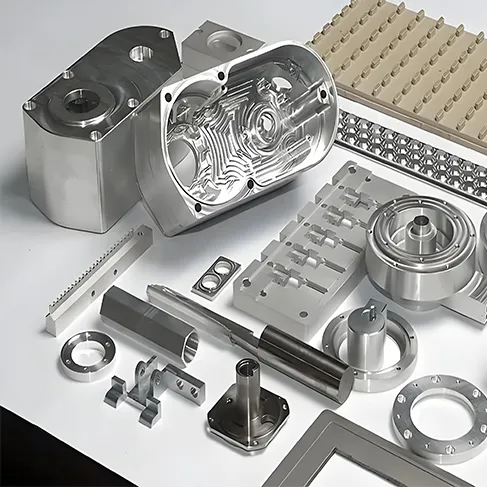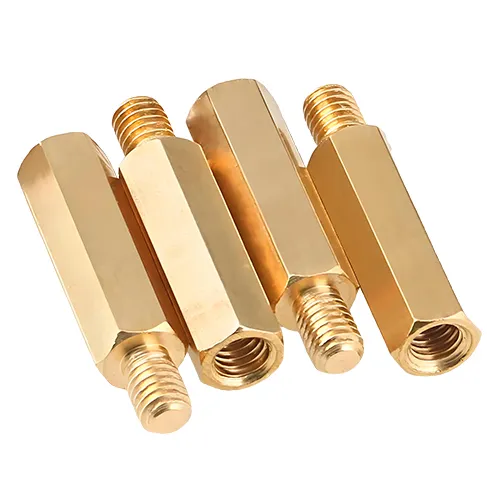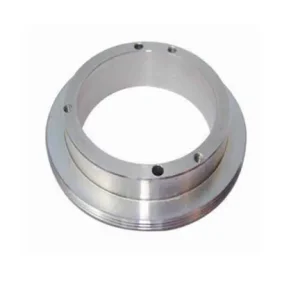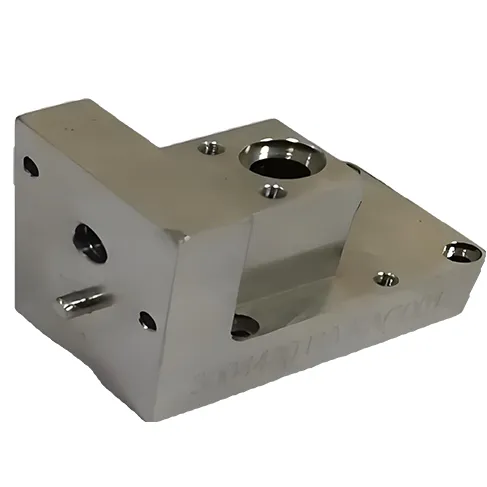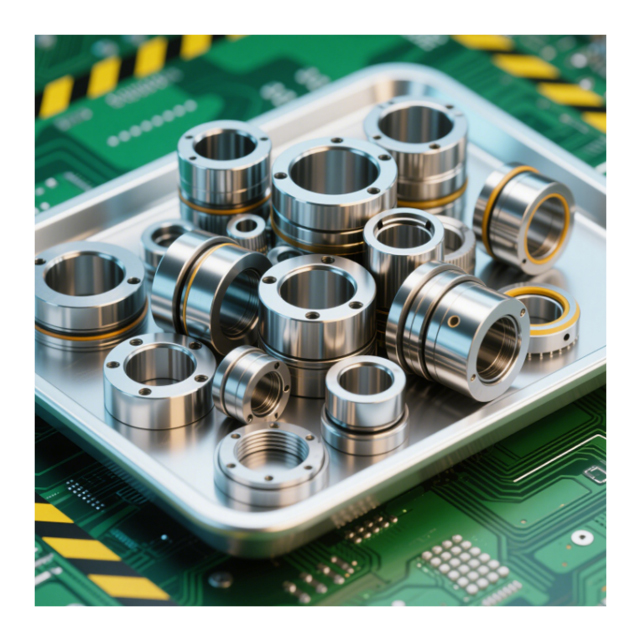
Custom CNC Parts | Aluminium, Brass, Stainless Steel
| Service Type | CNC Machining Customization Service for Metal Parts |
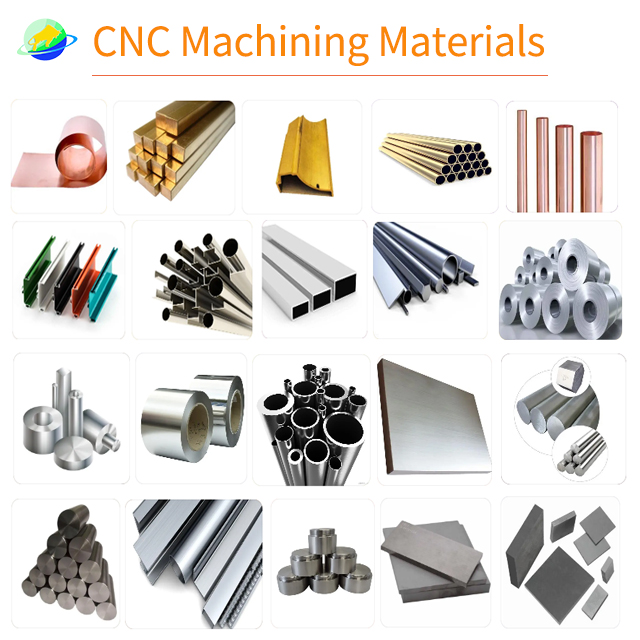
| Machining Materials | Aluminium, Brass, Stainless Steel, Copper, Bronze (Customization of other special metals supported) |
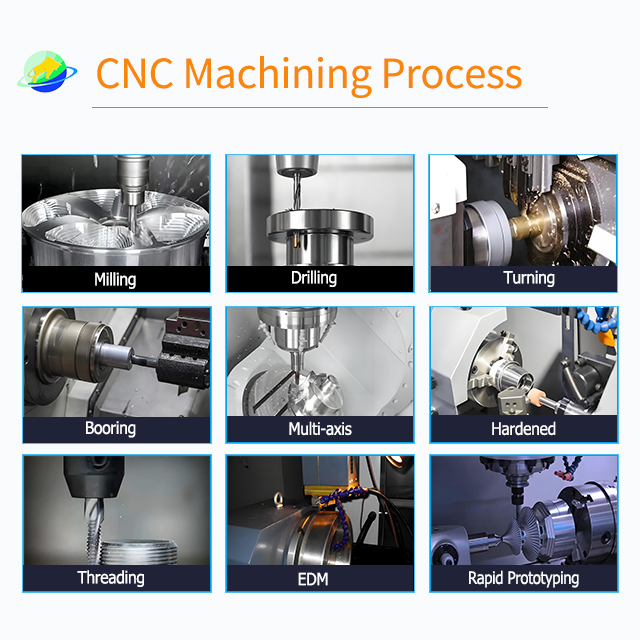
| Core Processes | Precision machining such as milling, turning, drilling, boring, tapping, etc.; 5-axis simultaneous machining supported |
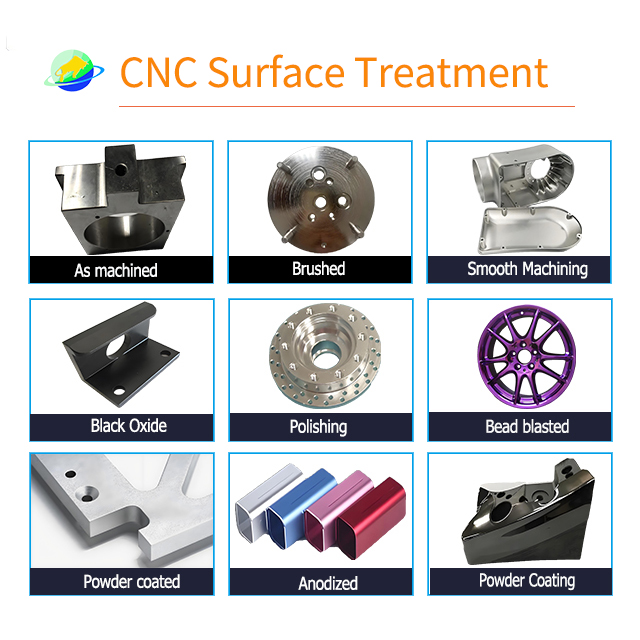
| Surface Treatments | Painting, electroplating, polishing, anodizing, passivation, brushing, sandblasting, etc. |
| Machining Precision | Dimensional tolerance: ±0.01mm, Geometric tolerance: ±0.005mm |
| Certifications | ISO 9001, SGS Certification |
| Minimum Order Quantity (MOQ) | 1 piece minimum |
| Packaging | Anti-static packaging, vacuum packaging, custom wooden crates (Special packaging requirements from customers are supported) |
| Lead Time | Samples: 3 – 7 days, Bulk orders: 7 – 20 days (Expedited delivery negotiable) |
| Service Scope | OEM/ODM customization, Processing based on drawings (Supports multiple drawing formats such as STP, IGS, DWG, etc.) |
| Application Areas | Automotive manufacturing, aerospace, medical devices, electronic equipment, mechanical engineering, etc. |
Description
Quick Answer: What Are Custom CNC Metal Parts?
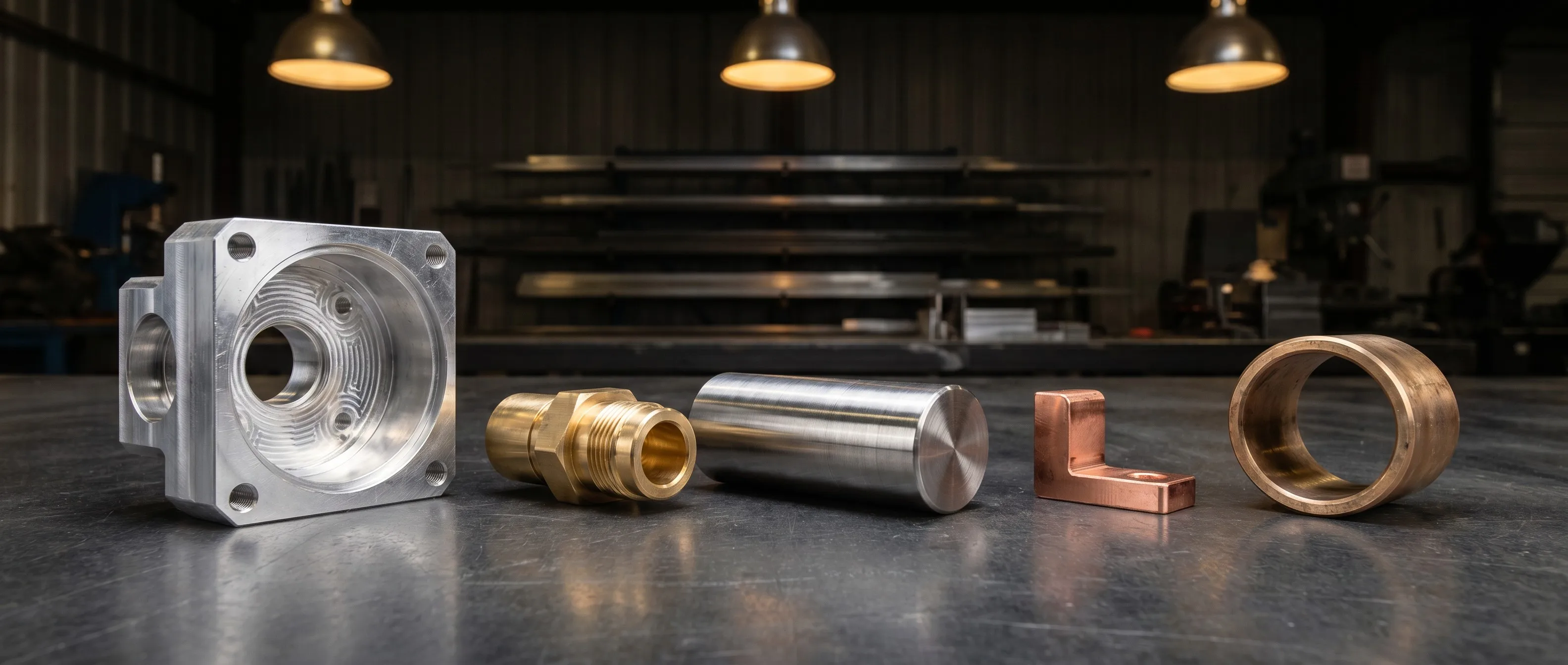
Custom CNC metal parts are precision-manufactured components produced from engineering metals using CNC milling and turning. Unlike casting or stamping, CNC machining removes material from solid stock with computer-controlled tool paths, enabling complex geometry, tight tolerances, and multi-material capability without dedicated tooling investment. This makes CNC machining the preferred process for low-to-medium volume production where design flexibility and dimensional accuracy matter more than per-unit cost at high volume.
Common applications: Industrial equipment housings and brackets, aerospace structural mounts, medical device components, robotics motion system parts, automotive precision fittings | Tolerance range: ±0.01 mm standard, ±0.005 mm for critical features | Materials: Aluminum (6061/7075), Stainless Steel (304/316), Brass (C360), Copper (C110), Bronze (C932)
Manufacturing Capability Overview
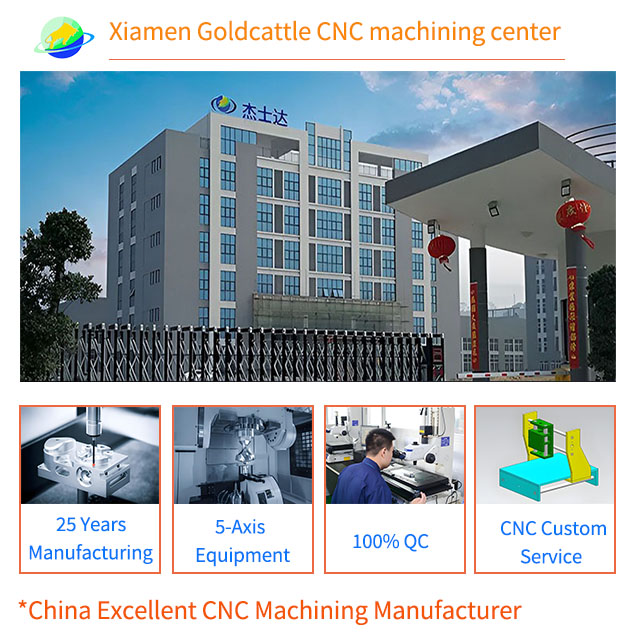
Goldcattle operates 100+ CNC devices including 5-axis machining centers, CNC lathes, and precision milling machines. Every production order undergoes CMM dimensional verification before shipment. The following specifications reflect our standard production capability across all five primary metals.
| Parameter | Capability |
|---|---|
| CNC Milling | 3-axis, 4-axis, 5-axis simultaneous |
| CNC Turning | Precision shaft, bushing and fitting production |
| Dimensional Tolerance | ±0.01 mm (standard), ±0.005 mm (geometric) |
| Surface Treatments | 20+ processes: anodizing, plating, polishing, passivation, bead blasting |
| MOQ | 1 piece (prototype); 100+ pcs (production) |
| Lead Time | 3–7 days (sample), 7–20 days (batch) |
| Inspection | CMM coordinate measuring, runout & concentricity report |
| Quality System | ISO 9001:2015, SGS certified |
| OEM/ODM | Drawing-based production, sample replication, free DFM review |
Why CNC Machining for Metal Parts?
When specifying custom metal components, procurement managers face a fundamental process choice: CNC machining from solid stock, or casting from molten metal into a mold. The decision hinges on volume, geometry complexity, tolerance requirements, and lead time urgency. CNC machining wins decisively in five scenarios that dominate industrial purchasing.
| Requirement | CNC Machining |
|---|---|
| Tight Tolerance (±0.01 mm) | Consistently achievable |
| Complex Geometry | 5-axis, unlimited contour |
| Low Volume / Prototype | 1 piece minimum, no mold |
| Fast Delivery | 3–7 days for sample |
| Multi-Material / Design Changes | Program change, no re-tooling |
CNC Machining vs Casting: Procurement Comparison
| Factor | CNC Machining | Casting |
|---|---|---|
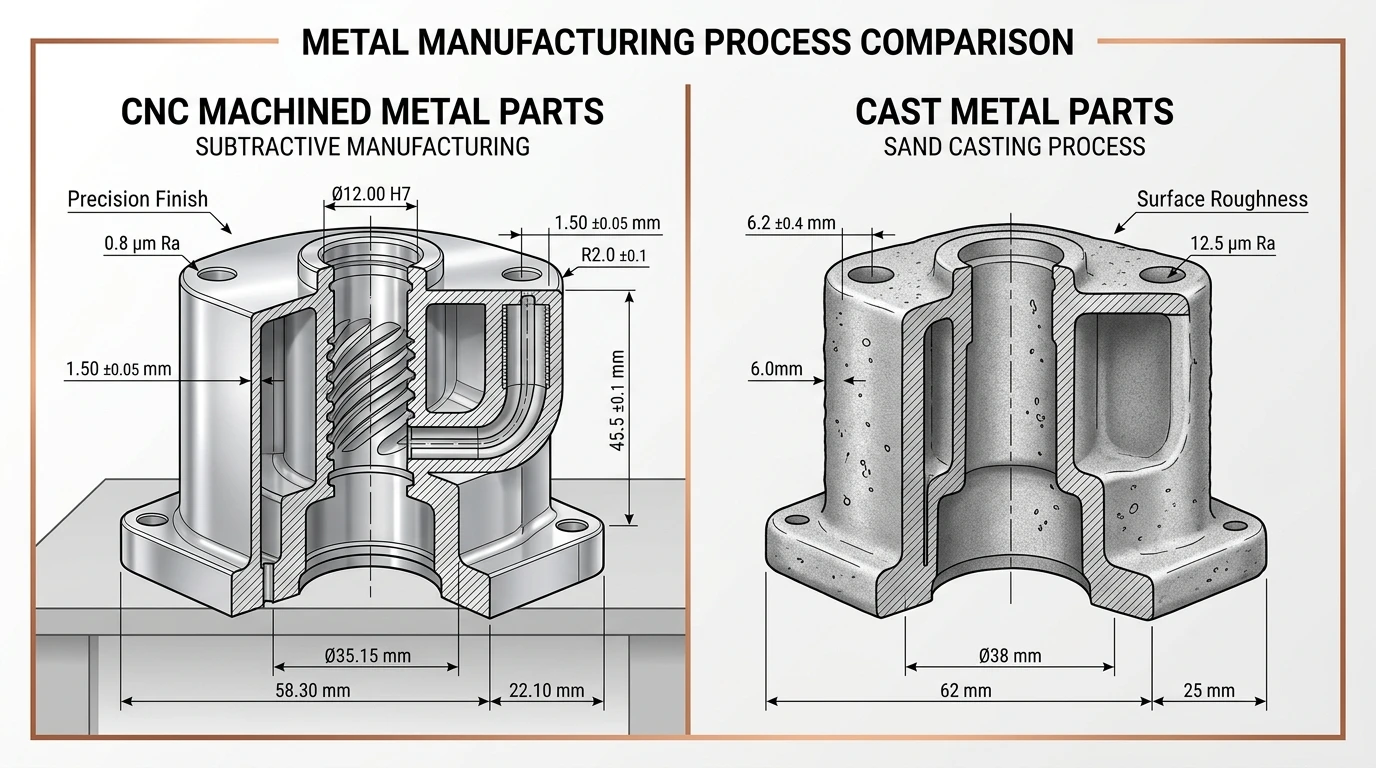
| Dimensional Precision | ±0.005–0.01 mm | ±0.05–0.1 mm |
| Surface Finish | Ra 0.8–1.6 μm | Ra 3.2–6.3 μm |
| Tooling Investment | None (CAM program) | $5,000–$50,000 mold |
| Prototype Speed | 3–7 days | 30–60 days (mold) |
| Design Change Cost | Low (program update) | High (new mold) |
| Volume Threshold | 1–500 pcs economical | 500+ pcs economical |
| Internal Defects | None (solid stock) | Porosity risk |
Selection Rule: CNC machining for orders under 500 pcs, any design iteration phase, tolerance ±0.01 mm or tighter, complex geometry requiring 5-axis access, or multi-material variants. Casting becomes cost-effective only at high fixed-volume production with stable geometry.
Metal Material Selection Guide
Choosing the right metal depends on three factors: the operating environment (corrosion, temperature, load), the machining complexity (thin walls, internal threads, tight bores), and the cost envelope. The following guide maps each metal to its strongest procurement scenarios, so you can specify material with confidence rather than defaulting to whatever the last supplier used.
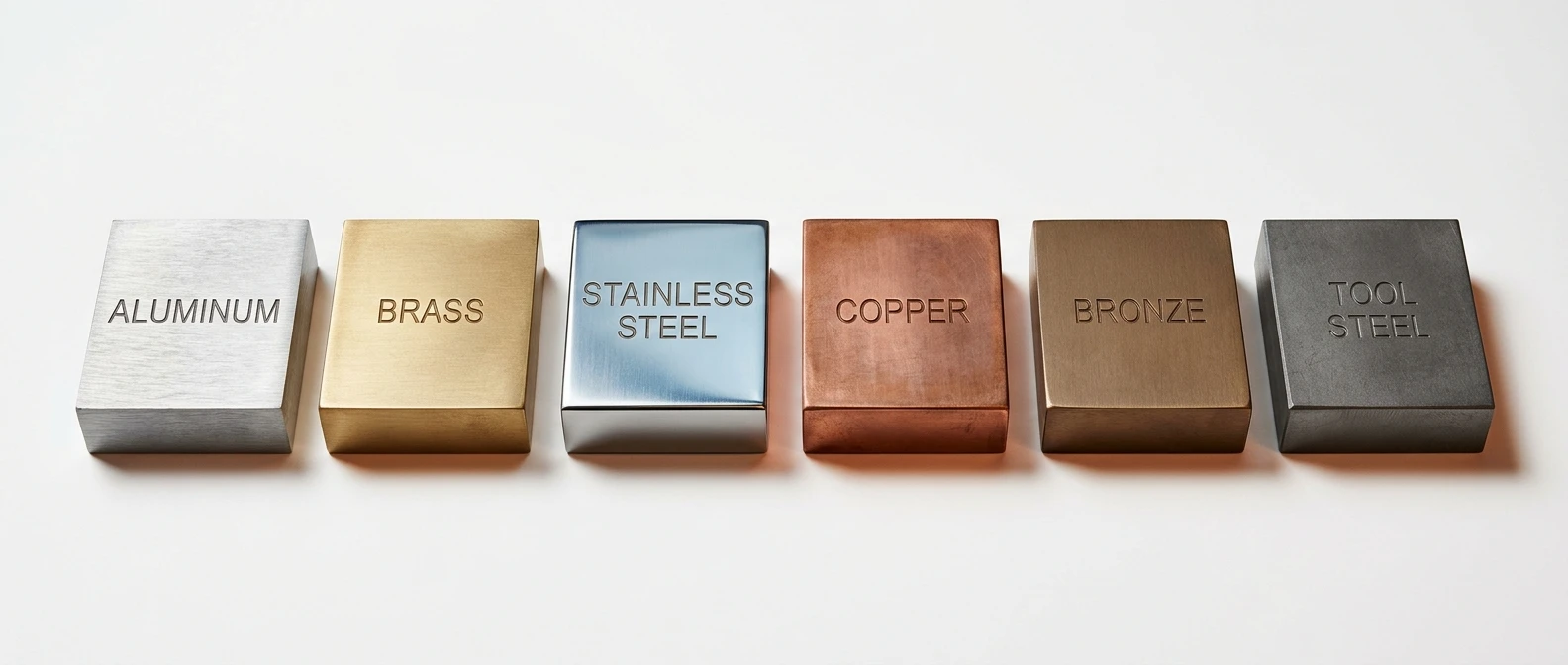
| Material | Best Application | Key Advantages | Tolerance | Surface Finish |
|---|---|---|---|---|
| Aluminum 6061-T6 | Robotics frames, general housings | Lightweight, cost-effective, excellent machinability | ±0.01 mm | Anodized Ra 0.8 μm |
| Aluminum 7075-T6 | Aerospace brackets, high-stress parts | Highest aluminum strength (572 MPa), fatigue-resistant | ±0.01 mm | Hard anodized |
| Stainless Steel 304 | General industrial, food processing | Corrosion-resistant, versatile, widely available | ±0.01 mm | Polished Ra 0.4 μm |
| Stainless Steel 316 | Medical, marine, coastal equipment | Superior corrosion resistance, passivable | ±0.005 mm | Electropolished |
| Brass C360 | Electrical connectors, plumbing fittings | Best machinability (100% rating), no tool wear | ±0.005 mm | Polished / plated |
| Copper C110 | Electrical contacts, heat exchangers | Highest conductivity, thermal transfer | ±0.01 mm | Polished / plated |
| Bronze C932 | Bearing sleeves, bushings, wear surfaces | Wear resistance, self-lubricating properties | ±0.01 mm | Precision bored |
Aluminum — Lightweight Structures
6061 for cost-sensitive housings and brackets. 7075 when strength-to-weight ratio matters — aerospace brackets, e-bike components, racing frames. Anodizing protects surface and allows color customization.
Stainless Steel — Corrosion-Resistant
304 for general industrial and food-grade. 316 for medical devices and marine environments requiring passivation. Both accept electropolishing for biocompatible surface finish. Work hardening requires carbide tooling strategy.
Brass / Copper / Bronze — Specialty
Brass C360 machinability makes it ideal for threaded connectors and fittings. Copper C110 conductivity suits electrical and thermal components. Bronze C932 wear resistance serves bushings and bearing surfaces in automation equipment.
Material Selection Rule: Default to 6061 aluminum for structural parts under moderate load. Upgrade to 7075 for high stress. Use 304 SS for corrosion resistance, 316 SS for medical/marine. Brass for connectors, copper for conductivity, bronze for wear surfaces. Contact our engineering team for special alloy recommendations.
CNC Machining Capabilities
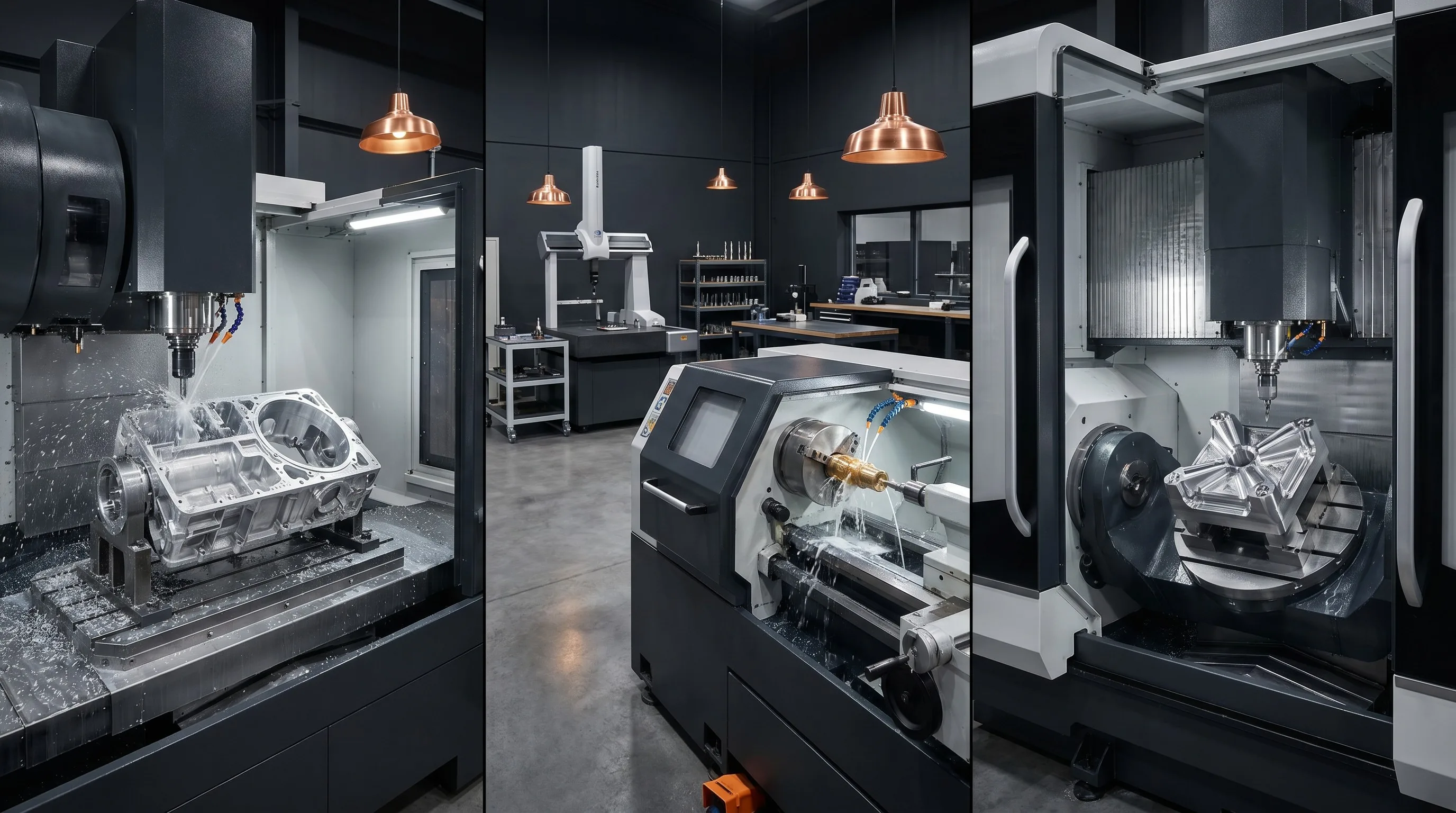
Three process tiers cover the full range of metal part geometry. Selecting the right process depends on part complexity: 3-axis milling handles planar features efficiently, 4-axis adds rotational indexing for multi-face parts, and 5-axis enables complex contour machining in a single setup — reducing error accumulation from repositioning.
CNC Milling (3/4/5-Axis)
Housings, brackets, structural frames, cover plates. 3-axis for flat geometry, 4-axis for multi-face features, 5-axis for complex contour — aerospace brackets, medical implants, turbine components.
Tolerance: ±0.01 mm | Surface: Ra 0.8 μm | Max travel: 600×400×300 mm
CNC Turning
Shafts, bushings, fittings, connector bodies, sleeves. Concentricity verified on cylindrical features. Internal threading and boring for connector and plumbing applications in brass, copper, and steel.
Tolerance: ±0.005 mm (bore) | Concentricity: ≤0.01 mm | Max diameter: 200 mm
5-Axis Complex Geometry
Aerospace structural mounts, medical device housings, impellers, turbine parts. Single-setup machining eliminates repositioning errors. Linked to our 5-axis CNC page for dedicated capability details.
Tolerance: ±0.005 mm | Surface: Ra 0.4 μm | Simultaneous: 5-axis
Industries Served by CNC Metal Parts
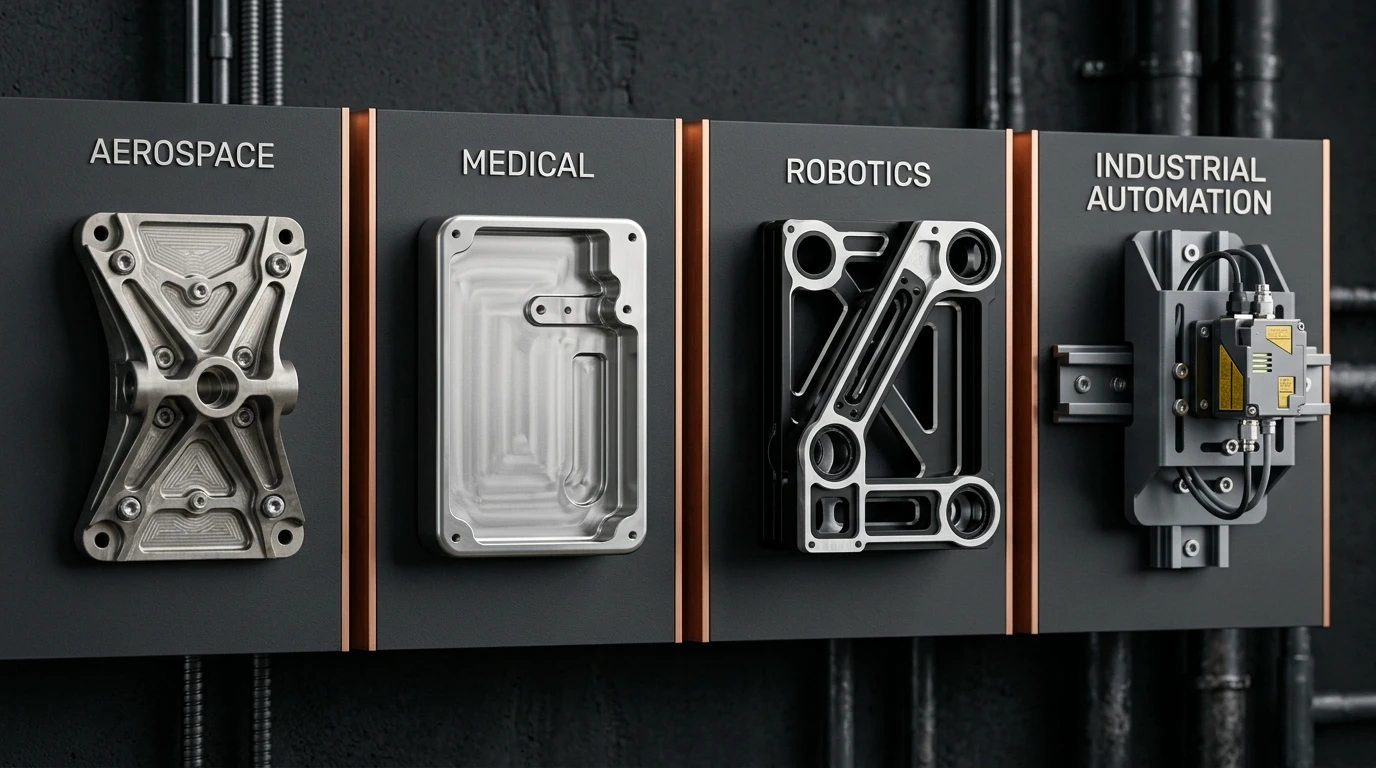
Aerospace
Structural mounting brackets, fuselage fittings, engine component housings. 7075-T6 aluminum and 316 SS are the primary materials. Tolerance ±0.005 mm on critical load-bearing interfaces. Every part undergoes CMM verification with full dimensional report.
Typical: 7075 brackets, 316 SS fittings, ±0.005 mm tolerance
Medical Devices
Surgical instrument components, implant housings, precision fluidic manifolds. 316L SS electropolished for biocompatibility. Titanium Grade 5 for implant-grade weight and strength. Cleanroom-compatible packaging available for regulated applications.
Typical: 316L SS housings, Ti Gr5 implants, electropolished finish
Robotics
Motion system components, lightweight frames, actuator housings, gear mounting plates. 6061-T6 for cost-efficient structural parts, 7075-T6 for high-cycle fatigue environments. Thin-wall pocketed structures reduce mass without sacrificing rigidity.
Typical: 6061/7075 housings, ±0.01 mm, pocketed weight reduction
Industrial Automation
Sensor mounts, precision fixtures, pneumatic fittings, valve bodies. Brass C360 for connector bodies and threaded interfaces. Bronze C932 for bearing surfaces in linear motion systems. 304 SS for corrosion-resistant outdoor equipment housings.
Typical: Brass connectors, bronze bushings, 304 SS fixtures
Case Studies: CNC Metal Part Manufacturing Results
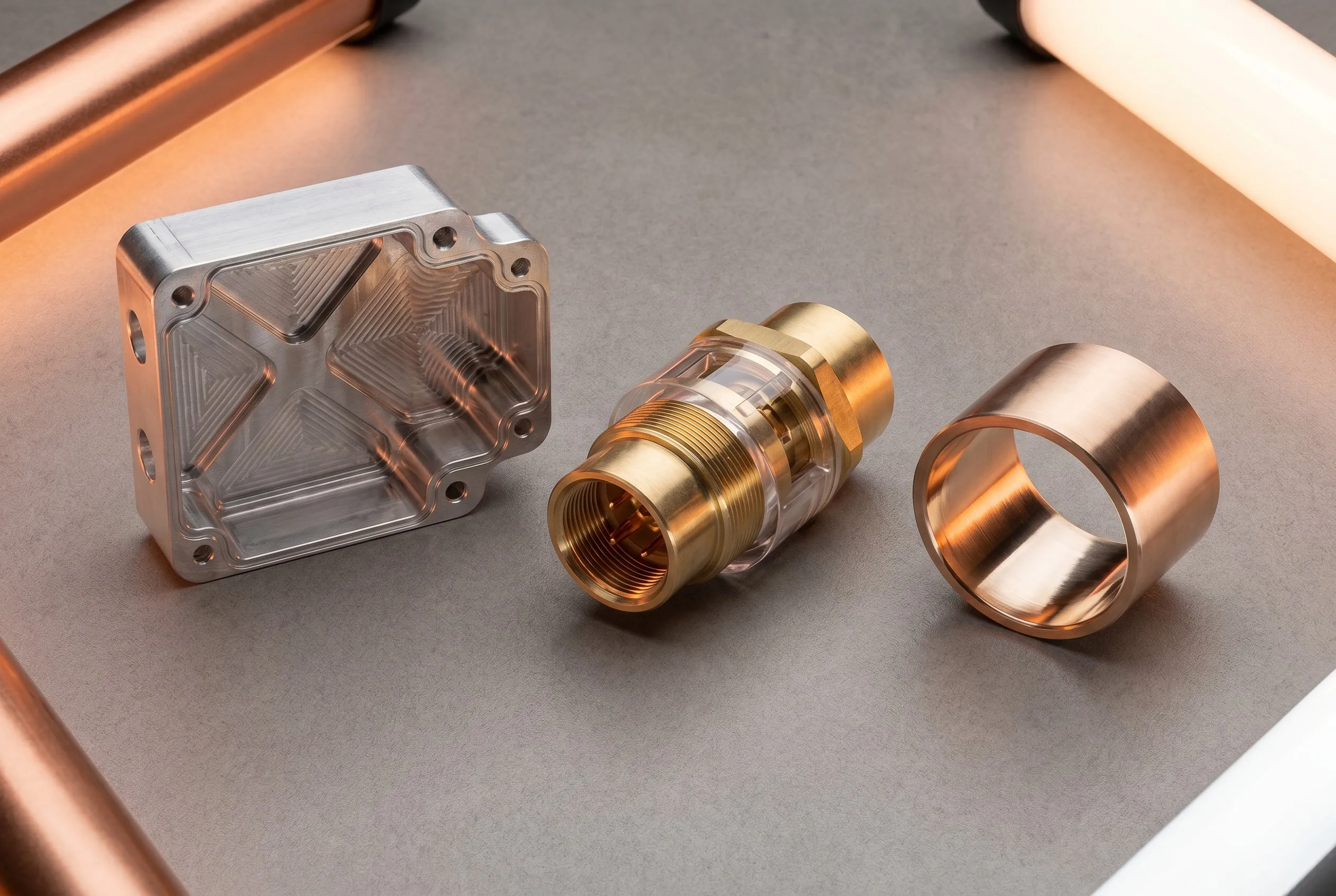
Aluminum Robotics Housing
| Material | 6061-T6 Aluminum |
| Tolerance | ±0.01 mm |
| Challenge | Thin-wall deformation on 1.2 mm wall housing during final bore pass |
Solution: Fixture redesign with internal support mandrel to stabilize wall during machining. Stress relief cycle added between roughing and finishing passes to prevent springback. Final bore pass at 0.05 mm depth of cut ensures roundness without deflection.
Result:
Yield rate >98% across 200-piece batch | Wall thickness variation ≤0.03 mm | No post-machining distortion after stress relief
Brass Electrical Connector
| Material | C360 Brass |
| Challenge | Complex internal threading (M6×0.75 fine pitch) with concentric external seal groove |
Solution: Multi-axis CNC turning with synchronized thread cutting and groove profiling in single setup. C360 brass machinability (100% rating) allows high-speed cutting with minimal tool wear, enabling consistent thread quality across batch production.
Result:
Thread gauge pass rate 100% | Concentricity seal groove ≤0.005 mm | Stable batch production at 500 pcs/month
Bronze Bearing Sleeve — Industrial Automation
| Material | C932 Bronze (SAE 660) |
| Application | Linear motion guide bushing in packaging automation |
| Challenge | Bore surface finish Ra ≤0.4 μm for low-friction operation; dimensional stability under reciprocating load |
Solution: Precision CNC boring with carbide tool at low RPM (800) and fine feed (0.05 mm/rev). Honing pass after boring achieves mirror bore finish. Bronze self-lubricating properties embedded in material reduce friction without external lubrication system.
Result:
Bore Ra 0.3 μm (exceeded spec) | Roundness ≤0.005 mm | Extended service life 2× vs standard brass bushing | Self-lubricating eliminated external oil system
Bronze C932 outperforms brass in wear applications because lead particles distributed in the matrix provide continuous micro-lubrication. For reciprocating and rotating bearing surfaces in automation equipment, bronze reduces maintenance intervals and eliminates contamination from external lubricants.
Request a Quote for Custom CNC Metal Parts
Submit your drawings and specifications. Our engineering team reviews feasibility within 48 hours and returns a comprehensive quotation covering manufacturing cost, material recommendation, surface treatment options, and realistic lead time — not a generic price estimate.
IGES / IGS
DWG
DXF
Parasolid
What You Receive Within 48 Hours
DFM Review
Manufacturability analysis, tolerance feasibility, design optimization suggestions
Material Recommendation
Best metal selection for your application environment and cost target
Cost Analysis
Transparent per-piece pricing with volume tier breakdown
Lead Time Estimate
Realistic delivery schedule for prototype and production phases
Engineering Challenges in Multi-Material CNC Machining
Stainless Steel Work Hardening
Issue: 304/316 SS hardens at the cutting edge zone, causing progressive dimensional drift and accelerating tool wear on subsequent parts in a batch.
Countermeasure: TiAlN-coated carbide inserts with continuous cutting path — no dwell or re-cutting. Flood coolant at 8+ L/min. For bearing bores, single-pass finish cut at controlled DOC prevents hardening accumulation.
Thin-Wall Aluminum Deflection
Issue: Aluminum housings with wall thickness below 1.5 mm deflect under radial cutting force, producing oval bores and inconsistent wall thickness across the part.
Countermeasure: Internal mandrel support fixtures stabilize walls during bore machining. Roughing passes remove bulk material, stress relief pause, then final pass at 0.05 mm DOC with reduced feed rate achieves roundness without wall springback.
Copper Adhesion on Tool Edges
Issue: Pure copper (C110) is soft and ductile — material adheres to cutting edge forming built-up edge (BUE), degrading surface finish and increasing cutting force unpredictably.
Countermeasure: High-speed machining with polished rake-face carbide tools. Flood coolant prevents thermal adhesion. Sharp tool replacement schedule — no extended run with worn edge. Result: consistent Ra 0.8 μm finish across batch.
Brass Thread Concentricity
Issue: Internal thread cutting in brass connectors can drift from bore centerline when turning setup allows chuck rotation variance, causing sealing failure in pressurized fittings.
Countermeasure: Thread cutting and external groove machining in single chuck setup eliminates repositioning error. Collet chuck with ≤0.005 mm runout. CMM concentricity verification on every threaded part.
Frequently Asked Questions
What metals can you CNC machine?
Aluminum (6061-T6, 7075-T6, 5052), Stainless Steel (304, 316, 303), Brass (C360, C260), Copper (C110, C101), Bronze (C932, C954), and specialty alloys including titanium, Inconel, and tool steels. Over 30 metal grades in active production inventory.
What tolerance can you achieve on metal parts?
±0.01 mm dimensional tolerance as standard across all metals. ±0.005 mm geometric tolerance for critical features (bearing bores, sealing surfaces, alignment holes). Tighter tolerances available on request with grinding finish pass for roundness ≤0.003 mm.
Do you support 5-axis CNC machining?
Yes. 5-axis simultaneous machining centers handle complex geometry parts — aerospace brackets, medical housings, impellers — in single setup. This eliminates repositioning errors and reduces cumulative tolerance deviation. See our 5-Axis CNC page for dedicated capability specifications.
Can you machine copper and bronze parts?
Copper C110 for electrical contacts and thermal components — high-speed machining with BUE prevention protocol. Bronze C932 for bearing sleeves and bushings — precision boring with honing finish for Ra ≤0.4 μm bore surfaces. Both materials are in regular production at our facility.
What is your minimum order quantity?
1 piece for prototype orders. This enables design validation and field testing before committing to batch production. Production orders of 100+ pcs receive volume pricing. No maximum order cap — monthly production capacity exceeds 800,000 pieces across all product lines.
Can you provide CMM inspection reports?
Yes. Every production order includes a CMM dimensional report covering critical feature dimensions, geometric tolerances, runout, and concentricity. Full traceability from raw material certificate to finished part inspection. Reports provided in PDF format with each shipment.
Do you support prototype and low-volume production?
Prototype: 1–30 pcs, 3–7 day delivery, same CNC machining process as production parts (no 3D printing substitute). Low-volume: 30–500 pcs with volume-adjusted pricing. This allows design iteration without tooling investment, then seamless scale-up to production quantities when design is finalized.
How long does CNC machining production take?
Sample/prototype: 3–7 working days from drawing approval. Production batch (100–500 pcs): 7–20 working days. Surface treatment adds 3–5 days. Expedited delivery available at additional cost. Drawing review and DFM feedback returned within 48 hours of submission.
Which surface treatments are available for metal parts?
Aluminum: anodizing (Type II/III), polishing, bead blasting. Stainless steel: electropolishing, passivation, polishing, powder coating. Brass: polishing, nickel/chrome plating, gold plating. Copper: polishing, tin plating, silver plating. Bronze: polishing, clear lacquer. Over 20 surface treatment processes in-house.
About Goldcattle
Xiamen Goldcattle Industrial & Trade Co., Ltd. is an ISO 9001:2015 and SGS certified OEM manufacturer with 25 years of precision machining experience. We operate 100+ imported CNC devices — including 5-axis machining centers, CNC lathes, and precision milling machines — alongside fully automatic surface treatment production lines. From single-piece prototype development to monthly output exceeding 800,000 pieces, we deliver consistent quality across aluminum, stainless steel, brass, copper, and bronze components for clients in Europe, North America, and Asia-Pacific.
SGS Certified
100+ CNC Devices
5-Axis Machining
CMM Inspection
OEM/ODM
Reviewed by
Chen, Senior CNC Manufacturing Engineer, 18 Years Experience
Specialized in: CNC Process Optimization, Multi-Material Machining Strategy, 5-Axis Programming, Aluminum/SS/Brass/Copper/Bronze Production
Custom CNC Metal Parts Manufacturing Summary
| Service Type | OEM Custom CNC Metal Parts Manufacturing |
| Core Process | CNC Milling (3/4/5-axis) + CNC Turning |
| Materials | Aluminum 6061/7075, SS 304/316, Brass C360, Copper C110, Bronze C932 |
| Dimensional Tolerance | ±0.01 mm (standard), ±0.005 mm (geometric) |
| Surface Treatments | 20+ processes: anodizing, plating, polishing, passivation, electropolishing, bead blasting |
| Industries | Aerospace, Medical, Robotics, Industrial Automation |
| MOQ | 1 piece (prototype), 100+ pcs (production) |
| Lead Time | 3–7 days (sample), 7–20 days (batch) |
| Quality System | ISO 9001:2015, SGS certified, CMM inspection |
| File Formats | STEP, IGES, DWG, DXF, PDF, Parasolid |
| OEM Capabilities | DFM review, material recommendation, custom dimensions, surface color, packaging |
| Author | Chen, Senior CNC Manufacturing Engineer, 18 Years |