
CNC machining cost varies by material, part geometry, machining time, tolerances, quantity, surface finish, and production requirements. Get a practical estimate below — or send us your drawing for a project-specific quote.
Indicative CNC Machining Price by Project Type
The figures below are indicative only. There is no single “price per CNC part” that applies to every component, because material, geometry, tolerances, machining time, and finishing can change a quote by orders of magnitude. Use this table to set expectations — then confirm with a drawing.
| Project Type | Typical Volume | Pricing Logic |
|---|---|---|
| Prototype | 1–5 pcs | Highest unit cost — setup & programming spread over very few parts. |
| Low Volume | 10–50 pcs | Lower unit cost as setup is shared across more parts. |
| Small Batch | 100–500 pcs | Setup cost diluted; per-unit machining dominates. |
| Production | 500–5,000+ pcs | Lowest per-unit machining cost once the process is optimized and fixtured. |
Note on accuracy: The numbers on this page are educational estimates drawn from common industry rate ranges. Your final quote depends on the actual CAD model. Goldcattle reviews every drawing for material availability, machining orientation, tolerances, finish, and inspection before confirming price — we do not publish a fixed price list, because doing so would be misleading for custom parts.
How Is CNC Machining Cost Calculated?
At its core, a CNC quote is the sum of what the machine, the material, and the people cost for your part. The simplified industry formula:
Seven factors push that total up or down. Understanding them is the fastest way to read — and reduce — a quote.
1. Material
Aluminum machines fast and cheap; titanium and PEEK add material and machining cost.
2. Part Size & Weight
Bigger stock = more material waste and longer roughing cycles.
3. Machining Time
The single biggest variable — driven by geometry, depth, and tool changes.
4. Geometry & Complexity
Deep pockets, thin walls, undercuts and tight corners add time and risk.
5. Tolerance
Tighter than functional need multiplies inspection and slow finishing.
6. Surface Finish
Anodizing, plating and polishing are per-part secondary processes.
7. Quantity
More parts dilute the fixed setup/programming cost per unit.
8. Tooling & Fixtures
Custom fixtures or special cutters appear on low-volume, high-complexity jobs.
9. Inspection
CMM reports, FAI and material certs add defined QC cost.
What Factors Affect CNC Machining Cost?
Nine levers decide your price. Below, each one with the practical takeaway a procurement manager actually needs.
1. Material Selection
Material cost ≠ total machining cost. A metal can be expensive for two reasons: the raw stock price and how hard it is to cut. Titanium, for example, costs more not only as material but because of lower cutting speeds, faster tool wear, longer cycle times, tighter process control, and higher scrap risk.
| Material | Relative Cost Impact | Why |
|---|---|---|
| Aluminum 6061 | Low–Medium | Easy to machine, low tool wear. |
| Aluminum 7075 | Medium | Higher material cost, still good machinability. |
| Stainless Steel 304 | Medium | Harder & gummy to machine than aluminum. |
| Stainless Steel 316 | Medium–High | Material + machining difficulty. |
| Brass | Medium | Excellent machinability. |
| Titanium (Ti-6Al-4V) | High | Material cost + slow cutting + tool wear. |
| PEEK | High | Engineering plastic, tight process window. |
| Other engineering plastics | Varies | Depends on grade & stock form. |
See our full CNC machining materials & capabilities for grades we stock and routinely run.
2. Machining Time
Machining time is the largest swing factor. As a rough planning guide (not an industry standard):
Simple Part
~5–15 min
Few features, easy access, standard stock.
Medium Complexity
~15–60 min
Multiple features, some 3+2 or 4th-axis work.
Complex Part
60+ min
5-axis, deep cavities, many tool changes.
Machining time itself depends on material, stock size, cutting strategy, feature depth, tool changes, tolerances, and machine configuration — which is why two “similar” parts can quote very differently.
3. CNC Machine Type
The machine class sets the hourly rate and the setup strategy. A key point we repeat to buyers: 5-axis is not automatically more expensive overall. On complex parts it can remove setups, fixtures, repositioning, and inspection errors — sometimes beating a 3-axis job that needs four operations.
| Machine | Best For | Cost Level |
|---|---|---|
| CNC Turning (Lathe) | Shafts, bushings, cylindrical parts | $ (lower) |
| 3-Axis Milling | Brackets, plates, housings | $$ |
| 4-Axis CNC | Multi-sided components | $$$ |
| 5-Axis CNC | Complex / tight-tolerance geometries | $$$$ |
| Mill-Turn | Complex turned + milled parts | $$$$ |
| Swiss Machining | Miniature high-precision volume | $$$ |
Indicative 2026 machine-hour rates: 3-axis milling $35–$60/hr, lathe $35–$80/hr, 4-axis $60–$90/hr, 5-axis $100–$200+/hr, Swiss $80–$180/hr. Compare the two approaches in our 5-Axis vs 3-Axis guide.
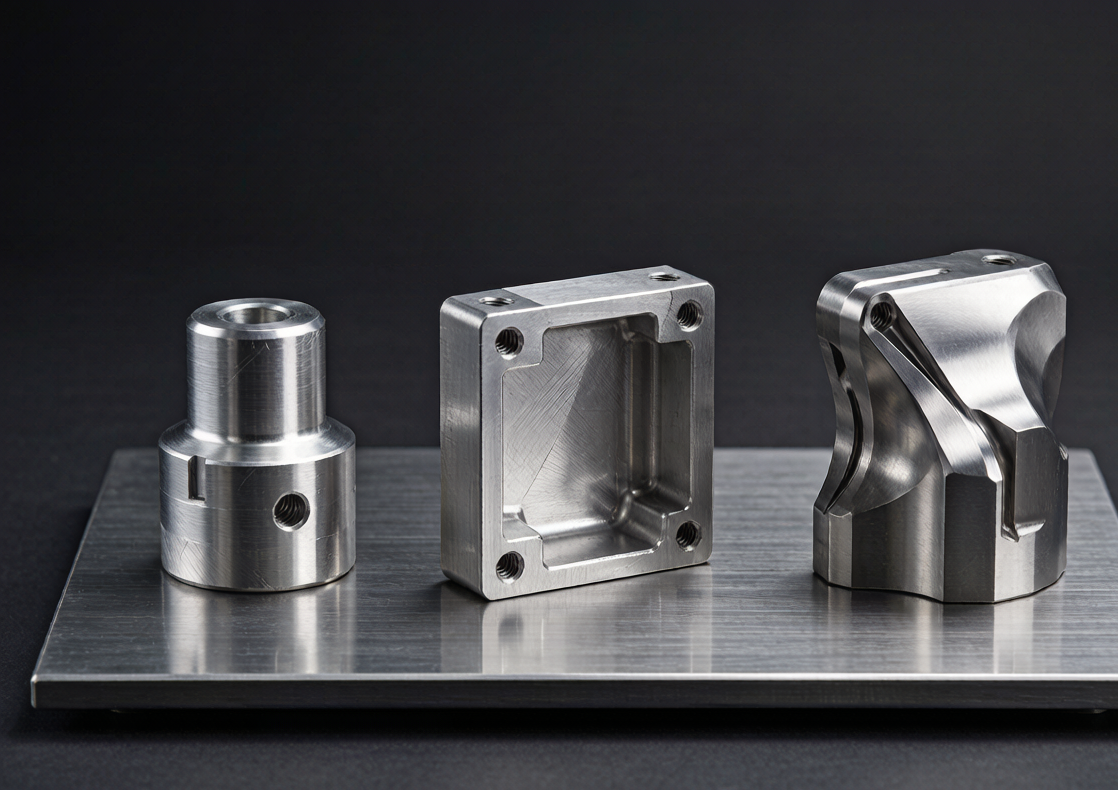
4. Part Complexity & Geometry
“More complex” means specific, billable features — not a vague feeling:
- Deep pockets & deep holes — long tools, slower passes, chatter risk.
- Thin walls — need gentle cuts and support, more time.
- Small / deep holes & internal threads — special tooling, fragile bits.
- Complex curved surfaces & undercuts — 4/5-axis or extra setups.
- Tight internal corners — force smaller end mills, longer milling.
- Hard-to-fixture geometry — custom fixtures = added cost.
- Multiple setups — each re-clamp adds fixed time and risk.
5. Tolerances
Tighter tolerance than the function needs is the most common — and most avoidable — cost add-on. Standard machine capability is cheap; ±0.005 mm needs slow finishing, careful setup, and heavy inspection.
| Tolerance Requirement | Cost Impact |
|---|---|
| Standard (e.g. ISO 2768-m) | Lowest |
| ±0.05 mm | Moderate |
| ±0.02 mm | Higher |
| ±0.01 mm | High |
| ±0.005 mm | Application-dependent / High |
Procurement tip: specify ±0.01 mm only on the critical bore, not on the whole part. A housing with ±0.05 mm general tolerance + ±0.01 mm on one bore is far cheaper — and easier to hold — than ±0.01 mm everywhere. (Goldcattle routinely holds ±0.005 mm where the function demands it.)
6. Surface Finishing
Finishing is a per-part secondary process. We quote it case-by-case (area, batch, and process vary by region & supplier), so treat the table as relative cost, not fixed percentages.
| Finish | Relative Cost |
|---|---|
| As Machined | $ (none) |
| Deburring | $ |
| Brushing | $$ |
| Sand Blasting | $$ |
| Anodizing (Type II/III) | $$ |
| Powder Coating | $$ |
| Electroless Nickel | $$$ |
| Hard Anodizing | $$$ |
| Polishing | $$$ |
7. Order Quantity
This is the lever buyers control most directly. Setup & programming are fixed; spread across more parts, they approach zero per unit.
Worked illustration: Setup + programming = $100 (fixed); machining = $30/part.
1 piece → $100 + $30 = $130/part.
100 pieces → $100÷100 + $30 = ~$31/part (before material & finish).
| Volume | Category | What happens to cost |
|---|---|---|
| 1–5 pcs | Prototype | Setup dominates → highest $/part. |
| 10–50 pcs | Low Volume | Setup shared → noticeable drop. |
| 100–500 pcs | Small Batch | Setup nearly negligible per part. |
| 500–5,000+ pcs | Production | Optimized process → lowest $/part. |
8. Tooling & Fixtures
For low-volume, high-complexity parts we may build a dedicated fixture or order a special cutter. On repeat production this cost is amortized and often disappears from later orders — tell us if the part will reorder, and we plan tooling accordingly.
9. Inspection & Quality Requirements
CMM inspection, First Article Inspection (FAI), and material certifications (EN10204 / mill cert) are defined QC costs. They protect you downstream — and they are exactly what separates a trading agent from a real factory. Goldcattle runs incoming / in-process / final QC across 100+ machines with a 99.8% on-time delivery record.
CNC Machining Cost by Material
Rule of thumb for budgeting: aluminum < brass < stainless < titanium ≈ PEEK on total cost. But always separate “stock price” from “cutting cost” — a cheap material that is slow to machine may not be the cheapest part.
Cheapest to run
Aluminum 6061/7075, ABS, POM — easy cutting, low tool wear, fast cycles.
Mid-range
Brass, mild steel, stainless 304 — harder, slower, but standard.
Higher cost
Stainless 316, hardened steel — work hardening & tool wear.
Premium
Titanium, Inconel, PEEK — material + slow cutting + scrap risk.
CNC Machining Cost by Machine Type
Pick the right process, not the cheapest machine. A part forced onto 3-axis with four setups can cost more (and scrap more) than the same part on 5-axis in one operation.
| Process | Indicative Rate | Best economics when… |
|---|---|---|
| 3-Axis Milling | $35–$60/hr | …part is 2.5D, single/few setups. |
| CNC Turning | $35–$80/hr | …part is rotationally symmetric. |
| 4-Axis | $60–$90/hr | …multi-sided but not full 5-axis. |
| 5-Axis | $100–$200+/hr | …complex geometry where it removes setups/errors. |
Read 5-Axis vs 3-Axis CNC Machining to decide which your part needs.
How Quantity Changes CNC Cost Per Part
The curve is steepest between prototype and ~100 pieces, then flattens as machining time dominates. Plan your first order at a volume that justifies the setup — but don’t over-order before validation. Many buyers run 5–10 pcs to prove the design, then jump to 100–500.

CNC Machining Cost Example: Aluminum Housing
A concrete walk-through beats theory. Parameters:
Material: Aluminum 6061-T6 | Process: 3-axis CNC milling | Finish: Anodized (Type II) | Tolerance: ±0.05 mm | Qty: 10 / 100 / 500 pcs
| Cost Element | Relative Weight | Note |
|---|---|---|
| Material (6061 stock) | $$ | Per-part, scales with volume. |
| Programming | $$ | Fixed — one-time per design. |
| Setup / Fixturing | $$ | Fixed — diluted by quantity. |
| Machining (3-axis) | $$$ | Largest variable at volume. |
| Anodizing | $$ | Per-part secondary process. |
| Inspection | $ | Sampling at volume. |
Illrative per-unit trend (setup $150 fixed; material $14, machining $22, anodize $5, inspection $3 per part):
- 10 pcs → ~$59 / part (setup still a big share).
- 100 pcs → ~$45.50 / part (setup now ~$1.50/part).
- 500 pcs → ~$44.30 / part (setup ~$0.30/part; machining dominates).
These numbers are illustrative to show the shape of a quote — not a price. Send the drawing and we return the real breakdown.

How Much Does 5-Axis, Turning & Milling Cost?
How Much Does 5-Axis CNC Machining Cost?
5-axis hourly rates run $100–$200+, but “expensive per hour” is not “expensive per part.” On a complex aerospace or medical component, 5-axis can collapse 4 setups into 1, cut scrap, and shorten inspection — often beating a cheap-machine multi-op job on total cost and lead time. Use it when geometry or tolerance demands it, not by default.
How Much Does CNC Turning Cost?
Turning (lathe) is usually the lowest-rate CNC process ($35–$80/hr) and the right choice for any shaft, bushing, or rotationally symmetric part. Mill-turn centers add milling capability for one-operation complex parts.
How Much Does CNC Milling Cost?
3-axis milling ($35–$60/hr) covers most brackets, plates, and housings cost-effectively. Move to 4/5-axis only when multi-sided accuracy or complex surfaces require it. See our CNC machining services for capability detail.
10 Ways to Reduce CNC Machining Costs
Most savings come from design, before a chip is cut. These are the changes our engineers flag most often in DFM reviews:
1. Use standard stock sizes
Avoid oversized blanks that waste material and roughing time.
2. Avoid unnecessary tight tolerances
Apply ±0.01 mm only where function needs it (ISO 2768-m elsewhere).
3. Avoid needless complexity
Drop features that add no function but add setups and risk.
4. Design for CNC machining
Features the process makes naturally are the cheapest.
5. Reduce setups
Favor 2-sided or one-op designs; consider 5-axis to cut repositioning.
6. Standard holes & tooling
Use common drill sizes; keep internal radii ≥ 3 mm (R ≥ tool radius).
7. Pick the right process
Turn what is round; mill what is flat; don’t over-specify 5-axis.
8. Optimize finishing
Specify finish only on visible/functional faces, not the whole part.
9. Consolidate similar parts
One fixture run for a family of parts lowers total setup.
10. Order the right quantity
Validate at low volume, then batch to dilute setup cost.
Is CNC Machining the Cheapest Manufacturing Process?
No single answer — it depends on volume and part nature. CNC wins on low/medium volume and precision; tooling-heavy processes win at scale.
| Process | Best For | Typical Volume | Tooling |
|---|---|---|---|
| CNC Machining | Low–medium volume precision parts | 1–5,000+ | Low |
| 3D Printing | Prototypes / complex shapes | 1–100 | Very low |
| Injection Molding | High-volume plastic parts | 1,000+ | High |
| Die Casting | High-volume metal parts | 5,000+ | High |
| Sheet Metal | Thin metal components | 10–10,000+ | Low–Medium |
Takeaway: CNC is often the most economical choice for prototypes, low-volume production, and high-precision components. Tooling-intensive processes pull ahead only at higher volumes. Compare in our CNC vs Additive Manufacturing guide.
Is CNC Machining Cheaper in China?
Often yes — but “cheaper unit price” is the wrong single metric. Evaluate total landed cost.
Why Chinese CNC can be cost-competitive
- Manufacturing scale — deep supplier ecosystem and material sourcing.
- Process integration — one factory covering CNC, injection, die casting, sheet metal (Goldcattle runs all six).
- Equipment depth — 100+ machines including Haas & DMG, 24/7 capacity.
- Experience — 26 years, 100+ countries shipped, 99.8% on-time delivery.
What to weigh beyond unit price
Quality · Shipping & duties · Communication · Inspection · Tooling · Lead time · Certifications (ISO 9001:2015, SGS, RoHS, Rmbond) · Defect rate · Rework · total landed cost. A low unit price with high scrap or long lead time is not cheap.
What Do You Need for an Accurate CNC Quote?
The more complete your package, the tighter (and faster) our quote. Minimum viable set first:
| Information | Why It Matters |
|---|---|
| 3D CAD (STEP / IGES / SolidWorks) | Geometry & machinability analysis. |
| 2D Drawing | Dimensions, tolerances, critical features. |
| Material | Material cost & cutting strategy. |
| Quantity | Setup allocation & process choice. |
| Surface Finish | Secondary process cost. |
| Tolerances | Machining difficulty & inspection. |
| Application | Quality & cert requirements. |
| Target Lead Time | Production planning & scheduling. |
| Inspection Requirements | CMM / FAI / certs → QC cost. |
How Goldcattle Quotes Custom CNC Parts
Buyers don’t only ask “how much?” — they judge “is this quote professional?” Our quoting logic (not trade secrets, just the process):
Request a CNC Machining Quote
Send your drawing and we return a project-specific, itemized quote — usually within 24 hours. 100% Secure & NDA Protected.
To get a precise, itemized quote, prepare: 3D CAD (STEP / IGES / SolidWorks) + 2D drawing, your material, quantity, surface finish, tolerances, application, and any inspection requirements. Our engineering team reviews every drawing and replies with a project-specific quote — usually within 24 hours, 100% NDA protected.
Prefer email? Send your drawing to our engineering team and reference “CNC Cost Page inquiry.” Full specs & file formats are also covered in How to Custom CNC Machining Parts.
Frequently Asked Questions
1. How much does custom CNC machining cost?
Custom CNC machining typically runs $35–$200+ per hour, or about $5–$500+ per part, depending on material, geometry, tolerances, volume, and finish. Prototypes often start around $50–$200 each, while optimized production can cut per-unit cost by up to 70%. The only accurate number comes from a drawing — use our ranges to budget, then request a project-specific quote.
2. How much does CNC machining cost per part?
There is no single per-part price because every component is different. A simple aluminum bracket in volume may be a few dollars; a tight-tolerance titanium part can be hundreds. Cost per part = (fixed setup ÷ quantity) + material + machining time + finishing + inspection. More parts dilute the setup, which is why volume sharply lowers unit price.
3. How much does CNC machining cost per hour?
Indicative 2026 machine-hour rates: 3-axis milling $35–$60, CNC lathe $35–$80, 4-axis $60–$90, 5-axis $100–$200+, Swiss $80–$180. Hourly rate is only one input — total cost also depends on how many hours your part needs, which is set by geometry, material, and tolerances.
4. Why are CNC prototypes more expensive per part?
Because setup, programming, and first-article inspection are fixed costs. On 1–5 pieces they are spread over very few parts, so each unit carries most of that overhead. At 100+ pieces the same fixed cost is diluted to near zero per unit, which is why prototypes look “expensive” relative to production.
5. Does CNC machining get cheaper in larger quantities?
Yes — significantly, up to a point. Example: $100 setup + $30/part machining = $130 for one piece but ~$31/part at 100 pieces (before material/finish). The biggest drop is between prototype and ~100 pieces; beyond that, machining time dominates and savings flatten. Right-sizing your first order matters.
6. What material is cheapest for CNC machining?
Aluminum 6061 is usually the cheapest overall — low stock cost and fast, low-wear cutting. ABS and POM plastics are similarly economical. Brass machines well but costs more in material. Stainless, titanium, and PEEK add both material and machining cost, so reserve them for where performance requires.
7. Does aluminum CNC machining cost less than stainless steel?
Almost always, yes. Aluminum cuts faster with less tool wear and lower stock cost than stainless 304/316, so both cycle time and consumables are lower. Stainless also work-hardens and needs slower feeds. If corrosion resistance isn’t required, aluminum is the cost-smart default for most parts.
8. Is 5-axis CNC machining more expensive?
Per hour, yes ($100–$200+). Per part, not necessarily. On complex geometries, 5-axis can replace multiple 3-axis setups, custom fixtures, and repositioning — reducing scrap and inspection. For simple parts it’s overkill; for complex ones it can be the cheaper total solution. We advise the right process, not the priciest machine.
9. How much does tolerance affect CNC machining cost?
Standard tolerance (ISO 2768-m) is cheapest. Tightening to ±0.05 mm adds moderate cost; ±0.01 mm or ±0.005 mm needs slow finishing, careful setup, and heavy inspection — often 30–100% more. Specify tight tolerance only on critical features; general ±0.05 mm with ±0.01 mm on one bore is far cheaper than ±0.01 mm everywhere.
10. How much does anodizing add to CNC machining cost?
Anodizing is a per-part secondary process we quote case-by-case (it varies with part area, batch size, and process). Treat it as a moderate add-on versus as-machined. We’ll itemize it in your quote rather than quote a fixed percentage, because area and volume change the real cost substantially.
11. Is CNC machining cheaper than 3D printing?
For one or a few prototypes of a simple shape, 3D printing is often cheaper and faster. For functional, precise, or production parts — especially metal — CNC is usually more economical and stronger. 3D printing shines at complex single shapes; CNC wins on volume, accuracy, and material properties. See our CNC vs Additive guide for detail.
12. What information do I need for an accurate CNC quote?
Send a 3D CAD file (STEP/IGES/SolidWorks) plus a 2D drawing with dimensions and tolerances, your material, quantity, surface finish, application, target lead time, and any inspection needs (CMM/FAI/certs). The more complete the package, the tighter and faster our quote — typically within 24 hours.
13. Can you quote a single prototype?
Yes. We quote from 1 piece upward — no minimum order value. A single prototype carries the full setup cost, so it is the highest per-unit price, but it’s the right way to validate design and fit before committing to volume. Many customers then reorder at 100–500 pcs to capture the setup dilution.
14. Can I reduce the price through DFM?
Usually, yes — often 20–40%. Common wins: standard stock sizes, tolerances only where functional, internal radii ≥ 3 mm, fewer setups, standard hole sizes, and finish only on visible faces. Our engineers review every drawing and propose DFM changes that cut cost without hurting performance. Send your CAD and we’ll show you the options.
Get Your CNC Machining Quote
Upload your CAD file or drawing and tell us material, quantity, and requirements. Our engineering team reviews your project and returns a project-specific, itemized quote — usually within 24 hours, 100% NDA protected.