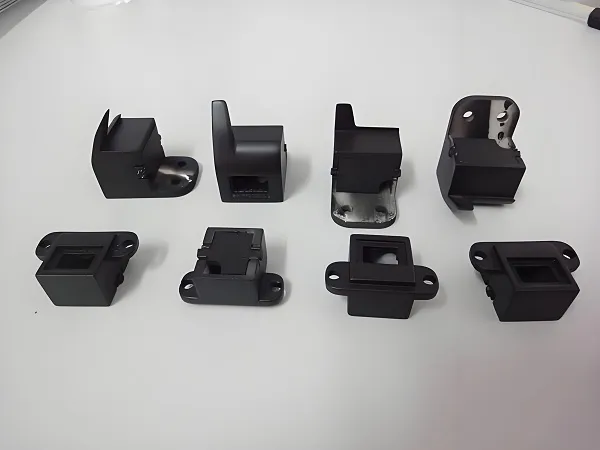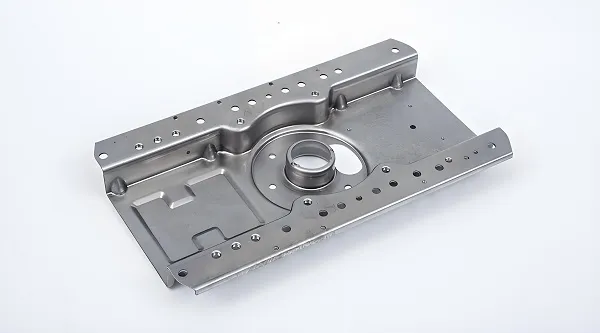
Precision CNC machining of titanium components for medical devices, surgical instruments and qualified implant-related applications, with material traceability, dimensional inspection and project-specific quality documentation.
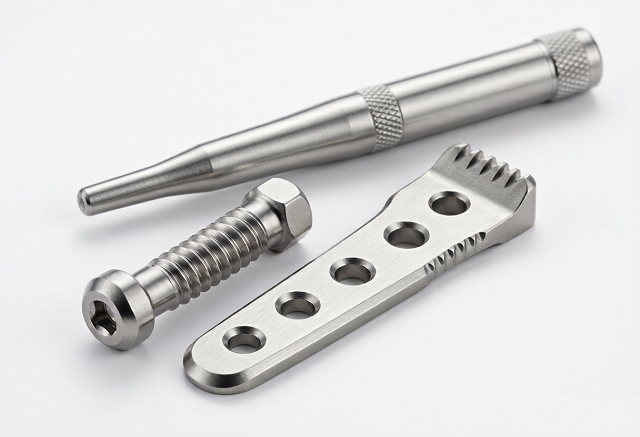
Medical Manufacturing Scope
We machine components for medical-device and healthcare applications according to customer drawings, material specifications and quality requirements. Regulatory approval, biocompatibility, sterilization validation and finished-device compliance remain application- and customer-specific. Material grading, process qualification and traceability are confirmed per project before production.
Why Is Titanium Used in Medical Devices?
Titanium is selected for medical applications because of specific engineering properties. The relevance of each property depends on the device, the load case and the governing specification — not on marketing claims.
Biocompatibility
For a given device, material conformity must match the specified standard and the finished-product regulatory requirement. Titanium grades such as Ti-6Al-4V ELI are widely referenced for implant-related work, subject to the applicable specification.
High Strength-to-Weight Ratio
Titanium provides steel-like strength at roughly 40–45% lower density, which reduces mass where weight-sensitive structural components matter.
Corrosion Resistance
A stable passive surface makes titanium suitable for long service in bodily-fluid and sterilizable environments, depending on grade and condition.
Modulus Considerations
Compared with many steels, titanium's lower modulus is meaningful in specific implant contexts — but the choice must follow the device engineering, not a generic "better" claim.
Non-Magnetic Behavior
Many titanium alloys are generally non-ferromagnetic, useful for MRI-adjacent equipment — confirmation is required against the specific system and field condition.
Osseointegration
Certain titanium surfaces support bone apposition in qualified implant programs. Surface state, cleanliness and specification drive the result, not the base metal alone.
Medical Titanium Grades We Machine
We work to the grade written on your drawing or purchasing specification. The most common medical titanium grades we machine are below.
Ti-6Al-4V
General high-strength titanium alloy for surgical instruments, housings, fixtures and structural medical components.
Ti-6Al-4V ELI
Extra-low-interstitial variant referenced for implant-related applications. Customers commonly specify it to a standard such as ASTM F136 rather than simply "medical titanium".
Commercially Pure Titanium
Lower-strength, high-ductility grade for specific components where corrosion resistance and formability lead. Grade and condition per device requirement.
Grade Selection at a Glance
| Material | Typical Role | Key Consideration |
|---|---|---|
| Ti-6Al-4V | General high-strength medical components | Widely used titanium alloy |
| Ti-6Al-4V ELI | Implant-related applications | Extra-low-interstitial specification |
| Commercially Pure Titanium | Specific lower-strength applications | Depends on device requirements |
| Other titanium grades | Specialty applications | Must match customer specification |
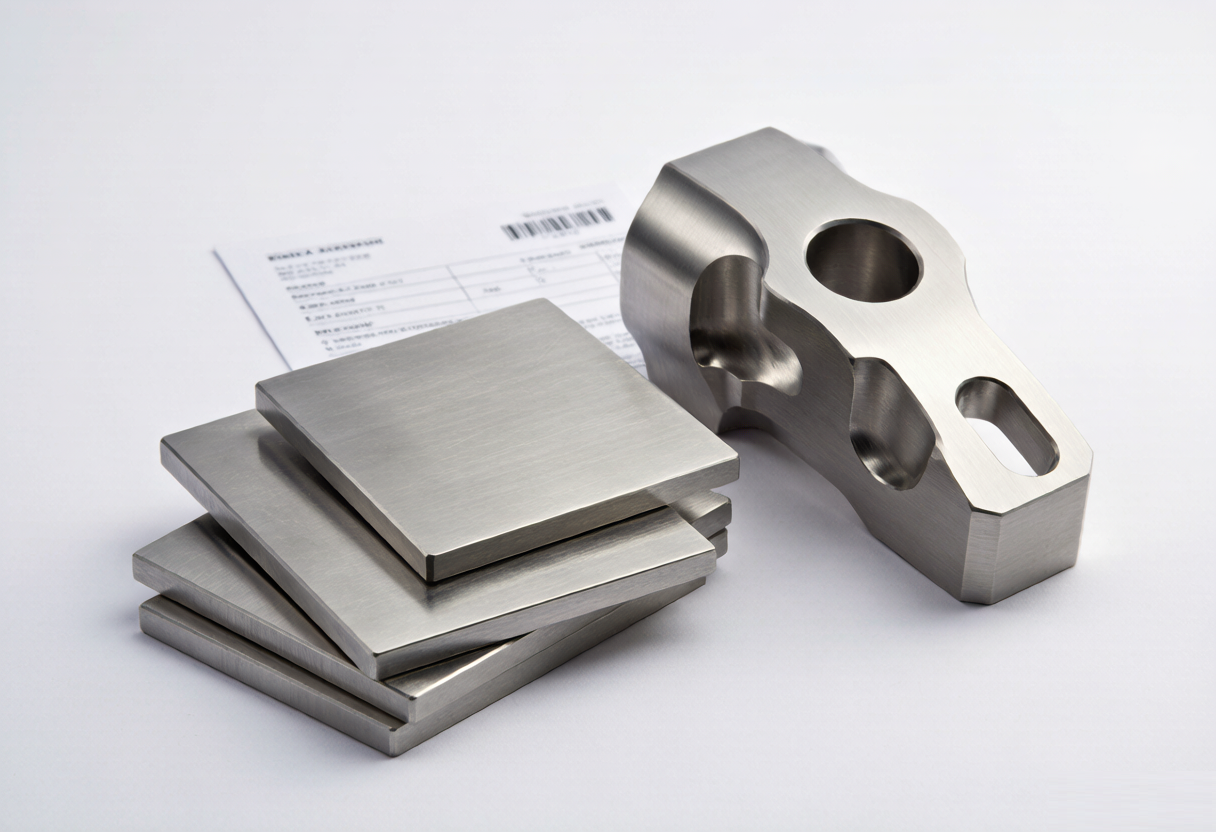
Material grade, temper/condition and governing specification should be stated on the drawing or purchasing specification. Do not specify only "medical titanium" — the exact standard determines inspection and certification.
Ti-6Al-4V vs Ti-6Al-4V ELI
ELI means Extra Low Interstitials. It is a material-specification choice tied to application requirements — not simply a "stronger version" of standard Ti-6Al-4V.
Ti-6Al-4V (Grade 5)
- Balanced strength and machinability
- Broad use across instruments and structural parts
- Standard interstitial limits per grade spec
Ti-6Al-4V ELI (Grade 23)
- Lower oxygen, carbon, nitrogen and iron content
- Referenced for implant-related applications
- Usually specified to ASTM F136 or equivalent
The correct choice follows the device's material standard and risk file. We machine to whichever grade your specification defines and provide the corresponding material certificate.
Why Use CNC Machining for Medical Titanium?
Tight Dimensional Control
Suited to bores, interfaces, bone-contact features and instrument geometry where fit drives function.
Complex Geometry
Orthopedic components, surgical instruments, custom housings and fixtures with multi-surface features.
Repeatability
Consistent output from prototype → low volume → production under a controlled process plan.
Material Integrity
CNC removes material rather than melting the whole part, avoiding bulk metallurgical change from fusion — while cutting heat, tool wear and residual stress still require control.
Multi-Axis Machining
5-axis adds value for curved surfaces and multi-datum features. Capability does not by itself guarantee a medical tolerance — see inspection below.
Documentation Link
Each machined lot can be tied to material cert, inspection report and work order for traceability.
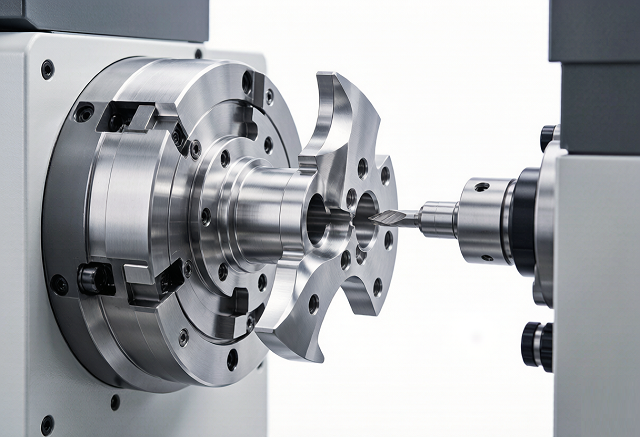
5-Axis CNC Machining for Medical Titanium
Complex curved surfaces and multi-sided features are common in orthopedic and instrument work. 5-axis machining reduces setups and re-fixturing.
- Complex curved surfaces with fewer setups
- Multi-sided features in one clamping
- Better tool access to deep or angled geometry
- Stronger datum consistency across features
- Reduced handling for delicate titanium parts
What Makes Titanium Difficult to Machine?
Titanium is a technically demanding material. Naming the challenge is how a supplier shows it understands the process.
Cutting heat concentrates at the tool edge rather than dissipating into the workpiece.
Thermal management through coolant strategy, cutting-parameter selection and tool-condition monitoring.
Wrong tool path or rubbing can harden the surface and accelerate wear.
Defined depths of cut and sharp tooling to maintain a steady shear, avoiding dwell and friction.
Titanium attacks tool edges faster than many steels.
Tool-life control and grade-appropriate carbide with suitable coating and geometry.
Long features and thin walls flex under load, risking tolerance loss.
Rigid setups, staged roughing/finishing and reduced-reach tooling where needed.
Medical parts need controlled surfaces, not just a number on a print.
Process plan plus inspection of critical surfaces and finishes per requirement.
Cutting parameters are selected according to alloy grade, part geometry, tool geometry, machine rigidity and thermal-management needs — not taken from a fixed public table.
Medical Titanium CNC Machining Process
Every stage links to the applicable drawing and quality requirements.
Grade, condition and standard defined by the customer drawing.
MTR / heat-lot verified before issue.
Feature, datum and tolerance review before programming.
Tool path and thermal strategy planned per feature.
Staged removal to control heat and deflection.
Edge control appropriate to the application.
Per specified finish or cleaning requirement.
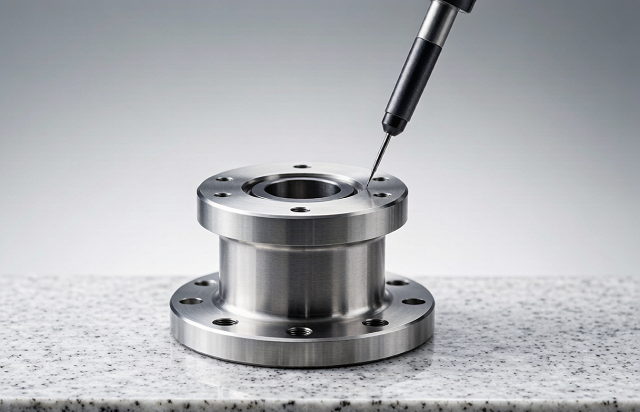
CMM and gauges on critical features.
Reports and traceability compiled for shipment.
Design Guidelines for Medical Titanium Parts
Thin Walls
Keep minimum wall thickness realistic for titanium; confirm with the quoted process plan.
Deep Cavities
Tool length and rigidity constrain depth — discuss early in DFM.
Small Features
Micro features need tool access and inspection method agreed up front.
Complex Surfaces
5-axis helps, but datum strategy defines repeatability.
Datum Strategy
Clear primary/secondary datums reduce setup error on critical features.
Tolerance Allocation
Apply tight tolerances only to CTQ features to protect cost and yield.
Medical Titanium CNC Tolerances
Goldcattle publishes CNC machining capability down to ±0.005 mm, with project-specific tolerance depending on geometry, feature size, setup, material condition, thermal control and inspection strategy. Medical parts are judged on drawing critical features, not a blanket number.
| Requirement | Approach |
|---|---|
| General dimensions | Standard CNC process control |
| Tight tolerance | Dedicated process plan and datum strategy |
| GD&T | CMM measurement against the drawing |
| Critical surfaces | Controlled finishing + inspection |
| Complex geometry | 5-axis machining + CMM |
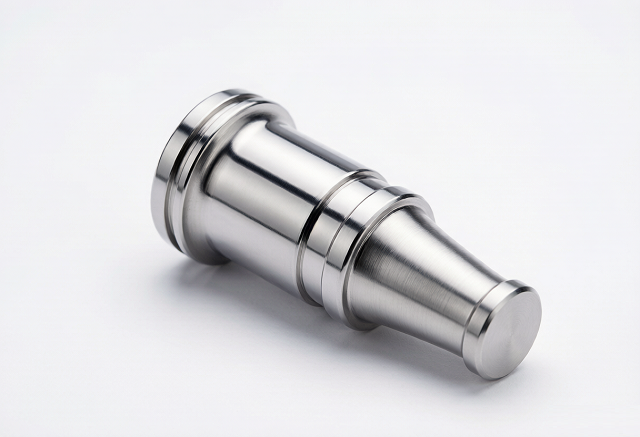
Surface Finishing for Medical Titanium
Finish options are selected to the device requirement — not as a generic "biocompatible" claim.
- As-machined
- Polishing / electropolishing where specified
- Passivation where applicable to the grade and process
- Anodizing for suitable non-implant components
- Bead blasting / textured finishes
- Coating where the specification requires it
Cleaning & Contamination Control
Medical parts are not finished like general industrial components. Handling and cleanliness affect acceptance.
Dedicated Cleaning
Residual cutting fluid and particulate removal per the agreed process.
Particulate Control
Handling and packaging steps defined to limit contamination.
Protective Packaging
Segregated, labeled packaging tied to lot traceability.
Controlled cleaning and packaging are provided according to project requirements. Claimed cleanroom classifications are stated only where a qualifying certification and monitoring record exist.
Material Traceability & Documentation
In medical programs, "no record" means "did not happen." We link each part back to its source material.
Grade and supplier recorded.
Identification carried forward.
MTR / MTC attached.
Production batch linked.
Lot traceable to shipment.
Documents Available by Project
| Document | Purpose |
|---|---|
| Material Certificate (MTR / MTC) | Material conformity |
| Heat / Lot Traceability | Material traceability |
| Dimensional Inspection Report | Part dimensions |
| CMM Report | Critical geometry |
| FAI / FAIR | First article |
| Certificate of Conformance (CoC) | Conformance statement |
| Surface Roughness Report | Surface requirement |
| Cleaning / Process Record | Manufacturing traceability |
Documents are provided according to the project's quality requirements — not every order automatically receives the full set. State needed reports in the RFQ.
Medical Titanium Inspection & Quality Control
Inspection is staged, not a single pass at the end.
- Material verification — alloy, grade, specification, heat/lot.
- Dimensional inspection — key dimensions against the print.
- GD&T — geometrically tolerated features measured where defined.
- CMM — Zeiss CMM for critical geometry and datums.
- Surface roughness — per specified Ra / finish.
- Visual / workmanship — defined acceptance criteria.
- Critical-feature inspection — CTQ features recorded.
- Final documentation — reports compiled for release.
ISO 13485, FDA QMSR & Medical Quality Requirements
Medical buyers must separate supplier-level claims from product-level regulations. These terms are not interchangeable.
| Item | What It Means |
|---|---|
| ISO 13485 | Medical-device quality management system standard. |
| FDA QMSR | U.S. medical-device quality-system regulation; effective February 2, 2026, incorporating ISO 13485:2016 by reference. |
| ASTM F136 | Material specification for wrought Ti-6Al-4V ELI surgical implant applications. |
| FDA device authorization | Product-specific regulatory status of the finished device. |
| MTR / MTC | Material verification document. |
Titanium vs 316L Stainless Steel
| Factor | Titanium | 316L Stainless Steel |
|---|---|---|
| Weight | Lower | Higher |
| Strength-to-weight | Excellent | Good |
| Corrosion resistance | Excellent | Excellent |
| Modulus | Lower | Higher |
| Machinability | More demanding | More straightforward |
| Cost | Higher | Usually lower |
| Typical uses | Weight-sensitive / implant-related | Instruments / general medical |
| Magnetic behavior | Generally non-ferromagnetic | Depends on condition/alloy |
Choose titanium when low weight + high strength + application-specific performance matter. Choose 316L when cost, stiffness and conventional fabrication lead.
CNC vs Metal 3D Printing for Medical Titanium
| Factor | CNC | Metal 3D Printing |
|---|---|---|
| Material | Wrought billet / bar | Powder |
| Surface finish | Usually better direct from machining | Often needs finishing |
| Dimensional control | Excellent for many features | Geometry-dependent |
| Complex internal channels | Limited | Strong |
| Traceability | Relatively straightforward | Powder/process control important |
| Best use | Precision interfaces | Lattice / complex lightweight |
For geometry exploration and complex internal structures, metal 3D printing may fit; for tight dimensional interfaces and precision finishing, CNC is the stronger route. We can advise the right process per part.
Medical Titanium CNC Applications
Orthopedic Components
Bone-fixation components, instrument bodies, trial components — machined to drawing.
Surgical Instruments
Handles, cutting and positioning components, instrument bodies.
Dental
Abutment-related parts and surgical dental tooling per specification.
Diagnostic / Lab Equipment
Housings, fixtures and mechanical components.
Rehab / Prosthetic
Lightweight structural parts, connectors, custom components.
Implant-Related
Machined only where the customer's qualified program, material certification and regulatory basis support it.
Medical Titanium CNC Case Study
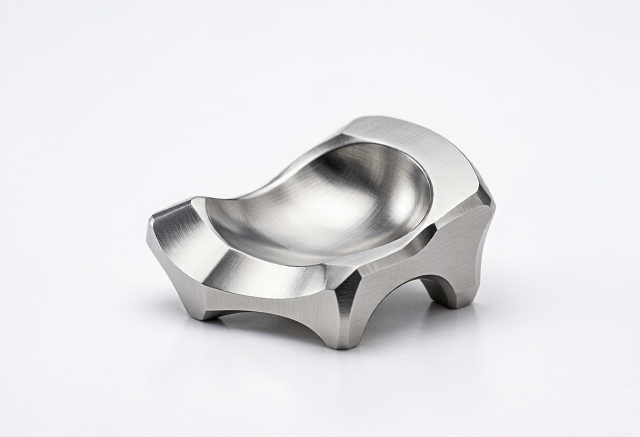
| Part type | Orthopedic / surgical component (customer-specified) |
| Material | Ti-6Al-4V ELI, to ASTM F136 |
| Process | 5-axis CNC machining |
| Key requirements | Complex geometry, tight tolerance, controlled surface |
| Inspection | CMM + dimensional report |
| Documentation | Material certificate + traceability + FAI |
| Quantity | Prototype / low volume |
| Outcome | Customer-approved parts |
Shown as a capability example. Actual project data is shared under NDA and only with customer authorization.
Why Medical Device Companies Work With Goldcattle
Titanium Machining
Ti-6Al-4V / Ti-6Al-4V ELI machined to customer specification.
5-Axis CNC
Complex geometry and multi-sided features with fewer setups.
CMM
Zeiss CMM for critical dimensions and datums.
Material Traceability
Material certificate and lot traceability per project.
FAI on Request
First-article documentation where the project requires it.
Prototype → Production
One partner from sample through repeat production.
How Much Does Medical Titanium CNC Machining Cost?
Cost is driven by material and process factors, not a flat per-part price.
Material
Titanium stock cost and grade (ELI carries a premium).
Geometry
Blank size, material removal and thin-wall risk.
Machining
Cycle time, tool wear and 5-axis programming.
Tolerance
Tight CTQ features need dedicated process plans.
Finish & Inspect
Surface treatment, CMM and documentation.
Quantity
Volume spreads setup and programming cost.
For medical projects, the cheapest machining quote is not necessarily the lowest total cost — rework, missing traceability and incomplete documentation raise total cost of ownership.
How Long Does Medical Titanium CNC Machining Take?
Lead time is a chain, not a single number. Typical planning ranges are confirmed per project.
DFM and datum strategy.
Verify grade and heat/lot.
CAM and thermal plan.
Rough / finish stages.
Specified surface / clean.
CMM and reports.
Compile certificates.
Protected packaging.
What Should You Include in a Medical CNC RFQ?
The more precisely you specify, the more accurate the quote and the safer the program.
Part & Material
- CAD file (STEP / IGES / DWG / DXF)
- Titanium grade & specification (e.g. ASTM F136)
- Part name and function
- Quantity and annual volume
Requirements
- Critical tolerances / GD&T
- Surface roughness and finish
- Cleaning / packaging needs
- Required inspection reports
Compliance
- Material certificate requirement
- NDA / IP protection need
- Regulatory basis (if known)
- Target delivery date
Frequently Asked Questions
What titanium is best for medical CNC machining?
What is Ti-6Al-4V ELI?
Is Ti-6Al-4V suitable for medical implants?
What is ASTM F136?
Why is titanium difficult to CNC machine?
Can titanium medical parts be machined on a 5-axis CNC?
What tolerances can medical titanium CNC achieve?
How is titanium material traceability maintained?
What quality inspections should a medical CNC supplier provide?
Does medical titanium CNC require ISO 13485?
What is the difference between ISO 9001 and ISO 13485?
Is FDA approval required for a medical CNC supplier?
Can you provide CMM and material reports?
Can titanium CNC parts be electropolished or passivated?
Can you manufacture orthopedic or dental components?
How much does medical titanium CNC machining cost?
How long does it take?
Request a Medical Titanium CNC Quote
Send your CAD file and specification. We will respond with grade options, process route, tolerance capability and a quote sized to your quantity — under NDA.
Accepted files: STEP · IGES · DWG · DXF · PDF · STL