Custom injection-molded refrigerator plastic parts for OEMs and ODMs — crisper drawers, door bins, trays, air ducts, covers and functional components — manufactured to your drawings. Each project is reviewed for material, low-temperature behavior, dimensional fit, tooling and repeat production before the quote is confirmed. Parts outside the verified molding envelope are evaluated on their own, not treated as standard capability.
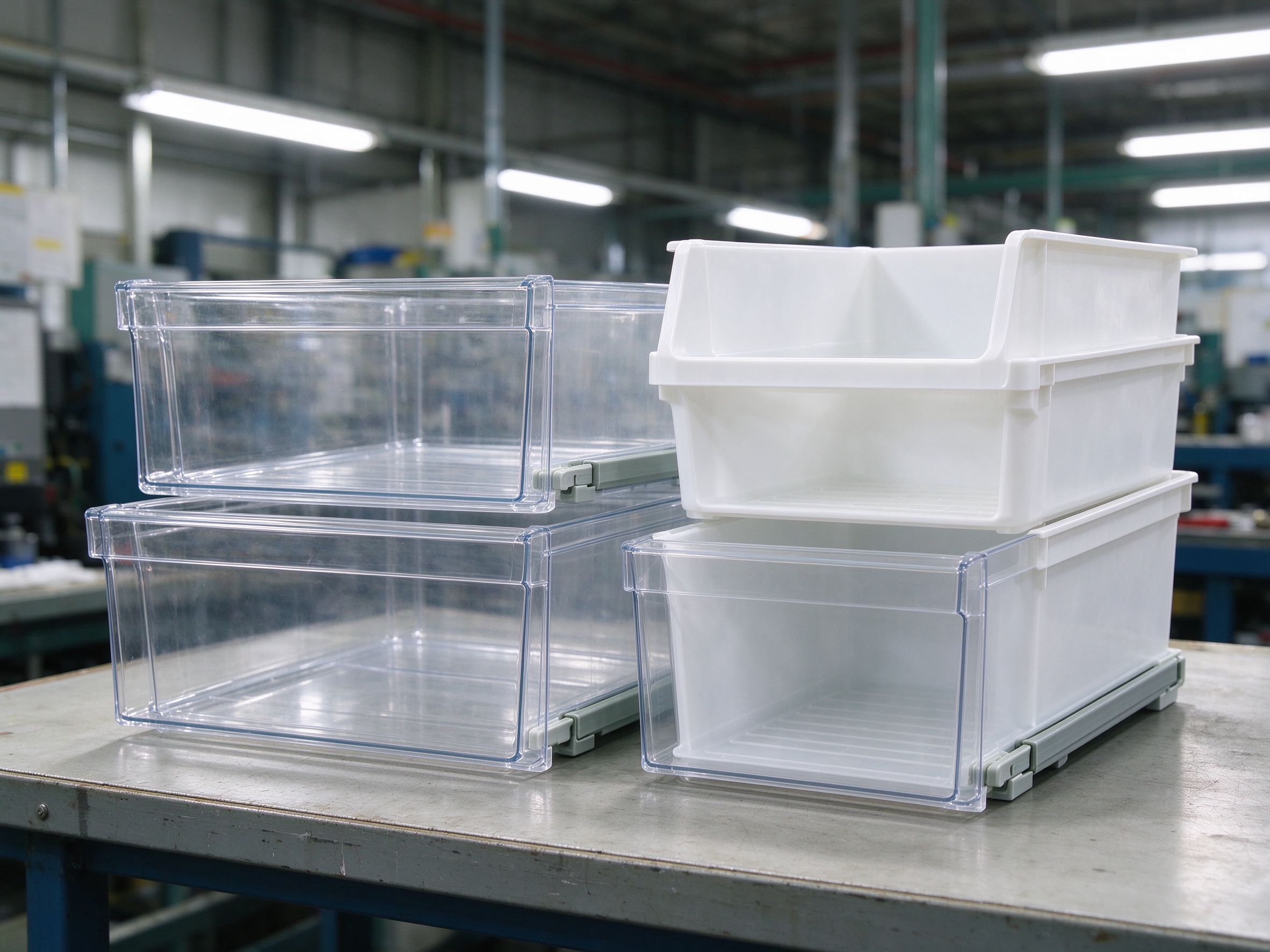
Goldcattle molds refrigerator plastic components to your drawings — drawers, bins, trays, air ducts, covers and functional housings within our verified injection molding envelope. Material choice is reviewed against operating temperature, transparency, impact and chemical exposure; fit and warpage are controlled at design and trial stage; and repeat orders are managed with material, color and mold records. Parts outside the standard envelope (large liners, hollow vessels, high-cosmetic transparent optics) are assessed per project instead of being presented as standard capability.
Refrigerator Components We Can Evaluate
Crisper drawers & storage bins
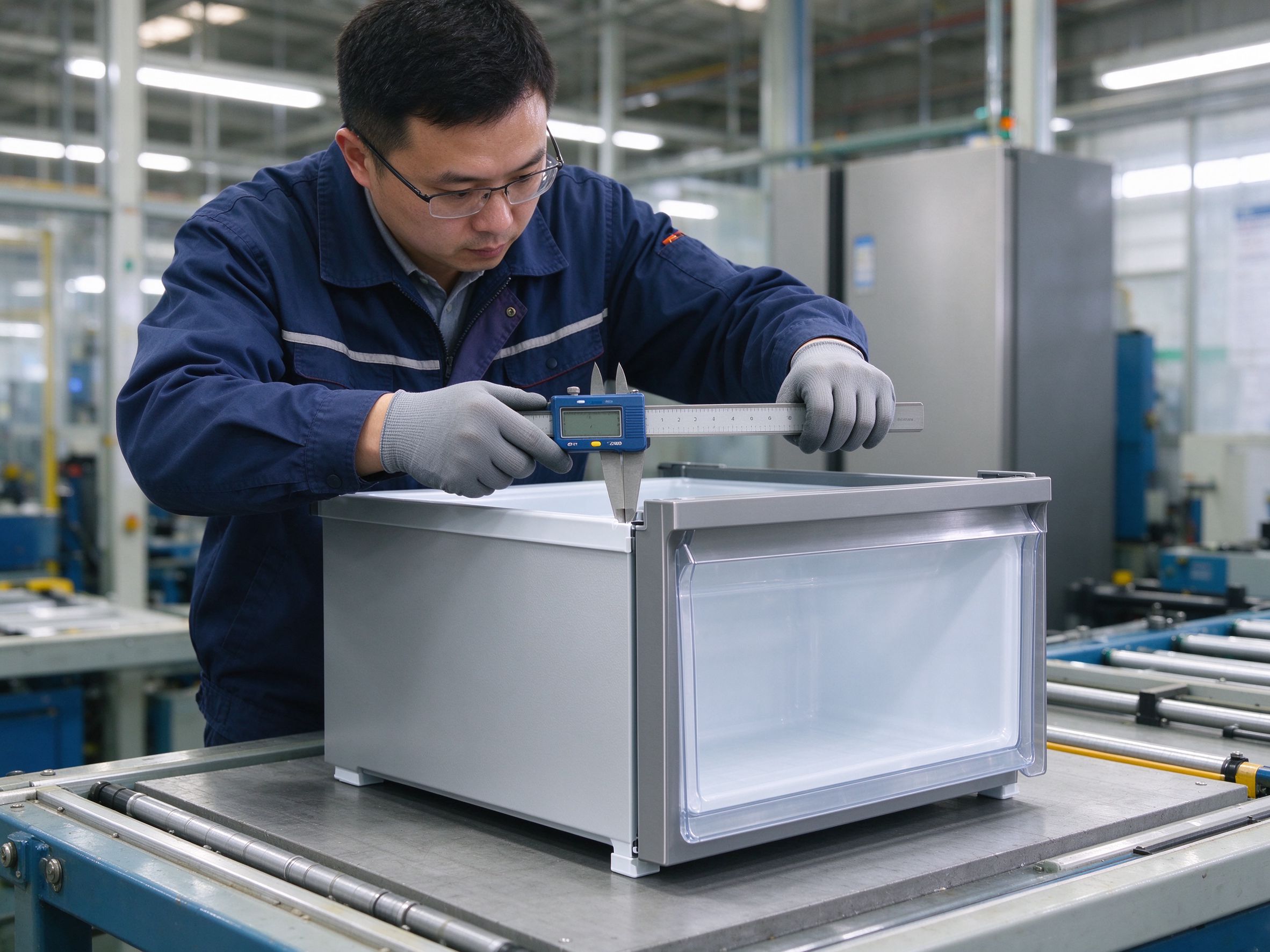
Transparency or color, low-temperature impact, edges and clips, slide clearance, load deflection and cleaning. Drawer structure, dimensions and assembled state are reviewed from the drawing.
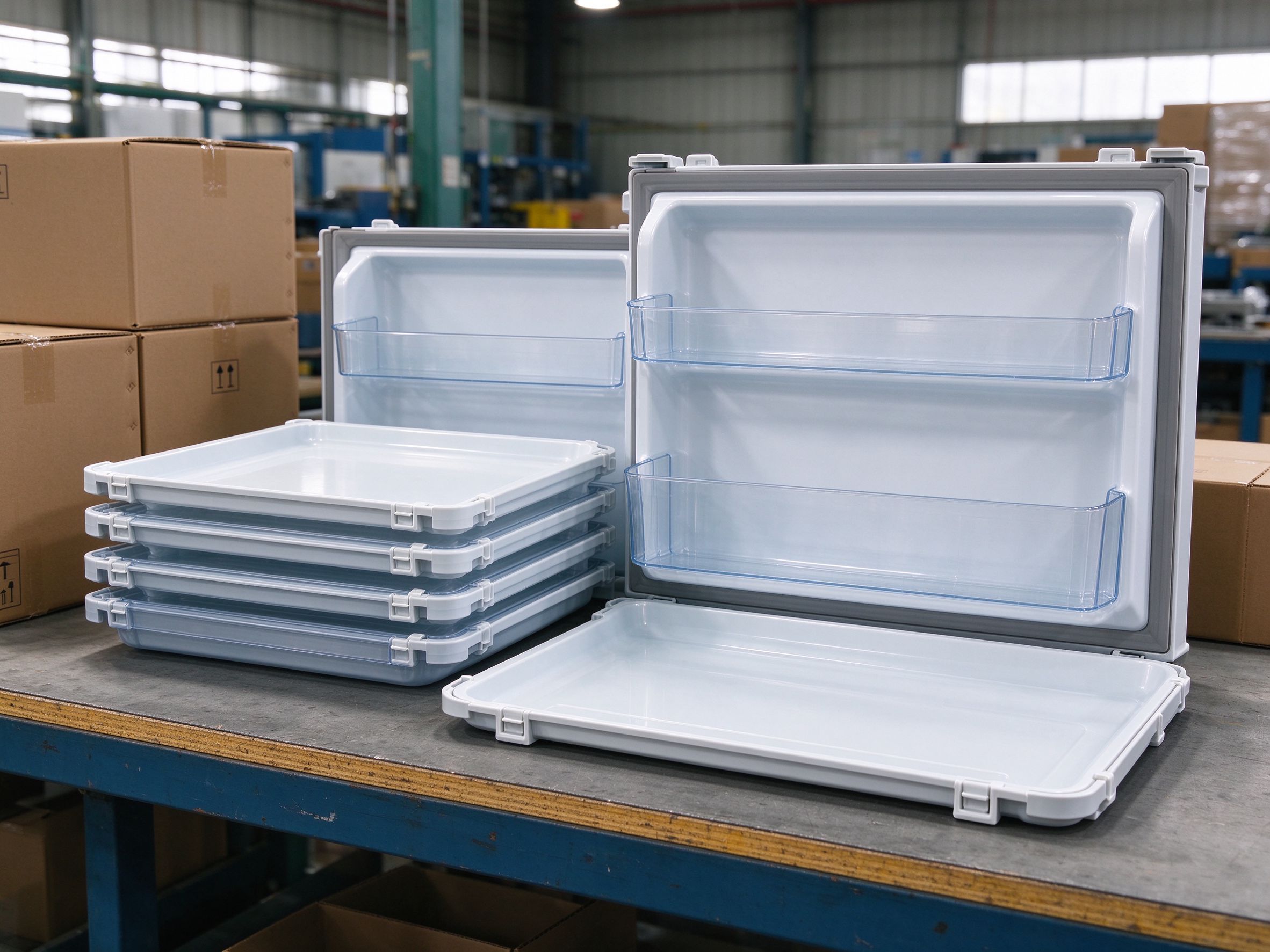
Door bins & trays
Load, snap locations, wall thickness uniformity, impact resistance and fit to the door liner. Mounting interfaces and critical dimensions matter more than the front view.
Air ducts, fan shrouds & internal covers
Assembly hole patterns, duct geometry, wall thickness, stiffness, warpage and coordination with fans or other parts. Airflow, noise or air-distribution tests are scoped per project when specified.
Brackets, supports, trim & covers
Bosses, clips, hole pitches, locating datum, fit and assembly clearance. Structural parts with clear dimensional and function requirements suit engineering-driven B2B procurement.
Functional housings & water-related components
Material and media compatibility, sealing interfaces, assembly structure and leak verification where applicable. Hollow water tanks are reviewed for blow molding or another route before molding is assumed.
What is not treated as a standard claim: large refrigerator liners or thin-wall structures beyond the verified press envelope (about 400 × 400 × 300 mm typical max part size on the current machines), hollow or large parts needing dedicated blow molding or thermoforming, unverified optical or high-cosmetic parts, and products needing specific food-contact files, special low-temperature tests or customer-designated certifications that are not yet supported.
Material Selection for Refrigerator Parts
| Material direction | Candidate use | What must be considered |
|---|---|---|
| PP | Drawers, covers, some storage and functional components | Low-temperature impact, stiffness, shrinkage, warpage, chemical resistance |
| HIPS / PS | Selected storage boxes, internal parts, some appearance parts | Transparent or opaque requirement, impact, service temperature, surface quality |
| SAN | Transparent drawers and storage parts | Transparency, notched impact, assembly stress, detergent compatibility |
| ABS | Appearance frames, functional housings, structural parts | Impact, color, surface treatment, long-term environment |
| PC | Parts needing transparency or specific impact performance | Stress cracking, chemical resistance, surface scratch, cost |
| PA / POM | Mechanical movement, guides or wear-resistant structures | Friction, wear, moisture or dimensional change, fit and life |
These are candidate directions to evaluate, not fixed matches. The final choice follows the resin supplier's data sheet, specific grade, color, thickness, actual temperature and use requirements. Absolute claims such as "PP always survives low temperature" or "PC never cracks" are avoided — the fresh-food zone and freezer zone are not the same condition.
Cold-Temperature Performance and Fit
Low-temperature performance is confirmed by material and design validation, not by comparing room-temperature datasheet values:
- Impact and embrittlement risk at the buyer's specified temperature condition
- Clips, thin walls, bosses and guide structures reviewed for cold-condition risk
- Drawer and door bin fit, slide clearance and mounting verified
- Load, deflection and hot-cold cycling tests scoped from the application
Where no project record exists yet, this is offered as the DFM and validation plan for the part, not as a finished fixed-test service.
Process Route Choice: Not Everything Is Injection Molding
| Part feature | Route to evaluate | Decision focus |
|---|---|---|
| Rigid drawers, bins, covers, brackets | Injection molding | Tooling investment, cavity count, structure, part cost |
| Hollow water tanks and vessels | Blow molding or other suitable route | Hollow structure, wall thickness, sealing, part size |
| Large, deep-draw liners | Thermoforming / vacuum forming | Size range, wall distribution, tool cost, follow-up work |
| Soft-hard combined parts | Overmolding or multi-material molding | Material compatibility, bond strength, mold structure |
| Function parts with metal inserts | Insert molding or post-mold assembly | Insert positioning, joint strength, dimensional inspection |
The page presents Goldcattle's injection molding capability, and the engineering review states when another route fits better. Blow molding or thermoforming is only treated as a confirmed service where that capability is actually in place.
Mold, Cost and Production Volume
| Factor | What the review covers |
|---|---|
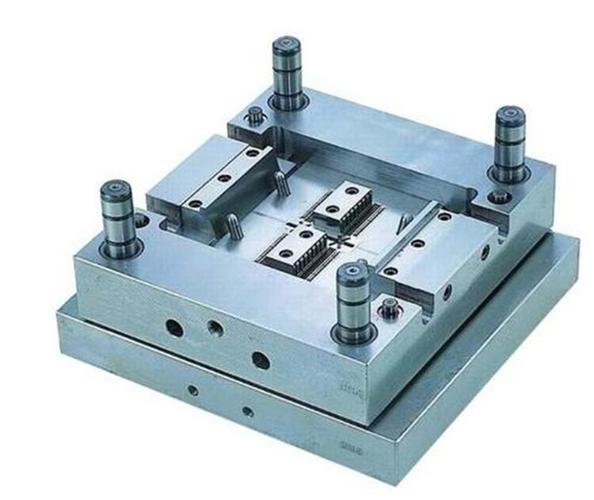
| Tooling cost | Mold steel, cavity count, mold structure, gate, cooling, slides and lifters |
| Annual volume | Expected yearly demand, first batch and lifecycle demand for comparing mold options |
| Material cost | Resin grade, color, additives and material usage |
| Part quality | Critical dimensions, cosmetic class, material performance and inspection scope |
| Cycle time | Evaluated per project, not promised as a fixed number for every part |
| Mold maintenance | Wear parts, maintenance, repair and modification terms |
| Repeat orders | Material and color batch records, drawing revision, mold condition and consistency |
| Packaging | Scratch protection, stacking, transparent-part protection, shipping packaging |
From Drawing to Repeat Production
- Drawing & requirement review — 3D model, 2D drawing, material, environment, quantity and key interfaces confirmed.
- DFM & process selection — wall thickness, draft, clips, shrinkage, warpage, gating and process feasibility assessed.
- Tooling & quotation — mold structure, cost, material, batch cost and project conditions stated.
- Mold trial & sample inspection — trial runs with dimensional and appearance checks per the agreed plan.
- Sample approval — customer confirms critical dimensions, fit, appearance and required function tests.
- Production & quality control — production follows the approved drawing, material and inspection plan.
- Packing, delivery & repeat supply — packaging, batch records, mold maintenance and follow-up order requirements confirmed.
Long-Term Supply for Refrigerator Components
White-goods spare-parts lifecycles create a real purchasing need: a part must stay available for years after the appliance is launched. EU regulation on refrigerating appliances requires certain spare parts (for example door handles, hinges, trays and baskets) to be available for at least 7 years, and door seals for at least 10 years — an obligation that applies to the appliance manufacturer, importer or authorized representative, not automatically to a component supplier.
Goldcattle supports what sits in its actual service scope:
- Repeat production of approved parts
- Material grade, color, drawing and revision records
- Mold storage, maintenance and modification assessment
- Manufacturability review for low-quantity spare orders
- Agreed spare-part packaging, marking and batch management
If these are needed, mold storage, maintenance, revision and re-order procedures are confirmed in the supply agreement. Goldcattle does not claim to carry the appliance brand's full lifecycle obligations.
RFQ Information for Refrigerator Parts
| Information | Purpose |
|---|---|
| Company / work email | Identify the buyer |
| Component type | Drawer, door bin, air duct, cover or other part |
| 3D CAD / 2D drawing | Geometry, interfaces and mold approach |
| Resin grade / color | Material and color requirements |
| Initial quantity / annual volume | Mold option and batch economy |
| Critical dimensions / assembly drawing | Key fits and size requirements |
| Operating temperature / test requirements | Low-temperature, load, impact and cycling validation |
| Surface / cosmetic standard | Transparency, color, texture and visible-defect standard |
| Packaging / repeat supply requirements | Packing, batches and re-order arrangement |
| Target delivery date | Project schedule |
No full drawing yet? Send product photos and initial requirements — the engineering team will tell you what is needed for a quote.
Frequently Asked Questions
What refrigerator plastic parts can be injection molded?
Which plastics suit refrigerator drawers and door bins?
How do you control warpage and dimensional variation?
Can you manufacture custom refrigerator components from CAD drawings?
What is needed for a refrigerator plastic part quote?
How are mold cost and part price calculated?
Can parts be evaluated for low-temperature impact performance?
How do you keep consistency across repeat orders?
Can you provide material certificates and dimensional reports?
How should oversized refrigerator components be manufactured?

Request a Refrigerator Parts Quote
Send the drawing or CAD, component type, resin and color, annual volume and critical dimensions. The review covers material selection, low-temperature fit, mold approach, inspection scope and repeat supply before the quote is issued.
Xiamen Goldcattle · Manufacturing since 1998 · Injection mold making and custom injection molding · Related: custom plastic injection mold →