The Complete Aluminum Die Casting Guide
Everything engineers and procurement teams need to know about aluminum die casting — from alloy selection and mold design to cost optimization, quality control and production.
- ✓ 12+ alloys compared with real mechanical data
- ✓ DFM rules, tolerances & surface finish options
- ✓ Defect troubleshooting + cost & process comparison
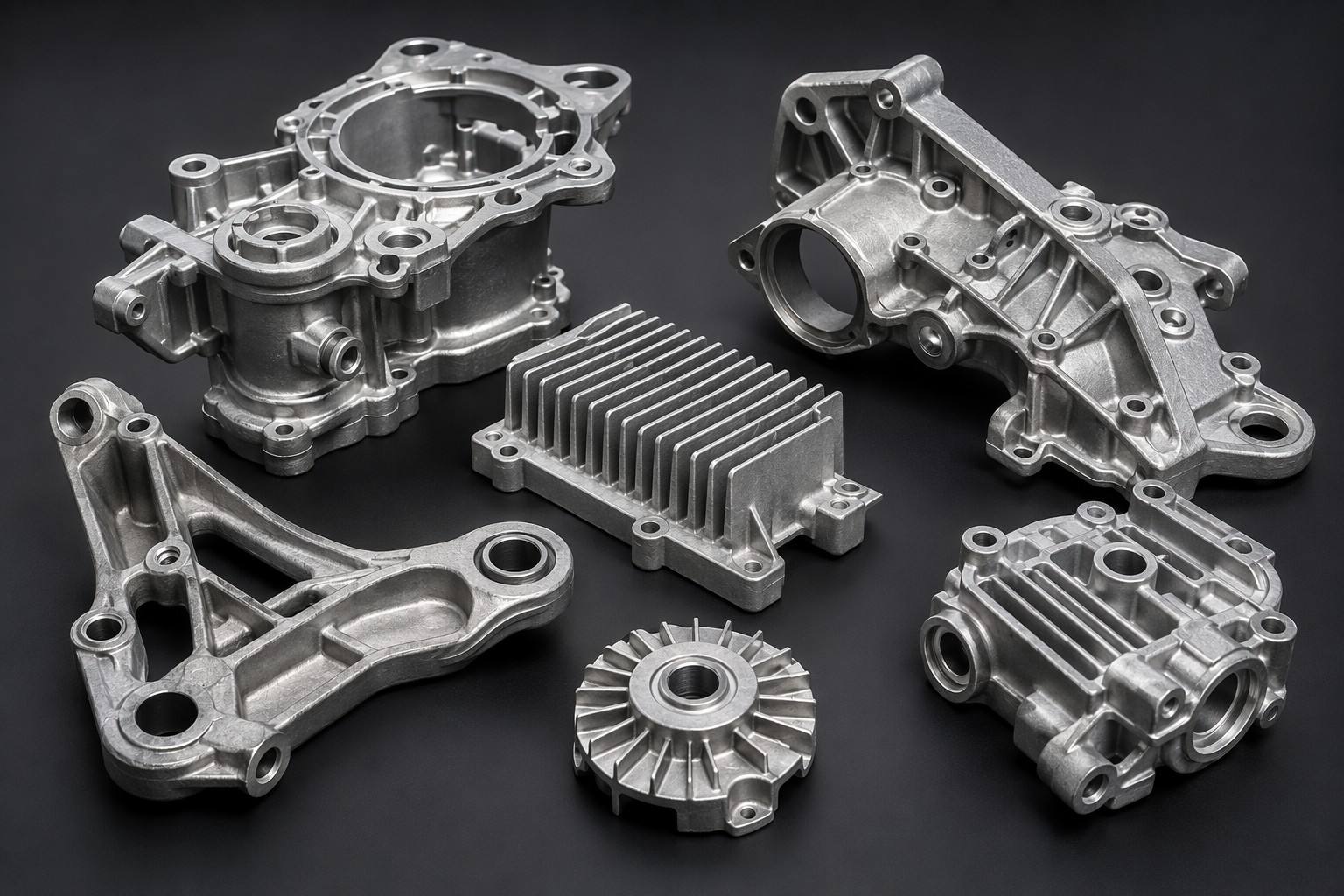
Quick answer — what is aluminum die casting (and when to use it)?
- Definition: a high-pressure process that forces molten aluminum into a reusable steel die to make precise, repeatable, thin-wall metal parts.
- Best for: high-volume housings, brackets, enclosures and structural components where tolerances, surface and unit cost matter.
- Top alloys: ADC12 & A380 (general), A360 (corrosion/anodizing), A413 (pressure-tight), B390 (wear).
- Typical tolerance: ±0.1–0.3 mm as-cast; tighter features by secondary CNC (±0.005 mm).
- Tooling: US$8k–150k+ NRE; per-part cost falls sharply with volume (economical ~5,000+ pcs).
- Watch-outs: porosity on pressure-tight faces, fixed tooling cost, limited undercuts, alloy-specific anodizing.
1 · What Is Aluminum Die Casting?
Aluminum die casting is a metal-forming process that injects molten aluminum alloy into a precision steel mold (the die) under high pressure — typically 1,000–20,000 psi — to produce a solid, near-net-shape component in seconds. The die is reused for hundreds of thousands of cycles, so once the tool is paid for, each part costs very little to make. That combination — speed, repeatability and low unit cost at volume — is why aluminum die casting is the default choice for everything from automotive transmission housings to consumer-electronics enclosures.
The process earns its place when a part is needed in volume, has thin walls or complex geometry, must hold consistent dimensions, and where lightweight aluminum beats steel on weight and machining cost. Aluminum itself brings a strong strength-to-weight ratio, good thermal and electrical conductivity, natural corrosion resistance and full recyclability — which is exactly what electrification, lightweighting and heat-management trends demand.
What makes aluminum the dominant die casting metal is the balance it strikes. Compared with zinc it is lighter and cheaper per gram; compared with magnesium it is easier to finish and more widely specified; compared with plastics it conducts heat and electricity and survives high temperatures; and compared with steel it is roughly one-third the density and needs no forging press. For a buyer, that balance usually translates into a lighter product, a cooler-running product, and a lower landed cost at volume.
In the broader manufacturing toolbox, die casting sits between near-net-shape mass production (where it wins) and low-volume precision (where CNC wins). It is the natural answer when you must make the same complex metal part tens of thousands of times, hold its shape, and keep the unit price low. Understanding that position — and its exceptions — is the first step in specifying the part correctly.
It is not the right tool for one-off prototypes, very low volumes, ferrous alloys, or parts requiring extreme mechanical strength or internal threads without secondary machining. Those cases are better served by CNC, 3D printing, sand/investment casting or forging. The rest of this guide helps you tell the difference with confidence — and choose alloy, tolerance, finish and supplier accordingly.
2 · How Aluminum Die Casting Works
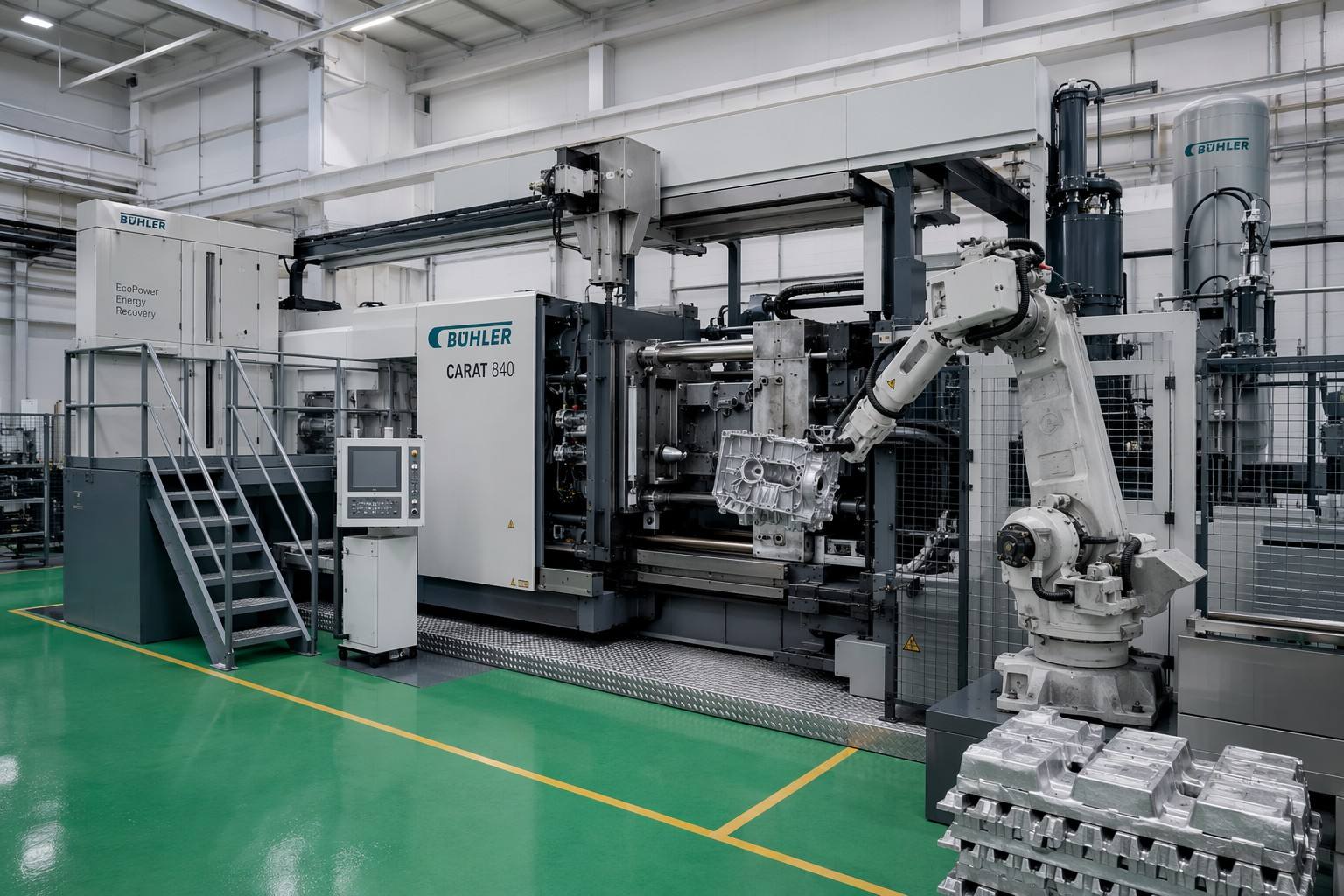
From a 3D model to a boxed, inspected part — the production path is a tightly controlled loop. Each step is where cost and quality are won or lost.
1. Design & DFM
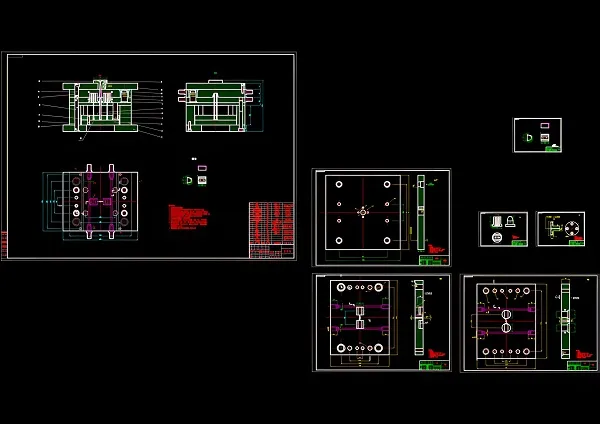
The 3D model is reviewed for manufacturability — wall thickness, draft, ribs, bosses, gate location, machining allowance and cosmetic faces. This step prevents most tooling rework.
2. Mold & Tooling
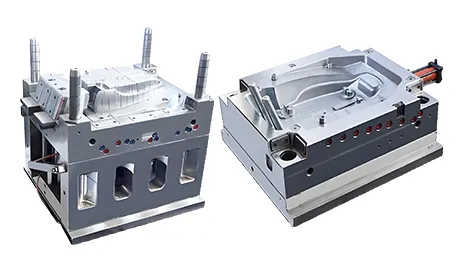
The die is designed and built (in-house preferred), with cavity, gating, venting, cooling and ejection engineered for fill and cycle time.
3. Injection & Solidify
A measured shot of molten aluminum is forced into the closed die. It solidifies in seconds; the die opens and the part is ejected.
4. Trim & Deburr
Runners, gates and flash are removed. Secondary CNC machines the tight-tolerance bores, threads and sealing faces.
5. Finish & Inspect
Surface treatment (anodize, powder, etc.) is applied, then CMM / X-ray / leak testing verifies the part before packing.
6. Pack & Ship
Parts are protected, CoC and traceability attached, and exported. Batch consistency is tracked across repeated lots.
Process and design references follow NADCA Product Specification Standards and ISO 8062 dimensional tolerances.
3 · Aluminum Die Casting Alloys
Alloy selection is the true starting point of any die casting project — it decides castability, strength, corrosion, finishing and cost in one decision. Below are the alloys most specified for high-pressure aluminum die casting, with referenced properties (typical values; confirm per your drawing and process validation).
Before comparing cards, fix the three questions every alloy decision answers: (1) What must the part do? — load, temperature, pressure-tightness. (2) What must it survive? — corrosion, wear, outdoor or under-hood environment. (3) What must it look like and cost? — anodized cosmetic surface, painting, and target unit price. The right alloy is the one that satisfies all three at the lowest total cost, not the one with the highest number on a single property. A common, expensive mistake is over-specifying (A360 when ADC12 would do) or under-specifying (ADC12 on a pressure-tight seal face).
ADC12
- Si / Cu
- 9.6–12.0 / 1.5–3.5%
- Density
- 2.74 g/cm³
- Tensile
- ≈ 228 MPa
- Corrosion
- Good
- Thermal
- High
- Machining
- Good
A380
- Si / Cu
- 7.5–9.5 / 3.0–4.0%
- Density
- 2.74 g/cm³
- Tensile
- ≈ 320 MPa
- Corrosion
- Moderate
- Thermal
- Good
- Machining
- Good
A360
- Si / Mg
- 9.0–10.0 / 0.4–0.6%
- Density
- 2.68 g/cm³
- Tensile
- ≈ 317 MPa
- Corrosion
- Excellent
- Thermal
- Good
- Machining
- Moderate
A383
- Si / Cu
- 9.5–11.5 / 2.0–3.5%
- Density
- 2.74 g/cm³
- Tensile
- ≈ 250–310 MPa
- Corrosion
- Good
- Thermal
- High
- Machining
- Good
A413
- Si / Cu
- 11.0–13.0 / ≤1.0%
- Density
- 2.66 g/cm³
- Tensile
- ≈ 250–280 MPa
- Corrosion
- Good
- Thermal
- Excellent
- Machining
- Good
A384
- Si / Cu
- 10.5–12.0 / 3.0–4.5%
- Density
- 2.74 g/cm³
- Tensile
- ≈ 300 MPa
- Corrosion
- Moderate
- Thermal
- Good
- Machining
- Good
B390
- Si / Cu
- 16–18 / 4.0–5.0%
- Density
- 2.74–2.80 g/cm³
- Tensile
- ≈ 320–360 MPa
- Corrosion
- Good
- Thermal
- Moderate
- Machining
- Poor
LM6
- Si / Cu
- 10–13 / ≤0.5%
- Density
- 2.65 g/cm³
- Tensile
- ≈ 170–230 MPa
- Corrosion
- Excellent
- Thermal
- Good
- Machining
- Poor (hi-Si)
LM24
- Si / Cu
- 7.5–9.5 / 2.0–4.0%
- Density
- 2.74 g/cm³
- Tensile
- ≈ 200–240 MPa
- Corrosion
- Good
- Thermal
- Good
- Machining
- Good
A356
- Si / Mg
- 6.5–7.5 / 0.2–0.4%
- Density
- 2.69 g/cm³
- Tensile
- ≈ 230 (up to 310 T6)
- Corrosion
- Excellent
- Thermal
- Good
- Machining
- Good
AlSi9Cu3 (ENAC43400)
- Si / Cu
- 8–11 / 2.0–4.0%
- Density
- 2.74 g/cm³
- Tensile
- ≈ 240 MPa
- Corrosion
- Moderate
- Thermal
- Good
- Machining
- Good
AlSi12 (ENAC44100)
- Si / Fe
- 10.5–13.5 / ≤1.0%
- Density
- 2.65 g/cm³
- Tensile
- ≈ 200–230 MPa
- Corrosion
- Excellent
- Thermal
- Good
- Machining
- Poor (hi-Si)
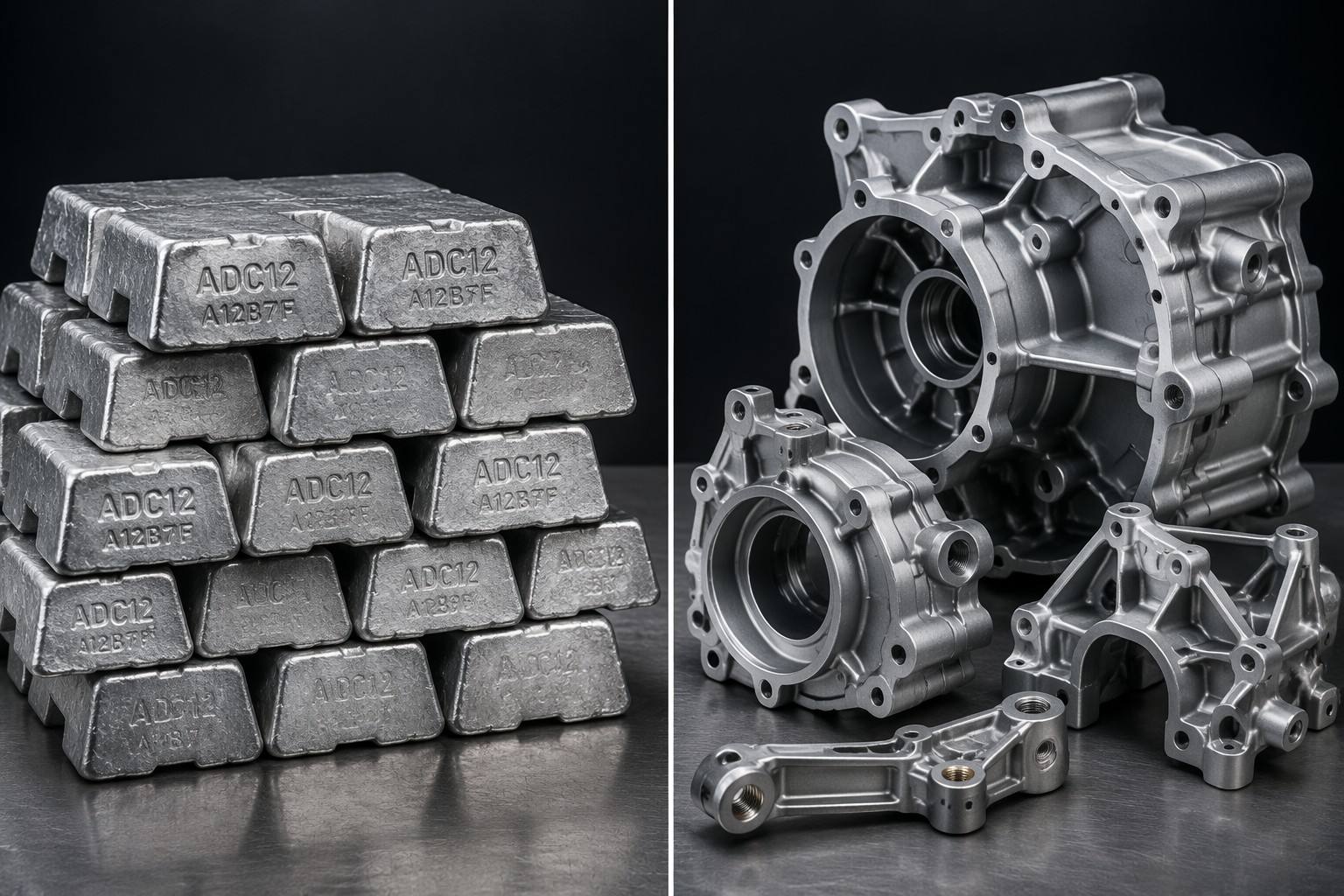
A practical shortlist: general industrial and electronics parts → ADC12 or A383; structural / load-bearing → A380 or A384; corrosion or anodized appearance → A360; pressure-tight or thermal → A413; extreme wear → B390; European standard programs → AlSi9Cu3(Fe) / AlSi12. When two alloys look equivalent, choose the one your supplier casts most often — process familiarity reduces scrap and lead time more than a marginal property difference.
Regional grade cross-reference: because standards differ by market, the same physical alloy appears under different names — ADC12 (JIS) is the Asian workhorse and maps closely to A383 (ASTM) and to A380; LM24 (BS) is the UK/Commonwealth equivalent; AlSi9Cu3(Fe) / ENAC43400 and AlSi12 / ENAC44100 are the European EN grades. If your drawing calls out one standard and your supplier quotes another, confirm the composition and mechanical values are equivalent rather than assuming — a material certificate resolves it.
Reading the property table: tensile strength is only one axis. For a bracket, yield and elongation matter more (resistance to bending and cracking); for a heatsink, thermal conductivity and fluidity dominate; for a marine part, corrosion resistance beats raw strength; for a wear plate, hardness and silicon content win. Also note that die casting values are as-cast and vary with section thickness and process — so treat the numbers as selection guidance and confirm with a validated material certificate and, where needed, your own test coupons before committing to volume.
Cost ranking by alloy: at equal volume, ADC12 and A383 are usually the most economical (high fluidity, mature supply, low scrap); A380 and A384 sit slightly higher on strength; A360 and A413 cost more for corrosion/pressure performance; B390 and specialty EN grades are the premium tier for wear or certification. But "cheapest alloy" is rarely the cheapest part — a slightly dearer alloy that needs less machining or finishing, or that avoids a defect loop, can be the lower total cost. Decide on total cost, not the ingot price.
Property values are typical reference ranges from standard specifications (JIS / ASTM / EN / BS) and vary with casting condition. Treat as guidance for alloy selection, not a substitute for a validated material certificate.
4 · Alloy Comparison Table
The single most-cited table in any die casting decision. Use it to shortlist 2–3 candidates, then validate with your supplier against the actual part.
| Alloy | Strength | Castability | Corrosion | Machining | Pressure-tight | Cost | Primary use |
|---|---|---|---|---|---|---|---|
| ADC12 | Good | Excellent | Good | Good | Good | Low | General / electronics |
| A380 | High | Very good | Moderate | Good | Good | Low–Mid | Structural / frames |
| A360 | High | Moderate | Excellent | Moderate | Excellent | Mid | Marine / anodized |
| A383 | Good | Excellent | Good | Good | Good | Low–Mid | Thin-wall complex |
| A413 | Good | Excellent | Good | Good | Excellent | Mid | Hydraulic / heatsink |
| A384 | High | Very good | Moderate | Good | Good | Mid | Structural housings |
| B390 | High | Moderate | Good | Poor | Moderate | Mid–High | Wear parts |
| LM6 | Moderate | Excellent | Excellent | Poor | Good | Mid | Marine / architectural |
| LM24 | Good | Very good | Good | Good | Good | Low–Mid | General (UK/EU) |
| A356 | High* | Good | Excellent | Good | Good | Mid | Wheels / struct.* |
* A356 is used in squeeze / low-pressure casting and can be heat-treated (T6); it is not a standard HPDC alloy.
How to read this table: no alloy is "best" in every column. ADC12 and A383 win on castability and cost, which is why they dominate high-volume electronics and brackets; A380 and A384 add strength for structural loads; A360 and A413 lead on corrosion and sealing; B390 trades machinability for wear resistance. Use the table to narrow to two or three candidates, then validate the final choice against your actual load, environment and finish — ideally with your supplier's DFM input before tooling.
5 · Advantages of Aluminum Die Casting
Each advantage below is a real purchasing decision factor — not a slogan.
Excellent productivity
Cycle times are measured in seconds to a minute. A single die can produce hundreds of thousands of identical parts, so per-piece cost collapses at volume — the core reason die casting wins for mass production.
Good surface finish
As-cast surfaces are smooth (typically Ra 1.6–3.2 µm) and ready for painting or powder coating with minimal prep. Cosmetic-grade parts often need no secondary finishing at all.
Thin-wall capability
Aluminum HPDC routinely holds walls down to ~0.8 mm, enabling lightweight, material-efficient designs that CNC or sand casting cannot match economically.
Dimensional consistency
Reusable steel dies give repeatable dimensions part after part. As-cast tolerance is around ±0.1–0.3 mm, and critical features are brought tighter by in-line CNC.
Cost-effective at volume
Once tooling is amortized, unit cost is dominated by material and cycle time — far below CNC for complex shapes. Design consolidation also cuts assembly cost.
Recyclable & lightweight
Aluminum is ~1/3 the density of steel and 100% recyclable with low remelt energy. That supports lightweighting, ESG goals and lower freight cost.
Complex net-shape geometry
Integrating bosses, ribs, threads inserts and features into one casting removes downstream operations and joining steps.
Good mechanical & thermal properties
Aluminum die cast parts deliver a strong strength-to-weight ratio plus high thermal and electrical conductivity — ideal for housings that must also dissipate heat.
Taken together, these advantages explain why die casting is the default for high-volume metal parts: it is fast, consistent, light, recyclable and cheap at scale. The practical buying point is that several advantages compound — thin walls reduce material weight and cost, net-shape geometry removes machining and assembly, and dimensional consistency reduces inspection and scrap. When you evaluate a quote, weigh the whole chain, not a single property, because that is where die casting's real saving shows up.
6 · Limitations — When NOT to Die Cast
Honest decision guidance: die casting is powerful, but it is the wrong choice in these cases. Knowing when to switch protects your budget and schedule.
Prototype / bridge quantity
One to a few dozen pieces do not justify tooling NRE.
→ Use: CNC machining or 3D printing for prototypes, then commit to a production die once validated.
Very low volume
Below roughly 5,000 pieces, the tooling cost dominates and unit price is uncompetitive.
→ Use: CNC machining or soft/rapid tooling for low runs.
Ferrous / high-temp alloys (steel, titanium)
Molten steel (~1500 °C) destroys hardened die steel; titanium is similarly unsuitable.
→ Use: investment casting, sand casting, forging or CNC.
Maximum strength / fatigue-critical
HPDC porosity limits fatigue performance versus forged or heat-treated parts.
→ Use: forging, squeeze casting or heat-treatable low-pressure casting.
Internal threads & ultra-tight bores
These cannot be cast directly to print and need secondary machining.
→ Use: die cast the body, then in-line CNC for features.
Pressure-tight without controls
Standard HPDC can trap gas and leak on critical faces.
→ Use: vacuum-assisted HPDC + X-ray / leak test, or secondary CNC on the seal face.
The honest framing for a buyer is value versus volume, not good versus bad. Die casting's limitations are real, but most are simply the price of its strengths: the tooling cost buys the low unit cost; the alloy range buys the speed; the as-cast tolerance buys the cycle time. The decision is therefore rarely "is die casting perfect?" and almost always "does my volume and geometry let its strengths outweigh its limits?" For the majority of housings, brackets and enclosures made in the thousands, the answer is yes — provided the design and quality plan are set before tooling.
Heat treatment note: standard high-pressure die cast parts are generally not T6 heat treated — the trapped porosity expands under heat and causes blistering. If you need heat-treated properties, specify a low-porosity route (vacuum HPDC or squeeze casting) or choose an alloy/process that delivers the strength without heat treatment. This is a common specification trap: asking for "T6 aluminum" on a standard die cast part is usually the wrong requirement, and a good supplier will flag it during DFM rather than quote a process that would fail.
Prototype-to-production bridge: you do not have to jump from CNC prototypes straight to a full production die. Many programs use CNC or rapid-tooling soft dies for the first 50–500 pieces to validate form/fit/function, then commit to a hardened production die once the design is frozen. This "bridge" de-risks tooling spend and is exactly where a supplier with both CNC and die casting in-house helps — the same part can be prototyped and productionized on one line, keeping the datum and process knowledge continuous from sample to volume.
Myths vs facts buyers should know:
| Myth | Reality |
|---|---|
| "Die cast parts are always porous." | Porosity is controlled, not eliminated; vacuum assist plus X-ray/leak verification makes pressure-tight parts routine. |
| "Die casting is only for huge volumes." | Bridge tooling makes low-thousands viable; below that, CNC is the fallback, not a failure of the process. |
| "Any aluminum alloy works." | Alloy drives castability, finish and cost — ADC12 and A380 do not anodize like A360. |
| "Tighter tolerance is always better." | Over-specifying wastes money; match the tolerance class to the function. |
| "Tooling is a supplier's property." | Best practice: the buyer owns the mold and its IP; state it in the contract. |
Rule of thumb
If volume is high, walls are thin, geometry is complex and tolerances are moderate — die cast it. If volume is low, material is steel, or strength is extreme — choose another process.
7 · Aluminum Die Casting Design Guidelines (DFM)
Good die cast parts are designed for the process. Following these rules at the drawing stage prevents scrap, reduces tooling cost and shortens lead time. Guidance aligns with NADCA design recommendations.
| Design element | Recommended | Why it matters |
|---|---|---|
| Wall thickness | 0.8–4.0 mm (uniform) | Uniform walls avoid sink marks, porosity and hot spots; variation causes defects. |
| Draft angle | 1–3° walls, 2–5° cores | lets the part eject cleanly without drag marks or sticking. |
| Corner / fillet radius | R 0.5–1.5 mm | Reduces stress concentration and improves metal flow into corners. |
| Boss | Ø ≥ 2× height; add draft | Keeps cores stable; tall thin bosses break or trap air. |
| Rib | 0.6–0.8× wall; height ≤ 3× thickness | Stiffens without creating thick sections that shrink. |
| Hole | Cast ≥ 2 mm Ø; smaller drilled | Small / blind holes are better machined after casting. |
| Thread | Not cast; tapped / inserted | Threads need secondary machining or threaded inserts. |
| Undercut | Avoid; use slides if needed | Undercuts require side actions, raising tool cost & cycle. |
| Shrinkage | 0.5–0.7% (Al) | Die is sized larger to compensate for solidification shrink. |
| Ejection | Pins on non-cosmetic faces | Ejector marks should land where they won't show or matter. |
| Overflow / gate | Gate at thick section; overflow at last fill | Proper gating/venting controls fill, porosity and surface. |
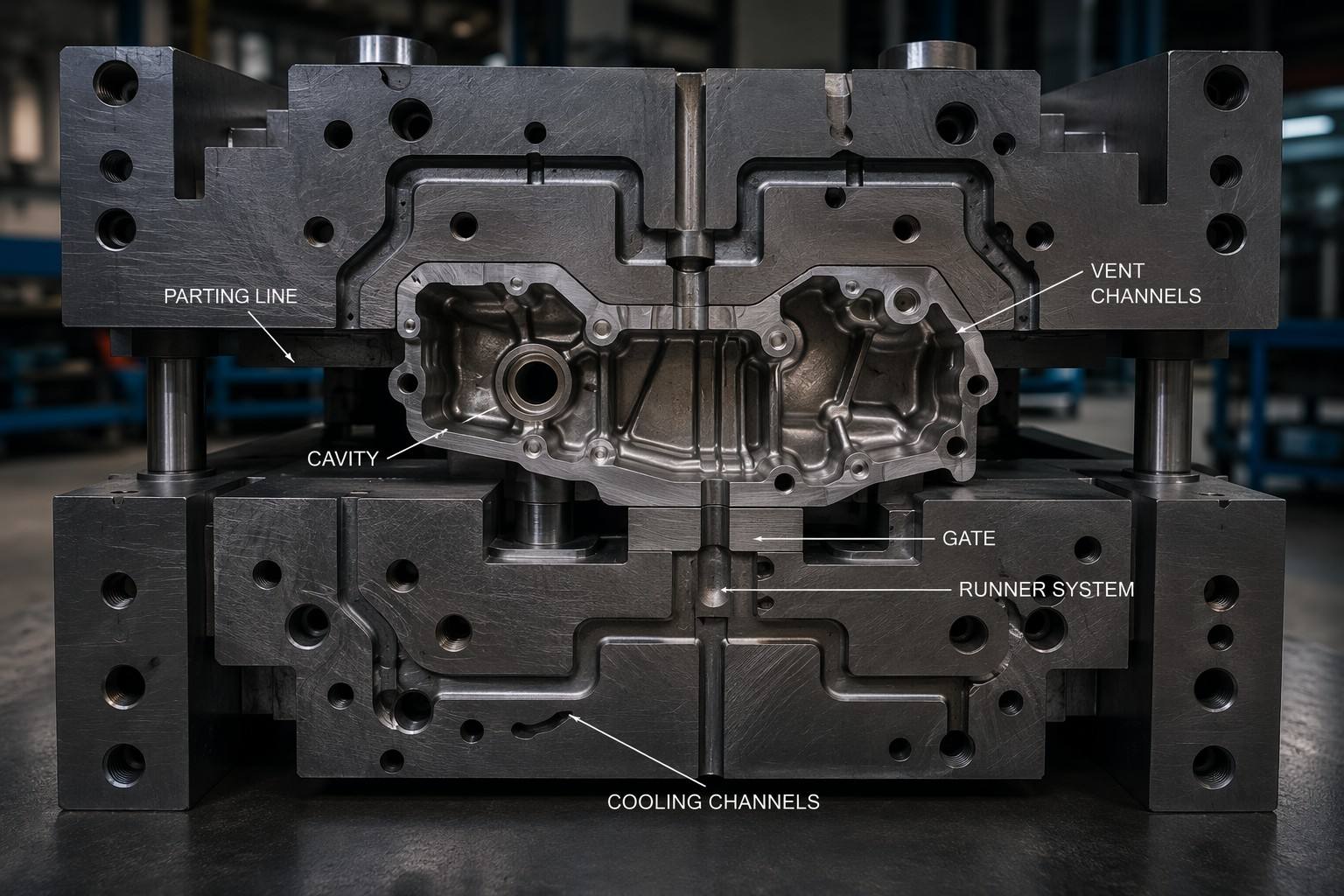
Common DFM mistakes to avoid: varying wall thickness sharply (causes sink and porosity); omitting draft so the part drags on ejection; placing ejector pins on a cosmetic face; specifying internal threads to be cast; designing tight blind holes instead of drilling them; and putting the gate on a thin far section so the cavity misruns. Most of these are caught in a good DFM review — which is why DFM support, not just a quote, is a qualifying question for any supplier.
For complex or thin-wall parts, ask whether your supplier runs fill / solidification simulation before cutting steel. Simulation predicts short fills, air entrapment and hot spots, so gating and cooling are optimized on screen rather than by trial and error on the shop floor — fewer tool modifications, faster first-article, and a more capable production die.
DFM checklist to send with every drawing:
- Wall thickness uniform, 0.8–4.0 mm, no abrupt thick-to-thin jumps.
- Draft 1–3° on walls, 2–5° on cores; ejector pins on non-cosmetic faces.
- Fillets R0.5–1.5 mm at corners; ribs 0.6–0.8× wall, height ≤ 3× thickness.
- Holes ≥ 2 mm if cast; smaller or blind holes designed for drilling.
- Threads specified as tapped or inserted, not cast.
- Undercuts minimized; any required side action called out explicitly.
- Critical dimensions and sealing faces flagged for secondary CNC.
- Cosmetic (Class A) surfaces identified so finish and inspection target them.
8 · Typical Tolerances
Die casting holds good general tolerances as-cast, but tolerance should follow feature and part complexity — not a single fixed number. Tighter features are brought in by secondary CNC.
| Feature | Typical as-cast capability | Note |
|---|---|---|
| Linear dimension | ±0.1 – 0.3 mm | Per ISO 8062 CT5–CT6 class; larger parts wider. |
| Hole diameter / position | ±0.1 – 0.2 mm | Small/blind holes usually drilled. |
| Flatness | 0.1 – 0.2 mm / 25 mm | Warpage controlled by cooling design. |
| Parallelism | 0.1 – 0.25 mm | Depends on parting-line flatness. |
| Wall thickness | ±0.1 – 0.2 mm | Uniform section preferred. |
| CNC-machined feature | ±0.005 mm | Used for bores, threads, sealing faces. |
Understanding the ISO 8062 classes: die casting tolerances are usually quoted per ISO 8062, where CT5–CT6 is the tight band a well-controlled aluminum HPDC can hold as-cast, and CT7–CT8 is a more relaxed, lower-cost band for larger or less critical parts. The "CT" number maps to a tolerance that grows with the dimension — a 10 mm feature and a 200 mm feature do not share one fixed value. Always ask which class your quote assumes; quoting CT6 when the part only needs CT8 is quietly paying for accuracy you don't use.
Worked example: a 50 mm housed bore might be held at ±0.15 mm as-cast (CT6), while a 50 mm cosmetic edge could be relaxed to ±0.3 mm. If that bore must press-fit a bearing, specify secondary CNC to ±0.02 mm and let the rest of the part stay as-cast — that split is where cost and performance are balanced.
Die casting tolerance vs CNC: as-cast tolerance is excellent for the overall shape but looser than machining on specific features. The practical rule is to let the die hold what it holds well (outer envelope, general dimensions) and reserve CNC for the few features that must be exact (bearing bores, threaded holes, sealing faces, datums). Over-machining the whole part defeats the cost advantage of casting; under-specifying CNC on a critical face causes fit failures. Mark the critical few clearly and let the rest stay as-cast.
9 · Surface Finish Options
Finish protects the part and defines its appearance. Choice depends on corrosion need, look and whether the alloy anodizes well.
As cast
Smooth as-cast surface (Ra ~1.6–3.2 µm), no extra treatment. Suitable for hidden structural parts.
Powder coating
Durable, uniform color layer with good corrosion protection. Common for industrial and automotive housings.
Anodizing
Anodic layer for corrosion resistance and color. Note: results differ strongly by alloy — A360 & low-Si alloys anodize evenly; high-Si ADC12/A380 give grey, uneven coatings. Confirm the appearance standard early.
Painting
Liquid paint for color and branding; needs proper pretreatment on porous surfaces.
Sandblasting / shot blasting
Matte uniform texture, also cleans the surface before coating.
Polishing
Mirror or bright finish for cosmetic parts; usually before plating/anodizing.
Chromate conversion
Thin chemical film (e.g. yellow/black) for corrosion resistance and paint adhesion.
Laser marking
Permanent logos, serials and traceability marks without contact or ink.
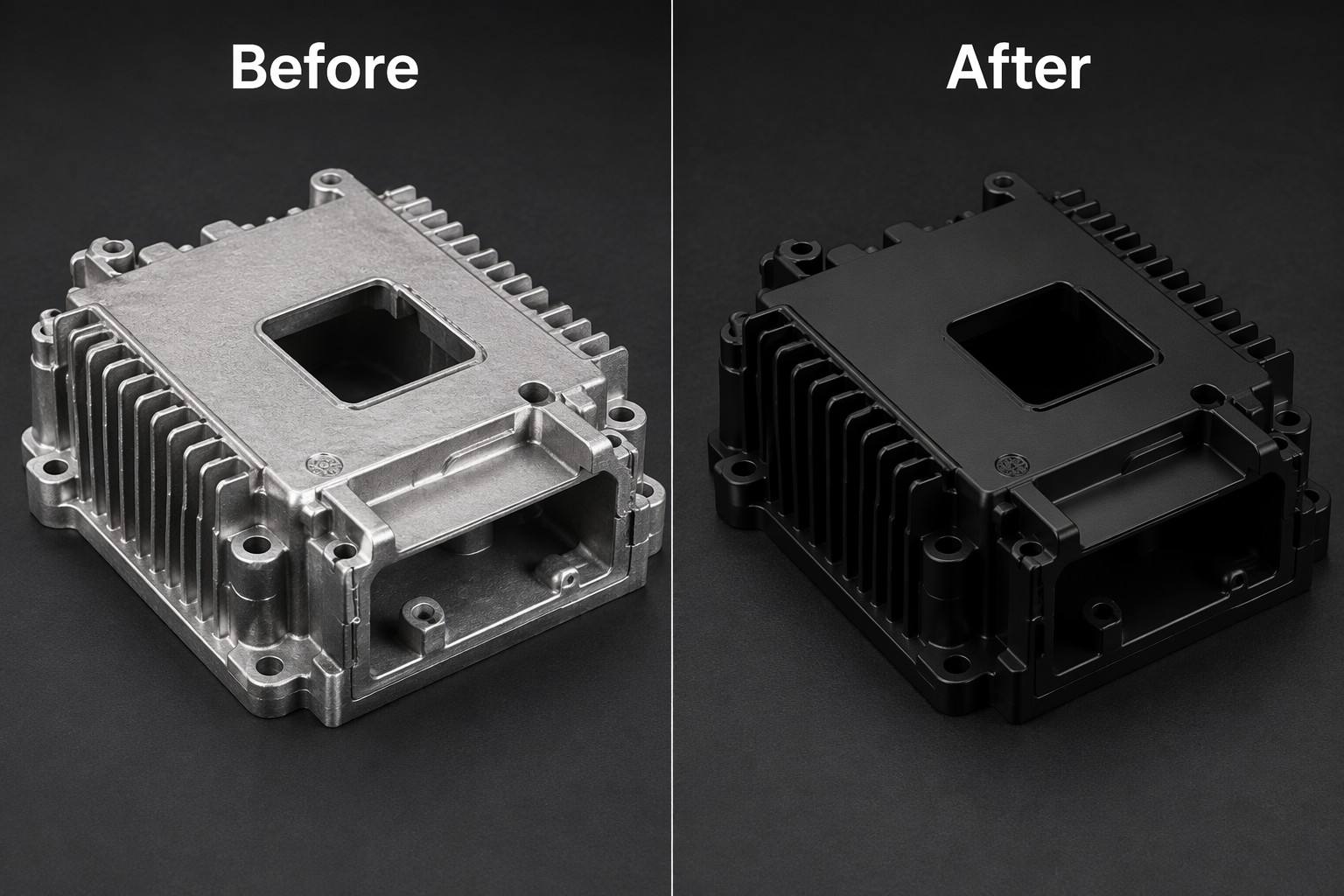
Choosing a finish: start from the environment, not the catalog. Indoor structural parts may need nothing beyond as-cast; outdoor or under-hood parts usually want powder coating or anodizing for corrosion; consumer-facing parts want painting or anodizing for looks; heat-dissipating parts want a clean as-cast or shot-blasted surface, not a thick coating that insulates. And remember the alloy rule — if you need a cosmetic anodized surface, the alloy (A360 / low-silicon) must be chosen up front, because you cannot anodize ADC12 into a uniform color later.
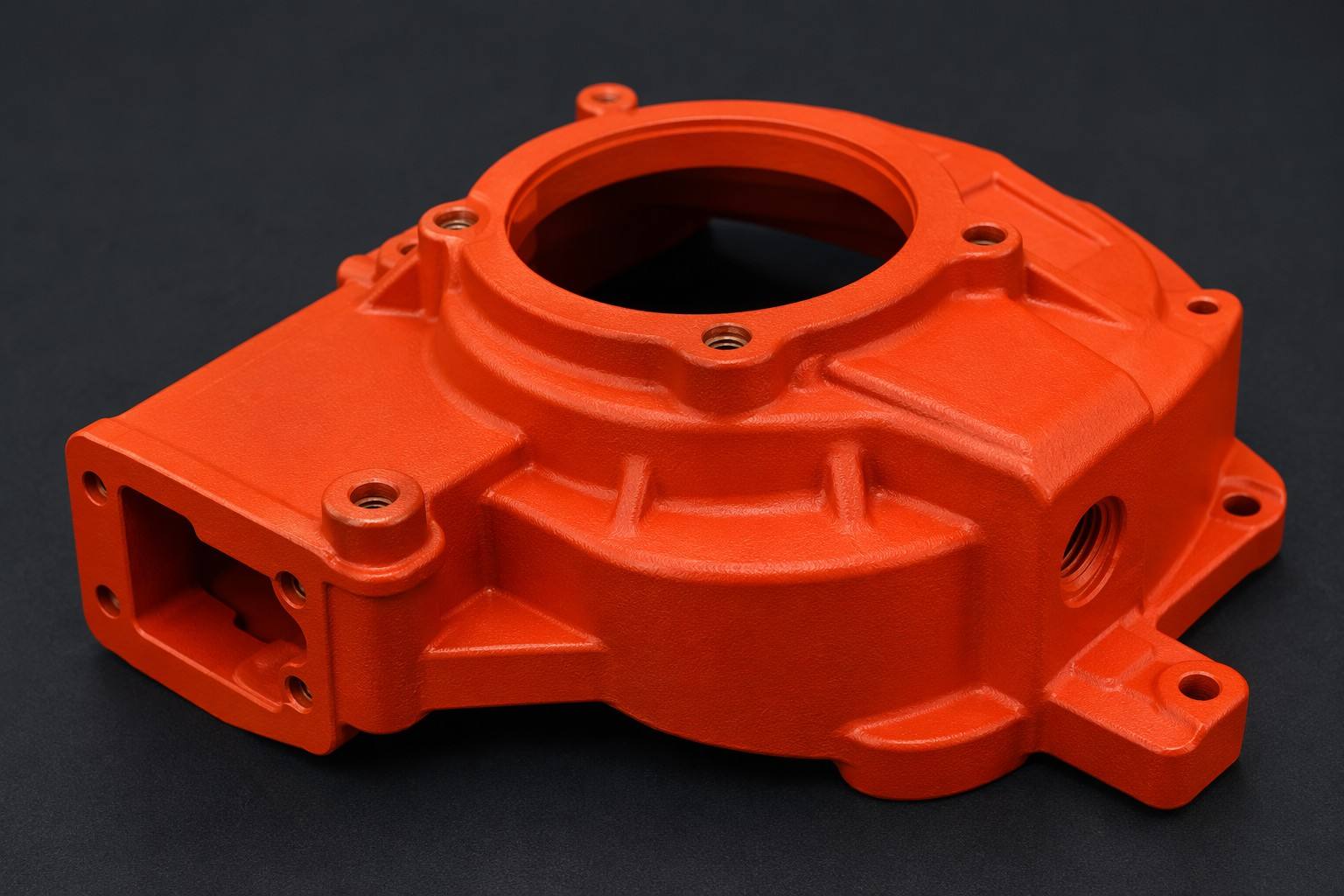
Finishing defects to watch: poor cleaning leaves pores and oil that cause coating blisters; thin or uneven coating reads as color mismatch; over-blasting hides detail; anodizing on a high-silicon alloy gives a grey, patchy color. These are prevented by correct pre-treatment, alloy choice and process control — which is why finishing should be specified and sampled, not assumed. Ask for a finish standard (coating thickness, salt-spray hours, color reference) so acceptance is measurable rather than a matter of opinion.
10 · Common Die Casting Defects & How to Avoid Them
Defects are controlled, not eliminated. The buying question is: does the supplier understand the cause and verify it? Below, each defect with cause → avoidance → detection → case note.
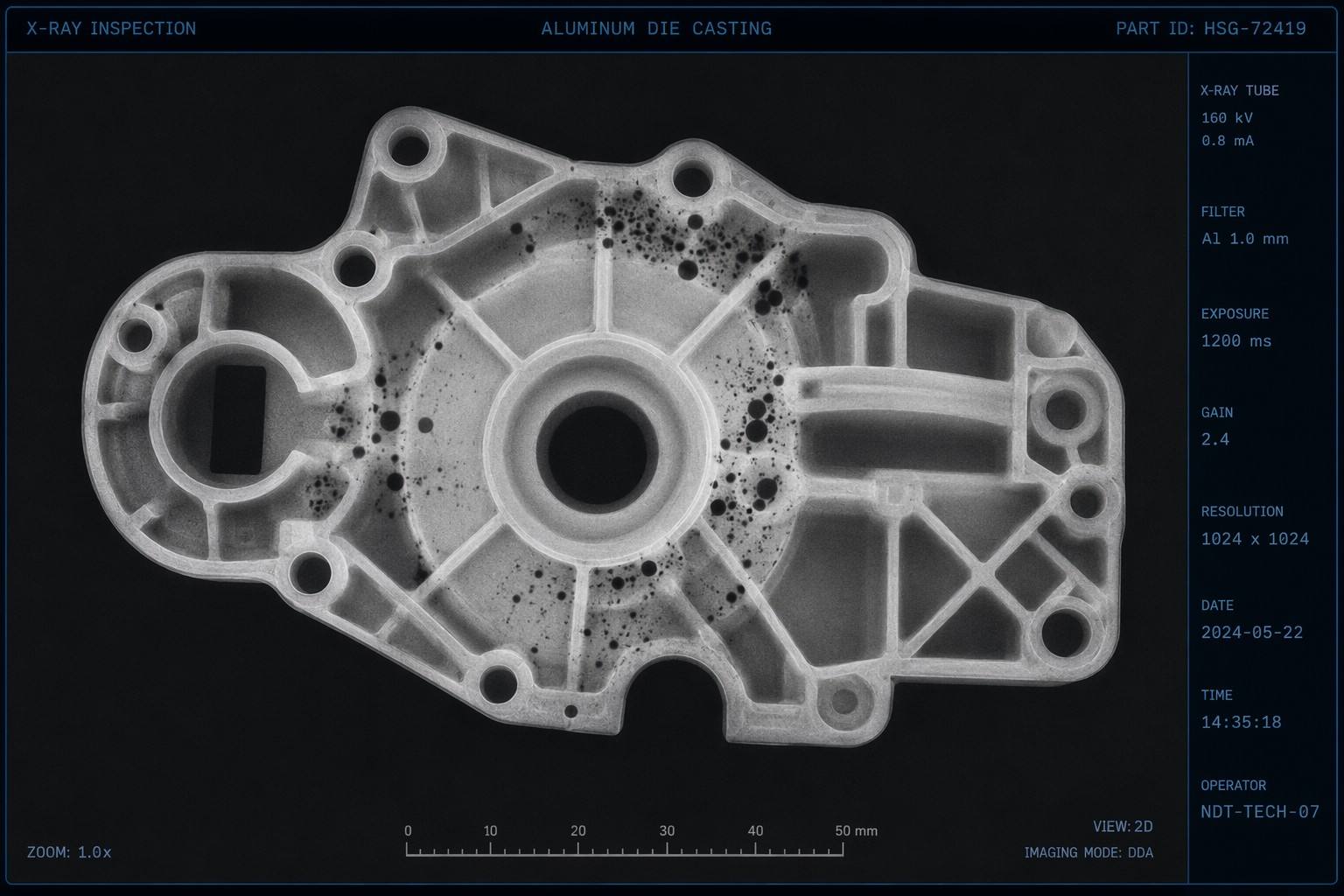
Porosity
Flash
Cold shut
Shrinkage
Misrun
Blister
Warping
A useful way to think about defects is as a prevention chain rather than a rejection list: DFM removes the design causes, gating/venting & cooling design removes the process causes, process control keeps them removed shot to shot, and inspection (X-ray, leak, CMM, visual) confirms the result on the parts that matter. A supplier who only talks about "we inspect and reject bad parts" is managing symptoms; one who can explain the DFM and tooling actions that prevent the defect is managing the cause. For a buyer, that distinction is the difference between a stable supply and a perpetual quality firefight.
11 · Aluminum Die Casting Cost Guide
Total landed cost = one-time tooling (NRE) + recurring part cost. The part cost itself splits into several drivers — understand them to control your quote.
| Cost driver | What affects it | How to reduce |
|---|---|---|
| Tool cost (NRE) | Size, cavity count, complexity, steel grade | In-house tooling; right-size cavities to volume. |
| Part / material | Alloy price, part weight, yield | Uniform thin walls; recycle runners via closed loop. |
| Machining | # of CNC features, tolerance | Relax non-critical tolerances; design features castable. |
| Surface finish | Process, color, coverage | Specify finish only where needed. |
| Assembly | Inserts, sub-assembly, testing | Consolidate parts into one casting. |
| Packaging | Protection level, export crate | Standardized, reusable packing where possible. |
Total cost of ownership, not unit price. The cheapest as-cast quote can be the most expensive program if it hides CNC, finishing, scrap and rework. Evaluate the full landed cost per good part: tooling amortized over the annual volume, material at the quoted weight basis, secondary machining, finish, inspection, packaging, freight and the cost of quality failures. A part that needs less machining because it was designed well, or less scrap because porosity is controlled, often beats a lower headline price.
How to read a die casting quote: confirm the weight basis (gross casting vs net drawing vs finished machined — they differ), whether tooling is a separate NRE or bundled, who owns the die, what the quote includes (CNC, finish, packaging, inspection reports), the stated tolerance class, and the lead-time definition (tooling only, or to first samples, or to mass production). Quotes that vary 20–40% for the same drawing usually differ on exactly these hidden lines — itemize them before comparing.
Common cost pitfalls buyers hit: (1) comparing quotes on different weight bases; (2) forgetting CNC and finishing in the "as-cast" price; (3) under-specifying tolerance and paying for CT6 when CT8 would do; (4) choosing an alloy for a marginal property and paying more material and scrap; (5) skipping DFM and paying for tool modifications later. Each is avoidable with the itemized, DFM-led quote described above — which is why the engineering conversation should happen before the purchase order, not after a bad first sample.
12 · Typical Applications (by Part)
Die casting is usually specified by the part, not the industry. The most common production parts:
The same housing shape recurs across industries — a motor housing in a power tool is conceptually the same engineering problem as one in a heat pump. Thinking in parts (rather than only in "automotive" or "electronics") helps you borrow best practice: a pump housing teaches you about pressure-tightness, a transmission case about machined datums, a heat sink about thermal fins. The cards below group the parts buyers actually source, with the alloy and feature patterns that tend to go with each.
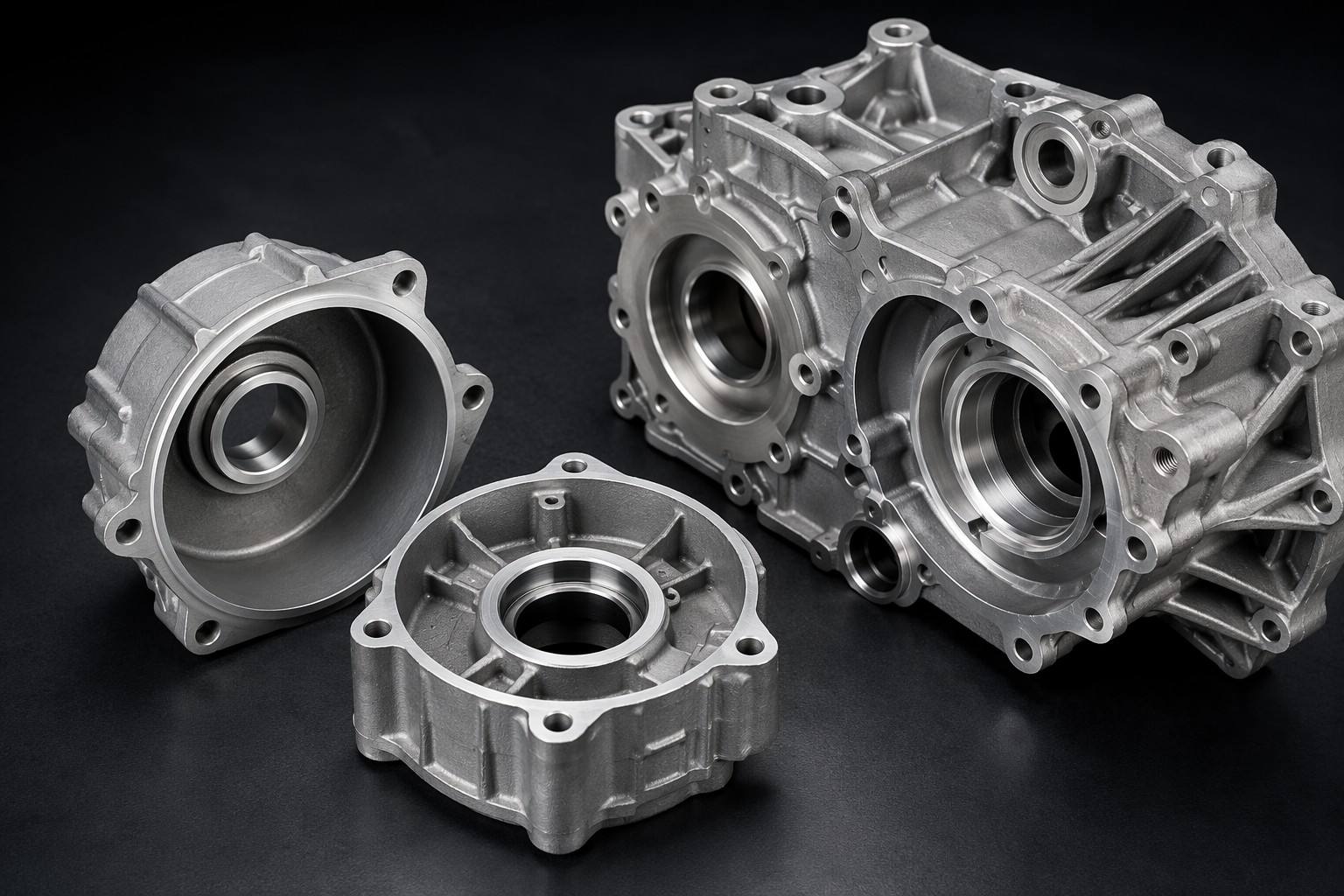
Read the cards as engineering patterns: housings that hold bearings need machined bores and datums; pressure-tight bodies need gating and verification planned up front; heat sinks need thin, continuous fins and a clean surface; EV and battery enclosures add EMI and structural demands. Tell your supplier which pattern your part follows so they tune alloy, gate location and machining allowance accordingly. A part specified this way reaches mass production faster and with fewer surprises than one described only by its outer shape.
Motor housing
Frames for electric motors — thin walls, heat dissipation, bearing bores machined.
A380 / ADC12Gearbox housing
Sealed, load-bearing cases with machined bores and datums.
A380Heat sink
High-surface area cooling fins; thermal conductivity matters.
A413 / ADC12Pump housing
Pressure-tight bodies; porosity-controlled + leak tested.
A413 / A360Valve body
Flow control with sealed faces; vacuum + X-ray verification.
A360Battery housing
EV pack / module enclosures — lightweight, EMI and structural.
ADC12 / A380EV components
Drive units, converters, charging parts for electrification.
A380 / A360Lighting housing
Luminaire bodies; cosmetic + thermal, often anodized/painted.
A360 / ADC12Robot base
Stable, stiff structural bases for automation equipment.
A380Transmission case
High-volume automotive case with tight machined datums.
A38013 · Industry Applications
Automotive
The largest die casting market — engine, transmission, EV drive and battery enclosures. High volume, tight quality (IATF 16949), traceability.
Medical
Enclosures and instrument parts needing clean finish and tight tolerance; lower volume, high documentation.
Electronics
Housings, heatsinks and brackets — thin walls, EMI shielding, anodized/painted cosmetic surfaces.
Industrial
Pumps, valves, gearboxes, robotics — structural and pressure-tight parts with machined features.
Robotics
Stiff, lightweight bases and arms; dimensional consistency across batches is critical.
Energy
Inverters, chargers, solar and storage enclosures — thermal management + corrosion resistance.
Across these industries the recurring buyer questions are similar — volume and quality documentation for automotive (IATF 16949, PPAP), clean finish and tight tolerance for medical, thin-wall and EMI for electronics, structural consistency for robotics, thermal and corrosion for energy. A supplier who has shipped to North America and Europe will already speak this language; ask for a reference in your industry rather than a generic portfolio, and confirm the exact standards (AMS, EN, ASTM, RoHS/REACH) your market requires before tooling.
Electrification is expanding die casting: EVs replace engine blocks with battery enclosures, drive-unit housings, inverters and charging parts — almost all aluminum, almost all die cast. The demands (lightweighting for range, thermal management, EMI shielding, structural stiffness) line up with die casting's strengths, and the volumes are high enough to justify tooling. If your program is EV-related, flag it early: it changes alloy choice (often ADC12/A380 for enclosures, A360 for sealed items), finish (coating for insulation/grounding) and verification (leak and hi-pot where relevant).
14 · Aluminum Die Casting vs Other Processes
Four side-by-side comparisons engineers actually ask for.
The point of a process comparison is not to rank processes as "better" but to match each to its job. Die casting wins on volume, thin walls and unit cost; CNC wins on low volume, tight tolerance and no tooling; sand/investment casting win on size, alloy range or complexity; plastics win on weight and cost when metal properties are not required. The right answer is usually a hybrid — die cast the body, CNC the critical features, and choose plastic only when metal is genuinely unnecessary.
| Factor | Die Casting | CNC |
|---|---|---|
| Best volume | High (5k+) | Low–mid |
| Tooling cost | High NRE | None |
| Complexity | Net-shape | Limited by tools |
| Lead time | Tooling first | Fast |
| Material use | Near net | More scrap |
| Factor | Die Casting | Sand |
|---|---|---|
| Volume | High | Low–mid |
| Surface | Smooth | Rough |
| Tolerance | Tight | Wide |
| Part size | Small–mid | Very large |
| Unit cost | Low @vol | Higher |
| Factor | Die Casting | Investment |
|---|---|---|
| Alloys | Non-ferrous | Steel/superalloy |
| Volume | High | Low–mid |
| Surface | Good | Good |
| Undercuts | Limited | Complex |
| Unit cost | Low @vol | Higher |
| Factor | Die Casting | Plastic |
|---|---|---|
| Strength | Metal | Polymer |
| Temperature | High | Limited |
| EMI / shield | Conductive | Needs fill |
| Weight | Heavier | Lighter |
| Cost @vol | Comparable | Comparable |
15 · Quality Control
A reliable supplier controls quality across the whole path — not just on the first sample. The checks buyers should expect:
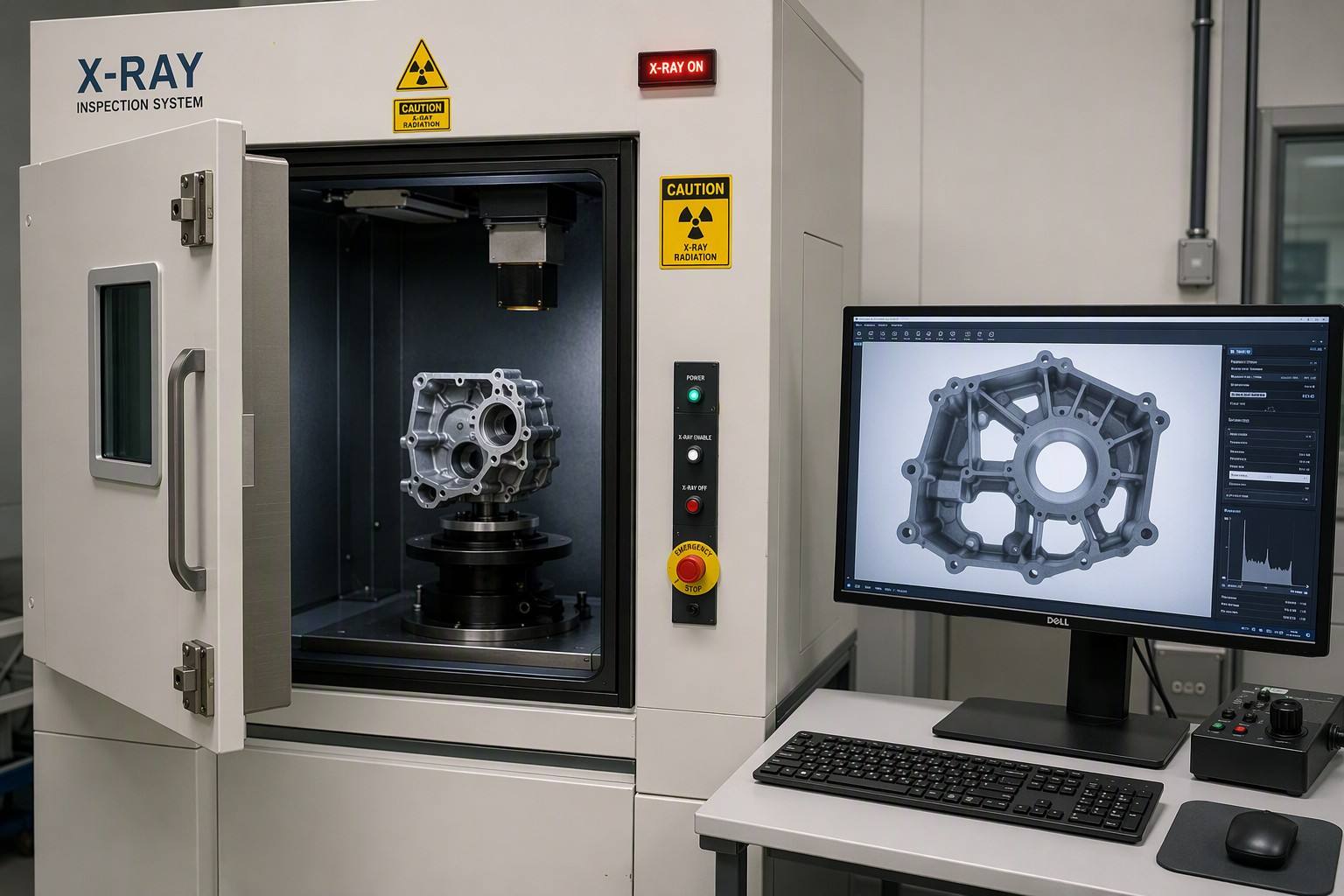
- ISO 9001 + IATF 16949 certified quality system; automotive programs supported with PPAP/FAI documentation and PPAP submission.
- Material certificate (mill test report) shipped with the lot; RoHS / REACH compliance for export.
- Batch consistency tracked via defect-rate logging, tooling maintenance records and SPC.
- Verification methods include CMM, X-ray, leak test, salt spray and spectrographic analysis as needed.
Quality documents worth requesting
- 3D CMM sheet — measured vs nominal on critical features.
- X-ray porosity map — with ASTM E505 / EN 12681 rating.
- Material cert (MTC) — alloy, heat, spectro analysis.
- Microstructure + tensile — proof of mechanical properties.
- Salt-spray / heat log — where corrosion or thermal duty applies.
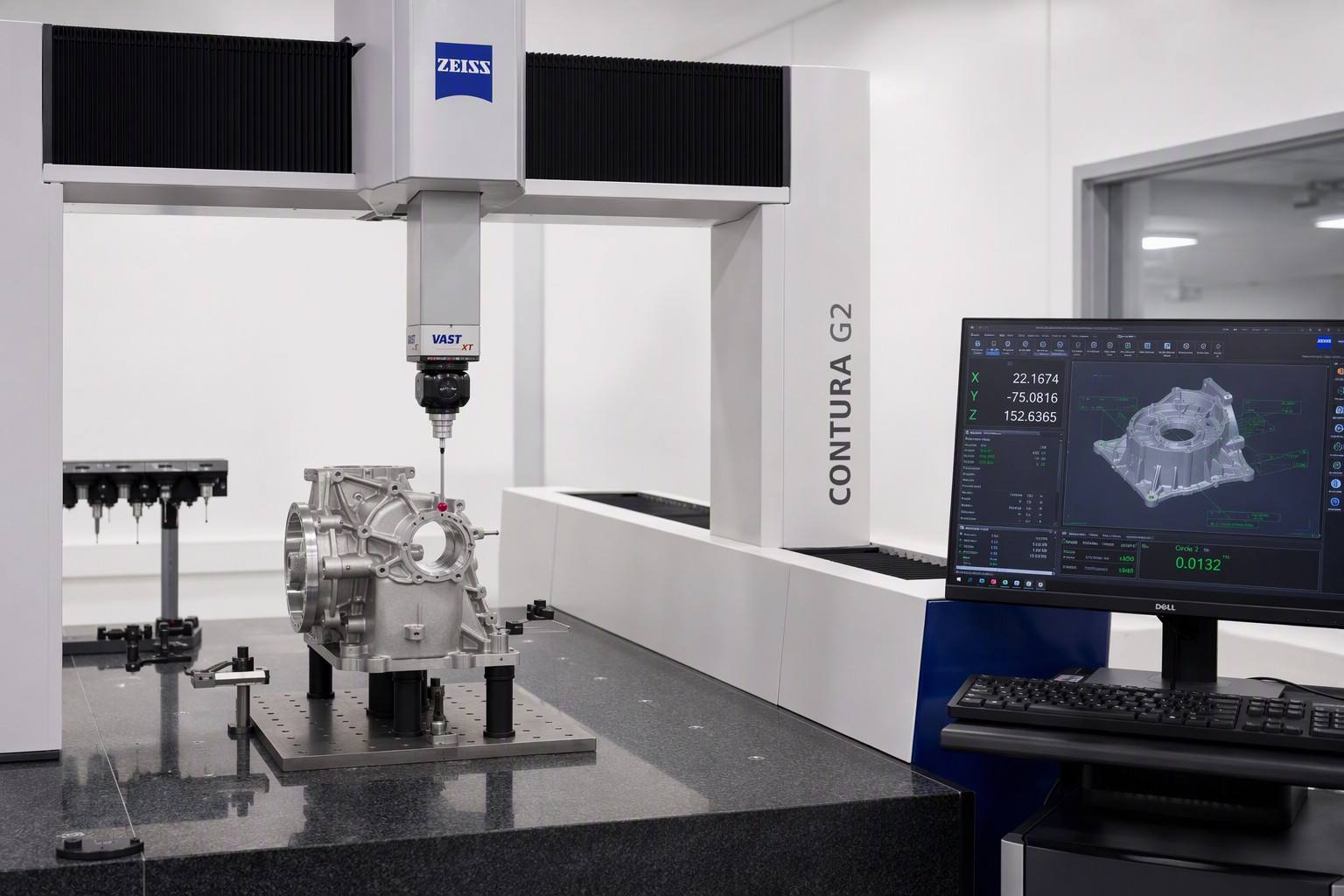
What a buyer should audit: do not only check that inspection exists — check that it is documented and consistent. Ask for a sample FAI/FAIR report, a typical CMM layout, the yield rate on similar parts (stable suppliers run 95–98%+), how non-conforming parts are replaced, and whether tooling maintenance and defect rates are tracked lot to lot. The gap between "we inspect" and "we can show you the data across repeated lots" is the gap between a sample that looked good and a supply you can rely on for years.
| QC stage | Typical method | What it proves |
|---|---|---|
| Incoming | Spectroscopy / cert check | Alloy is what was specified |
| First article | FAI / FAIR + CMM | Tool makes the drawing |
| In-process | IPQC, SPC | Process is stable shot to shot |
| Porosity | X-ray (ASTM E505) | No critical internal voids |
| Sealing | Leak / pressure test | Part holds pressure |
| Final | Cosmetic + AQL | Surface & quantity accepted |
| Export | CoC + traceability | Lot can be tracked |
Reading an inspection report: a useful report names the feature, the spec limit, the measured value and the result (pass/fail) — not just "OK". For pressure-tight parts, the leak rate and test pressure matter; for dimensions, the CMM deviation from nominal; for corrosion, the salt-spray hours survived. If a supplier can show this level of data on repeated lots, you have a controllable process; if you only get a thumbs-up, you are buying trust, not evidence.
16 · Why Choose Xiamen Goldcattle
Facts, not adjectives. Who we are, and the capabilities we bring to your aluminum die casting program:
Xiamen Goldcattle Industrial & Trade Co., Ltd. is a 26-year OEM/ODM manufacturer based in Xiamen, China, and a certified National High-Tech Enterprise. We run a one-roof plant with 100+ in-house machines spanning die casting, CNC machining, mold making, injection molding, 3D printing and sheet-metal stamping.
That means a die cast part can go from your drawing to a finished, inspected, packed product without ever leaving the building — no outsourcing, no hand-off risk, one purchase order and one accountable quality system. We serve automotive, electronics, medical, marine, machinery and appliance brands across 100+ countries, backed by ISO 9001 / IATF 16949 / SGS / RoHS / Rmbond compliance and a 99.8% on-time delivery record.
- Company
- Xiamen Goldcattle Ind. & Trade Co., Ltd.
- Founded
- 26 years · Xiamen, China
- Type
- National High-Tech Enterprise · OEM/ODM
- Facility
- 100+ in-house machines · one-roof plant
- Processes
- Die casting · CNC · Tooling · Molding · 3D · Sheet metal
- Industries
- Automotive · Electronics · Medical · Marine · Machinery
- Global
- 100+ countries served · 20+ delivered
- Certifications
- ISO 9001 · IATF 16949 · SGS · RoHS · Rmbond
Our aluminum die casting manufacturing chain (all in-house)
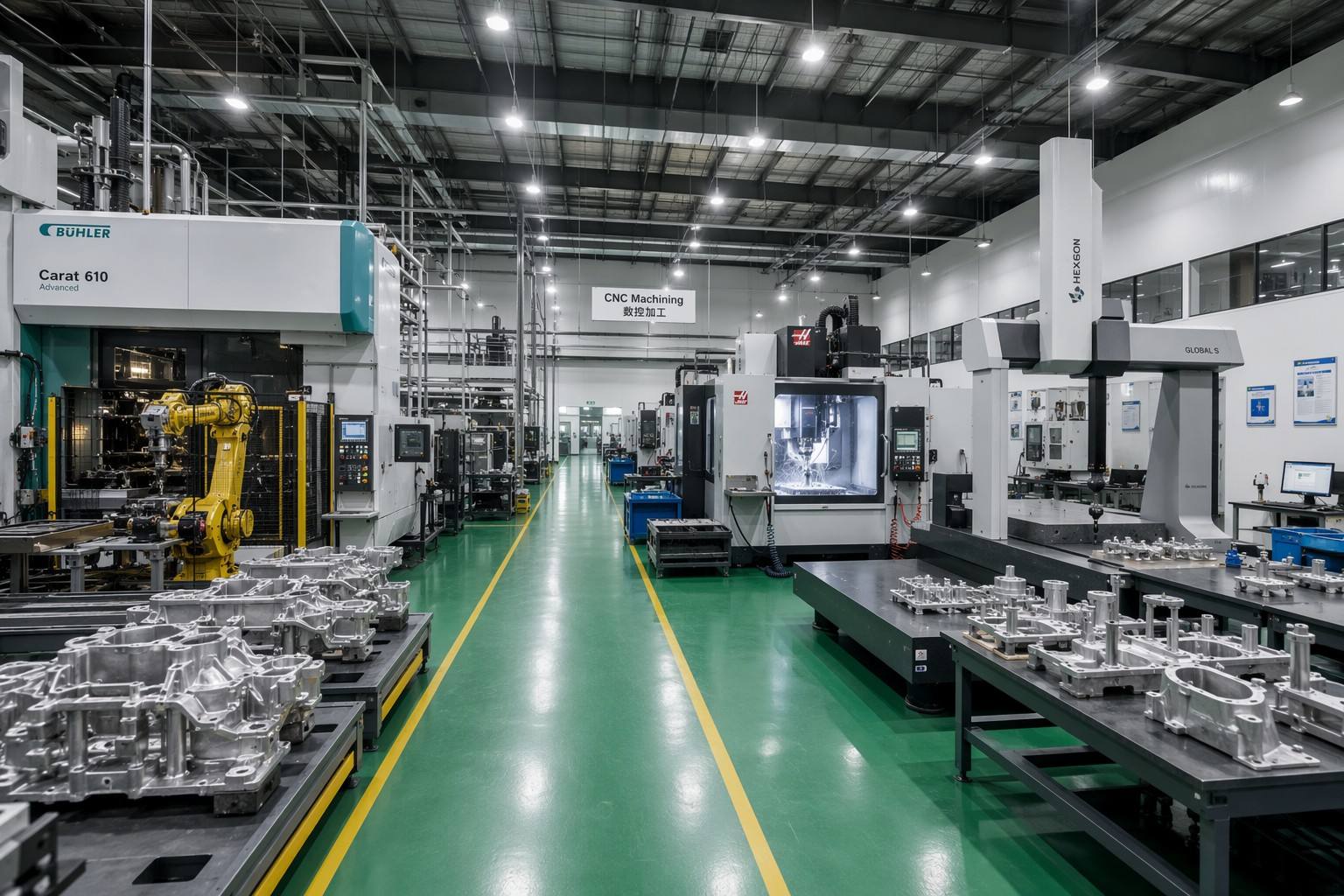
Beyond the spec sheet, the things buyers rate a supplier on are responsiveness and communication: a clear English point of contact, DFM feedback before the contract, weekly progress during tooling, and photo/video updates of trials. A supplier that is slow to answer before you pay will be slower after — so treat the pre-order conversation as the real qualification, not a formality.
Logistics & export: for international buyers, the unseen half of "delivery" is packaging, documentation and transit. Sea freight favors moisture control (desiccant, VCI paper) and stack-safe cartons; air freight favors light, compact pack. Confirm incoterms, HS codes, RoHS/REACH declarations and the document package up front so parts clear customs and pass incoming inspection without a fire drill. A supplier with export experience to North America and Europe will propose the right pack and paperwork rather than leaving it to you to discover at the dock.
How to evaluate a supplier: use the eight-point checklist in the Sourcing & Supplier Checklist section — a supplier that returns only a price with no DFM narrative, inspection data or defined lead-time milestones is the risk, not the number. The right partner lowers your total cost by preventing problems before tooling, not by quoting the lowest as-cast part.
17b · How to Write an Aluminum Die Casting RFQ (Buyer Checklist)
A precise RFQ gets a precise quote — and avoids 20–40% price scatter from hidden scope differences. Send the following and you will cut iterations and surprises.
1. 3D model + 2D drawing
STEP/IGES model plus a drawing with critical dimensions, tolerances and GD&T. Mark which features are fit-, seal- or safety-critical.
2. Alloy & standard
Name the alloy and the standard (ADC12/JIS, A380/ASTM, AlSi9Cu3/EN). If unsure, state the function and let the supplier recommend.
3. Volume & batch
Annual volume and per-order batch size — this drives tooling (cavities) and unit cost more than anything else.
4. Surface finish
Specify the finish and, for anodizing, the acceptable appearance standard and the alloy that supports it.
5. Inspection needs
X-ray, leak test, CMM report, salt spray, material certificate (MTC), RoHS/REACH. State acceptance criteria.
6. Pressure-tight / cosmetic
Flag any sealing faces, waterproof requirement or cosmetic-A surfaces so porosity and finish are planned, not discovered.
7. Quote scope & weight basis
Confirm what the price includes (tooling, CNC, finish, pack, freight) and the weight basis — gross, net or finished. A lighter basis hides cost.
8. Mold lead & commercial
Mold ownership & IP, storage/maintenance, T1/T2 + FAI timing, NDA, and replacement terms for non-conforming parts.
9. MOQ & pricing tiers
Die casting MOQ is typically 500–3,000 pcs. Ask for tiered pricing by annual volume and the economic lot size that reaches your real unit cost.
10. Logistics & Incoterms
State Incoterms, HS codes and RoHS/REACH docs; specify pack (VCI, EPE, export crate) for sea or air so parts clear customs undamaged.
17c · Sourcing Risks, Cost Traps & Supplier Checklist
What separates a low quote from a low total cost — condensed from how buyers actually get burned.
Where the cost hides (ask before you compare quotes)
- Tooling: shared inserts or replaceable cores cut NRE — ask what is reusable.
- Metal: an LME-linked clause shares aluminum-price swings instead of a fixed surprise.
- Machine time: one-touch clamping and multi-cavity tools cut per-part hours.
- Volume: calculate the economic lot size, not an arbitrary MOQ, to reach real unit cost.
- Finish: combine blast + coat under one roof to avoid double handling and freight.
Five common sourcing pitfalls — and the fix
| Pitfall | What goes wrong | Fix |
|---|---|---|
| Excess scrap allowance | Brittle or off-spec castings | Tighten alloy-input & degassing rules |
| Poor cooling layout | Shrink voids, warping | Review flow-simulation / cooling files |
| Generous machining allowance | Wasted metal & time | Request a value-stream map |
| Batch-to-batch finish shift | Color / texture mismatch | Demand retained approval samples |
| Vague Incoterms | Late-arrival fees, disputes | Define liability & milestones up front |
Eight-point supplier checklist (compare shops on facts)
1. Capacity
Annual output and press-tonnage range vs your part size and volume.
2. Certifications
ISO 9001 + IATF 16949; PPAP capability for automotive.
3. Prototype lead
Tooling + T1/T2 + FAI in calendar days, not vague weeks.
4. Sector mix
Experience across industries prevents single-market blind spots.
5. In-house melt check
Spectrometer + melt log history for alloy consistency.
6. Mold repair
On-site repair with spare-parts stock keeps you running.
7. Traceability
Barcode / RFID from melt to carton for recall control.
8. Sustainability
Scrap-reclaim % and documented energy / carbon cuts.
17d · Die Casting Glossary (Quick Reference)
The terms buyers and engineers meet most often in a die casting program — defined plainly.
| Term | Plain definition |
|---|---|
| Die / Mold | The reusable steel tool that shapes the molten metal; "die" is the preferred term in die casting. |
| HPDC | High-pressure die casting — molten metal forced into the die at high pressure; the core aluminum process. |
| Cold-chamber | Process where a shot of molten aluminum is poured into the machine chamber per shot; used for aluminum. |
| Vacuum assist | Evacuating the cavity before fill to cut entrapped-gas porosity. |
| DFM | Design for Manufacturability — reviewing the model to remove casting risks before tooling. |
| Gating / Runner | The channel that delivers metal into the cavity; gate location controls fill and defects. |
| Vent | Passage that lets air escape the cavity so it is not trapped as porosity. |
| Overflow | Reservoir at the last-fill area that captures cold metal and impurities. |
| Flash | Thin excess metal at the die parting line; removed by trimming. |
| Porosity | Internal gas or shrinkage voids; controlled, not eliminated, in HPDC. |
| NRE / Tooling | Non-recurring engineering cost of building the die, amortized over volume. |
| FAI / FAIR | First Article Inspection / Report confirming the tool makes the drawing. |
| PPAP | Production Part Approval Process — automotive supplier qualification documentation. |
| CT class (ISO 8062) | Tolerance grade band; CT5–CT6 is tight as-cast, CT7–CT8 more relaxed. |
| CMM | Coordinate Measuring Machine — precise dimensional verification. |
17 · Frequently Asked Questions
25 questions engineers and procurement teams ask most. (Also structured as FAQPage schema for search engines and AI answer engines.)
What is the best aluminum alloy for die casting?
There is no single best alloy — it depends on the part. ADC12 (JIS) and A380 (ASTM) are the general-purpose defaults for most housings and brackets. A360 is chosen when corrosion resistance or anodizing is critical. A413 is used for pressure-tight parts. B390 is used only for extreme-wear components. Match the alloy to strength, corrosion, pressure-tightness, finishing and cost targets.
Why is ADC12 so widely used?
ADC12 has high silicon content (≈9.6–12%), giving excellent fluidity that fills thin-wall, complex dies reliably. It is dimensionally stable, easy to machine, and low cost with a mature supply chain — ideal for general industrial parts, electronics housings and automotive brackets where ultra-high strength or premium anodizing is not required.
Can aluminum die casting parts be anodized?
It depends on the alloy. A360 and Al-Mg type alloys anodize well with consistent, attractive coatings. High-silicon alloys such as ADC12 and A380 produce grey, uneven anodized surfaces because the silicon particles do not color uniformly. If a cosmetic anodized look is required, specify A360 or a low-silicon alloy and confirm the appearance standard early.
Can die casting replace CNC machining?
For high-volume net-shape parts, die casting is usually far cheaper per piece than CNC because most of the geometry is formed in one shot. But die casting cannot hold the tightest tolerances or internal threads directly — those need secondary CNC. For low volume (typically under ~5,000 pieces) CNC is usually cheaper because there is no tooling cost to amortize.
Can aluminum die casting produce waterproof or pressure-tight parts?
Yes, with porosity control. Vacuum-assisted high-pressure die casting plus good gating/venting design and verification by X-ray and leak testing can produce pressure-tight housings. Standard HPDC without these controls can trap gas and leak, so porosity-critical faces should be specified and validated, often with secondary CNC on the sealing face.
What is the minimum wall thickness for aluminum die casting?
Practical minimum wall thickness for aluminum HPDC is about 0.8 mm for small parts, with 1.0–3.0 mm typical for most production parts. Walls should be as uniform as possible; abrupt thick-to-thin transitions cause sink marks and porosity. Zinc can go thinner (≈0.5 mm).
What tolerance can aluminum die casting hold?
As-cast general tolerance is typically around ±0.1–0.3 mm depending on feature size and part complexity (per ISO 8062 CT5–CT6 class). Tighter dimensions, bores, threads and sealing faces are held by secondary CNC machining (down to ±0.005 mm). Avoid specifying one fixed number — tolerance should follow feature and complexity.
How much does aluminum die casting tooling cost?
Tooling typically ranges from about US$8,000 to $150,000+ depending on part size, cavity count, complexity and steel grade. In-house tool making lowers both cost and lead time. Tooling is a one-time NRE amortized across the production volume, so per-part cost drops sharply as volume rises.
What is the typical lead time for die casting?
Tooling usually takes 3–5 weeks for a standard single-cavity die; complex multi-slide tools take longer. First-article (FAI) follows, then mass production. Sample lead time is commonly 7–15 days after tooling; mass production runs 15–25 days depending on volume and finishing scope.
What is porosity and can it be prevented?
Porosity is internal gas or shrinkage voids caused by trapped air and solidification shrinkage. It can be reduced (not fully eliminated) by vacuum-assisted filling, optimized gating/venting, proper cooling and controlled process parameters. For critical parts, verify with X-ray and leak testing rather than assuming zero porosity.
What aluminum die casting alloys are equivalent across standards?
ADC12 (JIS) ≈ A383 (ASTM) and is close to A380; LM24 (BS) is the UK equivalent of ADC12/A380; AlSi9Cu3(Fe) / ENAC43400 is the European general-purpose grade; LM6 / AlSi12 is a high-silicon European grade. Composition and mechanical values differ slightly, so confirm the exact standard and certificate with your supplier.
Is die casting suitable for prototypes?
For a few prototype pieces, die casting is usually poor value because of tooling cost. Use CNC machining, 3D printing or rapid-tooling soft dies for prototypes, then move to production HPDC dies once the design is validated. Some suppliers offer bridge tooling to prove the design before committing to a full production die.
Which process is best for low volume?
CNC machining or 3D printing is usually best for low volume because there is no tooling NRE. Die casting only becomes economical once volume is high enough to amortize the mold — commonly 5,000–10,000+ pieces, lower for very small parts.
What surface finishes are available for aluminum die cast parts?
As-cast, shot blasting/sandblasting, polishing, powder coating, painting, chromate conversion, anodizing (alloy-dependent), laser marking and plating. Finishing choice depends on corrosion need, appearance and whether the alloy anodizes well.
Can die casting be used for steel or titanium parts?
No. Molten steel (~1500°C) and titanium would destroy hardened die steel. Steel and high-temperature alloys use investment casting, sand casting, forging or CNC machining instead. Die casting is for non-ferrous alloys — aluminum, zinc, magnesium.
What causes cold shut and how is it avoided?
Cold shut is two partially-solidified metal fronts meeting without fusing, caused by low pour temperature, slow fill or thin sections far from the gate. Avoid it with higher melt/superheat, faster injection, better gating and thicker minimum walls. Inspect visually and by dye penetrant.
What is flash and how is it controlled?
Flash is thin excess metal at the die parting line from slight die separation under pressure. Control it with tight die fit/maintenance, controlled clamp force and regular trimming/deburring. Growing flash over a run signals die wear and needs maintenance.
Do you provide DFM review and NDA?
Yes. A qualified die casting partner should provide DFM (design for manufacturability) review, gating/venting strategy, trial-sample review, CNC planning, cosmetic-surface definition, inspection methods and NDA support before long-term orders.
What quality certifications should a die caster have?
At minimum ISO 9001. For automotive, IATF 16949 is expected; PPAP/FAI documentation, material certificates (mill test report) and compliance with RoHS/REACH for export. Ask about X-ray, leak test, CMM and salt-spray capability.
How do you control batch consistency?
Through in-process inspection (IPQC), CMM dimensional checks, cosmetic inspection, tooling maintenance records, defect-rate tracking and SPC. A good supplier provides inspection reports and reacts to quality feedback across repeated lots, not just on the first sample.
What is the difference between hot-chamber and cold-chamber die casting?
Hot-chamber injects molten metal from a built-in goose-neck — fast, for low-melting alloys like zinc. Cold-chamber pours a shot of molten aluminum into the chamber before injection — used for aluminum because its higher melting point would damage a hot-chamber gooseneck. Aluminum die casting is almost always cold-chamber.
What is the difference between die casting and sand casting?
Die casting uses a reusable steel die and high pressure for high-volume, thin-wall, tight-tolerance, good-surface parts. Sand casting uses a disposable sand mold, is slower with rougher surface and wider tolerance, but handles much larger and lower-volume parts and a broader alloy range.
What is the difference between die casting and investment casting?
Investment (lost-wax) casting makes complex, near-net shapes in steel, stainless and superalloys with good surface but lower volume and higher cost per part. Die casting is faster and cheaper at volume for aluminum/zinc but limited to non-ferrous alloys and simpler undercuts.
What information should I send for a die casting quote?
3D model (STEP/IGES) and 2D drawing with critical dimensions/tolerances, alloy and standard, annual volume and batch size, surface finish, inspection requirements, and any pressure-tight or cosmetic needs. Clarify whether the quote includes tooling, CNC, finishing and packaging.
Who owns the die and the intellectual property?
This must be stated in the contract. Best practice for buyers: the mold is owned by the buyer, the supplier shall not use it to produce for third parties, and the mold base/material and IP stay with the buyer. Confirm storage, maintenance and return terms.
Why choose Xiamen Goldcattle for aluminum die casting?
Goldcattle is a 26-year OEM/ODM manufacturer running die casting, in-house tool making, CNC machining, finishing and inspection under one roof — no outsourcing. Capabilities include 160–1250 t HPDC, ADC12/A380/A360 and more, ±0.05 mm cast tolerance (ISO 8062 CT5–CT6), vacuum option, X-ray/leak/CMM inspection, ISO 9001/SGS/RoHS and 100+ countries served.
What is vacuum-assisted die casting and when is it worth it?
Vacuum-assisted HPDC evacuates air from the die cavity just before the molten aluminum fills it, so far less gas is entrapped. It typically cuts porosity 70–80% versus standard HPDC and is worth specifying for pressure-tight, leak-tested, weldable or cosmetic-critical parts where standard casting would trap gas. It adds some tooling complexity and cost, so use it where porosity actually drives failure, not on every part.
How many cavities should the die have?
Cavity count (one, two, four or more parts per shot) is set by volume and part size. Higher cavity count lowers per-part cost at very high volume but raises tooling cost and requires a larger machine. For moderate volume, a single- or two-cavity die is usually the better balance; your supplier should justify the cavity count from your annual volume, not default to the most expensive tool.
Can die cast parts be welded or brazed?
Standard HPDC parts are hard to weld because entrapped gas pores blow out and blister under heat. Vacuum-assisted or porosity-controlled castings can sometimes be welded, and squeeze casting welds better; but for a welded assembly, design the joint on a machined (porosity-free) face or use mechanical fastening / adhesives. Confirm weldability with your supplier before specifying a welded die cast assembly.
What documents should accompany a die casting shipment?
At minimum a Certificate of Conformity (CoC) and material certificate (mill test report); for automotive, PPAP/FAI documentation; plus inspection reports (CMM, X-ray/leak as applicable), RoHS/REACH declarations, and lot traceability. Agree the document package in the RFQ so it is not a surprise at customs or incoming inspection.
How do I protect die cast parts in shipping?
Because die cast surfaces scratch and corrode if abraded or damp, use individual wrap or pocket packaging, protective caps on machined faces, desiccant for sea freight, and ruled cartons with clear labeling and lot IDs. A supplier with export experience will propose the pack that matches your transit mode (air vs sea) and storage, not just the cheapest box.
17c · Sustainability & Recycling in Aluminum Die Casting
Aluminum die casting is one of the more sustainable metal-forming routes — and a strong answer to lightweighting and ESG goals in procurement.
Infinitely recyclable
Aluminum keeps its properties through recycling. Runners, gates, overflow and scrap are remelted in a closed loop, so most of a die casting plant's feed is recycled metal, not virgin ingot.
Low remelt energy
Remelting aluminum uses ~5% of the energy of primary production. Using recycled metal sharply cuts the carbon footprint per part versus virgin material.
Lightweighting dividend
Replacing steel with aluminum die cast parts cuts product weight, which lowers freight emissions and — in vehicles and equipment — in-use energy over the product's life.
Near-net-shape efficiency
Because die casting forms the shape in one shot, it generates far less machining swarf than CNC from billet, reducing both material waste and the energy of removing it.
RoHS / REACH compliance
For export, parts can be supplied compliant with RoHS and REACH restrictions on hazardous substances, with material declarations available on request.
Traceable supply
Lot-level traceability lets buyers document the material origin and compliance needed for sustainability reporting and audits.
18 · Related Resources — The Die Casting Topic Cluster
This guide is the pillar page of the Aluminum Die Casting Topic Cluster. Explore the cluster to go deeper on each decision: