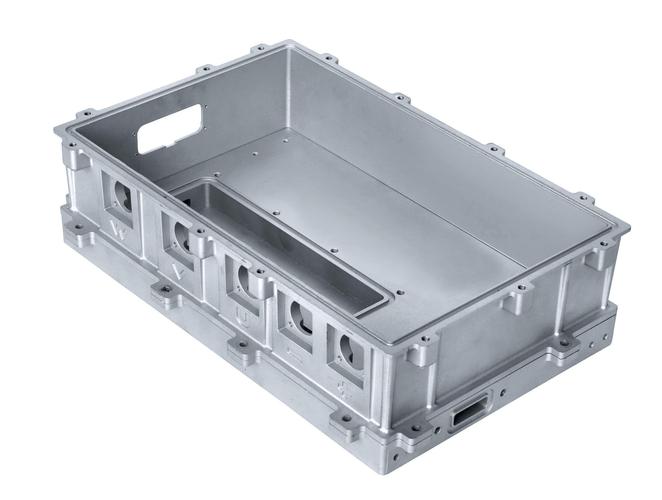
Custom CNC Machined Aerospace Parts & Components
Drawing-based CNC manufacturing for aerospace brackets, housings, fittings, structural components and other precision parts in aluminum, stainless steel, titanium and selected engineering materials.
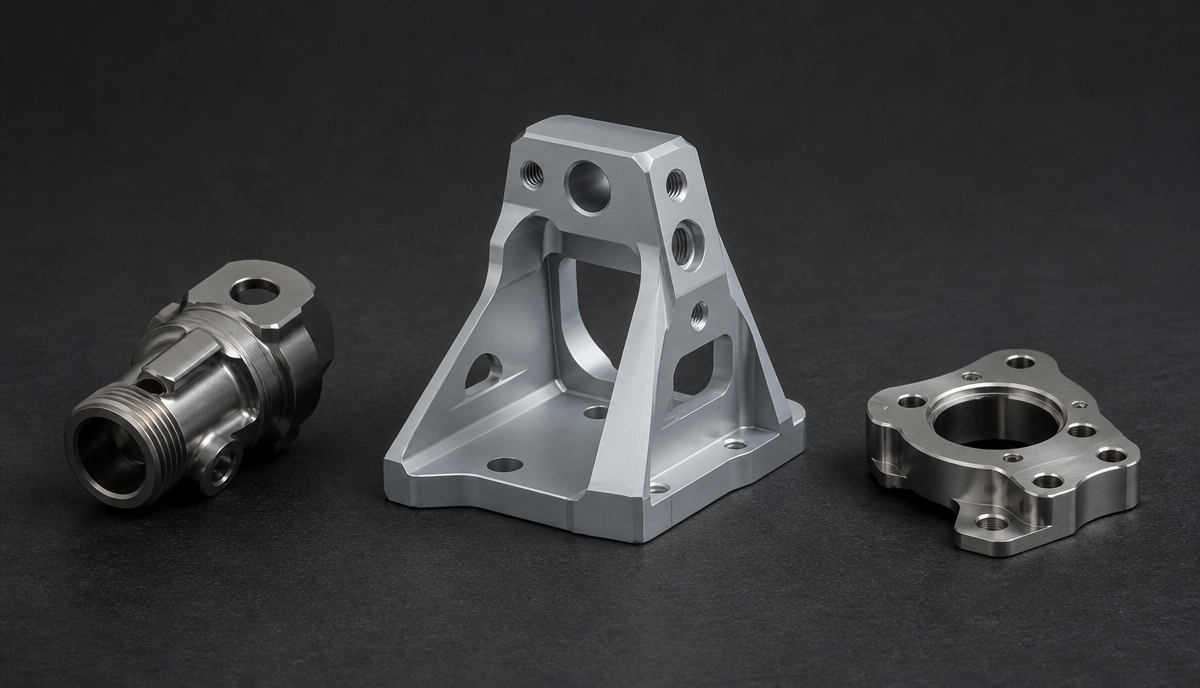
Capability Snapshot
| Machining | CNC milling / turning / multi-axis |
|---|---|
| Materials | Aluminum / stainless steel / titanium / selected alloys |
| Part Types | Brackets / housings / fittings / structural parts |
| Production | Prototype / low volume / repeat batches |
| Input | STEP / IGES / SolidWorks / 2D drawings |
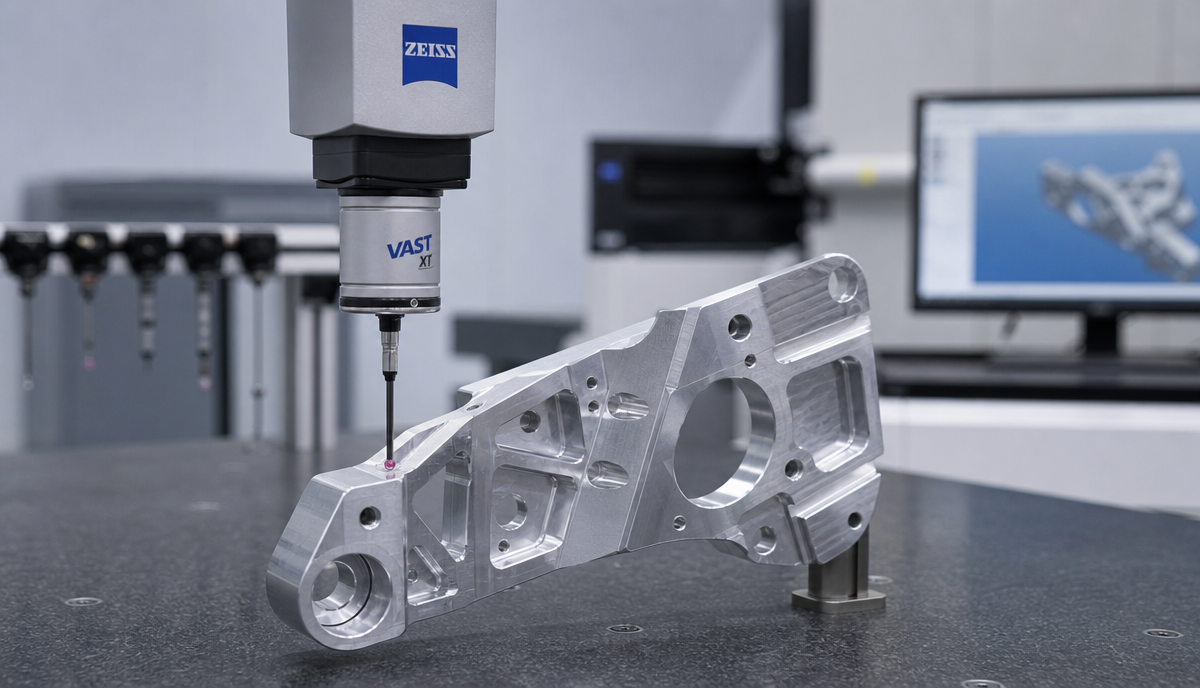
| Inspection | CMM / dimensional reports |
| Finishing | Anodizing / passivation / blasting / polishing |
| Quality System | ISO 9001:2015 |
Manufacturing since 1998. All capabilities subject to part geometry, material and project-specific review.
CNC Aerospace Components We Manufacture
Organized by component function — because the part type determines the machining strategy, critical features and inspection requirements.
Structural Brackets
- Mounting brackets
- Support brackets
- Equipment brackets
- Structural interfaces
Housings & Enclosures
- Sensor housings
- Instrument housings
- Protective covers
- Equipment enclosures
Precision Fittings
- Adapters
- Connectors
- Mounting fittings
- Mechanical interfaces
Machined Bodies / Blocks
- Valve bodies
- Manifolds
- Mechanical blocks
- Fluid-handling components
Rotary / Complex Components
- Impellers
- Complex shafts
- Rotor-related components
Assembly Components
- Clamps
- Spacers
- Retainers
- Precision mounting components
Part Type & Critical Features
Each part category has distinct manufacturing priorities — this table maps part function to the features that matter most during machining and inspection.
| Part Type | Critical Features |
|---|---|
| Structural bracket | Hole position, flatness, profile |
| Housing | Wall thickness, sealing interfaces, threads |
| Fitting | Threads, bores, concentricity |
| Manifold | Internal channels, ports, flatness |
| Mounting plate | Hole pattern, datum relationships |
| Complex 5-axis part | Multi-face access, profile, tool reach |
Aerospace Materials for CNC Machining
Material choice follows functional requirements — strength, weight, corrosion resistance and machinability all influence part design and manufacturing strategy.
Aluminum
6061-T6 / 7075-T6
- Lightweight structural components
- Brackets and housings
- Mounting parts
- Good machinability and anodizing response
Stainless Steel
304 / 316L / 17-4PH
- Corrosion-sensitive components
- Fittings and hardware
- Industrial aerospace support components
- Requires controlled heat management during machining
Titanium
Ti-6Al-4V / Grade 5
- High strength-to-weight requirements
- Complex precision components
- Low thermal conductivity — requires dedicated cutting strategy
- Positive tool engagement and effective coolant critical
Specialty aerospace materials (nickel alloys, selected superalloys) can require dedicated tooling, workholding and process controls. Material availability and machining feasibility are reviewed case by case.
When Aerospace Parts Benefit From 5-Axis CNC
5-axis is not automatically better — it delivers value when part geometry genuinely requires multi-directional tool access.
Multiple Faces
Features on several faces can be accessed without repeatedly re-fixturing the part.
Angled Surfaces
Complex contours and angled interfaces can benefit from controlled tool orientation.
Reduced Setups
Fewer setups can simplify datum relationships and reduce repositioning operations.
Complex Aerospace Geometry
Deep pockets, curved surfaces, compound angles and difficult tool access.
GD&T and Critical Feature Control
Aerospace buyers often care more about relationships between functional features than about an isolated dimensional tolerance.
True Position
Flatness
Parallelism
Perpendicularity
Concentricity
Profile
Runout
Design Review for CNC Aerospace Parts
Good aerospace DFM catches issues before they become manufacturing problems — and before they affect delivery.
Datums
Clearly defined primary, secondary and tertiary datums.
Hole Patterns
Hole location and orientation tied to functional references.
Thin Walls
Thin sections require attention to rigidity, workholding and machining sequence.
Pockets
Pocket depth, corner radius and tool reach affect machinability.
Threads
Thread type, class and engagement should be defined on the drawing.
GD&T
Position, profile, flatness and concentricity specified only where function requires.
Tolerance & Dimensional Control
Aerospace parts are manufactured to drawing specifications — not to a single blanket tolerance number.
Aerospace CNC Machining Process
From CAD model to inspected component — each step is a decision point that affects part quality and delivery.
CAD Review
Geometry + material + tolerance + quantity
DFM Review
Tool access + workholding + critical features
CAM Programming
Toolpath + cutting strategy + finishing
CNC Machining
Roughing + semi-finishing + finishing
Surface Treatment
Anodizing / passivation / blasting / polishing
Inspection
CMM / dimensional / FAI per drawing
Quality Control for Aerospace CNC Parts
Quality documentation follows the part — from incoming material verification through final inspection and shipping.
Material Certificates
Dimensional Reports
FAI Where Required
Traceability Records
Surface Treatment Docs
Certificate of Conformance
Surface Treatments for Aerospace Components
Finish selection depends on alloy, application and environmental requirements — not every part needs every treatment.
Aluminum
- Anodizing
- Hard anodizing
- Bead blasting
- Polishing
- Chem film
Stainless Steel
- Passivation
- Electropolishing
- Polishing
- Bead blasting
- Brushing
Titanium
- Bead blasting
- Polishing
- Anodizing (color)
- Passivation
From Aerospace Prototype to Repeat Production
Aerospace development typically moves through validation stages — each with different quantity and documentation requirements.
CAD / Drawing
DFM Review
Prototype
Dimensional Validation
Design Revision
Pilot Batch
Repeat Production
Typical Aerospace Component Applications
Organized by component role — not by aircraft system — because that is what determines manufacturing requirements.
Airframe Support Components
Avionics Equipment Housings
Mounting Brackets
Ground-Support Equipment
UAV / Drone Structural Parts
Aerospace Test Fixtures
Instrumentation Components
Aircraft Interior Hardware
Aerospace CNC Part Case Studies
Representative projects showing different material and geometry challenges in aerospace CNC manufacturing.
7075-T6 Structural Bracket
Ti-6Al-4V Precision Fitting
What We Need to Quote an Aerospace CNC Part
The more complete the drawing package, the more accurately manufacturing feasibility and cost can be evaluated.
3D CAD model
2D engineering drawing
Material grade
Annual / batch quantity
Critical tolerances
GD&T requirements
Surface finish
Surface treatment
Inspection requirements
Packaging / traceability
The more complete the drawing package, the more accurately manufacturing feasibility and cost can be evaluated.
Frequently Asked Questions
Have an Aerospace Part for CNC Machining?
Send your 3D CAD model, 2D drawing, material specification and quantity. We will review tool access, workholding, critical features, GD&T, surface treatment and inspection requirements before quotation.
Request an Aerospace Part Review