Complete Guide to CNC Coolant and Cutting Fluid
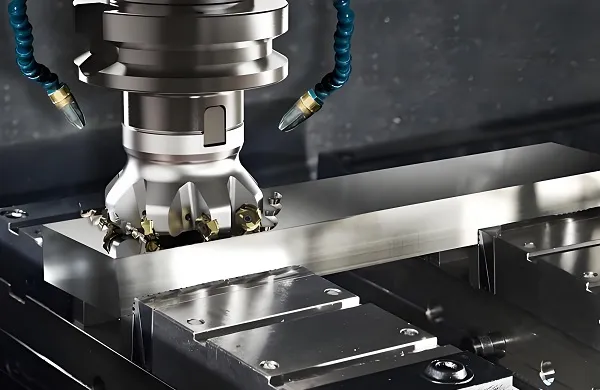
Coolant does three jobs on a CNC machine — it cools, it lubricates and it flushes chips out of a confined hole. This guide compares flood, through-tool, MQL, air blast and dry machining, explains concentration and maintenance, and shows how coolant failure cascades into hole quality, tool wear and chip jams.
Quick answer
CNC coolant performs three distinct jobs that are not equally important at every depth: it cools the cutting zone, it lubricates to reduce friction and built-up edge, and it flushes chips out of the cut. Past roughly 3×D, flushing quietly becomes the dominant function — a hole fails from packed chips long before it fails from heat. The right delivery method (flood, through-tool, MQL, air blast or dry) depends on the process, material, tool and hole depth, and any chemical or safety claim must follow the coolant manufacturer's data sheet and SDS.
Published 2026-08-05 · Updated 2026-08-05
01Quick answer
02Cooling vs lubrication vs chip evacuation
| Job | What it prevents | Dominates when |
|---|---|---|
| Cooling | Edge overheating, loss of hardness, blue chips | High-speed, shallow, heat-generating cuts |
| Lubrication | Friction, built-up edge, work-hardening | Gummy materials (aluminium, stainless) |
| Chip evacuation | Packed flutes, recut chips, drill breakage | Deep holes, confined bores — roughly > 3×D |
03Coolant types at a glance
Flood
External nozzles flood the cut. Simple, cheap, the shop default — but cannot reach a deep-hole tip against escaping chips.
Through-tool
Fluid pushed through the tool to the tip. The deep-hole and gummy-material answer; flushes chips out.
MQL
Minimum quantity lubrication: a fine oil mist. Great lubrication, low mess, but little chip flushing.
Air blast
Compressed air clears chips in shallow work and plastics. No cooling or lubrication.
Dry
No fluid. Only for materials/tooling designed for it. Heat and chips rise fast otherwise.
04Flood coolant
The workhorse. A pump pushes fluid through external nozzles at the cut. It is simple, cheap and perfectly adequate to roughly 3–4×D in most materials.
- Pros: low cost, simple to maintain, good all-rounder.
- Cons: cannot reliably reach the tip of a deep hole; chips coming up the flute block the stream.
- Best for: shallow drilling, milling, turning where chips clear on their own.
05Through-tool coolant
Fluid is delivered through the tool's internal channels to the cutting edge. Instead of fighting chips coming up, it pushes them out from behind.
06MQL (minimum quantity lubrication)
A very fine oil mist is applied at the cut. Lubrication is excellent and the part stays nearly dry, which helps cleaning and some secondary operations.
- Pros: superb lubrication, cleaner parts, less fluid to manage.
- Cons: very limited chip flushing — not a deep-hole solution on its own.
- Best for: aluminium and materials where lubrication matters more than cooling, when near-dry is desirable.
07Air blast
Compressed air clears chips from shallow cuts and keeps plastics from melting. It does no cooling and no lubricating, so it is a clearing aid, not a full coolant.
08Dry machining
Running with no fluid is viable only with the right tooling and material. Cast iron, for example, is often run dry with extraction. For most metals, dry means heat builds in the tool and chips pack.
09Material and operation selection
| Material / operation | Typical coolant | Why |
|---|---|---|
| Aluminium drilling | Flood or through-tool; MQL common | Lubrication beats heat; evacuate long chips |
| Steel, shallow | Flood emulsion | General-purpose, cheap, adequate |
| Stainless | Through-tool where possible | Heat and work-hardening need strong delivery |
| Titanium | High-pressure through-tool | Heat must be pulled from the edge aggressively |
| Cast iron | Dry with extraction, or mist | Abrasive dust; fluid can make slurry |
| Deep hole > 5×D | Through-tool, almost always | External flood cannot reach the tip |
Table 1. Direction only. Final choice follows the tool and coolant manufacturer's recommendations for the exact combination.
10Drilling and deep-hole coolant strategy
Deep holes are where coolant strategy is decided, not assumed. The rule of thumb:
- Up to ~3×D: flood coolant is usually enough.
- ~3–5×D: through-tool or a peck cycle (G73/G83) with flood.
- > ~5×D: through-tool coolant becomes the practical answer; parabolic or gun drills depend on it.
11Concentration and mixing
Concentration is the ratio of concentrate to water. Too lean and you lose corrosion protection and lubrication; too rich and you invite foam, residue and waste.
- Read the supplier's targetThe correct range is product-specific — we do not publish a generic number.
- Mix concentrate into waterAlways add concentrate to water, never the reverse, to avoid "oil-in-water" inversion problems.
- Use the right waterHard or soft water changes behaviour; follow the supplier's water-quality guidance.
- Verify with a refractometerA calibrated handheld check on a schedule, not a visual guess.
12Filtration and maintenance
A coolant system is a living tank, not a fill-and-forget item. The maintenance loop:
13Foam, odor, corrosion and staining
- Likely cause
- Too-high concentration, soft water, air pulled in by a worn pump seal, over-agitation
- Check first
- Refractometer reading; water hardness; pump seal and return splash
- Then adjust
- Correct to target ratio; fix air ingress; verify water quality
- Likely cause
- Stagnant, contaminated tank; tramp oil feeding microbes
- Check first
- Tank cleanliness, tramp-oil skimming, concentration
- Then adjust
- Skim tramp oil, clean and re-dose per supplier guidance
- Likely cause
- Concentration too lean; incompatible chemistry; dirty system
- Check first
- Actual concentration vs target; supplier alloy compatibility
- Then adjust
- Re-establish correct ratio; confirm fluid matches the alloy
14Delivery direction and pressure
Where the fluid lands matters as much as how much you pump. Aim it at the cut, not the general area; for through-tool work, sufficient pressure is what drives chips out of a deep hole. Pressure and flow targets are set by the tool and coolant manufacturer — we do not quote generic values.
15Safety, SDS and disposal
- Follow the fluid manufacturer's SDS for handling, PPE and storage.
- Disposal must follow local regulation and the supplier's guidance — do not treat spent coolant as ordinary waste.
- For medical, aerospace or food-contact parts, cleaning, residue and documentation are reviewed per the project, not assumed.
16Troubleshooting matrix
| Symptom | Likely coolant cause | First check |
|---|---|---|
| Foam | High concentration / air ingress | Refractometer; pump seal |
| Odor | Bacterial load | Tramp oil; tank cleanliness |
| Corrosion | Lean concentration | Actual ratio vs target |
| Staining (aluminium) | Incompatible fluid / dirty system | Supplier compatibility; clean tank |
| Built-up edge | Poor lubrication delivery | Nozzle aim; through-tool pressure |
| Chip jam / packed flute | Insufficient flushing | Through-tool vs flood; peck cycle |
Table 2. Many "tool" and "quality" problems are really coolant problems wearing a disguise. Check delivery before changing speeds and feeds.
17How Goldcattle controls coolant
Xiamen Goldcattle runs coolant as a process variable, not an afterthought:
- Through-tool capability on deep-hole and gummy-material work.
- Filtration and tramp-oil management on production tanks.
- Refractometer checks on a schedule, not by eye.
- First-article verification that includes surface finish and bore condition, not just diameter.
FAQFrequently asked questions
What does coolant actually do at the cut?
Three things: it cools the edge, it lubricates to cut friction and built-up edge, and — most importantly in deep holes — it flushes chips out of the cut. Past about 3×D, that flushing job dominates. A coolant strategy that only 'cools' a deep hole will still fail from packed chips.
Can I just run dry to avoid coolant mess?
Only for materials and tooling designed for it (some cast irons, certain dry-capable systems). For most metals, dry machining lets heat build in the tool, chips pack, and holes grow rough and oversize. Dry is a deliberate engineering choice with the right tooling — not a default to avoid cleanup.
Is through-tool coolant worth the hassle?
For deep holes and gummy materials, almost always yes. It pushes chips out from the tip instead of fighting them going the other way, often removes the need to peck, and recovers cycle time. It needs a through-coolant drill, holder and machine capability — but the payoff in deep-hole work is large.
How do I check coolant concentration?
With a calibrated handheld refractometer against the coolant supplier's target ratio, checked on a schedule. Do not guess by colour or feel — too weak invites corrosion and poor lubrication; too strong invites foam, skin irritation and waste. The exact target always comes from the fluid manufacturer's data sheet.
Why is my coolant foaming?
Usually too high concentration, contaminated or soft water, excessive agitation, or air pulled in by a worn pump seal. Reduce to the correct ratio, check water quality, and fix air ingress before blaming the fluid.
Why does my aluminium part stain or corrode?
Often a concentration that is too lean, bacterial load in a neglected tank, or a coolant chemistry incompatible with the alloy. Confirm the target ratio and the supplier's aluminium compatibility, and keep the system clean.
What concentration should I run?
Whatever the coolant manufacturer specifies for your operation and material — there is no universal fixed value. We do not publish a generic number because the safe range is product-specific and must follow the supplier's data sheet.
How does coolant affect tool wear?
Poor delivery is a leading cause of thermal cracking and built-up edge. Insufficient flushing means chips recut and load the tool; heat that cannot escape accelerates wear. See the tool wear guide for the full chain.
Does coolant choice affect hole quality?
Directly. Insufficient flushing produces recut chips that scratch the bore and load the drill, so the hole comes out oversize, rough and out of round. Good coolant control is part of hole quality, not separate from it — see the hole quality guide.
What about safety and disposal?
Follow the fluid manufacturer's SDS for handling, PPE and disposal. We do not make generic health or environmental claims; medical and disposal decisions must follow the SDS and local regulation. For sensitive industries (medical, aerospace) we review cleaning, residue and documentation per the project.
●The CNC drilling & parameters library
Coolant is the quiet multiplier on every other parameter. Get it wrong and good speeds and feeds still make scrap; get it right and marginal tools survive.
The complete hole-making framework: operations, drill types, accuracy, cycles and process selection.
How cutting speed, RPM, feed per revolution and chip load fit together, with starting points by material.
Built-up edge, long chips, burrs, deep holes and hole accuracy in 6061, 7075, 2024 and 5052.
Feed per tooth vs feed per revolution, chip thinning, and what chip shape tells you about your parameters.
What SFM and m/min measure, why diameter changes RPM, and how to convert between them correctly.
Convert surface speed and tool diameter into spindle RPM, in both imperial and metric units.
Feed rate from RPM and chip load (milling) or feed per revolution (drilling), plus reverse calculation.
Canned cycle selection, Q/R/P/K parameters, G98/G99 returns, commented examples and alarms.
A decision framework from operation and material to geometry, coating, holder, reach and volume.
Identify flank wear, cratering, BUE, chipping and thermal cracking, then correct them in the right order.
Diameter, true position, cylindricity, finish, burrs, process capability and how each one is inspected.
Need stable deep-hole drilling or burr-controlled machining?
Coolant strategy is where deep holes and tough materials either succeed or scrap. Send us the part and the conditions — material, depth, tool, coolant type and machine — and we will return a controlled process plan with the delivery method, pressure and maintenance checks spelled out.
- 26 years of in-house precision machining
- Through-tool coolant, filtration and first-article control
- 3-, 4- and 5-axis CNC, 100+ machines
- Deep-hole and burr-controlled expertise
- ISO 9001 quality system
- 24-hour response on engineering reviews
Goldcattle CNC Engineering Team
Xiamen Goldcattle Industrial & Trade Co., Ltd. has run in-house precision machining for 26 years as a Chinese National High-Tech Enterprise, with more than 100 machines covering CNC machining, injection moulding, tooling, die casting, 3D printing and sheet metal. Everything on this page reflects how we actually set up, prove out and inspect holes on production parts — not a catalogue reprint.
Technically reviewed by our Process Engineering Lead · ISO 9001 quality system · Published 2026-08-05 · Last updated 2026-08-05. Cutting data, coolant concentrations and controller syntax should always be confirmed against your machine, controller, tooling and fluid manufacturer's current documentation.