Materials · Medical Equipment Components
How to Specify Titanium Alloy Parts for Medical Equipment
A titanium part for medical equipment is not defined by the material alone. It is defined by five separate claims — grade and standard, drawing, process, biological evaluation and quality-system scope — and each one is proved by a different document.
This is a specification guide, not a service page. It sets out what to write on the drawing and the purchase order, and what each document does and does not prove.
Scope of This Guide, and How It Differs From the Service Pages
The distinction matters because the site already carries a detailed medical machining page and a medical device parts page. Between them they cover the machining process, tolerances, finishing, cleaning, traceability, inspection and the RFQ fields a shop needs. What neither of them does — and what a purchasing engineer still has to work out alone — is how the specification is assembled: which standard governs which grade, what each certificate actually attests to, where the biological evaluation sits, and which of the several quality documents applies to a component maker rather than to a device maker.
That is the whole of this page. It is written for the person who has to issue the drawing and the purchase order, and who will be asked by an auditor or a customer why a particular certificate was requested.
"Medical Titanium" Is Not a Specification
The phrase survives because it sounds like a quality level. It is not one. There is no register of "medical" titanium, no single certificate that confers the status, and no property that a supplier can test for and declare. What exists is a set of material specifications written for surgical implant applications, and a supplier is held to whichever one the buyer names.
| Field | What it fixes | What happens when it is missing |
|---|---|---|
| Grade designation | Alloy family and interstitial level — for example unalloyed titanium, or Ti-6Al-4V at ELI interstitial limits | The supplier may substitute a mechanically different alloy within the same family, and the certificate will still look correct |
| Governing standard | The specification that defines chemistry, mechanical properties and metallurgical requirements | Two heats that both satisfy the grade name can differ on the properties the design relies on |
| Product form | Bar, forging stock, plate or sheet, and the mill form the part is cut from | Grain flow and property direction change with form, so a part proved on bar is not proved on plate |
| Condition | Annealed, cold worked, stress relieved, or as-supplied mill condition | Strength and residual stress shift, and with them the behaviour of a thin wall after machining |
Written out in full, a material requirement looks unglamorous and slightly long. That is the point:
The Five Claims Behind One Part
| # | Claim | Document that proves it | Who owns the claim |
|---|---|---|---|
| 1 | The material is what you asked for | Material test report or mill certificate, with heat or lot identity | Mill, confirmed by the supplier |
| 2 | The geometry is right where it matters | Drawing with critical features and datums; dimensional or CMM report | Designer, verified by the supplier |
| 3 | The surface and cleanliness suit the use | Process specification: passivation, cleaning, packaging, with records where required | Supplier, to the buyer's specification |
| 4 | The material and the device are biologically acceptable | Biological evaluation to ISO 10993, within a risk management process | Device manufacturer |
| 5 | The supplier's quality system covers this work | Certificate with a defined scope; audit report where applicable | Supplier, read by the buyer |
Two of these five are routinely misread. The material certificate is treated as though it certified the part, when it certifies the stock. And the biological evaluation is treated as though it were a material property, when it belongs to the device and its intended use. Both errors are common enough that they have their own chapters below.
Link 1: The Grade Name, and What It Commits You To
Titanium for medical components generally falls into two families: unalloyed, and the alpha-beta alloy Ti-6Al-4V. The unalloyed family is chosen for corrosion resistance and formability where the strength of the alloy is not needed. The alloy family is chosen where strength and fatigue resistance drive the design, and within it the interstitial content becomes a separate decision.
| Designation | What it is | Why a project chooses it |
|---|---|---|
| Unalloyed titanium, grades 1–4 | Commercially pure titanium at increasing strength and decreasing ductility | Corrosion resistance and formability where the alloy's strength is not required |
| Ti-6Al-4V, standard interstitial | The alpha-beta workhorse alloy at normal oxygen and iron limits | Strength-to-weight where the application does not demand the tighter interstitial control |
| Ti-6Al-4V ELI | The same alloy at extra-low interstitial limits — oxygen capped at 0.13% in the wrought implant specification | Better toughness and fatigue behaviour, which is why implant specifications name it |
| Vanadium-free alternatives | Alloys such as Ti-6Al-7Nb or Ti-13Nb-13Zr | Programmes that specify a composition without vanadium for their own reasons |
ELI is the designation most often ordered without being understood. The lower oxygen and iron limits are not a quality badge; they buy fracture toughness and fatigue performance at the cost of slightly lower tensile strength. A design that needs the strength of standard-interstitial material and a drawing that names ELI are pulling in opposite directions, and the drawing usually wins because nobody revisits it.
Link 1: The Standard Behind the Grade
| Standard | Scope as written | What it does not do |
|---|---|---|
| ASTM F67 | Unalloyed titanium for surgical implant applications | Does not qualify a finished part, and does not cover the alloy |
| ASTM F136 | Wrought Ti-6Al-4V ELI for surgical implant applications | Does not make a machined component implantable, and does not cover cast or additively built material |
| ASTM F1472 | Wrought Ti-6Al-4V at standard interstitial levels for surgical implant applications | Does not carry the ELI interstitial limits, despite the same alloy name |
| ISO 5832-2 | Unalloyed titanium for surgical implants | Is a different document from the ASTM equivalent; naming both creates two acceptance routes |
| ISO 5832-3 | Wrought Ti-6Al-4V alloy for surgical implants | Does not by itself distinguish ELI from standard interstitial content |
| ASTM F138 | Wrought 18Cr-14Ni-2.5Mo stainless steel for surgical implants | Is the contrast case: the same application area, a different alloy family entirely |
Two consequences follow, and both catch buyers out. First, these are material specifications: they describe the stock the part is cut from, not the part. A machined component cannot be "F136 certified" any more than a machined bracket can be certified to a steel mill standard — the certificate belongs to the heat, and the part inherits it only through traceability. Second, naming a standard for surgical implant applications does not license a surgical implant use. The applicability decision belongs to the device, its risk assessment and its regulatory pathway.
Link 1: Form and Condition, the Two Fields Everyone Leaves Out
| Field | Options a drawing may name | Effect on the part |
|---|---|---|
| Product form | Bar, forging stock, plate, sheet, or a near-net forging | Grain flow follows the forming direction, so fatigue and toughness are directional; a design proved on bar is not automatically proved on plate |
| Condition | Annealed, stress relieved, cold worked, or as-mill | Strength and locked-in stress move together; residual stress is released when material is removed and shows up as distortion in a thin wall |
| Heat or lot identity | Recorded at goods-in and carried through the route card | Without it the certificate describes a heat, not the parts that were shipped |
| Traceability chain | Heat number marked on the work order and referenced on the final document set | With it, a certificate can be tied to a specific delivery; without it, the link is an assertion |
The practical consequence is a rule worth writing into the purchase order: a change of form or condition is a change of material, and it reopens the qualification even when the grade name and the standard are unchanged. Suppliers substitute forms for availability more often than buyers expect.
What a Material Test Report Proves, and the Four Things It Does Not
| The document states | It does not state |
|---|---|
| Chemical composition of the heat or lot | That the delivered parts were made from that heat, unless the traceability chain is enforced and recorded |
| Mechanical properties measured on the lot | That the machined part retains those properties after thermal or mechanical processing |
| Conformance to the named material standard | That the standard is appropriate for the intended device use |
| Heat number, mill and date | Anything about dimensions, surface finish, cleanliness, burrs or packaging |
Certificate types are themselves a specification decision. The EN 10204 scheme distinguishes a 3.1 certificate, issued by the manufacturer's inspection function independent of production, from a 3.2 certificate, which additionally involves an independent inspection body. If a project needs the second, it has to be named on the enquiry, because it changes what is arranged before production rather than after.
Link 2: Reducing the Drawing to What Actually Matters
| Feature class | Why it is critical | What the drawing must carry |
|---|---|---|
| Mating interface | It sets position and alignment against another component | Size with its own tolerance, position or profile callout, and the datum scheme it is measured from |
| Sealing or seating face | Flatness or squareness decides contact, not size | A form or orientation callout; a size tolerance will not control it |
| Bore or bearing seat | Roundness and straightness decide fit and motion | Diameter, plus roundness or cylindricity where the function needs it, plus a finish band |
| Thin wall or web | It deflects under clamping and cutting force | A minimum wall with a stated measuring position, and the datum held during machining |
| Edge and burr condition | An edge that is not specified is an edge nobody inspects | An explicit edge treatment, and whether a burr is permitted at all on the functional surface |
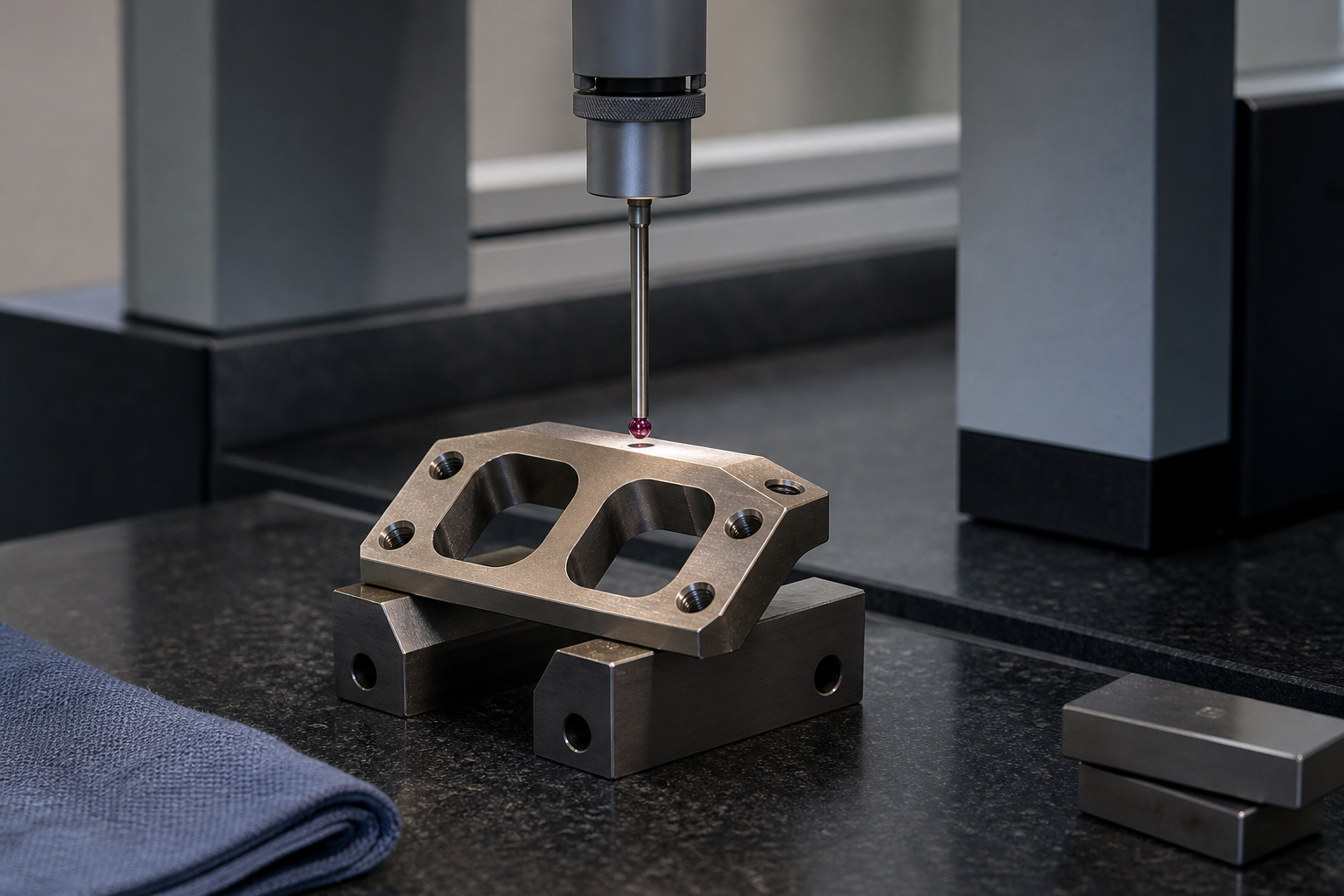
The datum scheme deserves more attention than it usually gets, because it is where a good part fails inspection. If the drawing nominates three datums that no fixture can hold simultaneously, the shop will pick its own, the CMM will pick a third, and the argument at first article is about arithmetic rather than about the part. Reducing the datum set to the ones the function actually uses makes both the machining and the inspection cheaper and more repeatable.
Why "Tight Everywhere" Is a Cost Decision, Not a Quality Decision
Tolerance cost is not linear. Tightening a feature changes the process: more operations, lighter cuts, more frequent tool changes, stress relief between roughing and finishing, temperature-controlled inspection, and a fixture stiff enough not to move the part. Those costs are incurred whether or not the feature matters, and they are incurred on every part in the batch rather than once.
| Symptom on the drawing | What it produces | Better formulation |
|---|---|---|
| Every dimension at the same tight limit | A quote priced for the worst feature, and no guidance on what to check first | Critical features individually toleranced; a general tolerance for the rest |
| No distinction between size and form | Flatness requested as a plus-or-minus, which no process can hold as written | Geometric callouts for form, orientation and location; size tolerances for size |
| A dimension chain all at the same limit | Worst-case stack several times the individual tolerance | Identify the closing dimension and tighten only what the stack needs |
| Surface finish stated as a single value for the whole part | The functional face and the hidden cavity priced identically | Finish bands tied to function, zone by zone |
Link 3: The Process Specification Buyers Usually Leave Empty
| Item | What the specification states | What can be evidenced |
|---|---|---|
| Passivation | Acid system and the practice followed, applied after all material removal is complete | Process record with bath and time, or a certificate of conformance naming the practice |
| Deburring | Method permitted, and the acceptance criterion with the magnification it is judged at | Visual and tactile criteria, plus first-article photographs at the agreed magnification |
| Cleaning | Cleaning route and the residue or cleanliness acceptance method | Process record; verification result where the method produces one |
| Marking | Method, location and whether marking is permitted on a functional or wetted surface at all | Marking sample; note that laser marking leaves an oxide and a heat-affected zone that must be removed or avoided |
| Packaging | Individual protection, thread and edge protection, desiccant, double bagging where the part enters a controlled area | Packaging specification and label content |
| Handling after cleaning | Gloves, and whether bare-hand contact is prohibited once the part is cleaned | Stated in the route; visible in the packaging method |
Link 3: Two Passivation Standards, Two Different Metals
| Stainless steel | Titanium | |
|---|---|---|
| Governing practice | ASTM A967, chemical passivation treatments — nitric or citric systems | ASTM F86, surface preparation of metallic surgical implants, a nitric acid practice |
| What the treatment is for | Removing free iron and exogenous contamination so the chromium oxide layer can form and stabilise | Removing contamination and embedded foreign material, including iron picked up from tooling, from a surface that oxidises in air within moments |
| What happens if the wrong one is applied | A citric or nitric treatment does what it says; the risk is an unremoved heat tint, not the acid choice | A stainless routine may be applied, recorded, and still leave the contamination the specification was trying to remove |
| The contamination source to control | Machining with iron-bearing tooling, blasting media, workshop atmosphere | The same, plus any shared fixturing and any blasting or brushing with carbon steel tooling |
The practical instruction for a drawing is short: name the practice, not just the word "passivated". "Passivated" on its own does not tell a shop which acid, which standard, or whether the step applies to the alloy on the drawing at all.
Link 4: What ISO 10993 Actually Is
The series is structured as an umbrella standard plus test-specific parts. The umbrella, ISO 10993-1, sets out how the evaluation should be planned and conducted within a risk management process: the device's materials, the manufacturing process, the nature and duration of contact, and the existing data are all inputs before any test is chosen. The other parts describe individual assessments — cytotoxicity, sensitization and irritation, systemic toxicity, implantation effects, and so on.
There is one part of the series that a material or component supplier genuinely can contribute to: chemical characterization of the material, ISO 10993-18. That is the analytical work that describes what the material is made of and what it may release, and it is an input to the device manufacturer's evaluation rather than a substitute for it.
| Item | Who produces it | What it establishes |
|---|---|---|
| Material identity and chemistry | Mill, carried by the supplier | Which alloy and which standard, at which interstitial level |
| Chemical characterization | Analytical laboratory, on request | Composition and extractable substances as a input to evaluation |
| Biological evaluation plan and report | Device manufacturer | Which assessments were selected, on what basis, and what they concluded |
| Biological test results | Test house, commissioned by the device manufacturer | Outcomes for the device or its material, under the stated conditions |
The Three Variables That Decide Which Tests Are Needed
| Variable | Categories | Why it changes the answer |
|---|---|---|
| Nature of contact | Surface contact with intact skin, mucosal membrane or breached surface; external communicating device; implant | The tissue the device meets determines which effects are plausible and worth testing |
| Duration of contact | Limited, under 24 hours; prolonged, 24 hours to 30 days; long-term, beyond 30 days | Longer exposure widens the set of effects that must be considered and increases the weight of chronic outcomes |
| Material and process | Alloy, surface treatment, cleaning residues, manufacturing aids | The material is only one contributor; a residue from machining or cleaning is part of what the body meets |
This is why a single sentence such as "our titanium is biocompatible" carries no information. It omits all three variables. The same alloy in a short-contact instrument body and in a long-term implant application sits in different rows of the same evaluation, and no material property moves between them.
The Cytotoxicity Clause That Gets Misquoted
The standard provides a qualitative assessment in which the cellular response is graded on a descriptive scale, and a quantitative assessment in which viability is measured instrumentally and reported as a percentage of a control. A viability threshold in the region of seventy per cent is commonly applied to the quantitative route when classifying a result as non-cytotoxic. Stating the numeric grade of the qualitative method as though it were the threshold of the quantitative one merges two separate reports into a single sentence that neither method produces.
| Qualitative route | Quantitative route | |
|---|---|---|
| What is observed | Condition of the cells under the stated conditions, described against a graded scale | Instrumental measurement of viability relative to a control |
| What is reported | A descriptive grade with the observations behind it | A percentage, with the assay and the acceptance criterion named |
| What it does not establish | Any numerical threshold for another method | That any other biological endpoint has been assessed |
Link 5: Three Quality Documents That Answer Three Different Questions
| Document | What it is | What a certificate against it does not tell you |
|---|---|---|
| ISO 9001 | A general quality management system standard, applicable to any industry | Nothing about medical device requirements: no regulatory, no risk-management or device traceability expectation is implied by it |
| ISO 13485:2016 | The quality management system standard written specifically for medical devices | Nothing about a specific part, and nothing about whether the certified scope actually covers the process used for your component |
| FDA QMSR | The US device quality system regulation: 21 CFR Part 820 as amended, effective 2 February 2026, incorporating ISO 13485:2016 by reference | Nothing about approval of a device or a part. It is a manufacturing quality requirement, not a product authorisation |
Two practical distinctions are worth carrying into a supplier review. First, certified is not the same as compliant: a supplier may operate a system aligned with ISO 13485 without holding a certificate, and a buyer who requires certification is buying third-party verification rather than the system itself. Second, a certificate has a scope — a site, a set of activities, sometimes a product family. A certificate that covers assembly at one site says nothing about machining at another.
Who the QMSR Actually Addresses
The FDA sets this out in its own terms. The regulation, effective 2 February 2026, amends the device current good manufacturing practice requirements of 21 CFR Part 820 and incorporates ISO 13485:2016 by reference. Its stated applicability is to finished device manufacturers who intend to commercially distribute medical devices. A finished device is defined in 21 CFR 820.3(a) as any device or accessory to a device that is suitable for use or capable of functioning, whether or not it is packaged, labelled or sterilised.
The regulation also notes an exception worth knowing: certain components, such as blood tubing or diagnostic X-ray components, are treated as finished devices because they are accessories to finished devices, and a manufacturer of accessories is subject to the QMSR. So the boundary is not "big device versus small part". It is whether the item is itself a device or an accessory to one.
| Question often asked | More useful question |
|---|---|
| "Are you QMSR compliant?" | "Which of your customer's supplier controls do you accept, and how do you evidence them?" |
| "Are you ISO 13485 certified?" | "What is the scope on the certificate, and does it cover the process for this part?" |
| "Can you certify biocompatibility?" | "Can you supply material identity and chemical characterization as inputs to our evaluation?" |
| "Do you have FDA registration?" | "In which role would you be acting, and does that role require registration?" |
Registration Is a Scope Statement, Not a Grade
Registration ties an establishment to the devices it manufactures, processes or distributes for the US market, and listing identifies those devices. Because it attaches to devices and to establishments, whether it applies to a supplier of machined components depends on two things: whether the component is itself a device or an accessory to one, and what role the firm plays in the supply chain. A shop cutting to another firm's drawing is in a different position from a firm that assembles and ships a finished device under its own name.
What follows is a reading rule rather than a formula. When a supplier displays registration, the question to ask is what the registration covers — which facility, which devices, which activities — and not whether the badge is impressive. Conversely, the absence of registration at a component supplier is not by itself a finding, because the regulation is not addressed to that role.
The Five-Line Block to Paste Into a Purchase Order
2. Critical features. The toleranced features and their datums; a general tolerance for everything else.
3. Surface and cleanliness. Passivation practice named by standard, finish bands by zone, deburr acceptance, cleaning and packaging.
4. Documentation. Certificate type, dimensional or CMM report scope, first article requirement, certificate of conformance.
5. Intended use. What the part does, and the contact situation if it is known.
If line five cannot be filled, say so explicitly rather than leaving it out. A supplier who knows the end use can flag a specification that will not survive the device maker's evaluation; a supplier who does not know it will manufacture exactly what was asked and nothing more. The clause that says "intended use not yet defined, to be confirmed before first article" is more useful than silence.
What to Send With a Titanium Medical RFQ
| Item | Why it belongs in the first message |
|---|---|
| Drawing revision with critical features and datums | Determines the process plan, the fixture and the inspection method before anything is priced |
| 3D model where one exists | Resolves the geometry that a dimensioned drawing leaves ambiguous, especially on curved surfaces |
| Grade, standard, form and condition | Fixes what the mill has to supply, and therefore the lead time |
| Surface, cleanliness and packaging requirements | Adds or removes process steps; a passivation or cleaning requirement changes the routing, not just the price |
| Documentation set required | Certificate type, dimensional report, first article and conformance documents are arranged before production, not after |
| Intended use, and the contact situation if known | Lets the supplier flag a material or process choice that will not serve the device evaluation |
| Annual quantity and first-order quantity | Separates prototype routes from repeat production, which are priced on different economics |
Where Each Question Is Answered
This page is one node in a set. Each question below has a page that owns it, and following the right one avoids reading two documents that say the same thing.
Grades machined, machining process, tolerances, finishing, traceability and inspection
Part types, materials beyond titanium, supplier selection and prototype to production
The cross-industry titanium capability, for parts outside the medical scope
Grade 5 behaviour, machining characteristics and application notes
What document set is issued against a machined order
Submit a drawing for a manufacturability and documentation review
Frequently Asked Questions
What does medical grade titanium actually mean?
It is a marketing phrase, not a specification. A titanium part is defined by a grade designation, the governing material standard, the product form and the material condition, and those four fields are what a supplier can actually verify.
Which ASTM standard covers Ti-6Al-4V ELI for surgical implants?
ASTM F136 covers wrought Ti-6Al-4V ELI for surgical implant applications. ASTM F1472 covers the same alloy at standard interstitial levels, and ASTM F67 covers unalloyed titanium for the same application area.
Does a material certificate prove the part is correct?
No. A material test report states the chemistry and mechanical properties of the heat or lot supplied. It says nothing about the dimensions, the surface, the cleanliness or the biological response of the finished part.
Who does the FDA QMSR apply to?
The QMSR applies to finished device manufacturers who intend to commercially distribute medical devices, and it incorporates ISO 13485:2016 by reference. A supplier of components that are not themselves finished devices is reached through the device manufacturer's own supplier controls rather than directly by that scope.
Is ISO 13485 certification required to machine titanium medical components?
No single answer applies to every project. ISO 13485 is the medical device quality management standard, and a device manufacturer may require it of a supplier by contract. It is a scope written on a certificate, not a property of a machining process.
Are titanium and stainless steel passivated the same way?
No. Titanium passivation is a nitric acid practice described in ASTM F86 for surgical implants, while the citric and nitric treatments in ASTM A967 are written for stainless steel parts. Applying a stainless procedure to titanium does not produce the same surface.
What is ISO 10993, and can a machine shop supply it?
ISO 10993 is the series for biological evaluation of medical devices, carried out within a risk management process. The evaluation belongs to the device and its intended use, so a component supplier cannot issue it. What the supplier contributes is material identity, process control and traceability.
How is biocompatibility tested?
Through a test set selected from the device's contact nature, contact duration and materials, not from a fixed list. Surface contact for a short period and long-term implant contact call for different evaluations.
Why can a drawing not simply say plus or minus 0.01 mm everywhere?
Because that prices every feature at the tightest level, including features nobody measures. Critical features carry individual callouts, and everything else is governed by a general tolerance that reflects what the function actually needs.
What should I send for a titanium medical part RFQ?
The drawing revision with critical features and datums, the grade and governing standard, the product form and condition, surface and cleaning requirements, the documentation set you need, the intended use, and the annual quantity.
Next step
Have a titanium component and an unfinished specification?
Send the drawing and whatever part of the five-line block is already settled. The review returns the features that need a datum, the process steps the specification is missing, and the documents that will be asked for at first article.
Request a Titanium QuoteDrawing and revision · grade and standard · critical features · documentation set · intended use
How this page was written. The regulatory statements on this page were checked against the FDA's own published description of the Quality Management System Regulation, including its stated applicability to finished device manufacturers and the definition of a finished device in 21 CFR 820.3(a). Material standards are described by their published scope. No test result, clinical outcome, service life or biological conclusion is asserted anywhere on this page, because none of those can be established by a component supplier from a machining process.