Custom tamper-evident plastic closure molding and tooling for OEM packaging projects. Breakaway bands, controlled-release bridges and molded tamper tabs are designed around the matching bottle neck, sealing requirement and opening performance. Submit closure drawings, neck specifications and volume requirements for an engineering review.
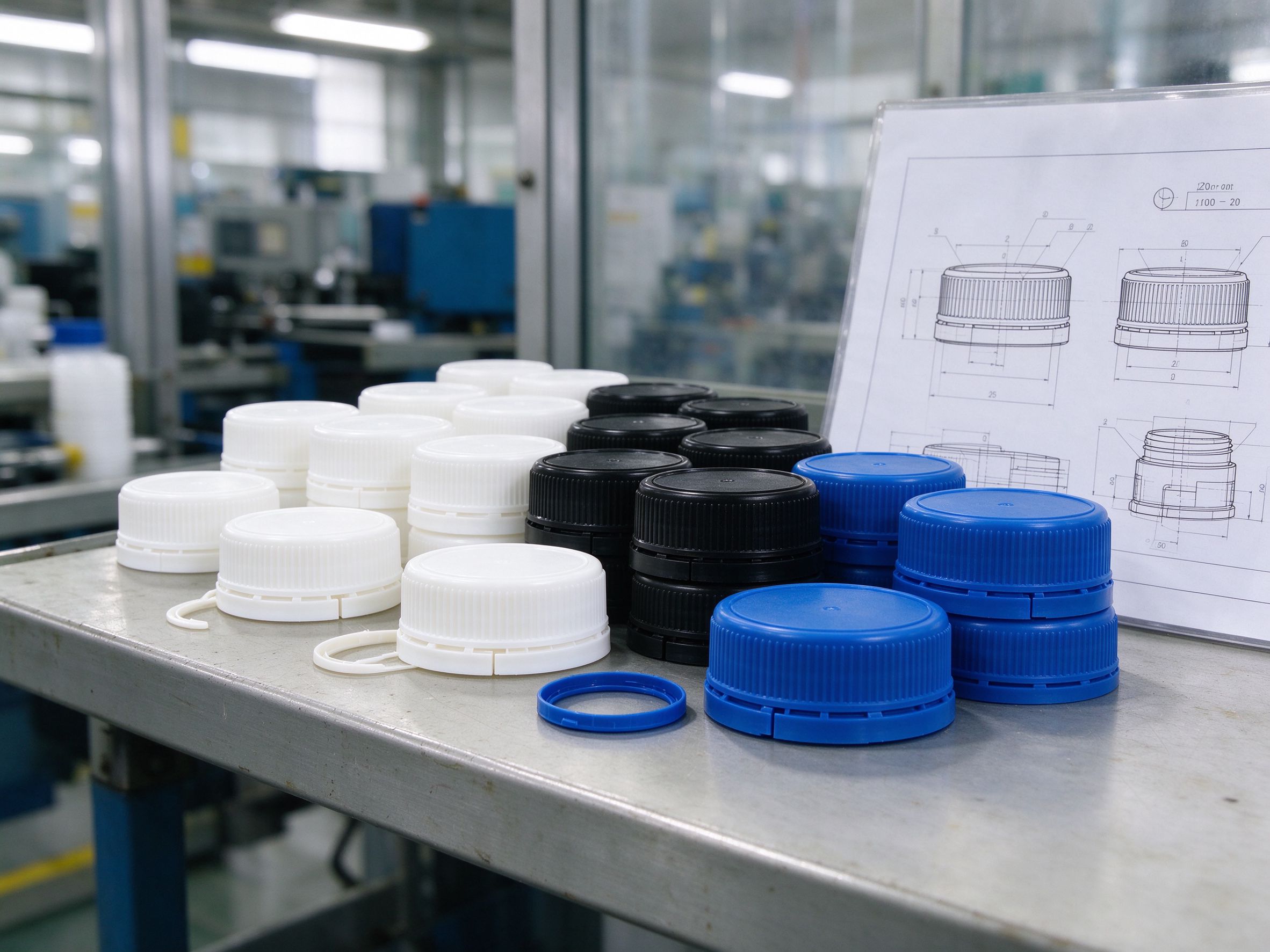
A tamper-evident closure shows visible evidence of first opening — through a breakaway band that separates from the cap, molded bridges that break on first twist, or a tamper tab that leaves a visible mark. Goldcattle reviews the closure geometry against the matching bottle neck, sealing method, opening torque and resin before tooling. The page covers injection-molded plastic closures and their molds; induction-seal liners and shrink bands are separate packaging processes, not molded into the cap.
Tamper-Evident Closure Types
| Structure | How it works | What to confirm |
|---|---|---|
| Breakaway tamper band | A ring below the cap separates or tears away on first opening, leaving a visible band on the neck | Band retention, bridge strength, release torque |
| Breakaway bridge design | Thin bridges between cap and band are engineered to break at first opening | Bridge geometry, wall thickness, resin flexibility |
| Integrated tamper-evident tab | A molded tab tears or deforms on first opening, leaving a visible change | Tab hinge, tear direction, residual appearance |
| Tamper-evident dispensing closures | Tamper feature combined with a flip-top or pour spout | Hinge life, sealing surface, opening sequence |
Structure sketches explain the working principle; they do not prove a design has been validated on production equipment. Induction-seal liners and shrink bands are alternative or complementary packaging methods and are not treated as molded-in features.
Critical Design Factors
- Bottle neck and thread compatibility — cap, thread and neck finish are reviewed as one interface; the cap is not designed in isolation from the bottle.
- Breakaway band and bridges — band geometry, bridge thickness and neck engagement control break behavior, band retention and premature-break risk.
- Application and opening torque — capping-line torque and end-user opening torque both feed the bridge and band design; specific values are set by project requirements.
- Seal design — bore seal, spigot seal, liner or other sealing approach confirmed, with its own validation method.
- Moldability and repeatability — wall thickness, gate, cooling, ejection and multi-cavity balance affect dimensional and functional consistency across batches.
Materials for Injection-Molded Closures
| Material | Considered direction | Engineering focus |
|---|---|---|
| PP | General screw caps, breakaway bands, dispensing closures | Stiffness, band flexibility, shrinkage, chemical compatibility |
| PE (HDPE / LDPE) | Flexible caps, liners, squeeze or squeeze-and-thread closures | Flexibility, stress cracking, seal behavior |
Selection is driven by band behavior, dimensional stability against the neck, content compatibility and sealing. A resin grade is not assumed to suit every closure or every packaging use. Recycled content, color and appearance are confirmed against the customer's specification and material documentation.
Custom Closure Mold Development
- Drawing and matching-neck review before tooling starts
- DFM on breakaway bridges, tamper band and thread geometry
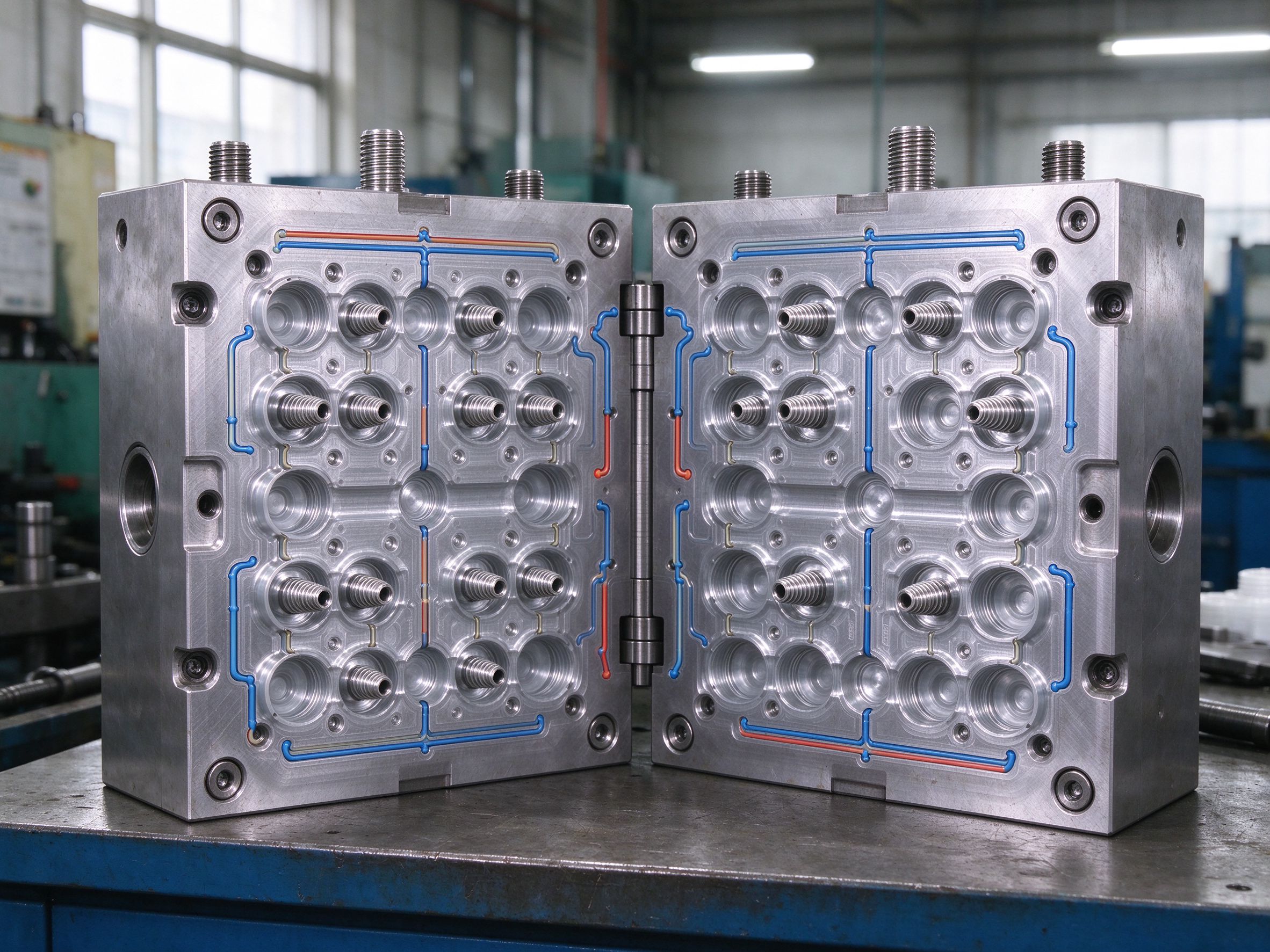
- Cavity count, runner layout, cooling and ejection designed around part volume and demolding (including unscrewing where required)
- Mold trial, sample measurement and agreed mold adjustments
- Production conditions confirmed after sample approval
High-speed cap production lines and their specific equipment are scoped separately where the project requires them.

Validation Before Production Release
| Check | What is confirmed |
|---|---|
| Fit with mating neck | Neck fit, threading and assembly state |
| Opening behavior | Break or release on first opening |
| Tamper-band retention | Band retained on the neck after opening |
| Application and removal torque | Against agreed capping and opening requirements |
| Seal or leak performance | Per the product and buyer requirement |
| Visual and dimensional inspection | Tamper feature integrity, flash, dimensions, appearance |
| Capping-line compatibility | Fit with the buyer's capping and filling conditions |
These are project-level acceptance items. Checks run in-house, by an external lab, or by the customer are listed per project — not claimed as a fixed test lab or fixed certification.
Compliance Notes
- Tamper-evident is not child-resistant. Child-resistant packaging under the U.S. Poison Prevention Packaging Act is a separate requirement with its own design and testing; a tamper ring does not prove child resistance.
- Pharmaceutical packaging. Where applicable, U.S. 21 CFR 211.132 sets tamper-evidence requirements for certain OTC human drug packages; the closure design is reviewed with the product's packaging system and the customer's compliance obligations, not assumed to meet them on its own.
- Food contact. Where the closure contacts food, the material and documentation are scoped per target market — for example EU Regulation (EU) No 10/2011 for plastic food-contact materials. General injection molding capability is not a food-contact certification.
- Sustainability. Single-material construction and recycled-content options are discussed as design directions, confirmed against material, structure and target recycling system.
What We Need to Quote a Custom Closure
| Information | Purpose |
|---|---|
| 3D CAD / 2D drawing / sample photo | Closure geometry and tamper feature |
| Matching bottle-neck drawing | Thread and interface compatibility |
| Resin grade and color | Material and appearance direction |
| Annual volume / initial order | Cavity count and tooling approach |
| Sealing method | Seal requirement and validation approach |
| Tamper-band design and opening requirements | Functional target for breakaway behavior |
| Food / pharma / other application | Special material and documentation needs |
| Target delivery date | Project schedule |
Frequently Asked Questions
What is tamper-evident closure injection molding?
How does a tamper-evident band work?
What is the difference between tamper-evident and child-resistant closures?
What information is needed to quote a custom tamper-evident closure?
How do you prevent a tamper band from breaking too early?
Can a tamper-evident closure be custom-made from an existing bottle design?
What determines the cost of a tamper-evident closure mold?

Request a Tamper-Evident Closure Quote
Send the closure drawing or sample, matching neck specification, resin and color, annual volume and opening requirements. The review covers the breakaway design, mold approach, validation scope and quote assumptions.
Xiamen Goldcattle · Manufacturing since 1998 · Injection mold making and custom injection molding · Related: custom plastic injection mold →