There is no single cavity count that fits every volume. A first-pass estimate comes from your annual good-part demand, cycle time, available press hours and effective production efficiency. That number tells you the minimum capacity the tool must deliver. The final mold choice also depends on part geometry, machine limits, cavity balance, tooling investment and lifetime demand. This page walks through the calculation, the engineering constraints, and how to compare 1-, 2-, 4- and 8-cavity options before you ask for quotes.
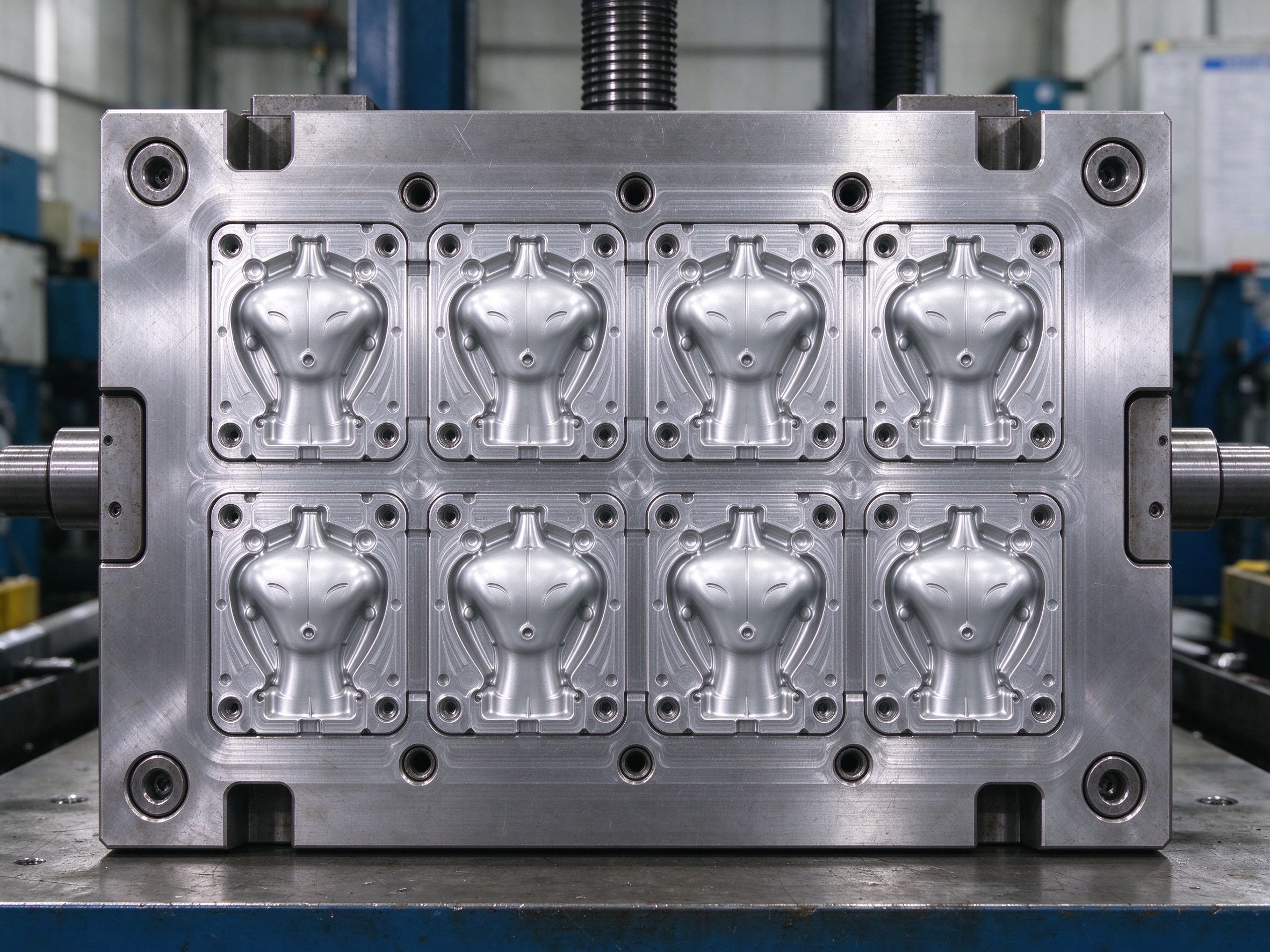
Start with the minimum cavities your press time can deliver, then compare the cost. Divide annual good-part demand by the parts one cavity can produce in a year at your cycle time and efficiency. Round up. That is the lowest cavity count that meets capacity. It is not automatically the most economical mold — a 2-cavity tool may clear capacity, but a 4-cavity tool could lower cost per part over the project life. Compare both before choosing.
The Cavity Count Formula
The first-pass estimate uses four inputs you can collect before contacting a mold maker:
| Variable | Meaning | Typical input |
|---|---|---|
| V | Annual good-part demand (pieces per year) | Your forecasted annual volume of accepted parts |
| T | Full cycle time in seconds per shot | Injection, hold, cooling, mold open, ejection |
| H | Planned production hours per year on this tool | Dedicated press time, not calendar hours |
| E | Effective production factor (0–1) | Uptime, speed losses and quality losses combined |
Nmin = ceil( V × T / ( H × 3600 × E ) )
The result rounds up to the next whole number because cavities are integer. If your efficiency factor already includes quality losses, do not multiply by yield again — that double-counts scrap. If it does not, subtract expected scrap separately.
A Worked Example
Annual good-part demand: 500,000 pcs
Cycle time: 30 seconds
Planned production hours: 4,000 h/year
Effective factor: 0.85
500,000 × 30 ÷ (4,000 × 3,600 × 0.85)
= 15,000,000 ÷ 12,240,000
= 1.2255 → round up to 2 cavities
At 30 seconds and 85% effective production, one cavity yields about 408,000 good parts per year — short of 500,000. Two cavities deliver about 816,000, which clears the target. This is an illustrative example, not a Goldcattle customer project.
Compare 1-, 2-, 4- and 8-Cavity Molds
| Configuration | Strengths | Risks to verify | Suits |
|---|---|---|---|
| 1 cavity | Lower tooling cost, simpler design and validation, easiest cavity balance | Long press time per part, limited output | Low volume, unstable design, prototype-to-production |
| 2 cavities | Balance of tooling cost and output, manageable runner and cooling layout | Cavity-to-cavity variation, mold size, machine limits | Stable mid-volume, where lower part price matters |
| 4 cavities | Meaningful output per shot, potential unit-cost reduction | Filling balance, cooling uniformity, tooling investment, press capacity | Higher stable volume, well-understood part design |
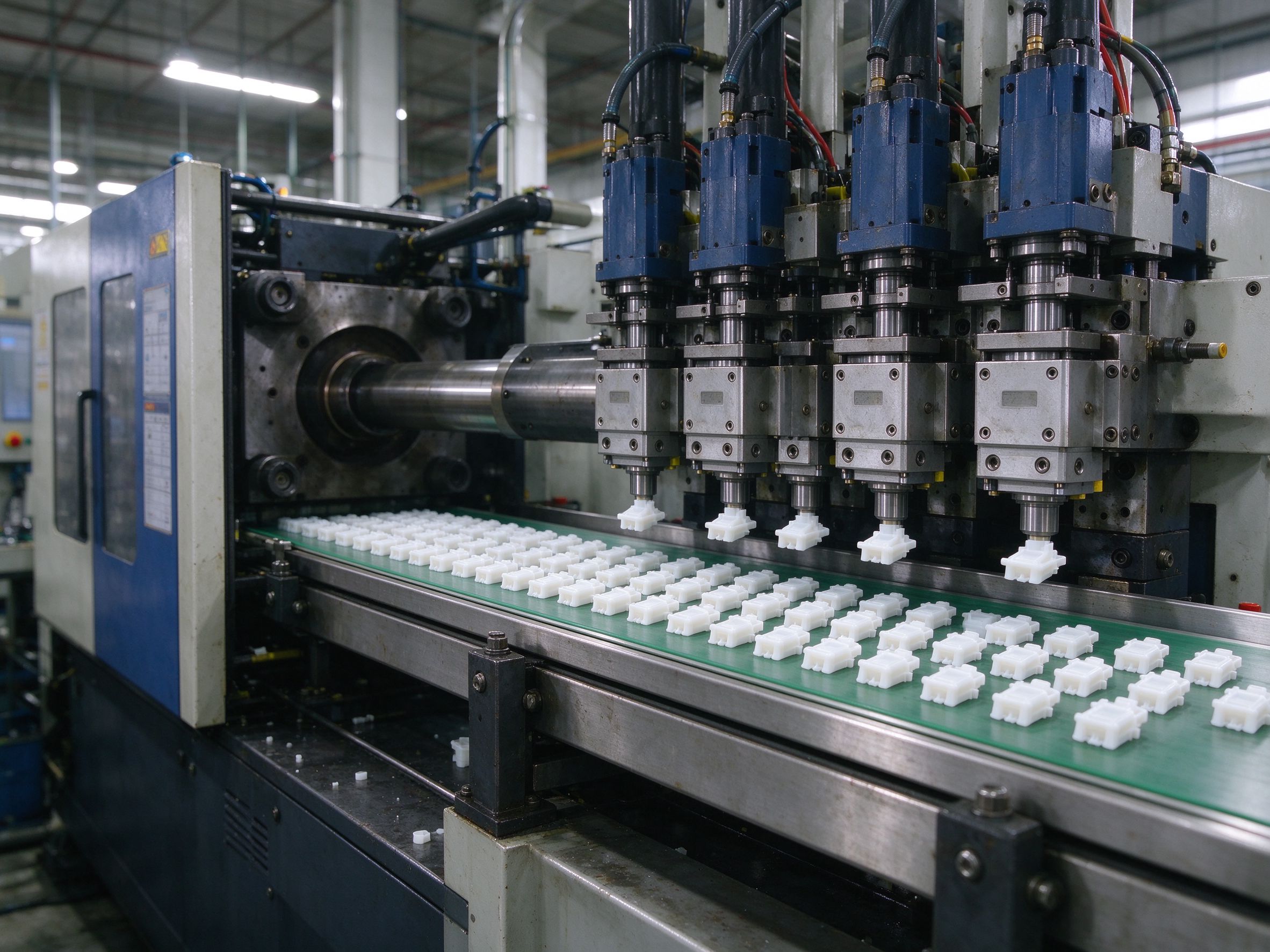
| 8+ cavities | High output per shot, best opportunity for low unit cost | Higher tooling and engineering cost, stricter process control, larger press, longer lead time to first good parts | High volume, stable design, proven process, multi-year run |
Do not treat annual volume as a fixed mapping to cavity count. Two parts with the same annual demand can land on different tools depending on size, material, cycle time and press availability.
Engineering Constraints That Change the Answer
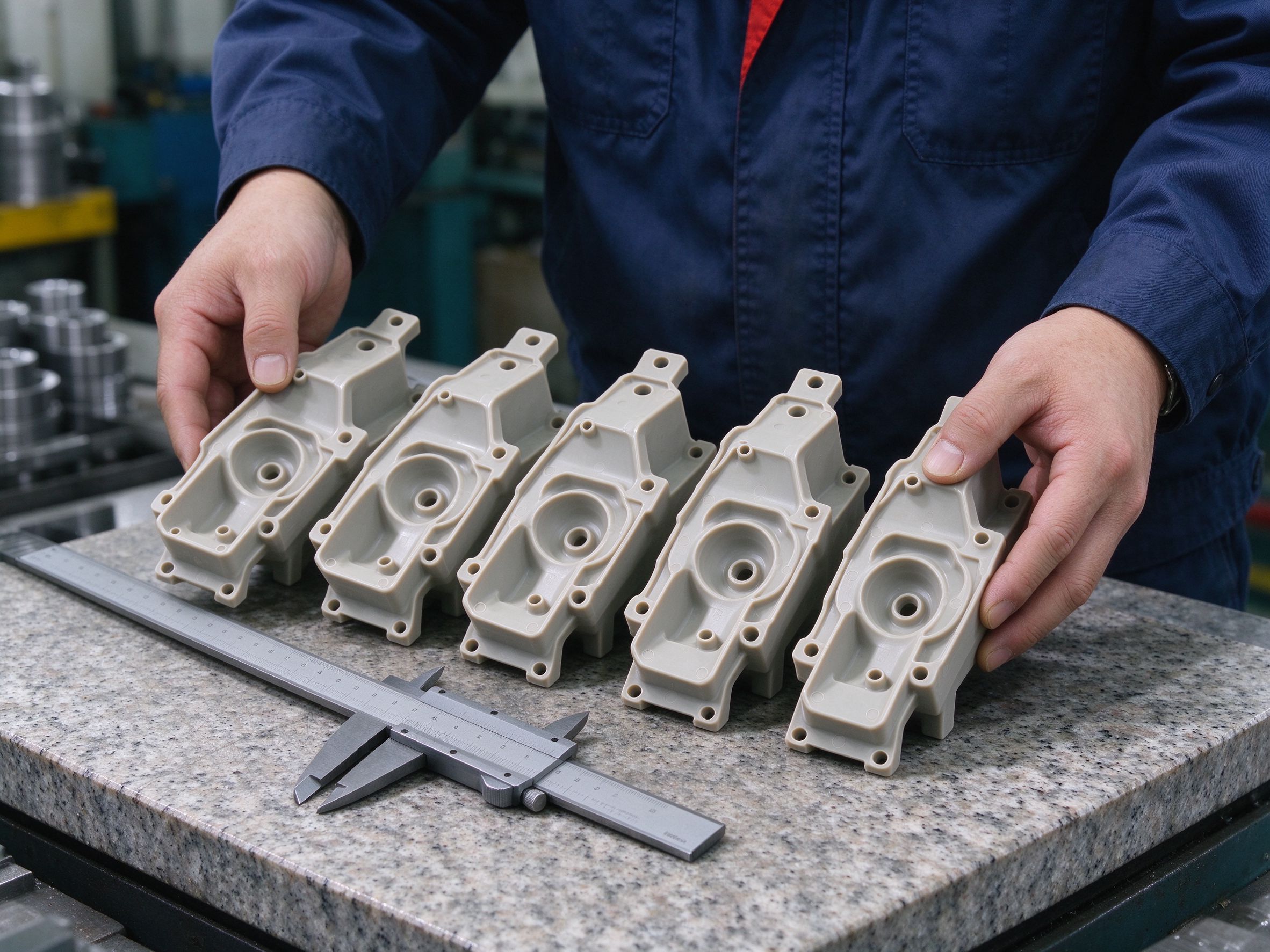
- Part geometry and mold size — large or complex parts may not fit 4 or 8 cavities in a standard mold base.
- Clamp force — more cavities spread projected area; confirm the press can hold the mold closed.
- Injection capacity — shot weight must fill all cavities in one cycle within the machine's injection unit.
- Gating and runner balance — family molds run different parts; multi-cavity molds run identical parts. Do not plan them as the same problem.
- Cooling and cycle — more cavities can mean longer cooling if layout is not balanced, erasing the output gain.
- Cavity-to-cavity consistency — appearance and critical dimensions must hold across cavities, not just in a sample part.
- Future growth — if demand may rise, factor that into tooling choice rather than outgrowing the first mold quickly.
Compare Total Cost, Not Just Tooling Price
The cheapest mold on the quote is rarely the cheapest over the project life. Compare each option on the same basis:
- Tooling amortization per part = tooling investment ÷ expected lifetime good parts. This is only the tooling share, not the full part cost.
- Actual cycle time per configuration — a 4-cavity tool may not deliver half the cycle of a 2-cavity tool.
- Material waste — runners and regrind change with cavity count and runner type.
- Scrap and rework — higher cavity count raises the cost of a bad shot.
- Press time and maintenance — machine occupancy, tooling maintenance and downtime affect total cost.
Ask suppliers to quote 1-, 2- and 4-cavity options on the same annual demand, project life, material and acceptance criteria, with their assumptions stated. Then compare delivered cost per good part, not tooling price alone.
What to Send in a Cavity-Count RFQ
Part and material
- 3D CAD and 2D drawing with revision
- Resin grade, color and additives
- Critical dimensions and acceptance standard
Volume and timing
- Annual demand and expected growth
- Lifetime project volume
- Order quantities and target delivery schedule
Process and machine
- Known cycle time, or ask the supplier to estimate
- Target production press or available tonnage
- Appearance, automation and packaging requirements
If you do not know cycle time or press size, send the drawing, material and volume. The mold maker should return a recommended cavity range with the assumptions behind it, not a single number without explanation.
Frequently Asked Questions
How many cavities do I need for 100,000 parts per year?
Is a 2-cavity or 4-cavity mold more cost-effective?
Does more cavities always mean a cheaper part?
What if my demand grows after launch?
Can I add cavities after the mold is built?

Compare Cavity Options for Your Part
Send the drawing, resin, annual demand and any known cycle time. We will return a recommended cavity range, the assumptions behind it, and tooling scope options so you can compare delivered cost per part — not just mold price.
Xiamen Goldcattle · Manufacturing since 1998 · Injection mold making and custom CNC machining · Related: how to compare China mold makers →