Custom CNC Turned Wood Parts and Wooden Components
Wood is not metal. It holds water, it moves when the air changes, and it has a grain direction that decides how it cuts. That is why a turned wood part is not judged only by its diameter. It is judged by how much water is still inside it, which way the grain runs, and whether it will still fit the furniture after a sea container and a heated room. We turn wood parts to your drawing or sample, then drill, mill, sand and finish them. This page explains what we make, what decides the fit, and what we can and cannot promise.
At a Glance
A turned wood part is sold twice: once as a shape, and once as a promise that it will still fit. The shape is easy. A CNC lathe copies a profile to a fraction of a millimeter on every piece. The promise is harder, and it depends on three things that no drawing normally shows. First, the moisture content of the blank, because wood swells and shrinks as it takes in or loses water, and a leg that is 8 % wet today is not the same size in a heated room. Second, the grain direction, because wood cuts cleanly along the grain and tears out across the end grain, and because a long thin part will bow along its grain. Third, the joint at the end, because a tenon that fits a dry socket will split it when the weather changes. So the useful questions to ask a wood supplier are not about the machine. They are: what moisture content will you deliver, how do you measure it, what straightness will you hold on a 600 mm spindle, and what sample do I approve before the batch runs.
Why Wood Is Not Metal
Most custom part pages are written for metal, and the advice does not move across. Three things behave differently in wood, and every other chapter on this page follows from them.
| What happens | Why | What it means for your order |
|---|---|---|
| The part changes size after it is made | Wood takes water from the air and gives it back. When it takes water it swells. When it dries it shrinks. It never stops doing this. | A measurement is only true at one moisture content. The drawing has to say which one, or the part will be argued about in the wrong room. |
| It changes more in one direction than the other | Across the growth rings wood moves about twice as much as along them. Along the length it barely moves at all. | Diameter and width matter far more than length. A turned leg keeps its length and loses its diameter. |
| The cut quality depends on the grain | Long grain cuts cleanly. End grain is a bundle of cut tubes, so it tears, fuzzes and burns. | Shoulders, tenons and cross-grain holes need sharp tooling, a slower feed and a support behind the cut. They are where rejects come from. |
| Every piece is slightly different | Two boards from the same tree differ in density, color and figure. A knot or a check cannot be machined away. | Acceptance has to allow for natural variation, and that has to be written down before the batch, not argued after it. |
What We Make
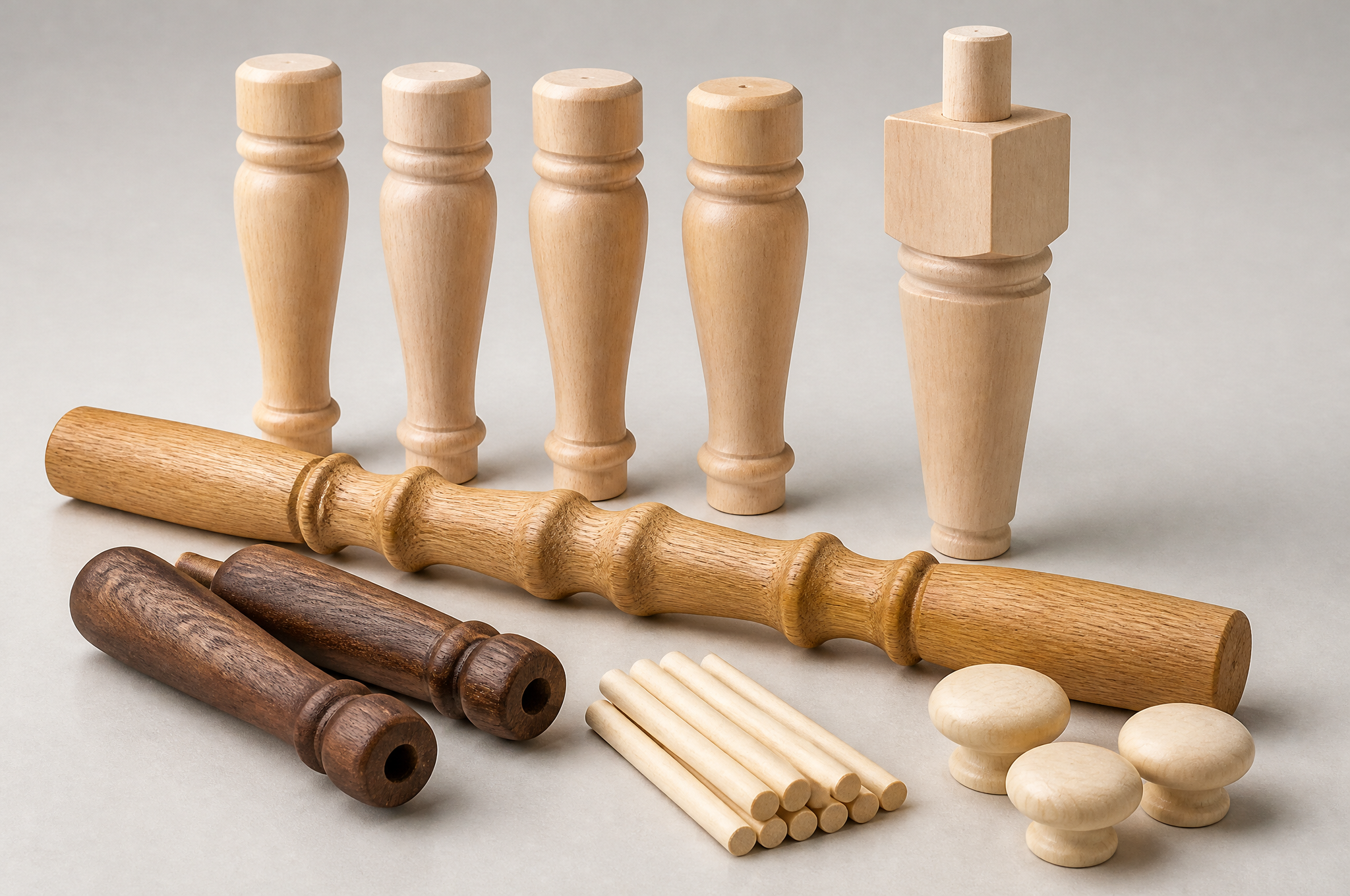
Turned wood covers a lot of parts, and they are bought for different reasons. The table groups them the way a buyer asks for them, and the last column says what decides whether the part is good.
| Group | Typical parts | What decides quality | Where it gets difficult |
|---|---|---|---|
| Furniture legs and feet | Sofa legs, chair legs, table legs, cabinet feet, bun feet, bed legs | Height and diameter repeat on every piece, mounting face square to the axis, finish color matched across the set | A set of four has to look like one set. Tone and figure differ between blanks, so the blanks are selected from one batch. |
| Spindles and balusters | Stair balusters, chair spindles, bed posts, newel parts, turned columns | Straightness over the full length, profile repeat, grain running the length | Long and thin. The part will bow if the blank was not straight before turning, and no program can fix a bent blank. |
| Handles and knobs | Drawer pulls, cabinet knobs, tool handles, grips, furniture handles | Comfort in the hand, smooth surface, bore straight and on center, insert seated square | Small parts are hard to hold. The bore is often drilled after turning, and that is when the part can run out. |
| Dowels and pins | Dowel pins, wooden pegs, rods, connectors, fluted pins | Diameter tolerance, straightness, clean chamfer, dry and stable stock | Sold by the thousand, so a small diameter error becomes a fitting problem on every joint in the cabinet. |
| Decorative turnings | Finials, caps, rings, lamp bases, architectural details, medallions | Profile detail, crisp edges, a clean sanded surface ready for finish | Fine detail and thin beads break out if the wood is brittle or the tool is dull. These are the parts most often re-made. |
| Turned and machined parts | Legs with tenons, axial bores, cross holes, milled flats, insert seats, hanger bolt holes | The turned shape plus the second operation staying on the same axis | This is the group most buyers actually need, and the one most turning shops cannot do. See Ends and Joints. |
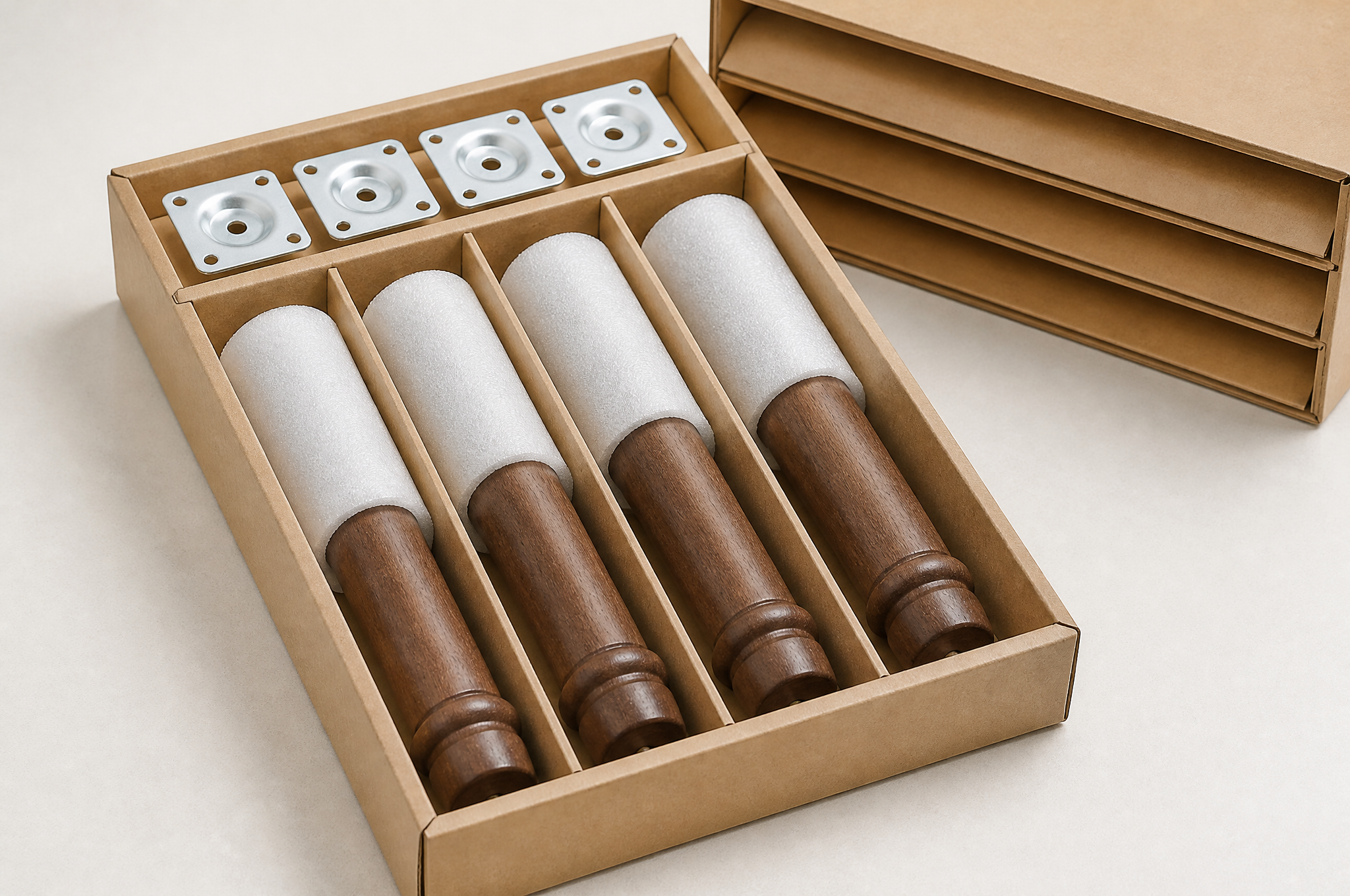
If your part is turned and then drilled, milled or fitted with metal, it belongs in the last group. That is the work where a turning shop and a machining shop usually have to hand the part to each other, and where the axis gets lost in between. We keep the second operation on the same machine or on the same datum, so the bore and the profile share one center line.
From Blank to Finished Part in Six Steps
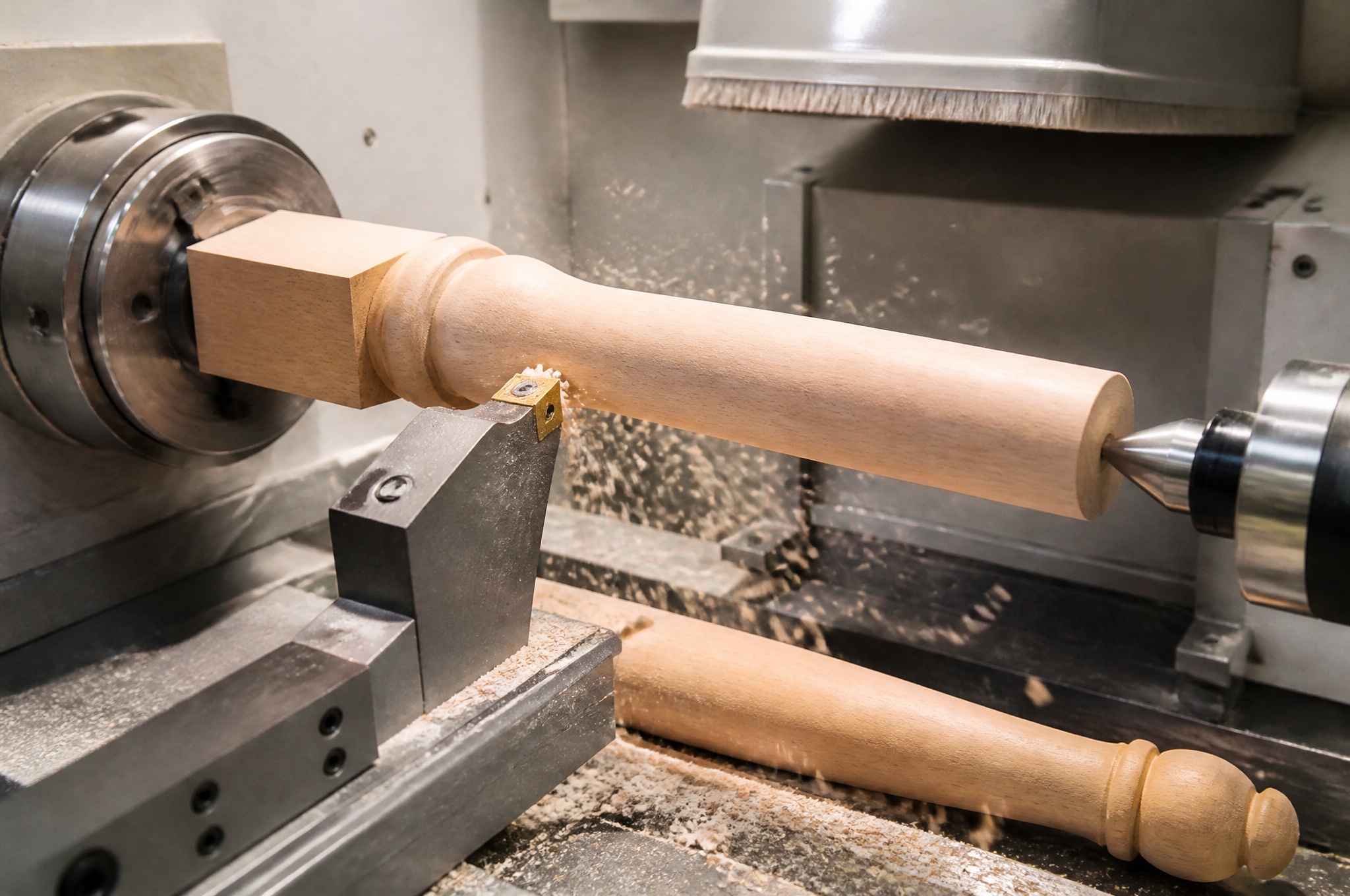
A turned wood part goes through the same steps whether it is one piece or ten thousand. What changes is how much of each step is planned in advance.
Choosing the Route: Three Ways to Make the Same Shape
Not every turned part should be made on a CNC lathe. A simple shape in a long run is cheaper on a copy lathe, and a complex shape in a short run is only possible on a CNC lathe. The useful question is not which machine is better. It is which route fits your shape and your quantity.
| Part and order | Route that usually fits | Why | What it costs you |
|---|---|---|---|
| Simple profile, long repeat run, same shape for years | Automatic or copy lathe | The shape is set once by a template or a cam, and every piece follows it | Lowest unit cost, but changing the profile means new tooling and a new set-up |
| Custom profile, several diameters, small or medium run | CNC wood lathe | The profile lives in a program, so a new shape costs programming rather than tooling | A one-off programming cost that disappears on repeat orders |
| Turned part with an axial bore, tenon or insert seat | CNC lathe, with the end cut in the same set-up | The second feature has to share the axis with the profile | More machine time per piece, and a fixture if the part is short |
| Turned part with cross holes, flats or slots | Turn, then mill and drill on a second machine, held on the turned diameter | The side features have a position relative to the ends | A second operation and a fixture, but no re-cutting of the profile |
| Very short run, hand-feel prototype | CNC lathe from a machined blank | No tooling to make, and the shape can change between pieces | Highest piece price, fastest way to a sample in your hand |
| Square parts, panels or routed shapes | CNC milling, not turning | A lathe only makes round parts | Different page, different enquiry: see the wood CNC guide |
We will tell you when a cheaper route fits your part. A perfect cylinder in 50,000 pieces does not need a five-axis machine, and quoting it as one only makes the price look bad.
Wood Species: The Choice You Cannot Change Later
Species decides how the part machines, how it moves, how it takes finish and what it costs. It is also the choice buyers most often leave blank, and the one that causes the most re-quotes.
| Species | Good for | Watch out for | Color and grain |
|---|---|---|---|
| Beech | Furniture legs, dowels, knobs, painted parts | Moves more than most, so moisture control matters. Not a strong outdoor wood. | Pale cream, close even grain, easy to stain to any color |
| Oak | Visible structural parts, table legs, balusters, stained work | Open grain drinks finish; reacts with steel fasteners when damp | Light honey to brown, strong figure, needs grain matching in a set |
| Ash | Legs and spindles that take impact, bent parts | Tears more than beech if the tool is dull; color varies between boards | Pale with a bold, coarse grain |
| Hard maple | Fine detail, knobs, small profiles, light natural finish | Hard and dense, so it burns easily at the sanding stage | Almost white, fine closed grain, little figure |
| Walnut | High-end visible parts, handles, decorative turnings | Expensive; color varies a lot from board to board | Rich brown with darker streaks, the hardest to color-match |
| Birch | Dowels, painted parts, low-cost painted legs | Soft, dents easily, and can blotch when stained | Pale, plain, very even |
| Rubberwood | Painted furniture parts where cost matters | Softer than the hardwoods above; not for a visible clear finish | Pale, even, low figure |
| Pine and spruce | Long spindles, rustic parts, painted work | Soft and resinous; resin can bleed through a finish | Pale with knots, warm tone |
Solid Wood or Laminated Blank
Some parts cannot be cut from one piece of solid wood at a sensible cost, or at all. The blank can be glued up instead. That is normal practice, but the buyer has to agree to it, because the joint line shows.
| Blank type | When it makes sense | What the buyer sees | What to agree in writing |
|---|---|---|---|
| Solid one-piece | Small and medium diameters, visible parts where grain should run continuously | Continuous grain around the profile, no glue line | Whether small defects are acceptable, and how much color variation is allowed |
| Edge-glued | Large diameters or square sections bigger than available stock | A glue line, usually hidden on a painted part and visible on a clear-finished one | Whether the joint may show, and on which face |
| Finger-jointed | Long parts and painted parts where the length is not available in solid | A visible zig-zag joint on the end, strong in tension | Whether the joint may be inside the visible length |
| Staved or wrapped | Very large columns and hollow parts | Several joint lines around the circumference | Pattern and number of staves, since it affects the look |
These blanks are not interchangeable. A glue line in a clear-lacquered walnut leg is a visible defect to one customer and completely normal to another. Ask the question at quotation, not at delivery.
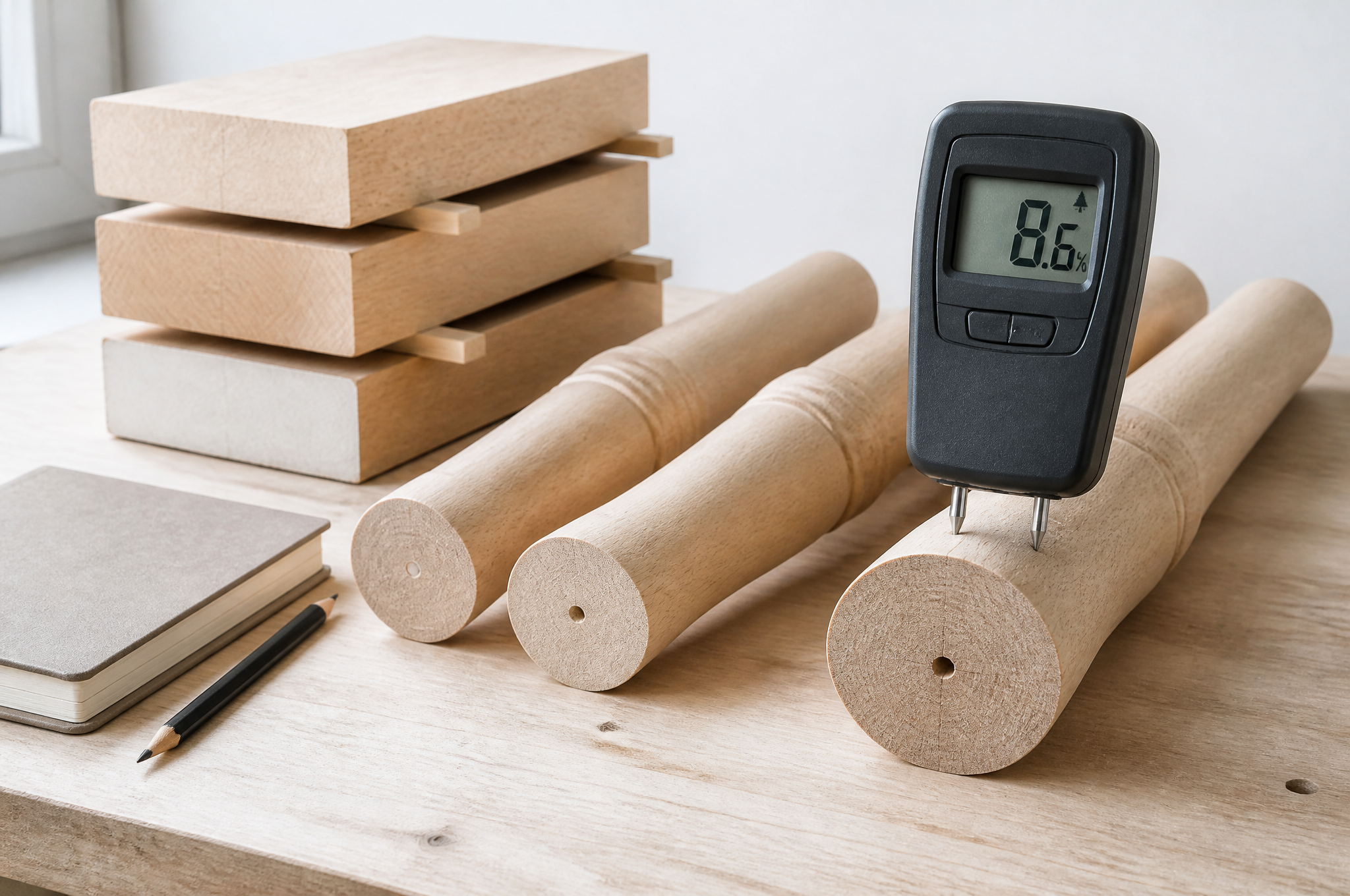
Moisture Content: The Number That Decides the Fit
This is the most useful chapter on the page. If you only check one thing before placing a wood order, check this one. Moisture content, usually shortened to MC, is the weight of water in the wood as a percentage of its dry weight. It decides the size of the part, the fit of every joint and whether the finish stays put.
| Where the part will live | Air it will sit in | Wood will settle near | Practical consequence |
|---|---|---|---|
| Heated indoor furniture, Europe or northern US | About 20 °C and 40–55 % relative humidity in winter | Roughly 8–10 % MC | Parts machined wetter than this will shrink after delivery and joints will open |
| General indoor furniture, mixed climate | About 20 °C and 55–65 % relative humidity | Roughly 10–12 % MC | The usual target for furniture components without a special requirement |
| Kitchens, bathrooms, covered outdoor | Higher and changing humidity | Roughly 12–15 % MC | Parts must be allowed to move, and a tight joint will fail by swelling rather than shrinking |
| Dry desert interiors | Very low humidity, air conditioning | Roughly 6–8 % MC | Drying to this level costs more, and the part must be packed against re-absorption |
We do not dry wood ourselves. We buy kiln-dried stock to an agreed species, grade and moisture range, we check every incoming batch with a pin meter, and we cut the blank oversize so the part can settle before the final pass. Where a project needs closer control than our stock allows, we say so before quoting rather than after the first batch. If drying or finishing is done by a partner because it leaves our floor, the quotation says which step and who does it.
Grain, Tear-Out and Straightness
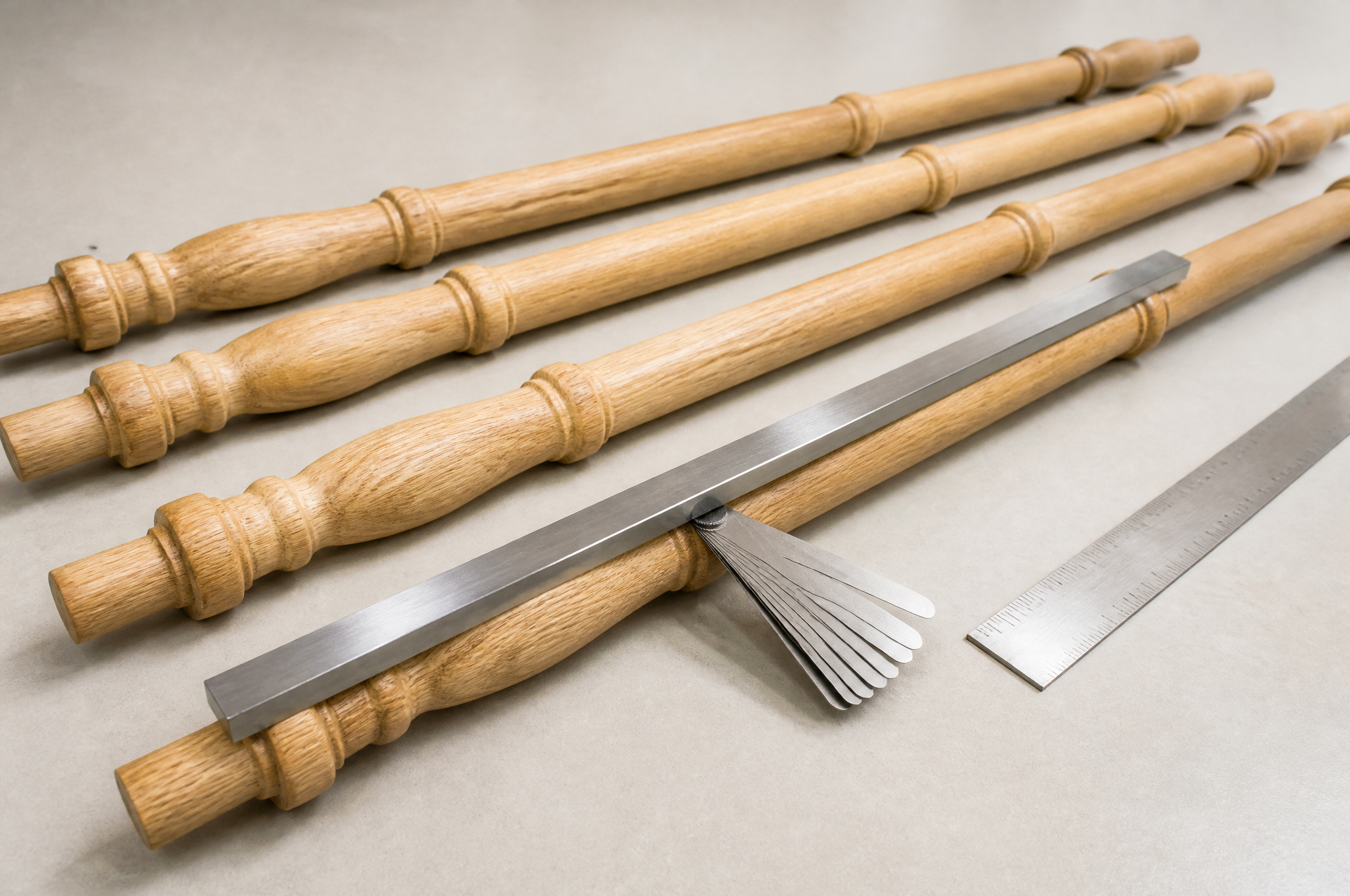
Grain direction is not a detail. It decides whether a shoulder comes out crisp or furry, and whether a long spindle ships straight or arrives with a bow.
| What you see | What caused it | How it is prevented | What actually fixes it |
|---|---|---|---|
| Fuzzy or torn shoulder next to a tenon | Cutting across end grain with a dull tool or too heavy a pass | Sharp tooling, lighter feed, and a backing piece behind the shoulder | Slower spindle speed and a finish pass, not more sanding |
| Burning or dark rings in the profile | Tool rubbing instead of cutting, or sanding with worn paper | Correct feed per revolution and fresh abrasive | Re-cutting the profile; the burn goes deeper than sanding can reach |
| Visible bow along a spindle | The blank was not straight, or the grain did not run the length, or stress released after turning | Straight blanks, grain parallel to the axis, and a rough pass before the finish pass | Nothing after the fact. A bowed part is scrap; straighten the blank selection instead |
| Split or check at the end | End grain dries much faster than the rest of the part | Wax or seal the ends of stored blanks, keep them out of moving air, dry slowly | Cutting back past the check, which costs length |
| Chatter marks in the middle of a long part | The part whipping between centers because it is thin for its length | A steady support, a lower spindle speed, or turning in two stages | Re-turning with support; the marks are too deep to sand out |
| Short grain at a narrow neck | The neck is cut through grain that runs out of the part | Choose blanks with grain running straight through the weak section, and keep the neck above a minimum diameter | Redesign or a bigger blank. This is the one that breaks in service |
Ends and Joints: Where a Turned Part Meets Metal
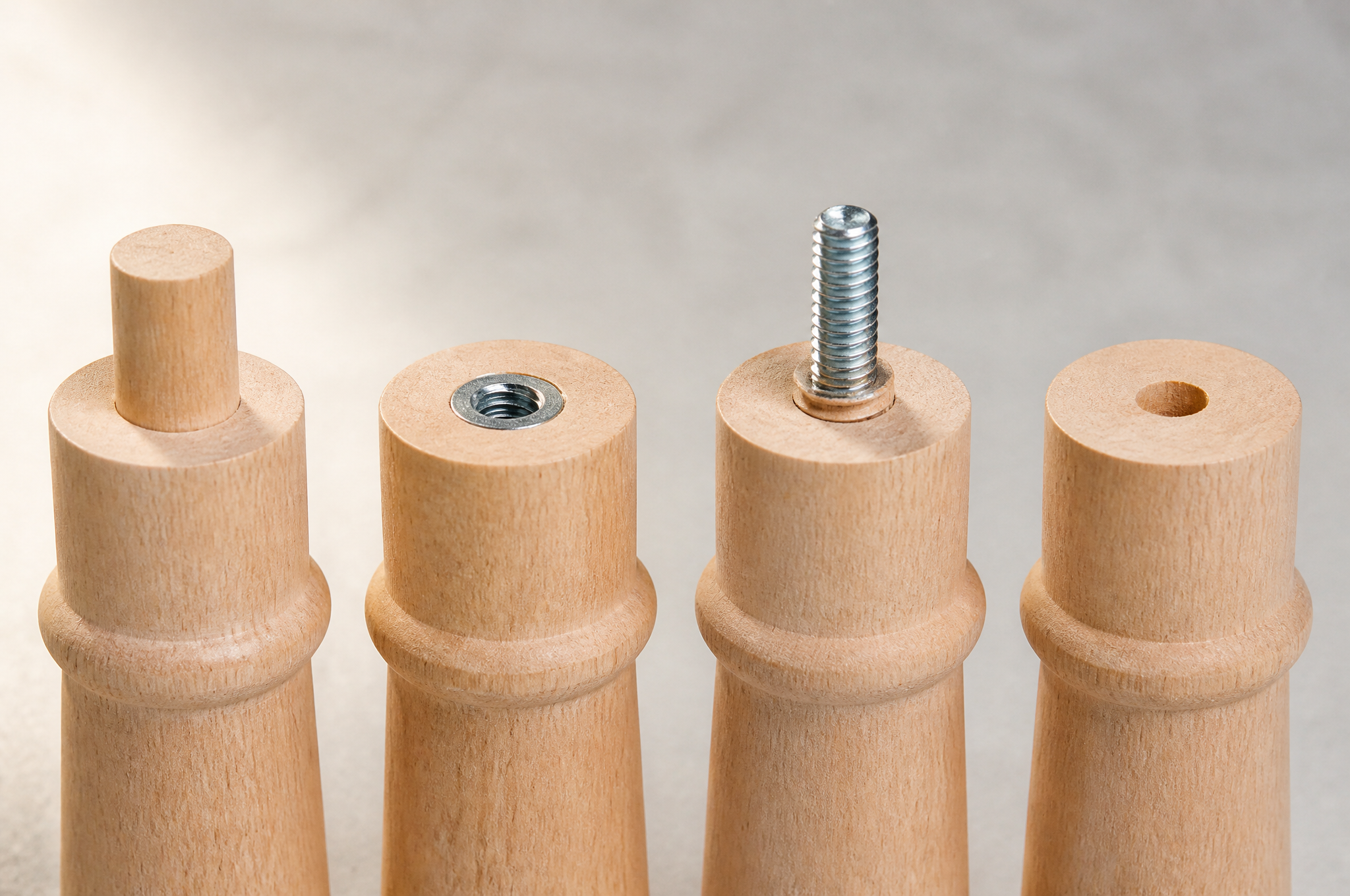
Most turned wood parts are not used alone. They are fixed to a frame, a plate or a bolt. The end of the part is therefore a machined interface, not just the end of the turning, and it is the part of the job most often quoted badly.
| End feature | Used for | What it needs on the drawing | Common failure |
|---|---|---|---|
| Tenon | Glued into a socket in a rail or frame | Tenon diameter, length, and the shoulder that stops it | Made to the socket size, it swells in a humid room and splits the rail |
| Axial bore | Receiving a dowel, a stud or a leg plate spigot | Bore diameter, depth, and whether it must be on the turning axis | Drilled after turning without a datum, so it runs out and the leg leans |
| Threaded insert | A machine screw from the frame into the leg | Insert type and thread, pilot hole size, fitted depth, whether fitted by us or by you | Pilot hole too small, so the insert splits the leg or spins loose |
| Hanger bolt | Wood thread into the leg, machine thread into the plate | Bolt size, fitted depth, and how far the machine thread must stand proud | Driven too deep or off-axis, so the leg hangs crooked |
| Spigot | Locating into a plate or a bracket | Spigot diameter and fit, and the face it seats against | Spigot face not square to the axis, so the part sits with a gap |
| Milled flat or slot | Stopping rotation, or locating a bracket | Width, depth, and its angular position relative to the profile | Position not called out, so every batch is clocked differently |
Sanding and Finish: Where the Part Becomes a Product
A sanded blank is not a finished part. The finish decides the color your customer sees, and it is also the last chance to hide a small tool mark, so the sanding has to suit the finish that follows.
| Finish | What it gives | Sanding it needs | What to send us |
|---|---|---|---|
| Sanded natural | Bare wood, ready for your own line to finish | Through the grits to a smooth, even surface with no swirl marks | The grit to stop at, and whether edges should be eased |
| Clear lacquer | Transparent protection, grain fully visible | Finer sanding plus a de-nib between coats | Gloss level, and whether a filled or open-pore look is wanted |
| Stain, then clear | Color change while keeping the grain visible | Fine sanding, then de-nibbing after the stain raises the fibers | A physical sample of the target color on the same species |
| Painted | Solid color, grain hidden, small defects covered | Coarser sanding is enough, but the surface must be flat | The color reference and the sheen, plus whether a primer coat counts as one of the coats |
| Oil or wax | Natural feel, easy local repair, less film | Sanding must be very even or the oil shows every scratch | Which product, and whether the part ships oiled or raw for you to oil |
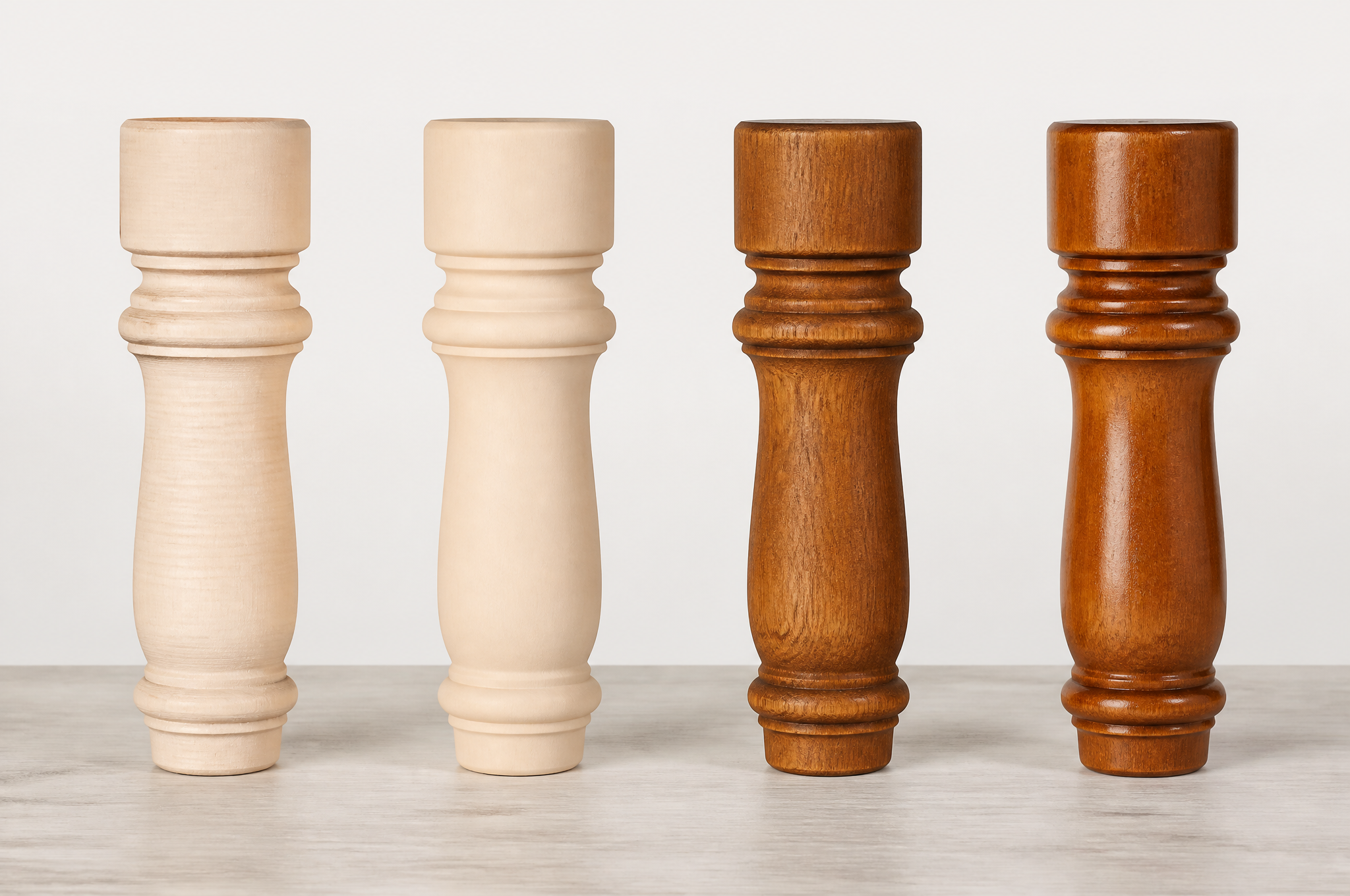
Color matching has a limit, and it is better stated now. Wood color varies within a tree and between trees. We can match an approved physical sample closely and select blanks from one batch to keep a set consistent. We cannot match a paint code exactly on bare wood, and we cannot promise that two separate orders six months apart will be identical unless the finish and the blank source are both fixed. If color is critical, approve a sample, keep it, and order the batch in one go.
Inspection: What We Measure, and What We Do Not Claim
Wood cannot be measured like steel. A turned diameter on a stable blank at agreed moisture content is straightforward. A turned diameter on green wood is not a measurement at all, because the number will change by the time the part reaches you. So the acceptance has to name the conditions.
| Check | How it is done | What it tells you |
|---|---|---|
| Diameter at agreed sections | Caliper or micrometer at the sections marked on the drawing, for example top mount, middle profile and foot | Whether the profile is the size you specified, where it matters for fit |
| Overall and section length | Rule or height gauge on a flat surface | Whether the set will stand level and whether the tenon will seat |
| Profile | Sample comparison against the approved piece, plus gauges on the key diameters | Whether the batch is the shape you signed off, not a near miss |
| Straightness | Straightedge and feeler gauge, or a dial indicator on a surface plate | Whether a long part will look bent once it is installed |
| End features | Bore depth and diameter, tenon diameter, insert seating, squareness of the shoulder | Whether the part will assemble, and whether the metal part will sit true |
| Moisture content | Pin meter, several pieces per batch, three points per piece | Whether the batch will move after shipping, which is the most expensive surprise |
| Appearance | Visual grading against the approved sample for knots, color, figure and sanding | Whether the set will look like one product on a showroom floor |
| Finish | Visual against the sample, plus a light rub for roughness and a check for runs or misses | Whether the finish will pass your customer's first inspection |
What we will not do is quote a metal tolerance for wood. Our metal pages talk about tolerances in the hundredths of a millimeter, and that has nothing to do with a wooden leg. On a turned wood part, a working agreement is a diameter range stated to a few tenths of a millimeter, agreed per feature, on a stated species at a stated moisture content, measured at a stated place. Anything tighter is possible on some features and is a conversation, not a default.
Sets, Batches and the Consistency Question
Furniture buyers rarely order one leg. They order four legs that have to look like one set, and a thousand sets that have to look like the same product. That is a different problem from making one good part.
| What has to be consistent | Why it matters | How it is held |
|---|---|---|
| Height and diameter across a set | Four legs of slightly different length make a table that rocks | Same program and same set-up for the whole batch, measured at the end |
| Color and figure across a set | Four legs from four boards look like four products | Blanks selected from one board batch, and the set packed from that batch |
| Finish across a set and across batches | The second order has to match the first one on the shop floor | Same finish product, same number of coats, and a retained approved sample |
| Mounting position | Plates and inserts must land in the same place on every leg | End features cut on one datum, with a check on the first and last piece of the run |
| Packing and counting | Your line takes a set from a carton, not a mixed pile | Sets packed as sets, parts separated so they cannot rub, count marked per carton |
Wood Sourcing, Traceability and Export Paperwork
Wood carries paperwork that metal does not. If you import into the EU or the US, some of that paperwork is your legal obligation, not ours. What we can do is give you the facts you need to complete it.
| Rule | Who it applies to | What we can provide |
|---|---|---|
| EU Deforestation Regulation (EUDR), Regulation (EU) 2023/1115 | Operators and traders placing the relevant wood products on the EU market. Application is phased: large and medium operators from 30 December 2026, micro and small operators from 30 June 2027. | Species and scientific name, country of harvest where known, supplier records and purchase documents for the batch |
| US Lacey Act | Importers of plant products into the US, who file the declaration for the goods they import | The same species, harvest country and supplier documentation, so the declaration can be completed accurately |
| FSC chain of custody | Anyone who wants to sell a product with an FSC claim | Whether FSC-certified stock is available for the species and size, and the relevant supplier documents. A claim on the finished product needs chain-of-custody certification held by the party making the claim. |
| TSCA Title VI, US | Composite wood products such as MDF, plywood and particleboard sold in the US | Panel specification and supplier declarations, if a project uses composite panels rather than solid wood |
Two things are worth saying plainly, because they are where suppliers over-promise. Buying certified wood does not make the finished part certified. That requires chain-of-custody certification held by the business that makes the claim, and we do not claim it unless it is in place for the project. Giving you the species and origin is not the same as completing your due diligence. The due diligence statement for an EU import belongs to the importer, and it has to be based on their own assessment of the supply chain, using the information we supply as input.
If a project needs a species we cannot source with acceptable documentation, we will say so at quotation. A part that cannot be imported legally is not a cheap part.
What to Send for a Quote
Wood quotes go wrong on the items below far more often than on the shape. Each one changes the price, the lead time or the acceptance, so each one is worth two minutes at the enquiry stage.
| Item | What to send | What it changes |
|---|---|---|
| Drawing | PDF or DWG with the key diameters, lengths and end details | Everything. A photo alone gets an estimate, not a price |
| 3D model | STEP or STL where the profile is curved or complex | Programming time, and whether the profile can be turned in one pass |
| Species and grade | Species, appearance grade, and whether knots are allowed | Material cost and how much blank selection the job needs |
| Blank structure | Solid, edge-glued, finger-jointed or no preference | Whether a joint line may show, and whether large sizes are possible |
| Moisture content | Target range and the air the part will live in | Whether stock has to be sourced specially, and the drying allowance |
| End details | Tenon, bore, insert, hanger bolt or spigot, with sizes and depths | A second operation, and whether the metal part is fitted by us |
| Grain direction | Whether grain must run the length, and which face is visible | Blank yield, and whether a part can be made at all at that section |
| Finish | Sanded, stained, lacquered, painted or oiled, with a physical sample | An extra process, a drying time, and packing that protects the surface |
| Quantity | Sample quantity, batch size and annual demand | Whether a cheaper route fits, and whether a fixture is worth making |
| Inspection | Which checks you need recorded, and whether a sample must be approved | Time per piece and the documents you receive |
| Packing | Loose, sleeved, or packed as sets in trays | Cost per carton and the condition the parts arrive in |
| Destination | Country and mode of transport | How much moisture protection the packing needs |
Frequently Asked Questions
What turned wood parts can you make?
Can you make parts from a drawing, a photo or a sample?
Which woods do you work with?
How do you control moisture content?
What moisture content should I specify?
Can you achieve the same tolerance as your metal parts?
Which is better, CNC turning or a copy lathe?
What is the difference between solid, edge-glued and finger-jointed blanks?
Can you fit threaded inserts or hanger bolts?
How do you keep a set of four legs consistent?
What straightness can you hold on a long spindle?
Do you supply FSC-certified parts, and who handles EUDR or Lacey Act paperwork?
Send the Drawing and Tell Us Where the Part Will Live
A drawing or a model, the species and grade, the moisture range, the end details and the finish. A photo or a physical sample also works for an existing part. The review comes back with the route, the features that decide the price, and anything that cannot be made as drawn — before a program is written.
Request a Wood Turning QuoteSTEP · STL · DWG · DXF · PDF · sample by post · NDA on request
Related Pages
CNC machining for wood parts
Routing, carving and the wider wood CNC picture, for parts that are not turned. Wood CNC guide
CNC turning services
Metal turning capability, tolerance tables and the lathes behind the same programs. Turning
CNC machining services
Plant, equipment and envelope for the second operations that follow turning. Machining
Surface finishing
Sanding, coating and treatment options, and their effect on fit. Finishing
Materials
The material library, including the metals used for inserts and plates. Materials
Quality and certifications
What the quality system covers and which documents are issued. Quality
Prototype to production
How a first sample becomes a controlled repeat order. Production support
Manufacturing services
All six manufacturing routes, so a wood part can be compared with the alternatives. Capabilities
CNC milling services
Milled flats, slots and housings when a turned part needs a side feature. Milling