Custom Sheet Metal Enclosures for Electronics: Precision-Built Metal Housings for OEM Devices
From connector-cut faceplates to grounded, EMI-shielded chassis — single-source sheet metal fabrication for electronics OEMs in North America and Europe, with DFM support from prototype through production.
At a Glance
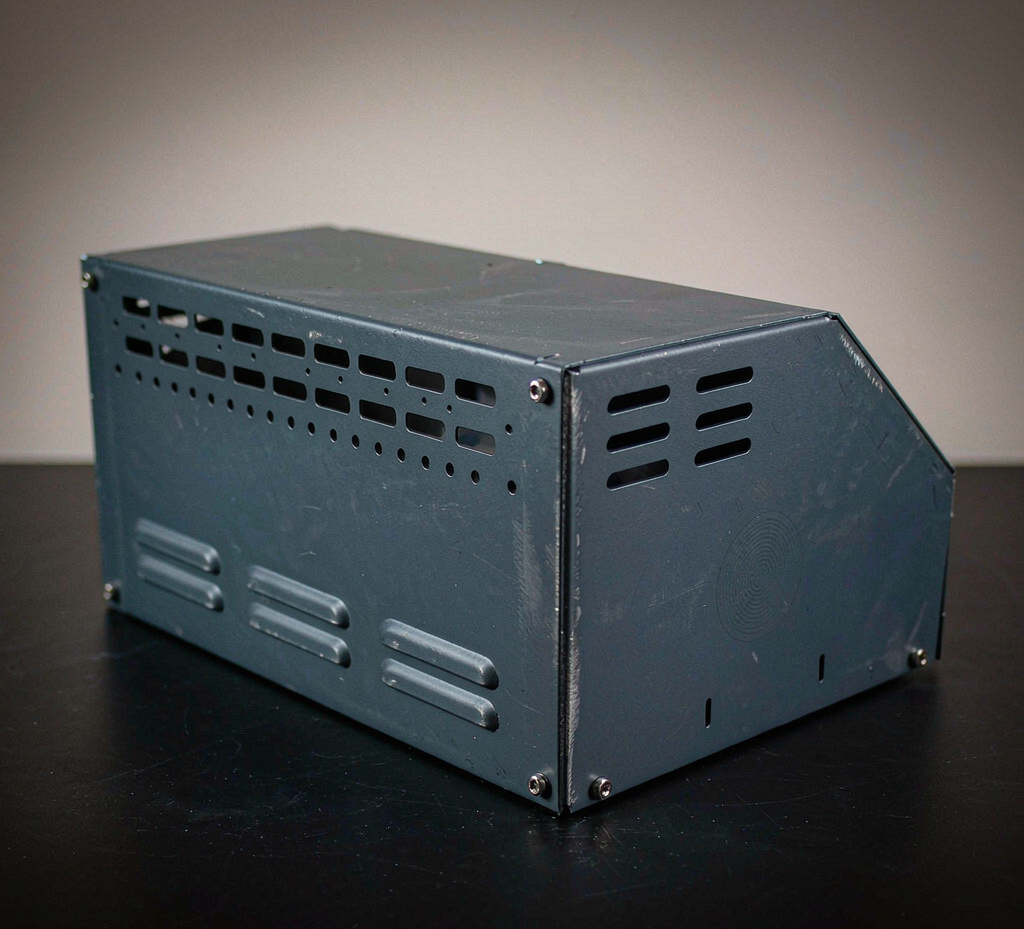
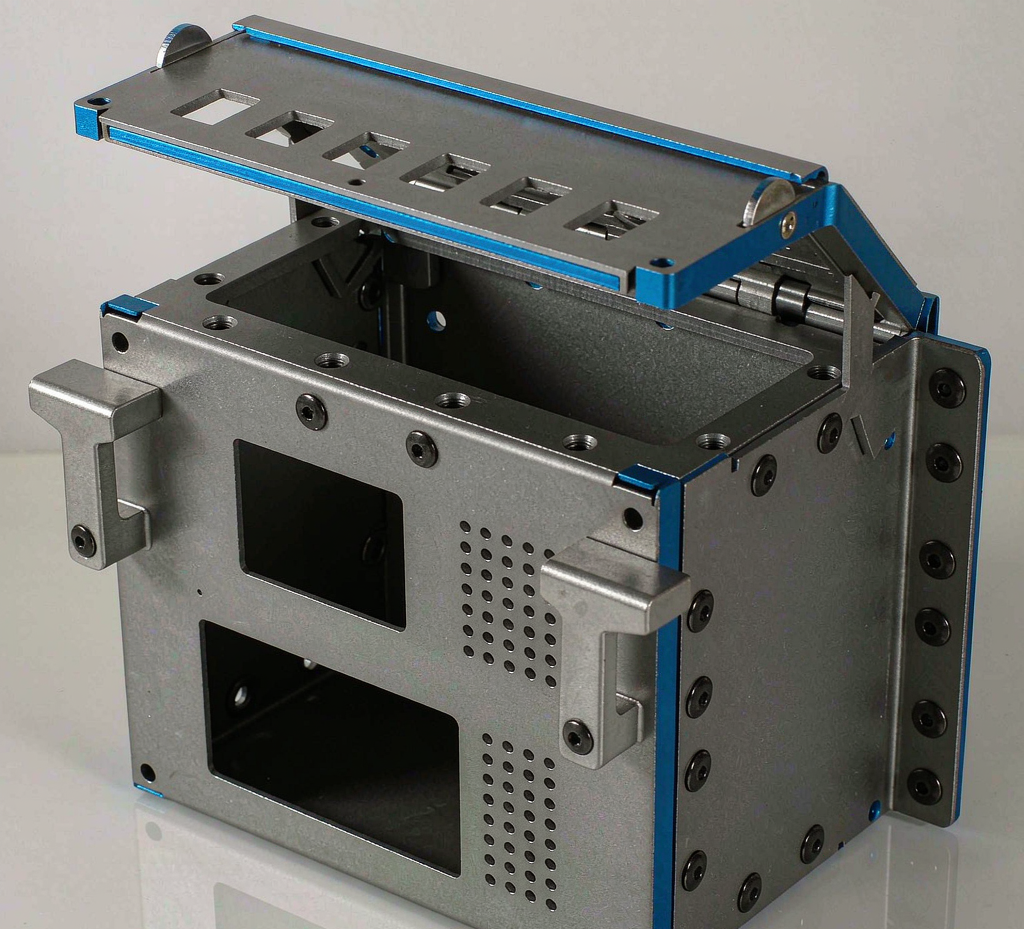
Custom sheet metal electronics enclosures are formed-metal housings — typically 0.5–6.0 mm aluminum, steel or stainless — built to hold PCBs, connectors and displays with precise cutouts, grounding and optional EMI shielding. Xiamen Goldcattle builds them in-house from prototype to production under one ISO 9001:2015 system, with DFM support and finishes specified to RoHS/REACH when required.
Enclosure Types We Build
Electronics enclosures are not one product — they are a family of forms matched to the device, the mounting method and the environment. We fabricate the common production forms below and combine them as needed.
Desktop & wall boxes
Sealed or vented rectangular housings with lids, flanges and mounting feet for controls, sensors and small instruments.
Rack-mount chassis
Standard 19-inch rack panels and sub-racks with rail mounting, handles and rear cutouts for servers and test gear.
Connector faceplates
Flat or lightly formed panels with precision-cut connector and display openings, countersunk for flush screws.
EMI/RFI shields
Thin copper or steel cans and covers that seat over sensitive circuitry and ground to the main enclosure.
Operator enclosures
Larger housings with hinged doors, viewing windows and cable glands for factory-floor equipment.
Hybrid shells
Metal frames paired with molded bezels, brackets and insulation within a single program.
Where These Enclosures Are Used
Procurement teams across several industries specify custom sheet metal because the geometry, grounding and finish must match the device rather than an off-the-shelf box. Typical programs include:
Controls & automation
VFD drives, PLC panels and sensor housings needing robust mounting, cable entry and workshop durability.
Comms & servers
Rack chassis and shielded sub-assemblies for switching, routing and edge-compute hardware.
Device enclosures
Instrument and monitor housings where clean finish, grounding and repeatable quality matter.
Power & EV
Battery and power-conversion enclosures with thermal paths and busbar mounting.
Appliances & AV
Decorative-faced housings combining formed metal with molded trims.
Instrumentation
Bench and field instruments needing EMI control and precise panel cutouts.
Engineering for Electronics
A metal enclosure does more than hold parts together. For electronics, the shell is part of the circuit — it routes heat, controls interference and protects the board. The items below are where most enclosure programs either succeed or fail in the field.
Precision connector & display cutouts
Faceplates and lids are laser-cut to your connector drawings so D-sub, RJ, USB, HDMI and custom mil-spec connectors seat flush without hand fitting. Cutouts are positioned to hold ±0.1 mm relative to datums, and we add relief so powder coating does not close small openings.
PCB mounting & stand-offs
Boards are located by PEM self-clinching stand-offs, tapped holes or molded-in bosses. We confirm hole pattern, board outline and keep-out zones against your PCB layout so the assembly drops together on the line, not in rework.
Grounding & seam continuity
Shielding starts at the join. We maintain conductive continuity across seams — through wipe contacts, grounding tabs and un-coated contact lands — so the enclosure itself becomes the reference plane. For two-piece lids we design the interface so the gasket and the metal both seat correctly.
EMI / RFI shielding
Where emissions or susceptibility are a concern we add conductive gaskets, finger stock or tin-plated copper shield cans, all tied to the enclosure ground. Attenuation is frequency-dependent and set by gasket type, seam length and contact pressure — it must be verified by test against your standard, not assumed from a material choice alone.
Thermal management
Heat leaves through material and geometry. We size wall thickness, add vent louvers or fan cutouts, and place heat-sinking features where the board needs them. For higher loads we pair the metal shell with CNC-machined or molded heatsink brackets.
Assembly & hardware
Self-clinching fasteners (PEM), inserts, hinges and handles are installed before finishing where possible, or masked for post-finishing fit. We can deliver sub-assembled enclosures with gaskets and shields fitted, reducing touch labour at your line.
Material Selection
Material drives weight, corrosion resistance, EMI performance and cost. The table shows the grades we use most for electronics work and where each fits.
| Grade | Type | Why use it | Typical use |
|---|---|---|---|
| 5052 | Aluminum | Good formability, corrosion resistance, light | General enclosures, indoor equipment |
| 6061 | Aluminum | Higher strength, weldable, good finish | Rack parts, structural brackets |
| 304 | Stainless | Corrosion resistant, clean appearance | Medical, food-adjacent, wet areas |
| 316L | Stainless | Enhanced corrosion resistance | Harsh or coastal environments |
| SPCC | Cold-rolled steel | Low cost, high stiffness, paint-friendly | High-volume, cost-driven boxes |
| C110 | Copper | Excellent conductivity, EMI shielding | Shield cans, grounding straps |
For corrosion-sensitive programs we pair the base metal with the right finish and, where needed, isolated stainless or coated fasteners to avoid galvanic issues. Material choice is confirmed during DFM against your environment and budget.
Fabrication Process
Laser cutting
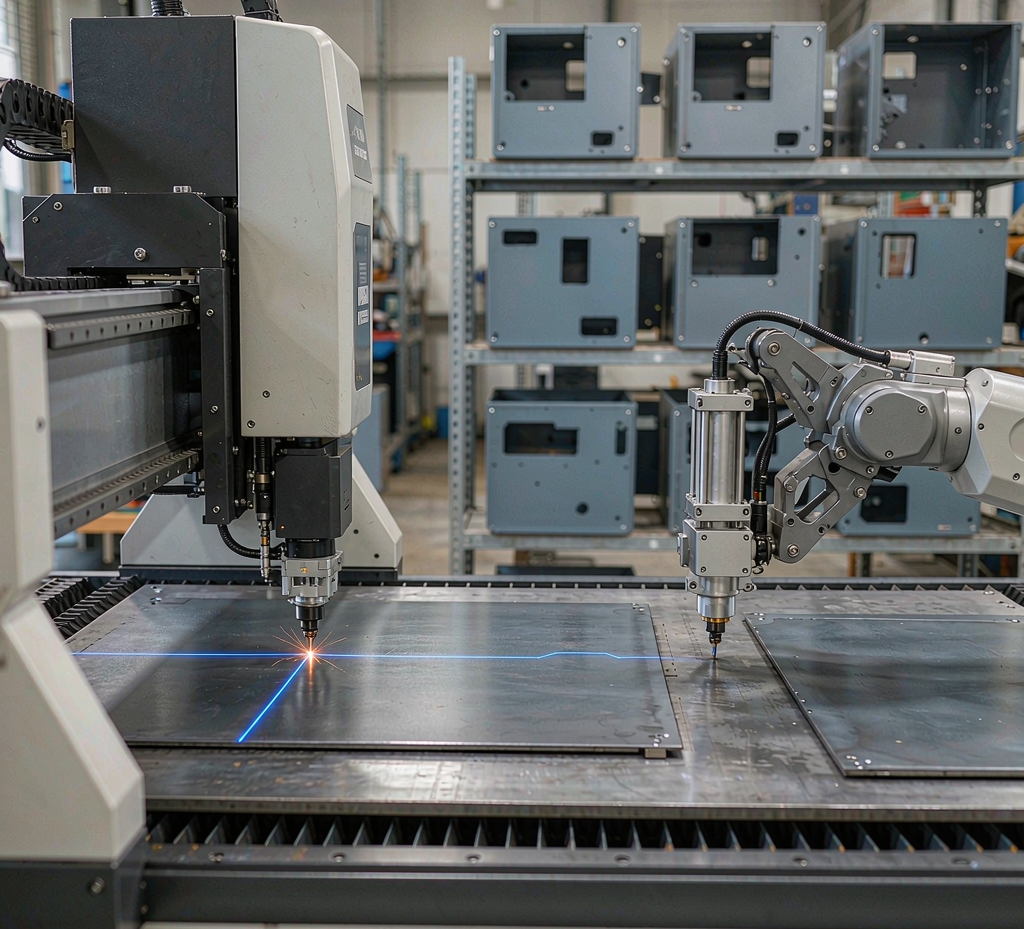
Nests and cuts blanks and all cutouts to about ±0.1 mm, including the small openings that off-the-shelf boxes cannot provide.
Bending & forming
CNC press brakes form flanges and folds to about ±0.5°, with bend sequencing planned to avoid clashes.
Hardware insertion
PEM fasteners, inserts and stand-offs are pressed or welded in position before finishing.
Welding & joining
Spot or TIG welds close seams where structure or shielding continuity requires a permanent joint.
Deburr & clean
Edges are deburred and surfaces cleaned so coating adhesion and safety are consistent.
Finish & mask
Powder, anodize or plate applied with masking at conductive and seating faces.
Surface Finishing
| Finish | Base material | Benefit | Note |
|---|---|---|---|
| Powder coating | Steel, aluminum | Durable, uniform color, 60–120 µm typical | Conductive faces masked |
| Anodizing | Aluminum | Hard, corrosion-resistant, insulative | Type II / III options |
| Plating | Steel, copper | Solderability, conductivity, looks | Tin for EMI shields |
| Passivation | Stainless | Restores corrosion resistance | Post-machining |
Finishes can be specified to RoHS and REACH requirements for EU and US programs, and we document the finish schedule so it repeats batch to batch. For electronics, the key discipline is masking: every surface that must stay conductive or seat a gasket is protected before coating.
Prototype to Production
Most programs start with a quick prototype to validate fit and shielding, then scale. Typical pacing:
3–7 working days
Single or small batch from your drawing or 3D model, with DFM notes returned alongside.
~15–25 working days
First production runs after design sign-off, fixtures and finish confirmed.
Per agreed schedule
Repeat batches with locked process and inspection so quality stays constant.
Representative Build Profiles
The profiles below show the kind of work we run — typical specs and geometries, not specific customer programs. They illustrate how material, thickness and shielding choices combine in real enclosures.
1.0 mm 5052 aluminum enclosure
Vented top, connector cutouts, powder-coated; a general indoor control housing.
1.2 mm 6061 control panel
Flat faceplate with countersunk display and connector openings, anodized.
0.5 mm tin-plated copper EMI shield
Shield can seated over circuitry and grounded to the main shell.
Rack-mount chassis
19-inch sub-frame with handles, rail mounts and rear cutouts for low-to-mid volume runs.
Sheet Metal vs Plastic Enclosures
Where a program needs both a metal shell and molded details, keeping sheet metal, CNC and injection molding under one roof removes the hand-off risk between suppliers. See our electronics enclosure injection molding and industrial enclosure molding pages.
Why Goldcattle
Xiamen Goldcattle Plastic & Metal Products Co., Ltd. is a one-stop OEM/ODM manufacturer Founded in 1998. For enclosure programs the practical advantage is breadth: the six core processes below are all performed in-house under one ISO 9001:2015 quality system.
Sheet metal fabrication
Cutting, bending, welding and finishing of enclosures and brackets.
CNC machining
Precision mating parts, heatsinks and tooling for the same program.
Injection molding
Bezels, insulators and brackets molded to fit the metal shell.
Mold making
In-house tooling so molded parts stay on the same schedule.
3D printing
Prototype fixtures and bracket samples ahead of tooling.
Die casting
Metal housings and frames where casting suits the geometry.
Related capabilities: sheet metal fabrication services, CNC machining services, manufacturing services, and our materials overview.
Start your enclosure program
Send a drawing or 3D model and our engineering team will return DFM feedback and a quote. From a single prototype to low- and mid-volume production, the same quality system carries your part from first article to volume.
Request a Quote Explore sheet metal services →Typical prototype lead time: 3–7 working days. We serve customers in 100+ countries.
Frequently Asked Questions
What materials do you use for custom sheet metal electronics enclosures?
We work primarily in 5052 and 6061 aluminum, 304 and 316L stainless steel, SPCC cold-rolled steel, and copper C110 for EMI-shielded parts. Material is selected with your thermal, weight, corrosion and EMC requirements in mind.
What sheet thickness can you fabricate?
Our standard sheet metal fabrication range is 0.5 mm to 6.0 mm. Thinner or thicker sections can be evaluated case by case, and we confirm feasibility during design review.
What tolerances can you hold on cut features and bends?
Laser-cut features are held to about ±0.1 mm and bends to about ±0.5°. Tighter values are possible on qualified features and are confirmed against your drawing during DFM.
Can you provide EMI/RFI shielding for the enclosures?
Yes. Shielding is achieved through seam continuity and grounding, conductive gaskets, and tin-plated copper shields. Actual attenuation depends on frequency, gasket type and seam construction, and should be verified by test for your application.
Do you build to NEMA or IP ratings?
We manufacture to the ingress-protection target you specify — NEMA 250 and UL 50E references for North America, and IEC 60529 (IP) for international programs. The rating is confirmed by your specified test plan, not self-declared by us.
What surface finishes are available?
Options include powder coating at a typical 60–120 µm, anodizing for aluminum, plating, and passivation for stainless. Powder coatings and finishes can be specified to RoHS and REACH requirements for EU and US programs.
Can you combine sheet metal with plastic parts in one program?
Yes. Because sheet metal fabrication, CNC machining and injection molding are all performed in-house, we can pair a formed metal shell with molded bezels, brackets and insulators within a single program.
What is your typical lead time from prototype to production?
Prototypes are typically ready in about 3–7 working days, and production runs follow in roughly 15–25 working days after design sign-off. Exact timing depends on part complexity and order volume.
Do you support DFM review and low-volume production?
Yes. We review your drawings for manufacturability, propose cost-saving changes, and support everything from a single prototype to low- and mid-volume production under one ISO 9001:2015 quality system.
How do I start a quote for my enclosure?
Send your drawing or 3D model together with material, finish, quantity and target rating. Our engineering team returns DFM feedback and a quote; use the request form on this page to begin.
Ready to review your drawings?
Share your enclosure requirements and we will respond with DFM feedback and a quote. One supplier, one quality system, from prototype to production.
Request a QuoteXiamen Goldcattle Plastic & Metal Products Co., Ltd. — Founded in 1998.