Custom Aircraft Precision Components
Drawing-based manufacturing of precision aircraft components in aluminum, titanium and stainless steel for brackets, housings, fittings, mounting interfaces and other custom mechanical parts.
Component Snapshot
Key parameters for custom aircraft component manufacturing — all subject to part geometry, material and project-specific review.
Manufacturing since 1998. All capabilities subject to part geometry, material and project-specific review.
Aircraft Precision Components We Manufacture
Organized by component function — because the part type determines the machining strategy, critical features and inspection requirements.
Aircraft Mounting Brackets
- Equipment brackets
- Structural mounting brackets
- Instrument brackets
- Support brackets
Aircraft Housings & Covers
- Instrument housings
- Avionics-related housings
- Protective covers
- Machined enclosures
Precision Fittings
- Adapters
- Connectors
- Mounting fittings
- Mechanical interfaces
Shafts & Rotary Components
- Precision shafts
- Bushings
- Spacers
- Rotary interfaces
Structural Components
- Lightweight machined supports
- Frames / brackets
- Equipment mounting components
Aerospace Ground / Test Equipment Parts
- Fixtures
- Test components
- Ground-support equipment parts
- Assembly tooling
Component Types and Critical Features
Each component category has distinct manufacturing priorities — this table maps part function to the features that matter most during machining and inspection.
| Component | Typical Critical Features | Common Materials | Typical Process |
|---|---|---|---|
| Mounting bracket | Hole position, flatness, profile | 6061-T6 / 7075-T6 | 3-axis / 5-axis milling |
| Housing | Wall thickness, sealing interface, threads | 6061-T6 / 7075-T6 | 4-axis / 5-axis milling |
| Fitting | Threads, bore, concentricity | 304 / 316L / Ti-6Al-4V | CNC turning + milling |
| Shaft | Diameter, runout, concentricity | 304 / 17-4PH | CNC turning |
| Mounting plate | Hole pattern, datum relationships | 6061-T6 / 7075-T6 | 3-axis milling |
| Complex 5-axis part | Profile, multi-face alignment, tool access | 7075-T6 / Ti-6Al-4V | 5-axis milling |
Materials for Aircraft Precision Components
Material choice follows functional requirements — strength, weight, corrosion resistance and machinability all influence part design and manufacturing strategy.
Aluminum
6061-T6 / 7075-T6
- Brackets and housings
- Mounting components
- Lightweight structural parts
- Good machinability and anodizing response
Titanium
Ti-6Al-4V / Grade 5
- High strength-to-weight components
- Corrosion-sensitive applications
- High-performance mechanical components
- Requires dedicated cutting strategy
Stainless Steel
304 / 316L / 17-4PH
- Fittings and hardware
- Corrosion-sensitive components
- High-strength interfaces
- Controlled heat management during machining
Specialty aerospace materials (nickel alloys, selected superalloys) can require dedicated tooling, fixturing and process controls. Material availability and machining feasibility are reviewed case by case.
When Aircraft Components Benefit From 5-Axis CNC Machining
5-axis is not automatically better — it delivers value when part geometry genuinely requires multi-directional tool access.
Multiple Faces
Features on several surfaces can be accessed with fewer repositioning operations.
Angled Interfaces
Complex angled surfaces and holes may benefit from controlled tool orientation.
Deep Pockets
5-axis access can help when long-reach tools would otherwise be required.
Complex Contours
Curved and compound surfaces can be machined with appropriate tool orientation.
Design Considerations for Aircraft CNC Components
Good aircraft DFM catches issues before they become manufacturing problems — and before they affect delivery.
Lightweight Design for CNC Machined Aircraft Components
A key engineering goal in aircraft components is to reduce mass without compromising required stiffness or strength.
Material Selection
Pocketing
Ribs
Topology-Informed Geometry
Controlled Wall Thickness
When Aircraft Components Start as Forgings, Castings or Billets
Aircraft components are not always machined from solid billet — the starting form depends on the component, material and production route.
Billet / Forging / Casting
Starting material form
CNC Machining
Final functional features
Heat Treatment *
Where required by spec
Surface Treatment
Per material and application
Inspection
Dimensional & documentation
CNC machining may be used to produce the final functional features from a billet, forging or casting depending on the component and material route.
From Aircraft Drawing to Finished Component
Each step is a decision point that affects part quality, cost and delivery.
Drawing Review
CAD / 2D / material / tolerance / GD&T / quantity
DFM Review
Tool access / workholding / thin walls / pockets / datums
Manufacturing Route
Billet / forging / casting + CNC strategy
Machining
Milling / turning / 4-axis / 5-axis
Finishing
Anodizing / passivation / blasting / polishing
Inspection
Critical dimensions / GD&T / surface / documentation
Release
Inspection approval / packaging / shipment
Surface Finishing for Aircraft Components
Finish selection depends on alloy, application and environmental requirements — not every part needs every treatment.
Aluminum
Stainless Steel
Titanium
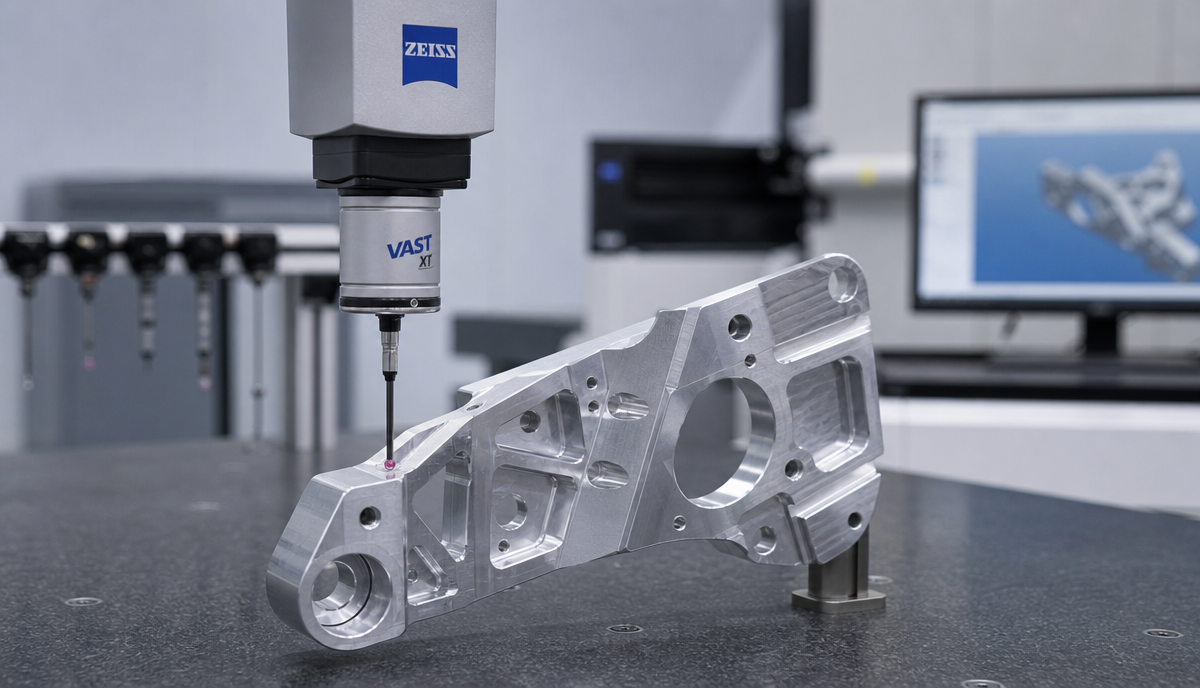
Critical Features We Inspect
Aircraft component inspection focuses on the functional features that matter — not just dimensional compliance.
Dimensions
Position
Flatness
Profile
Concentricity
Runout
Threads
Surface Finish
Quality Documentation Available by Project Requirement
Documentation follows the part — from material verification through final release.
Material Certificate
Dimensional Inspection Report
First Article Inspection (FAI)
Certificate of Conformance
Surface Treatment Record
Traceability Documentation
Documentation is supplied where included in the project requirements. ISO 9001:2015 quality management system. Additional certifications are project-specific and reviewed per customer request.
Aircraft and Aerospace Applications
Organized by component role — because that is what determines manufacturing requirements.
Aircraft Component Case Study
A representative component showing different material and geometry challenges in aircraft CNC manufacturing.
7075-T6 Precision Mounting Bracket
This is a representative component — not a specific customer project. Details vary per actual drawing and requirements.
What Determines the Cost of an Aircraft CNC Component?
A small aerospace component can still be expensive when it requires difficult 5-axis access, tight GD&T, expensive material or extensive inspection.
Frequently Asked Questions
Have an Aircraft Component to Manufacture?
Send your 3D CAD model, 2D drawing, material specification, quantity and critical requirements. We can review manufacturability, machining strategy, finishing and inspection requirements before quotation.
Request an Aircraft Component Review