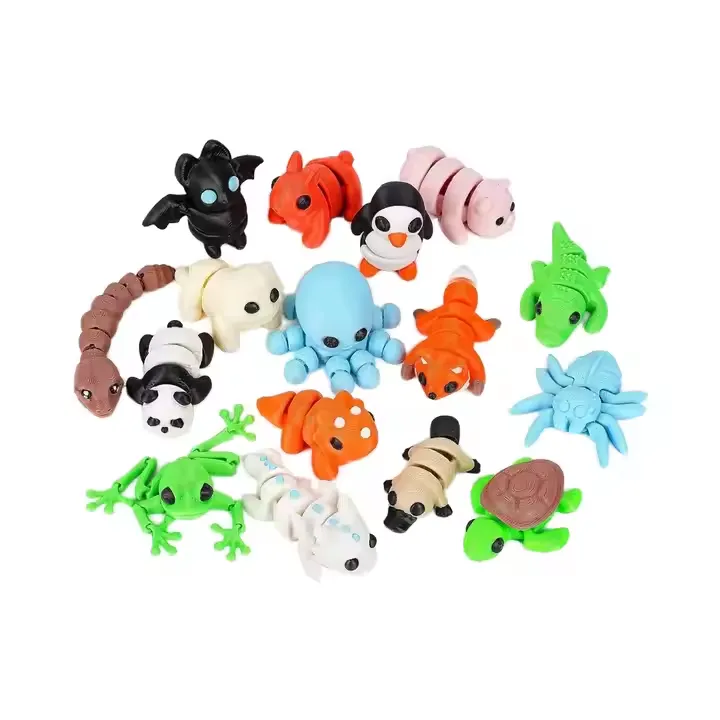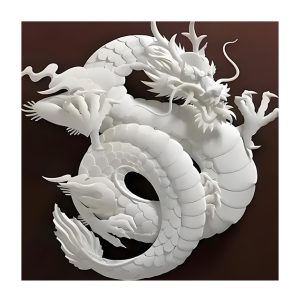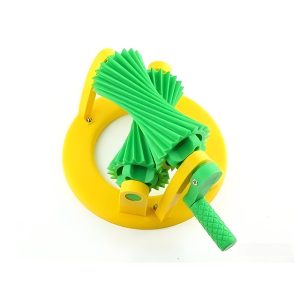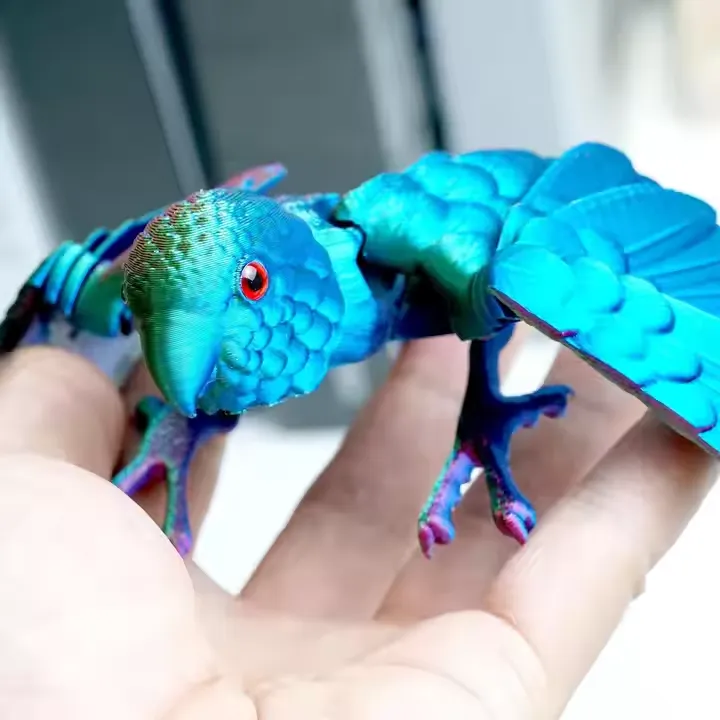
Custom 3D Printed Dragon & Egg Toys | OEM/ODM
Material: Non-toxic ABS Plastic (BPA-free)
Craftsmanship: High-precision 3D Printing & Movable Joints
Size: 10-12cm (Kid-Friendly Grip)
Features: Decompression Design, Smooth Movement, Customizable Colors
Age Recommendation: 3+ Years; Usage: Toy, Stress Relief, Gift
Description
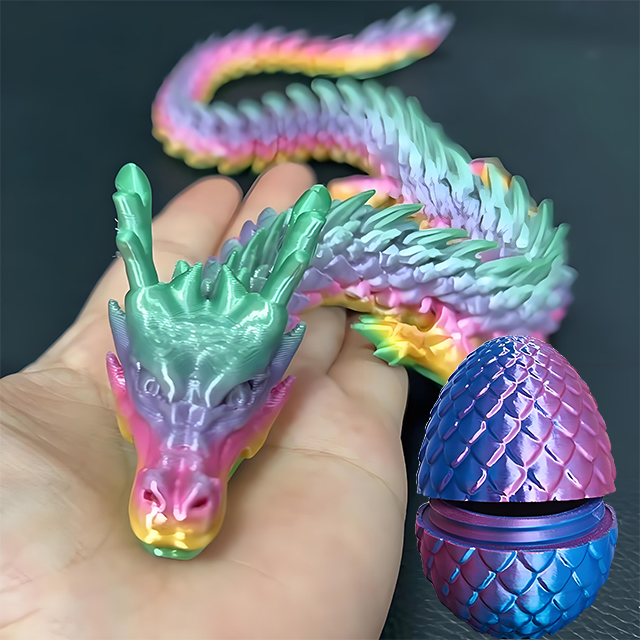
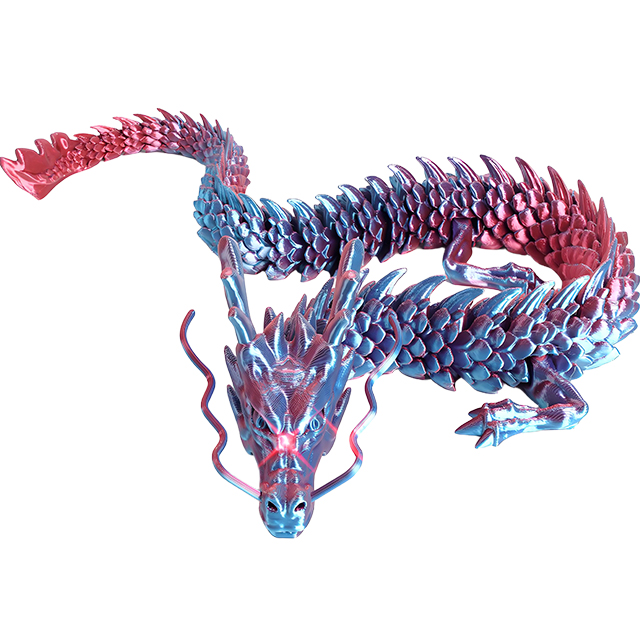
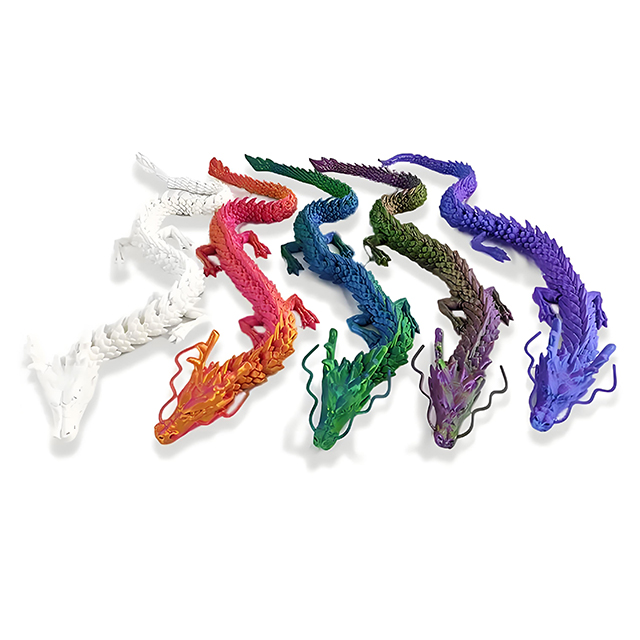
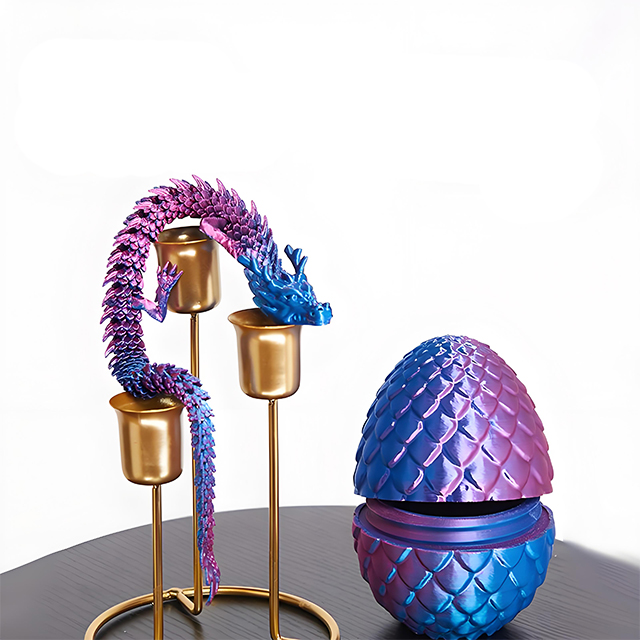
Custom 3D Printed Articulated Dragon Toy & Dragon Egg Model
Goldcattle manufactures articulated dragon figures and dragon egg models to your 3D design — from a single prototype to molded production runs. Built in Xiamen, China under one ISO 9001:2015 quality system, with material and process selection, DFM review, joint articulation tuning and QC handled in-house.
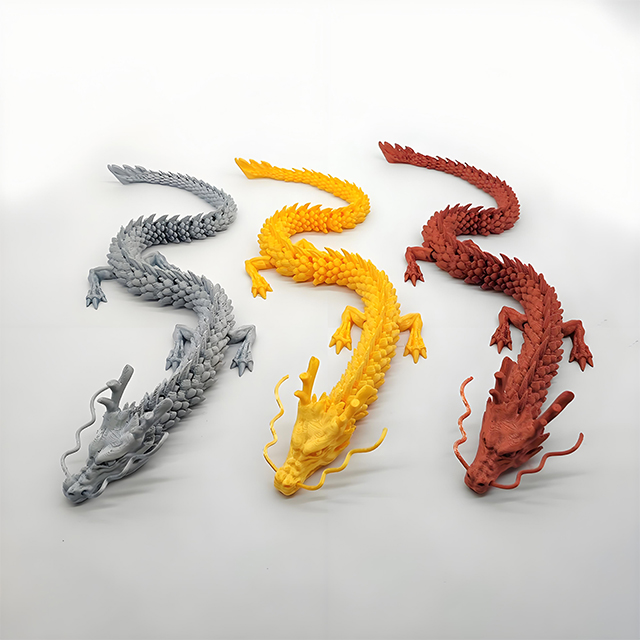
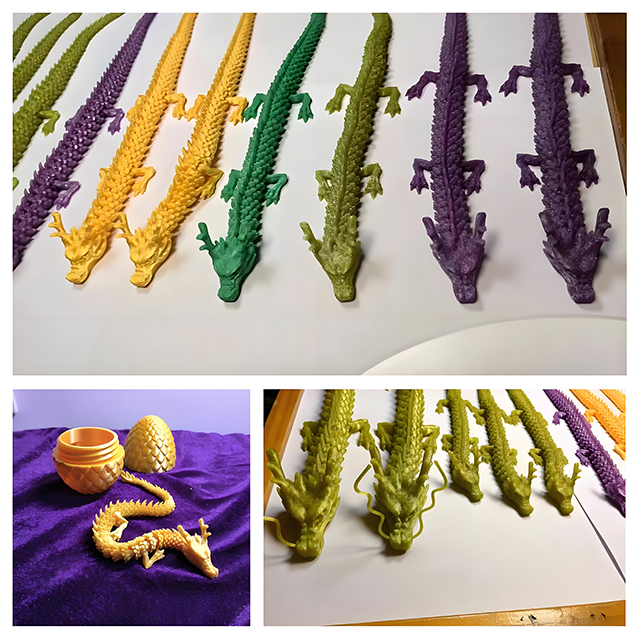
Articulated dragon & egg · sample builds
Quick answerCustom 3D printed dragon toys, in brief
Goldcattle is an OEM/ODM manufacturer that produces articulated dragon toys and dragon egg models from your 3D design, not a catalog seller. We print in FDM (PLA/PETG), SLA resin, SLS PA12 nylon or MJF, then tune the ball-and-socket joints so the figure holds pose without fusing. Prototypes start at 1 piece with 3–7 working-day lead times; small batches run 7–20 days and mass production 15–25 days. All six core processes are performed in-house under one ISO 9001:2015 system. We manufacture to your specification and support toy-safety documentation and third-party testing for the US (ASTM F963 / CPSIA) and EU (Toy Safety Regulation); final certification depends on target market, age grade and design, confirmed during specification.
Product definitionWhat a custom 3D printed dragon toy is
An articulated dragon toy is a figure built from segments — head, neck, body, limbs, wings and tail — connected by snap-fit ball-and-socket joints that print in place and move after post-processing. The dragon egg is the companion piece, often a two-shell print or a hollow shell with an internal dragon. Both are produced additively from a digital model, so every unit is identical to the file and geometry can be changed between runs without new tooling.
This page covers the manufacturing of buyer-supplied dragon designs. If you are evaluating our broader capability, see our custom 3D printed toys overview and our 3D printing services.
| Manufacturing model | OEM / ODM, made to buyer 3D file (no catalog resale) |
|---|---|
| Processes used | FDM, SLA, SLS, MJF |
| Typical materials | PLA, PETG, TPU, PA12 Nylon, SLA photopolymer resin |
| Joint type | Print-in-place ball-and-socket, manually articulated |
| MOQ | 1 piece (prototype) |
| Lead time | Prototype 3–7 · small batch 7–20 · mass 15–25 working days |
| Quality system | ISO 9001:2015 |
| Founded | Founded in 1998 (Xiamen, China) |
Capability × buyer needWhy 3D printing fits dragon toys
A dragon's value is in its poseability and surface detail — features that are expensive to mold at low volume. Additive manufacturing removes tooling cost entirely, so a buyer can validate a new dragon sculpt, run a small crowdfunding batch, or test two wing styles before committing to injection tooling. The trade-off is per-unit cost at high volume, which is why the realistic path is print-to-validate, then mold-to-scale.
No tooling to start
Go from file to physical dragon in days. Change scale, wing shape or joint size between revisions at zero tooling cost.
Print-in-place joints
Ball-and-socket articulation is printed as one assembly. No glue, no pins, no secondary fitting for the moving segments.
Low-risk validation
Order 1–50 units to confirm pose, weight and finish with real buyers before funding a mold.
Selection guideChoosing the right 3D printing process
Process choice drives surface finish, joint durability and unit cost. The table maps each process to where it fits a dragon program. For the underlying capability, see our 3D printing services.
| Process | Best for | Joint behavior | Surface | Unit cost trend |
|---|---|---|---|---|
| FDM (PLA / PETG) | Most articulated dragons, large runs | Layer lines act as natural pivot; reliable | Visible layers, sandable | Low → lowest at volume |
| SLA (resin) | Display / collectible detail | Print-in-place possible but brittle; often separate | Smooth, high detail | Mid |
| SLS (PA12) | Durable play pieces, no supports | Fully dense, most cycle-resistant | Matte, slightly grainy | Mid → drops at volume |
| MJF (PA12) | High-volume nylon, consistent color | Dense, low-friction joints | Matte, uniform grey/black | Lower at volume |
Material optionsMaterial choices and what they mean
Material sets the dragon's weight, flexibility, surface and durability. We stock the grades below; for the full material library see our materials hub.
PLA
Lowest cost, easy to print, good detail. Slightly brittle; best for display and light handling.
PETG
Tougher and more impact-resistant than PLA with low warp. The default for poseable play dragons.
TPU
Rubber-like. Used for wings, tails or grips that should bend rather than snap.
PA12 Nylon
Strong, lightly flexible, chemically stable. Dense joints survive high-cycle articulation.
Design for manufactureArticulated joint DFM and failure modes
The joint is where dragon prints succeed or fail. Print-in-place articulation demands real clearance; too tight and segments fuse, too loose and the figure cannot hold pose. The table lists the failure modes we design against.
| Failure mode | Cause | How we prevent it |
|---|---|---|
| Fused joints | Clearance below material/process minimum | 0.2–0.4 mm clearance set per material; process-specific offset |
| Weak socket | Thin wall around ball | Minimum socket wall ≥ 1.2 mm; segment overlap reviewed |
| Sagging overhang | Long unsupported necks | Support strategy or geometry split for FDM; SLS avoids supports |
| Loose pose | Excess clearance | Tolerance tuned so joints hold gravity pose but move by hand |
| Layer delamination | Poor bonding on large parts | Enclosed-chamber FDM, drying of filament, orientation review |
Product flowFrom dragon egg to articulated dragon
Many programs pair an egg shell with the dragon inside, or sell the egg as the unboxing moment. The four-step flow shows how a single order is structured.
File check
We review egg and dragon meshes for printability, split lines and joint clearance.
Egg shell (often two halves) and dragon printed by the selected process.
Articulate
Dragon joints freed, cleaned and tested for pose stability.
Pack
Egg and dragon nested, protected, and boxed to your spec.
CustomizationSix ways buyers customize a dragon program
Scale & proportion
From palm-sized to shelf display; same file, different print scale.
Color & finish
Single-color print, dual extrusion, or post-paint and clear-coat.
Articulation count
Fixed pose to fully poseable; wings, jaw and tail options.
Egg style
Solid, cracked, two-shell, or dragon-inside reveal.
Add-ons
Stands, magnets for wings, or assembled gift sets.
Branding
Blind-box packaging, hang tags, or private-label cartons.
Post-processingFinishing and surface options
Printed dragons leave the machine with layer lines or support marks. Finishing level is a buyer choice and a cost driver.
- As-printed — fastest, shows process texture; common for FDM play dragons.
- Sanded / smoothed — removes layer lines; recommended before paint.
- Primed & painted — custom color, gradient or detail work by hand or spray.
- Clear-coat / seal — protects paint and gives a display finish.
- Resin dip / vapor — for specific FDM smoothing where material allows.
AssemblyAssembly and articulation tuning
For print-in-place dragons, "assembly" is the articulation pass: each joint is gently worked to break any micro-bond, checked for free movement, and posed. For segmented designs, parts are clipped or magnetically joined. We tune joints so the figure holds a gravity pose yet moves by hand — the balance buyers notice immediately.
QualityQuality control on every batch
All six core processes are performed in-house under one ISO 9001:2015 quality system. For dragon builds, QC covers:
- First-article check against the approved file and dimensions.
- Joint articulation test — each moving segment confirmed free and pose-stable.
- Surface and finish inspection against the agreed sample.
- Critical dimensions measured where tolerance matters (e.g. socket fit).
- Pack-out verification against the order quantity and SKU.
LogisticsPackaging and shipping
Dragon figures are light but jointed parts can snag, so packaging is designed around protection and presentation. We support bulk cartons, individual boxes, blind-box formats and private-label cartons. We serve customers in 100+ countries and ship by air or sea; Incoterms are set at quotation.
ComplianceUS toy safety — what we support
US CPSC / ASTM F963
For items intended for children 12 and under in the US, the applicable framework is the Consumer Product Safety Improvement Act (CPSIA) and ASTM F963 (Standard Consumer Safety Specification for Toy Safety). Requirements typically include:
- Third-party testing by a CPSC-accepted laboratory.
- A Children's Product Certificate (CPC) issued by the importer/manufacturer of record.
- Lead, phthalate and mechanical-hazard limits; tracking labels.
Our role: Goldcattle manufactures to the buyer's specification and supports documentation and testing preparation (material data, build records, sample provision). The CPC and final certification are issued by the party placing the product on the US market, based on the buyer's design, materials and age grade.
EU Toy Safety Regulation
In the EU, toys are governed by the Toy Safety Directive 2009/48/EC, being revised into Regulation (EU) 2025/2509 (published 2025; entry into force 2026-01-01, with full applicability phased toward 2030-08-01). Core expectations include:
- CE marking by the EU responsible person before market placement.
- EN 71 series testing (mechanical, flammable, chemical).
- Technical file and EC declaration of conformity.
Our role: we build to the agreed specification and supply manufacturing evidence; CE marking and the declaration are the responsibility of the EU importer/brand owner, confirmed during product specification.
Regulation detailRegulation (EU) 2025/2509 — what changed
Regulation (EU) 2025/2509 replaces the directive format with a directly applicable regulation, tightening digital product passport and chemical requirements and streamlining the responsible-person obligations. Buyers targeting the EU should plan conformity assessment against the version applicable at their planned launch date. We align our documentation support to the buyer's notified timeline.
TrustIP protection and confidentiality
Buyer 3D files and drawings are treated as confidential and used only for the agreed order. We can sign an NDA before file transfer, will not reproduce customer-owned designs for third parties, and delete or return source files on request after the project closes.
Who buysTypical buyers we manufacture for
| Buyer type | Typical need | Common path |
|---|---|---|
| Toy brands / importers | Validated design, compliant, boxed | Prototype → compliant run → mold scale-up |
| Creators / crowdfunding | Small batch, fast, flexible | FDM PETG, 50–500 units |
| Collectible labels | High detail, painted | SLA or SLS + finishing |
| Gift / blind-box | Consistent color, packaged | MJF or FDM + private label |
| Promo / merch | Branded novelty | Single custom run |
Scale-upFrom 3D print to injection molding
When a dragon design proves out and volume justifies it, printing becomes the expensive option. We transition the validated design into injection molding using our in-house mold making and injection molding, adjusting for draft, wall thickness and gate location. This is the standard print-to-validate, mold-to-scale path and avoids paying for tooling on an unproven sculpt.
See our injection molding services for the scale-up capability, and our CNC machining services for mold components.
TransparentHonest cost drivers (no fake price list)
We do not publish fixed per-unit prices because dragon cost depends on the specific model. The factors below drive your quote. Send a file and we return a real number.
| Cost driver | Why it moves price |
|---|---|
| Model size & weight | Material volume and machine time scale with part mass. |
| Process & material | SLS/MJF PA12 and SLA resin cost more per gram than FDM PLA/PETG. |
| Finishing level | As-printed is cheapest; sand + prime + paint adds labor per unit. |
| Quantity | Unit cost falls as batch size rises; tooling only enters at mold stage. |
| Packaging | Bulk carton vs private-label box vs blind-box changes per-unit cost. |
| Compliance scope | Third-party testing and documentation are project costs, not per-unit. |
How we workProduction workflow
1 · File & spec intake
Send STL/OBJ/STEP with dimensions, material, quantity and target age grade.
2 · DFM review
We check joint clearance, walls, orientation and compliance scope; return notes.
3 · Prototype
1+ piece printed and articulated; 3–7 working days.
4 · Approval
Buyer confirms pose, finish and spec; we lock the approved file.
5 · Production
Small batch 7–20 days; mass 15–25 days under ISO 9001:2015.
6 · QC & ship
Inspection, pack-out, Incoterms shipment to 100+ countries.
EvidenceReal product examples
Articulated dragon figures and dragon egg models from our production. Design, material and process are specified per project — send your file for a DFM review and a quote.
FAQFrequently asked questions
Do you design the dragon model or only manufacture to my files?
Which process is best for an articulated dragon toy?
What is the minimum order quantity?
Are the dragons certified as children's toys?
Can you help scale a successful dragon design to injection molding?
How are articulated joints kept from fusing during printing?
What lead times apply?
How do you protect my dragon design and IP?
Do you ship worldwide and on what terms?
What file format should I send for a quote?
Start your dragon build
Send your 3D file and we return a DFM review and a real quote — prototype in 3–7 working days, MOQ 1 piece.
Upload CAD / Request Quote →