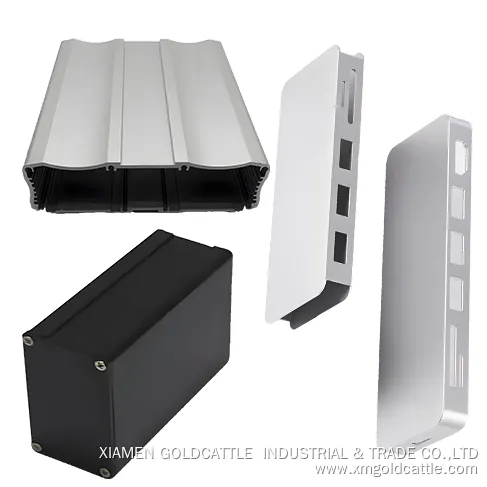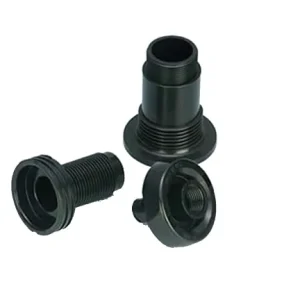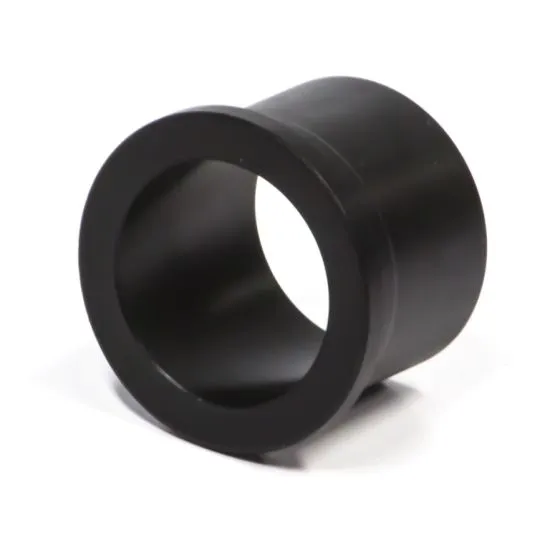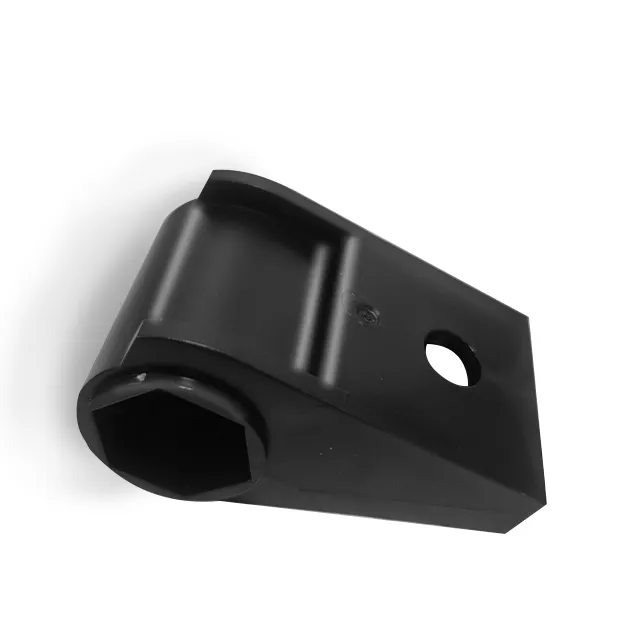
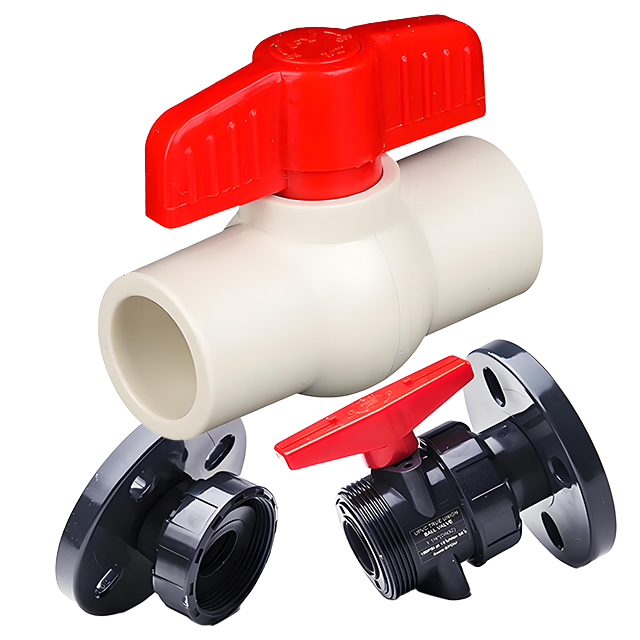
Customized plastic ball valve accessories
| Attribute | Details |
|---|---|
| Product Name | Custom PVC Ball Valve Accessories |
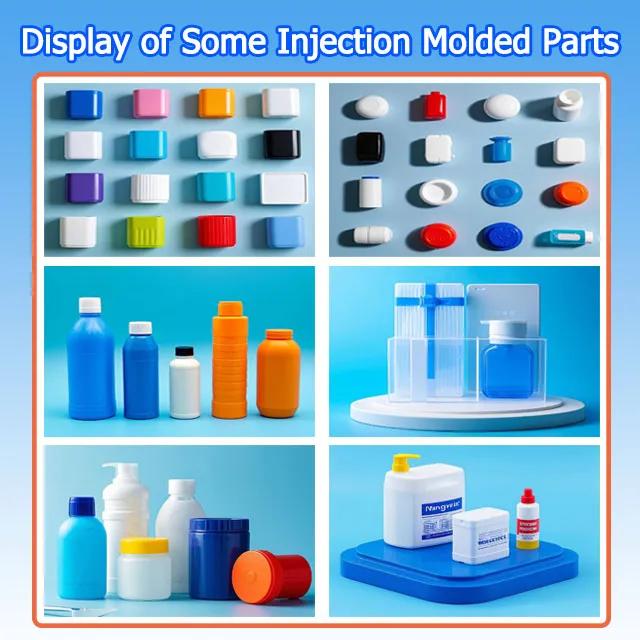
| Materials | ABS, PA66, PP, PC, PVC, PMMA and other engineering plastics (Other plastic materials supported for customization) |
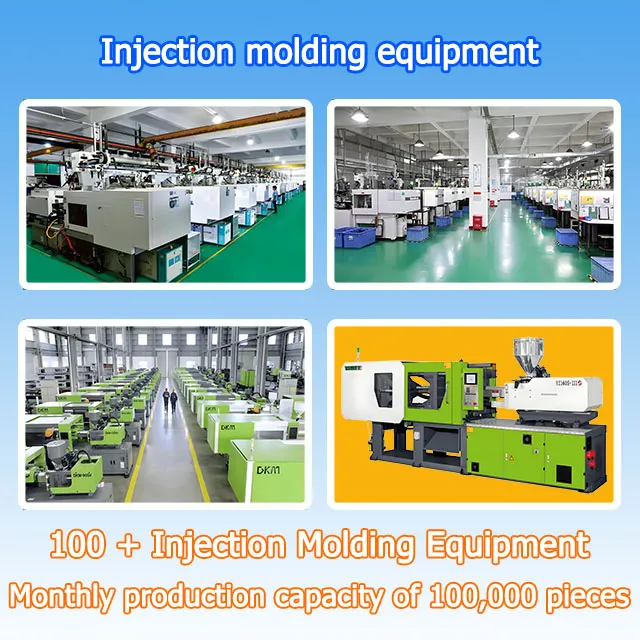
| Core Processes | Injection molding (Supports multi-cavity, two-color, and insert molding) |
| Specifications | Socket-type U-shaped design, customizable inner/outer diameter and length; support for custom colors and logos |
| Tolerance | ±0.005mm |
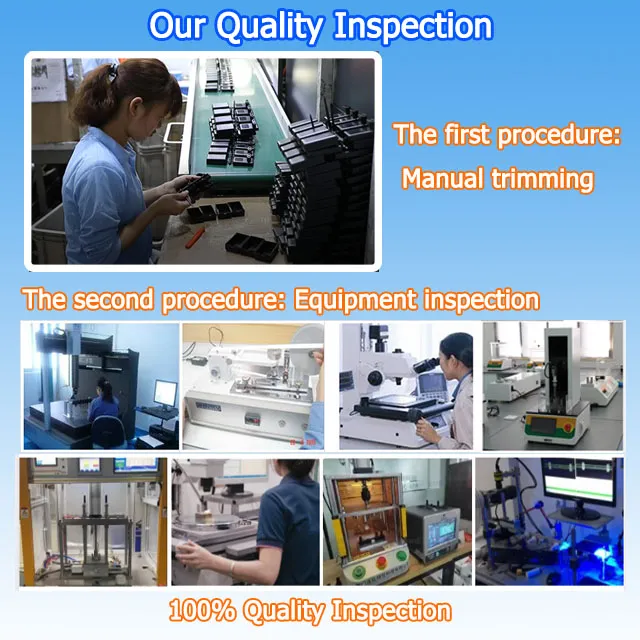
| Certifications | ISO 9001 |
| Minimum Order Quantity (MOQ) | 1 piece |
| Packaging | Single-piece packaging size: 8×8×3 cm, gross weight: 0.35kg; carton/wooden case/pallet packaging available |
| Lead Time | 1–100 pieces: 31 days; >100 pieces: Negotiable |
| Services | OEM/ODM customization, drawing-based processing (Supports 2D/PDF/3D drawings) |
| Application Areas | Water treatment systems, chemical pipelines, household water supply and drainage, industrial fluid control, etc. |
| Origin | Fujian, China |
| Brand | JSD |
Description
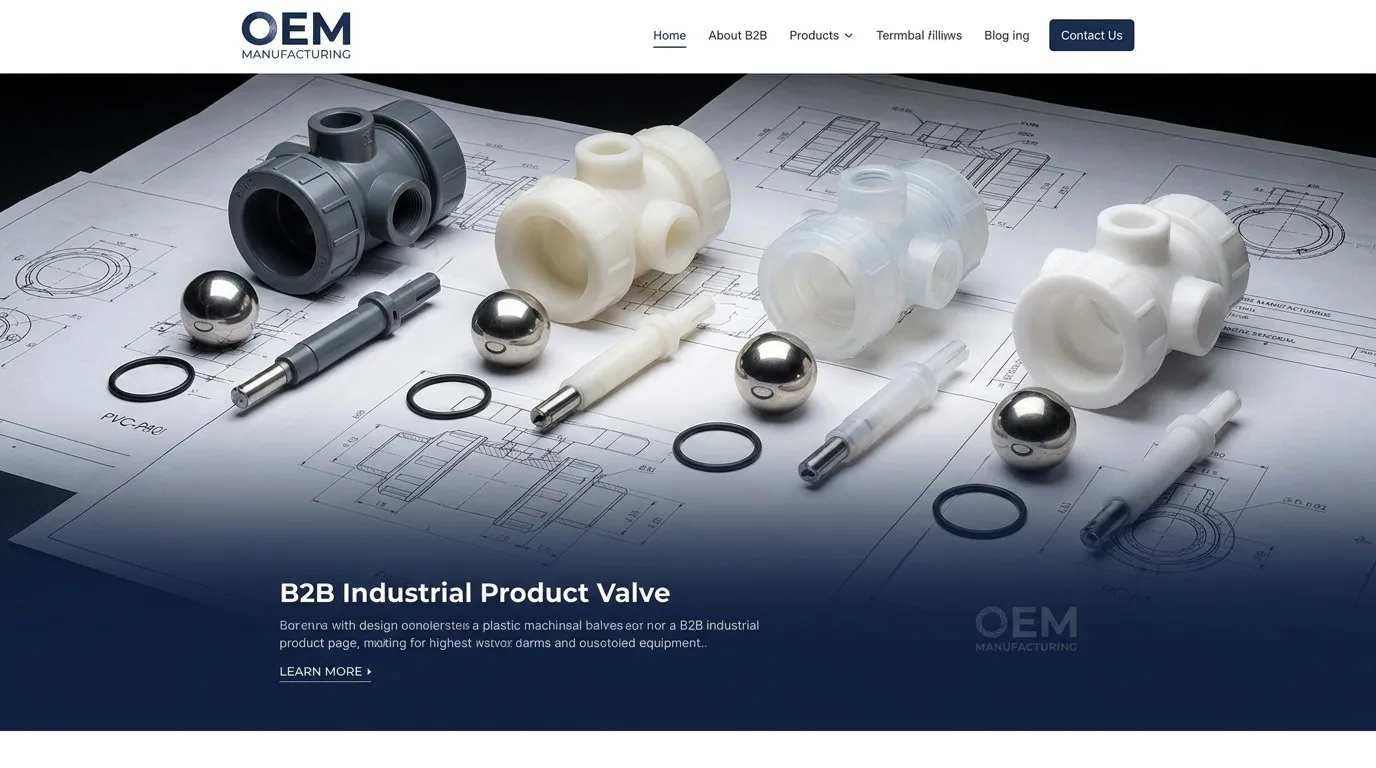
Product Snapshot
| Product Type | Plastic Ball Valve Components |
| Manufacturing Process | Injection Molding • Precision Machining • Assembly |
| Materials | PVC • CPVC • PP • PVDF • POM |
| Temperature Range | 0–140°C (Material Dependent) |
| Pressure Rating | Custom per Application Requirement |
| OEM Service | Available — Drawing-Based Customization |
| MOQ | 100 Pieces (Prototype to Mass Production) |
| Application | Chemical Processing • Water Treatment • Food • Semiconductor |
Problems These Components Help Solve
Procurement teams selecting valve hardware often face recurring failure modes. Engineering plastic components address each root cause directly.
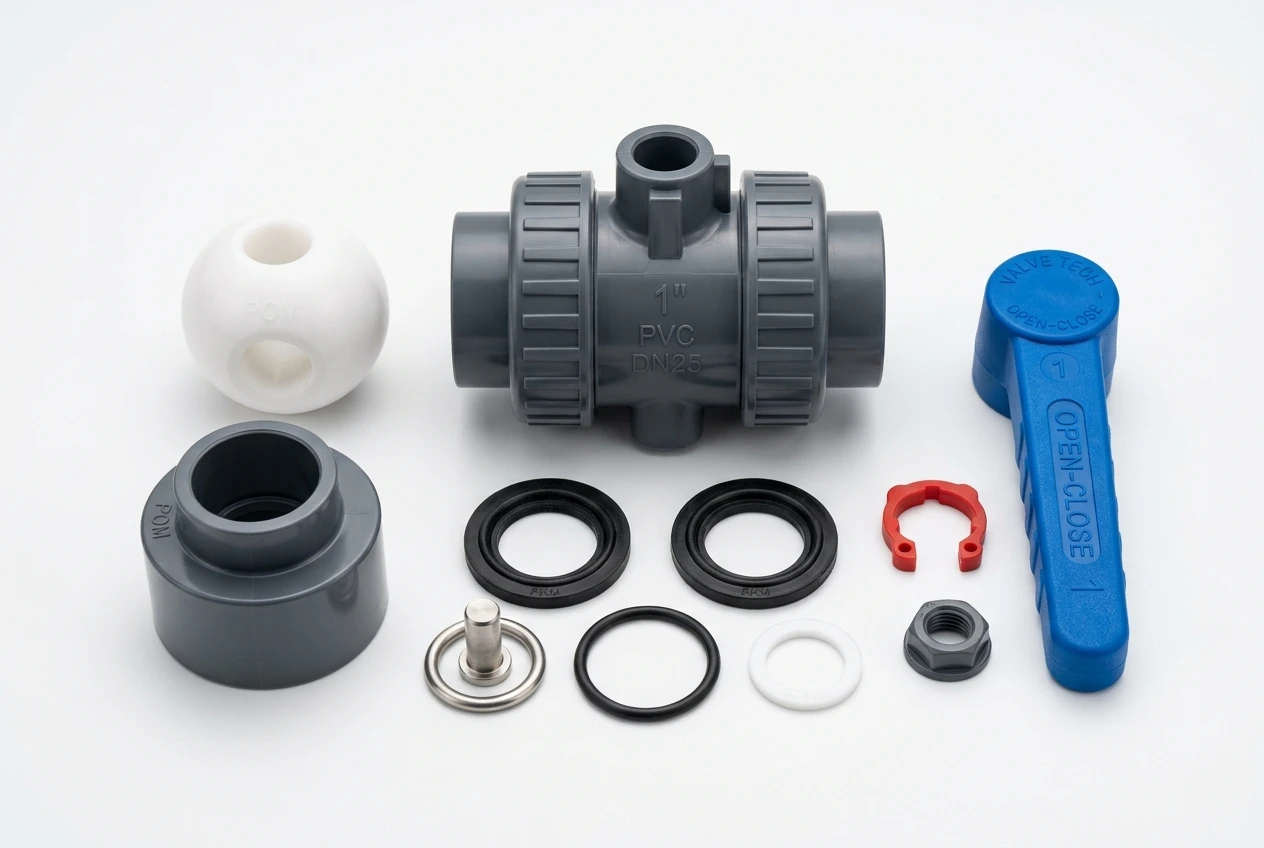
Typical Ball Valve Components
Each component serves a distinct function within the valve assembly. Understanding part roles helps procurement teams specify requirements accurately.
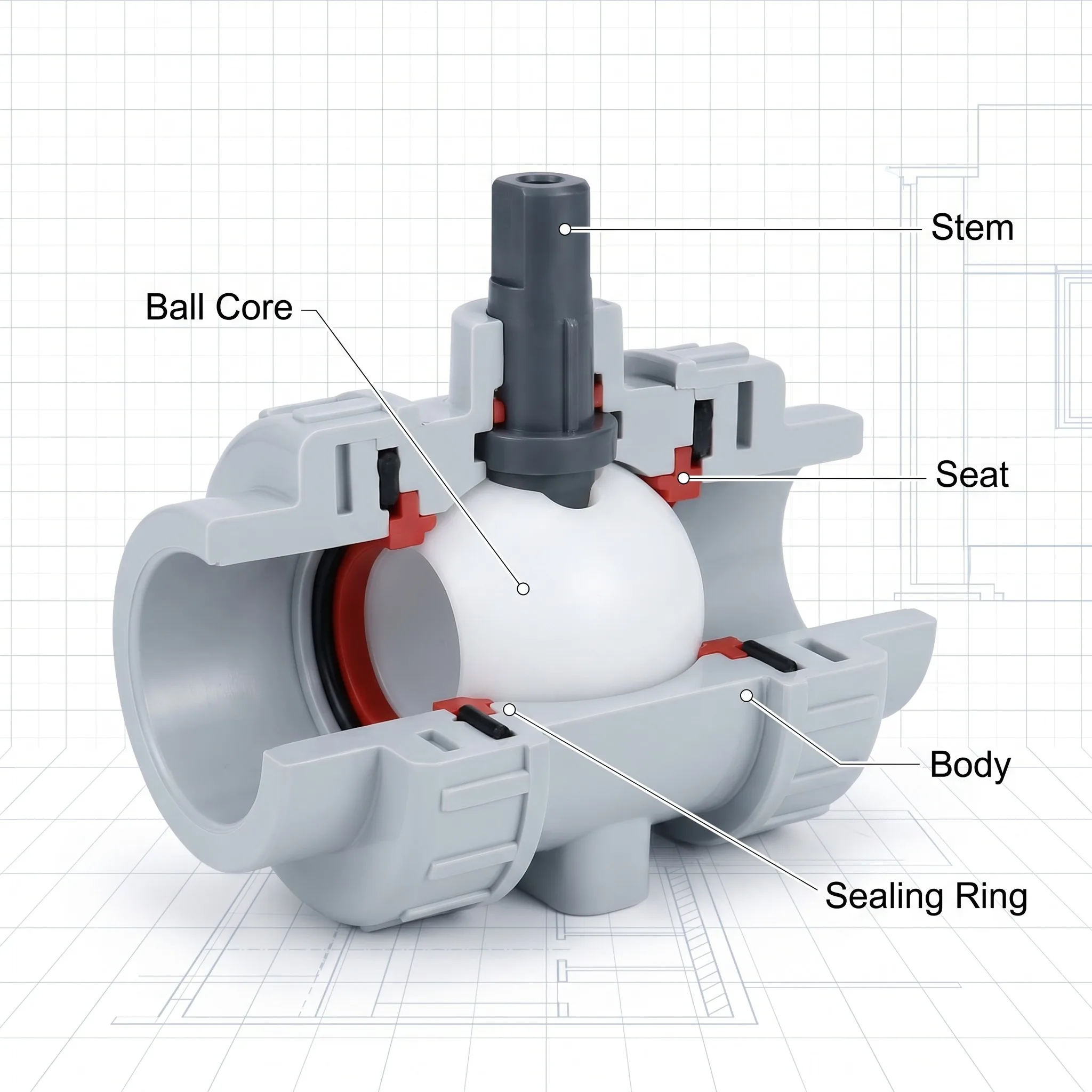
| Valve Body | Main housing enclosing internal flow path. Typically PVC or PVDF. Customizable: port size, thread type, flange pattern. |
| Ball Core | Rotating sphere controlling flow direction. POM preferred for wear resistance. Customizable: bore diameter (full/reduced port), surface finish. |
| Stem | Connects handle to ball core for rotation. POM or PP. Customizable: length, sealing interface, anti-blowout design. |
| Seat Ring | Seals ball core against body on both sides. PTFE or POM composite. Customizable: thickness, taper angle, dual-seat configuration. |
| Sealing Ring | O-ring or gasket preventing external leakage at stem and body joints. FKM or EPDM. Customizable: material per media, cross-section profile. |
| Handle | Manual lever for quarter-turn operation. PP or ABS. Customizable: shape, locking mechanism, actuator mount interface. |
Valve Material Selection Guide
Choosing the correct polymer directly affects service life, regulatory compliance and total cost of ownership. The following chart maps each material to its operating envelope.
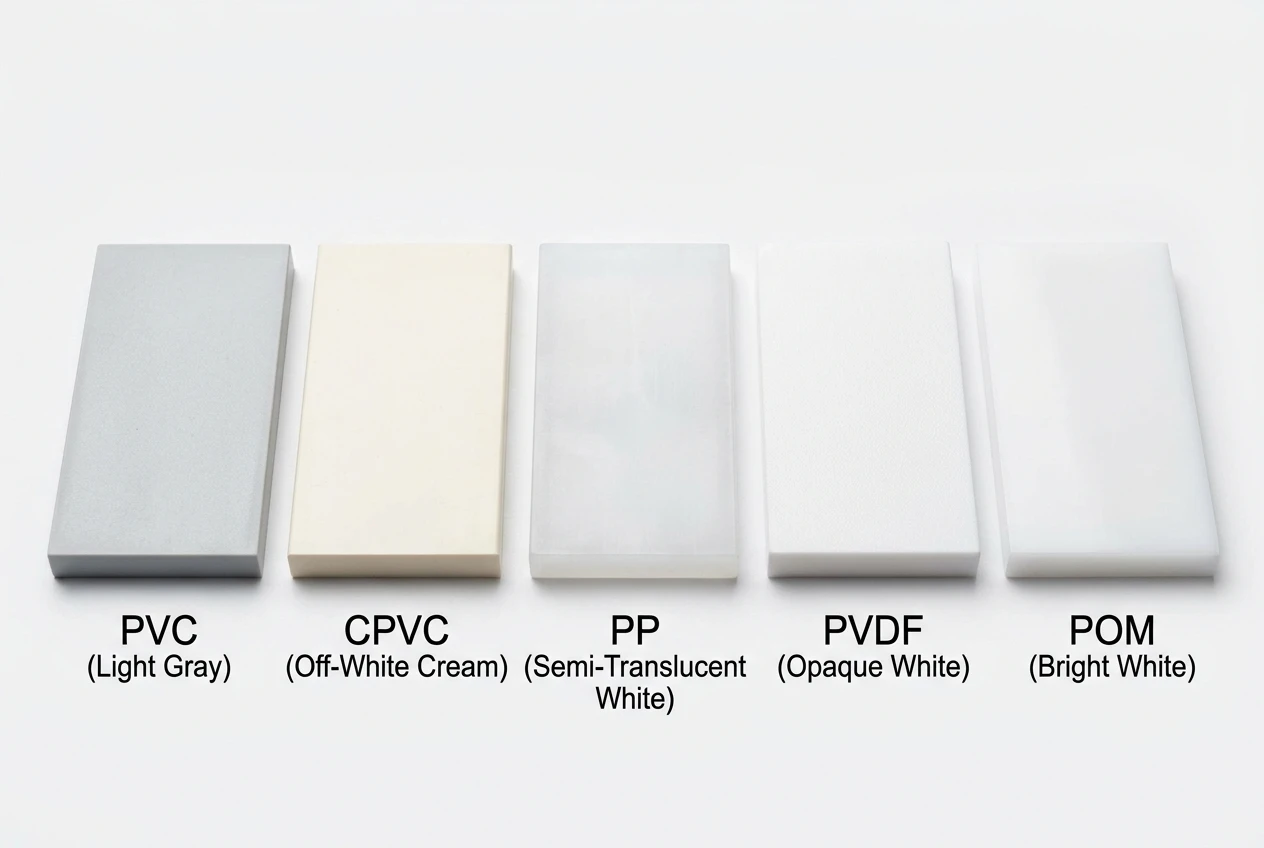
| Material | Chemical Resistance | Max Temp | Typical Use | Key Advantage |
| PVC | Good — acids, alkalis, salts | 60°C | Water treatment, drainage | Cost-effective, widely available |
| CPVC | Better — handles stronger acids | 93°C | Chemical dosing, hot water | Higher thermal rating than PVC |
| PP | Excellent — broad organic solvent range | 100°C | Industrial fluid transfer | Lightweight, good impact resistance |
| PVDF | Outstanding — concentrated acids, halogens | 140°C | Semiconductor • high-purity chemical | Ultra-pure, no leaching, USP Class VI |
| POM | Excellent wear resistance, moderate chemical | 100°C | Ball core, stem, internal moving parts | Low friction, high dimensional stability |
Manufacturing Process
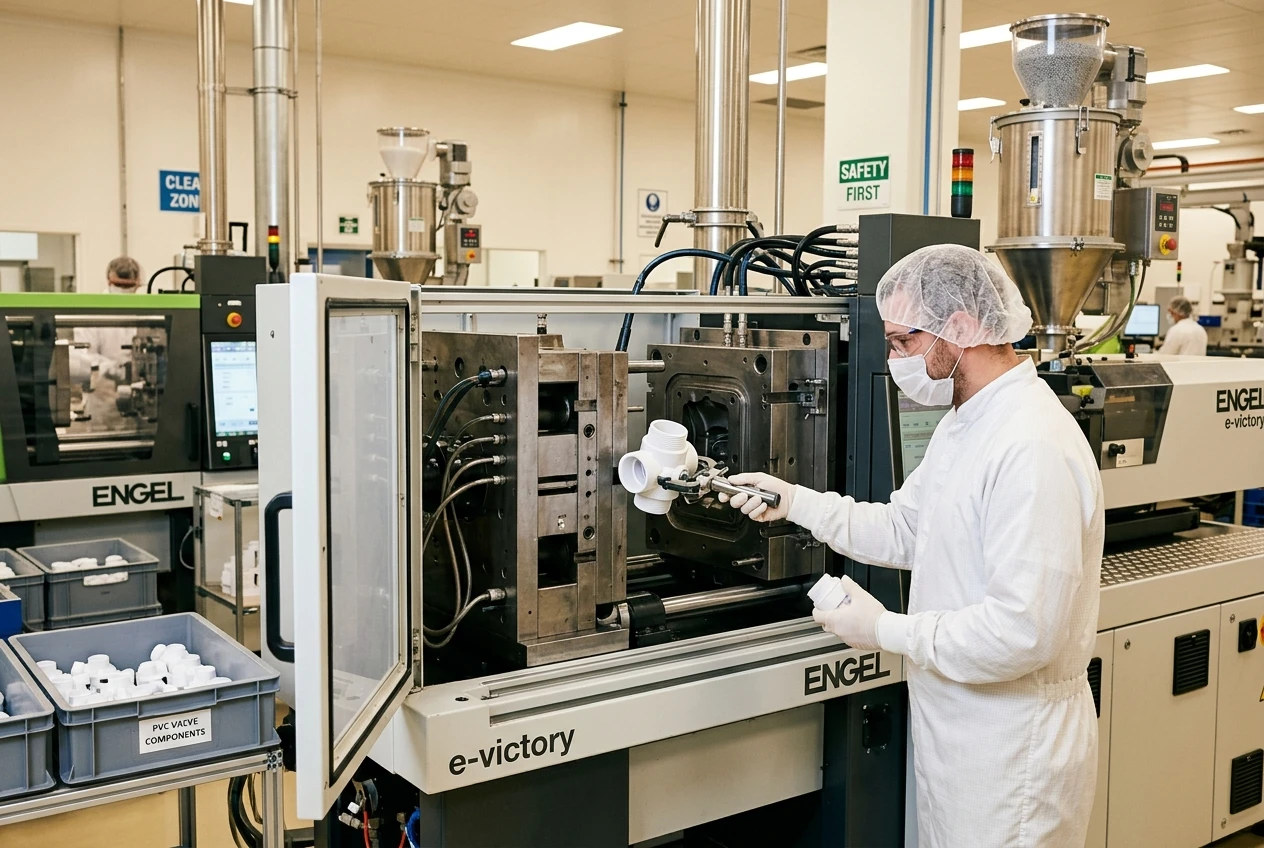
Technical Parameters
| Parameter | Specification |
| Dimensional Tolerance | ±0.05 mm (Molded); ±0.01 mm (Machined Feature) |
| Wall Thickness Range | 1.5–8 mm (Body); 0.8–3 mm (Seat) |
| Surface Finish (Sealing) | Ra ≤ 0.8 μm (Seat Face); Ra 1.6–3.2 μm (General) |
| Pressure Test | 1.5x Rated Pressure, 30s Hold, Zero Leakage |
| Shrinkage Allowance | PVC 0.3% • CPVC 0.4% • PP 1.5% • PVDF 2.0% • POM 1.8% |
| Mold Temperature | PVC 40–60°C • PVDF 80–100°C • POM 90–120°C |
| Melt Temperature | PVC 170–190°C • PVDF 200–230°C • POM 190–210°C |
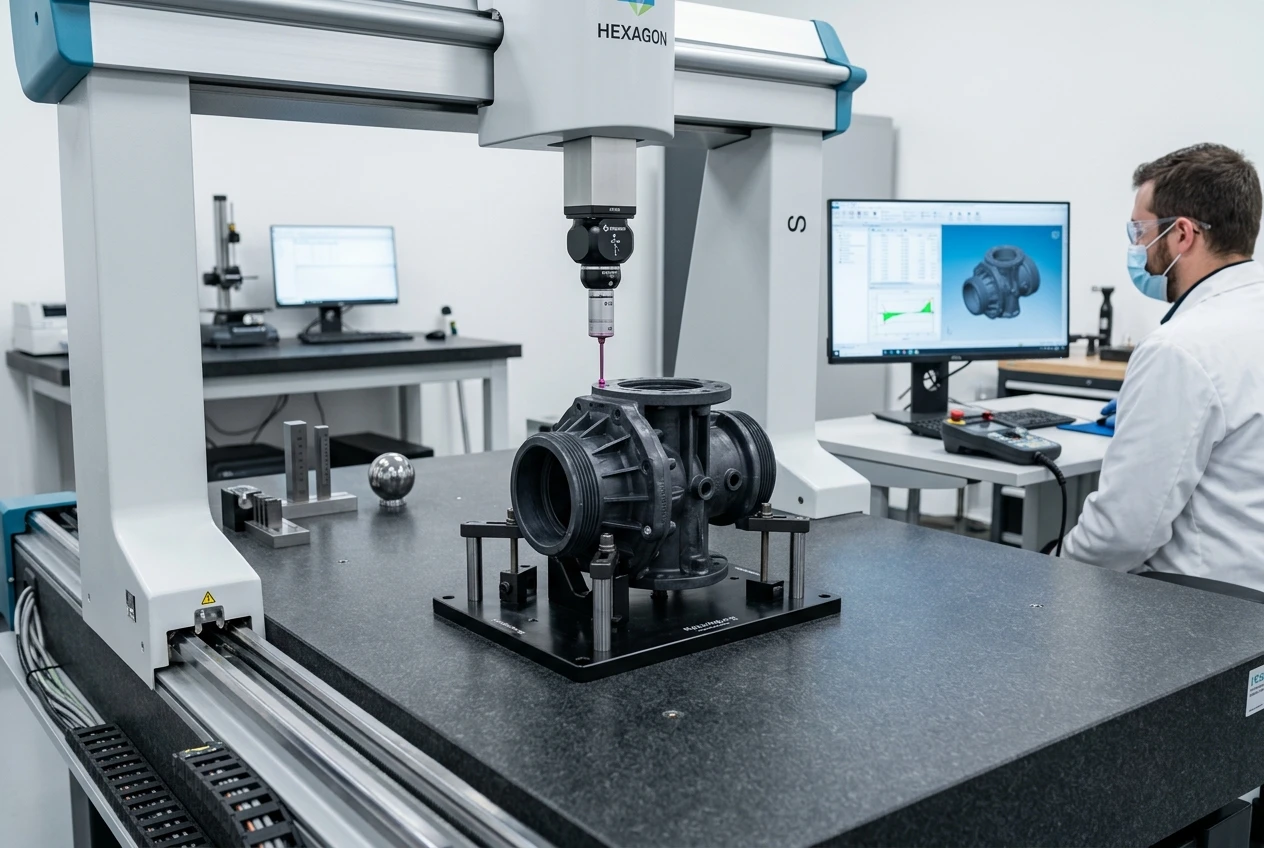
| Quality Standard | ISO9001 • Dimensional Report per Shipment • CMM Data |
Plastic vs Metal Ball Valve Components
Understanding the trade-offs between polymer and metallic valve hardware helps procurement teams make informed substitution decisions.
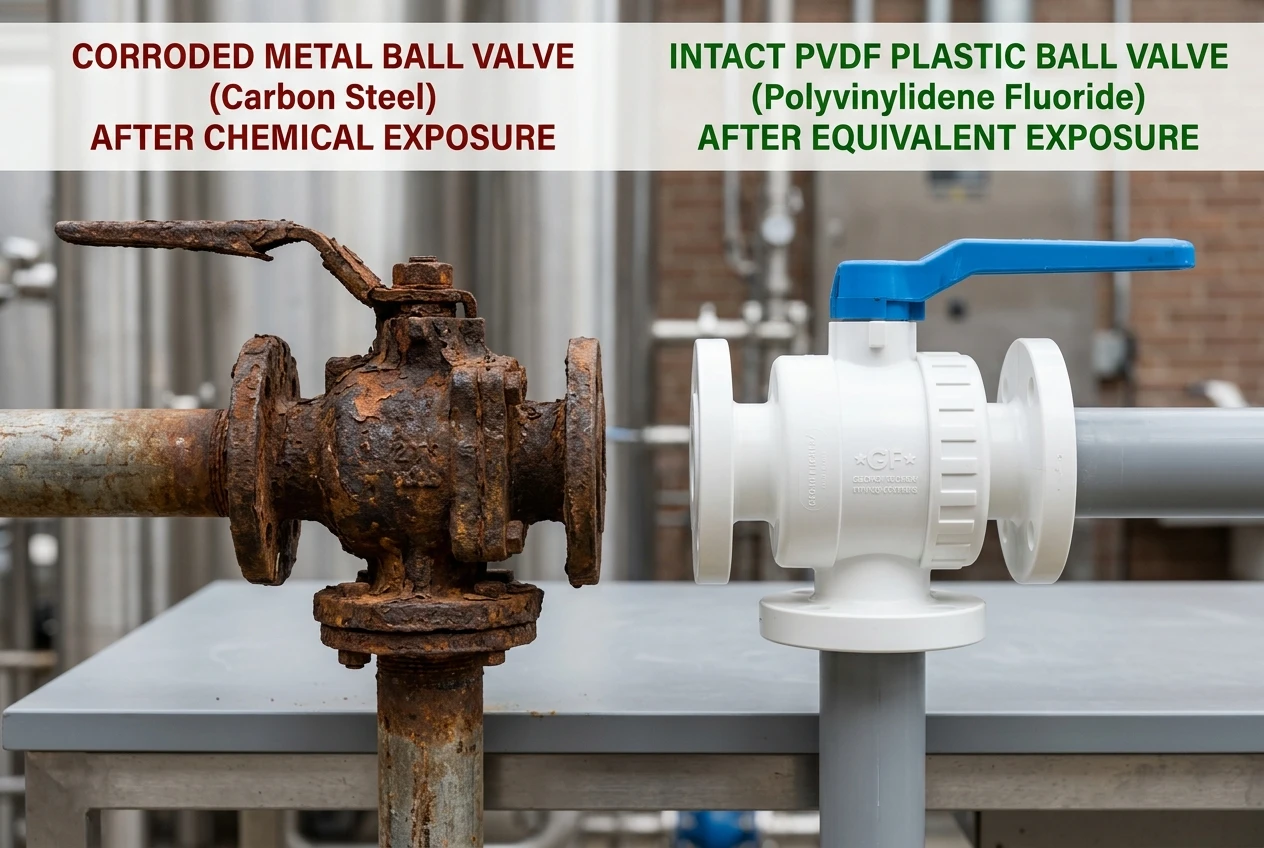
| Factor | Engineering Plastic | Metal (Stainless/Brass) |
| Corrosion Resistance | Excellent — inherent to polymer | Medium — pitting in chlorides, acid attack |
| Weight | Light — 1/3 to 1/4 density of metals | Heavy — requires structural support |
| Unit Cost | Lower — injection molding economics | Higher — machining + material premium |
| Chemical Compatibility | Broad — purpose-matched polymers | Varies — limited to specific alloys |
| Installation | Easy — lightweight, no heavy tools | Standard — bolting, lifting equipment |
| Temperature Limit | 0–140°C (PVDF max) | Up to 400°C+ |
| Pressure Rating | Up to 16 bar (typical) | Higher pressure capability |
Applications
Case Studies
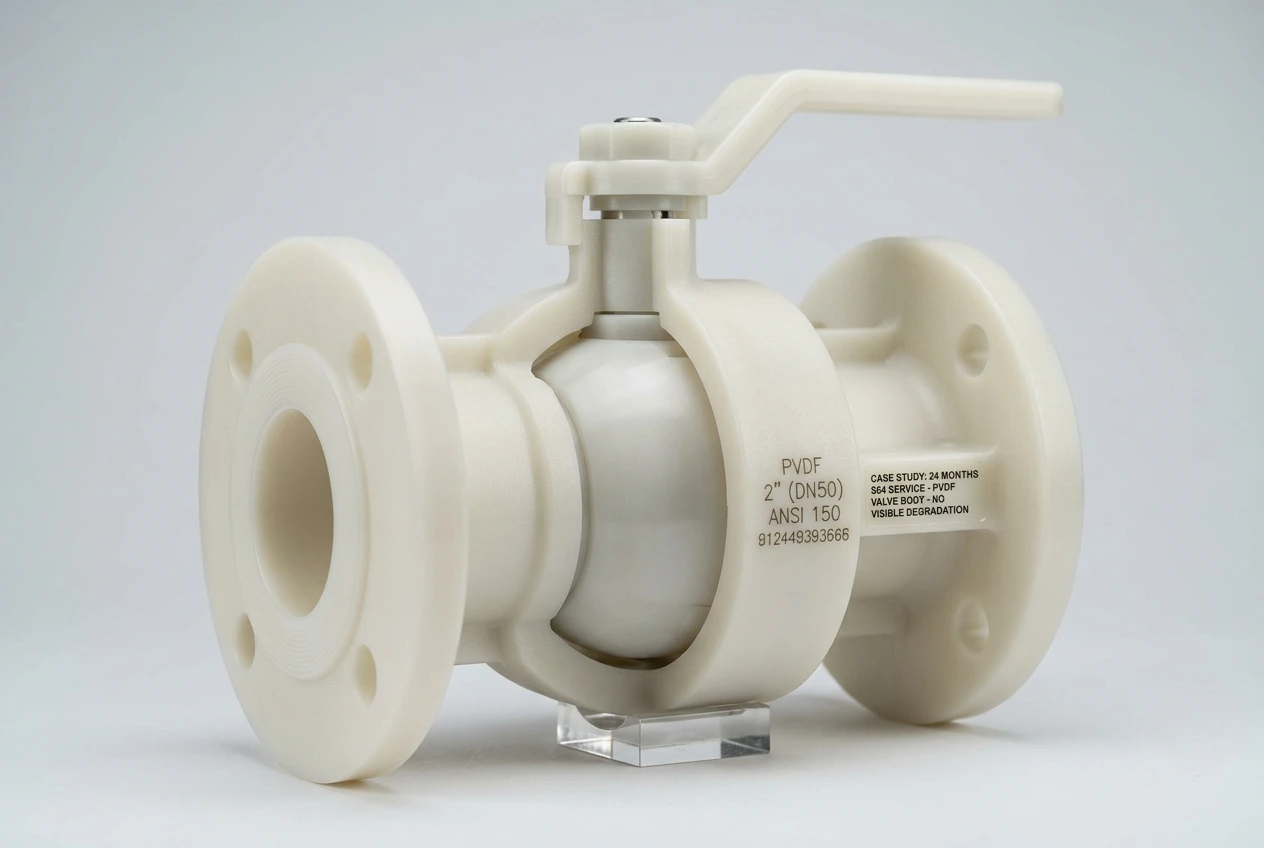
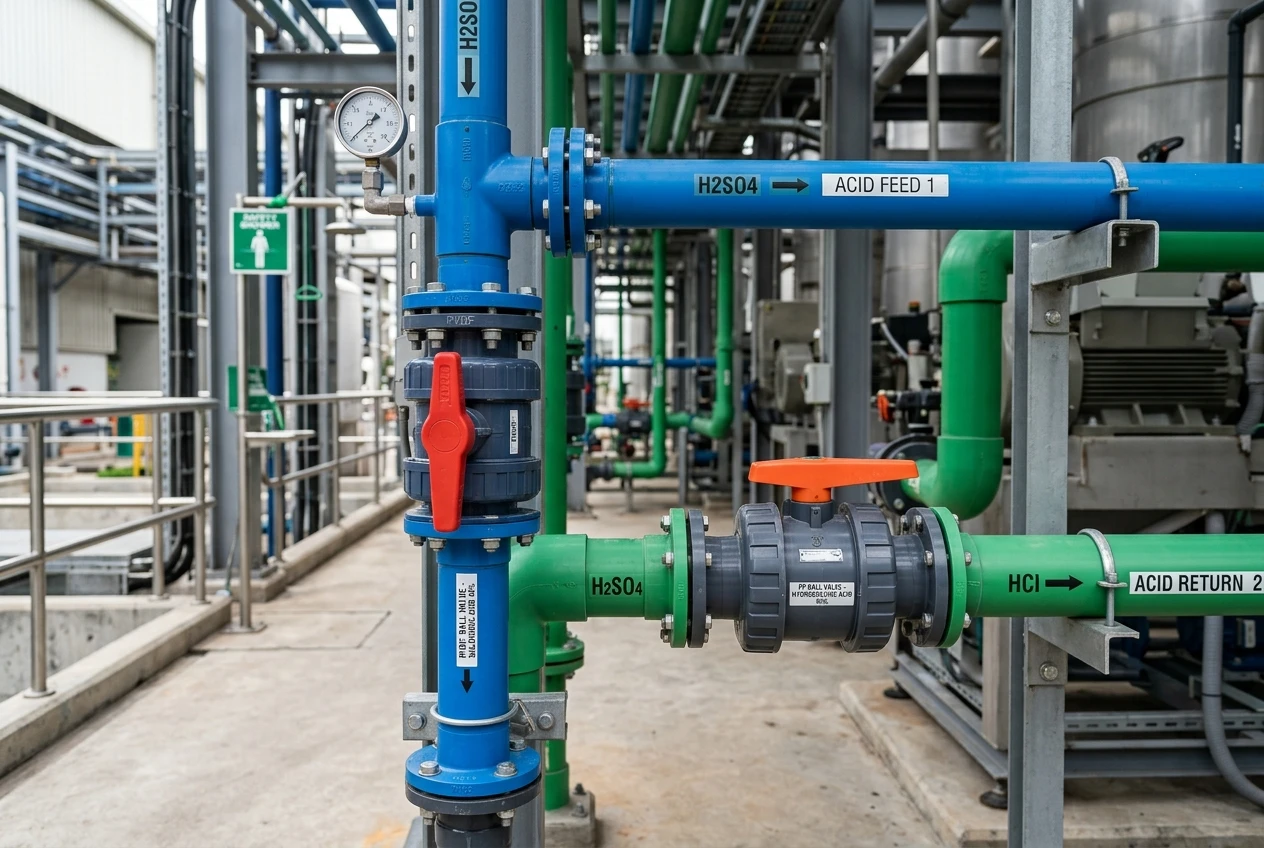
| Material | PVDF (Kynar 740) |
| Challenge | Concentrated sulfuric acid (98%) at 85°C — previous metal valves failed within 6 months due to pitting corrosion |
| Solution | Custom-molded PVDF body with PTFE seat, FKM seal. Dimensional tolerance ±0.05 mm on port alignment. |
| Result | 24 months continuous operation with zero visible degradation. Service life extended 3x vs previous metallic solution. |
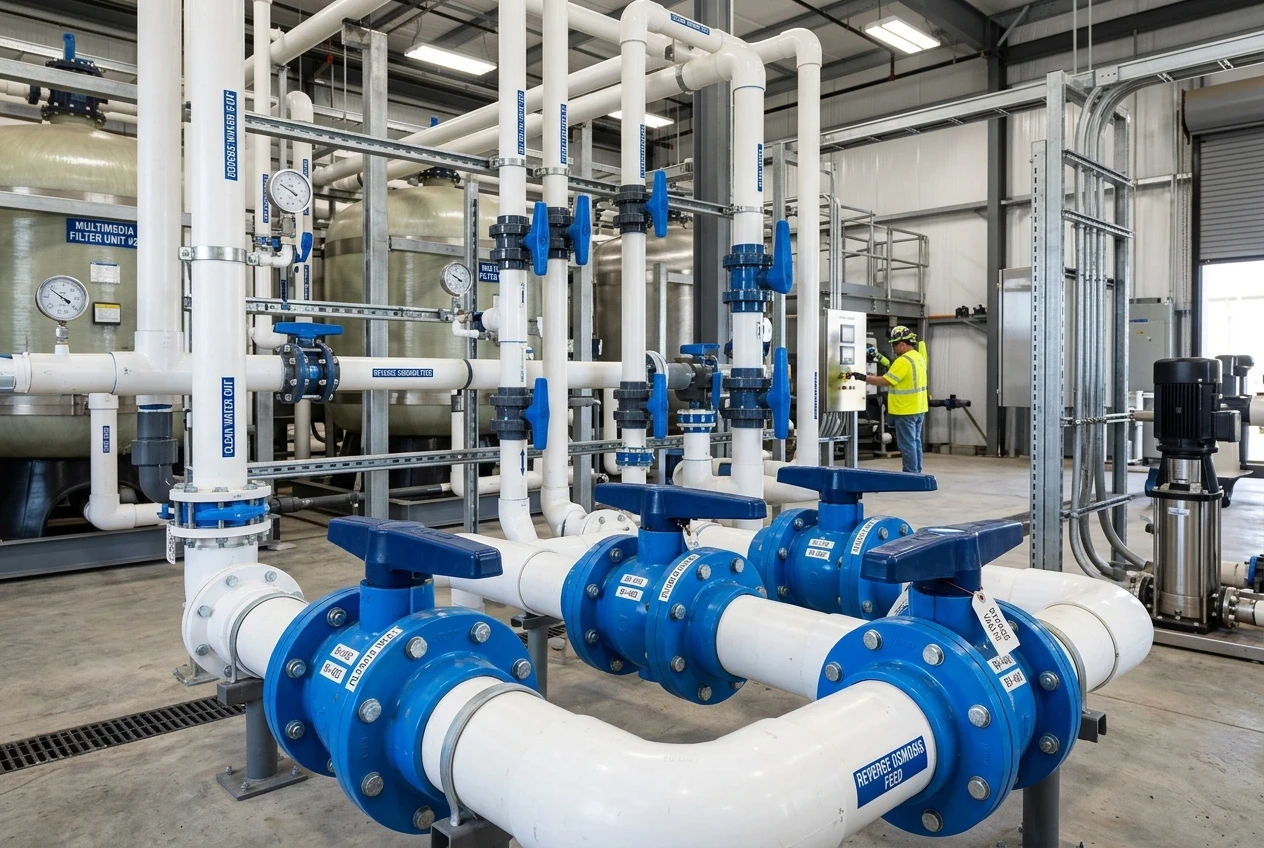
| Material | PVC (Schedule 40 grade) |
| Challenge | Stable supply of 8,000+ complete valve assemblies per quarter, consistent dimensional quality across multi-cavity production |
| Solution | 4-cavity mold for body, 8-cavity for handle. Automated degating and inline leak test at 1.5x rated pressure. |
| Result | 98.7% first-pass yield. Quarterly deliveries on schedule for 18 consecutive months. Zero field failure reports. |
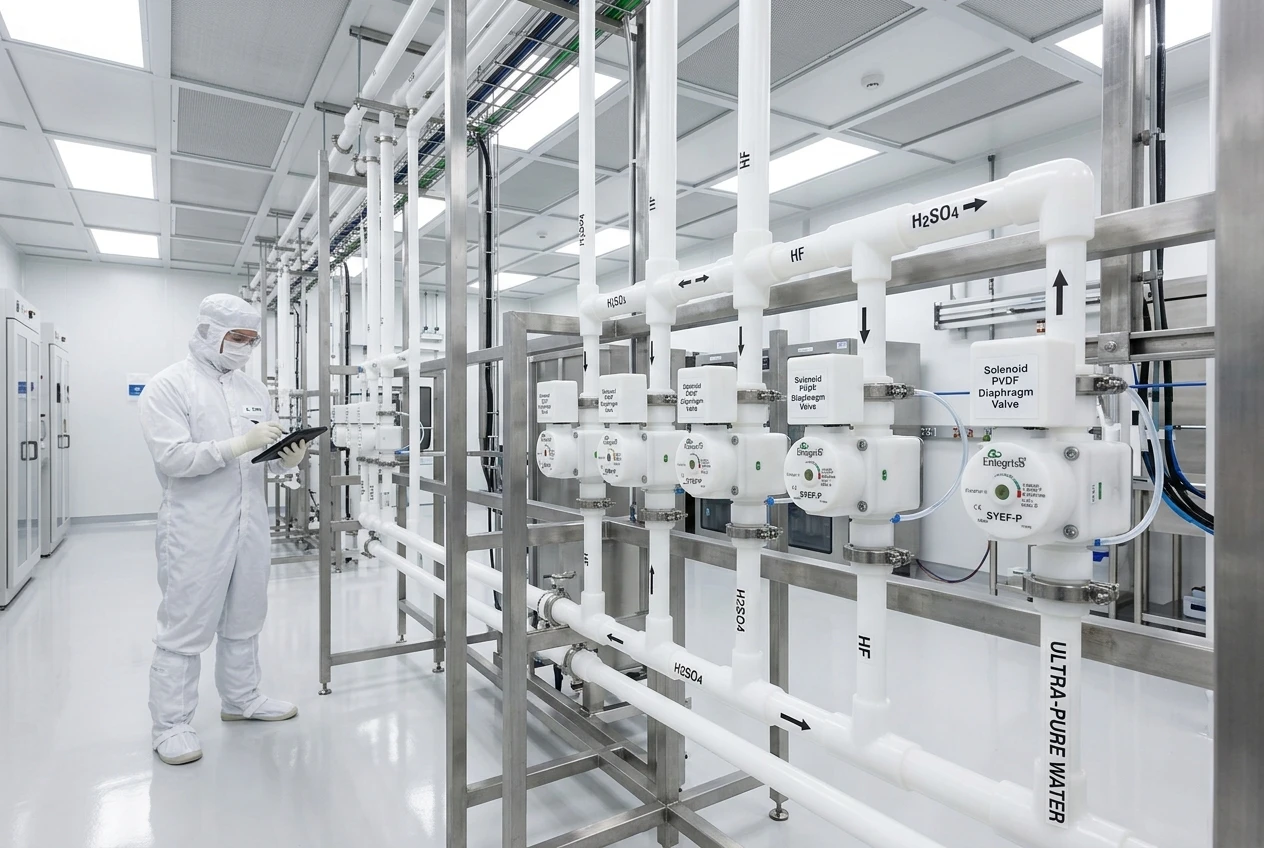
| Material | High-purity PVDF (USP Class VI certified) |
| Challenge | Particle generation ≤ Class 1000 requirement; zero ion leaching into ultra-pure water stream |
| Solution | Cleanroom-molded PVDF body and seat. Dedicated mold with chrome-plated cavity surfaces. Post-mold ultrasonic clean and nitrogen-pack packaging. |
| Result | Passed client’s particle count validation (≤ 5 particles ≥ 0.5 μm per mL). No detectable ion leaching in 72-hour extractables test. |
Frequently Asked Questions
About Xiamen Goldcattle
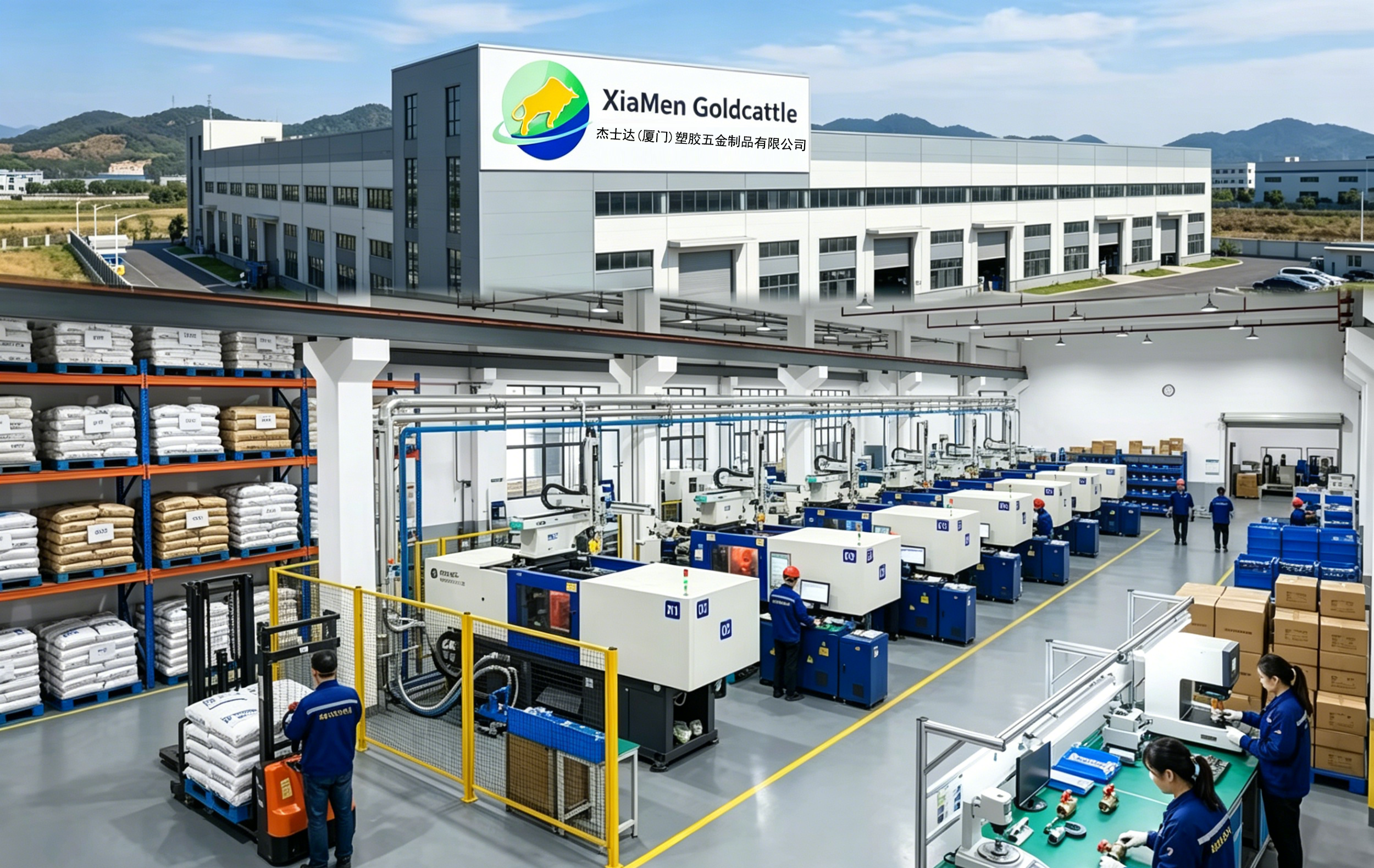
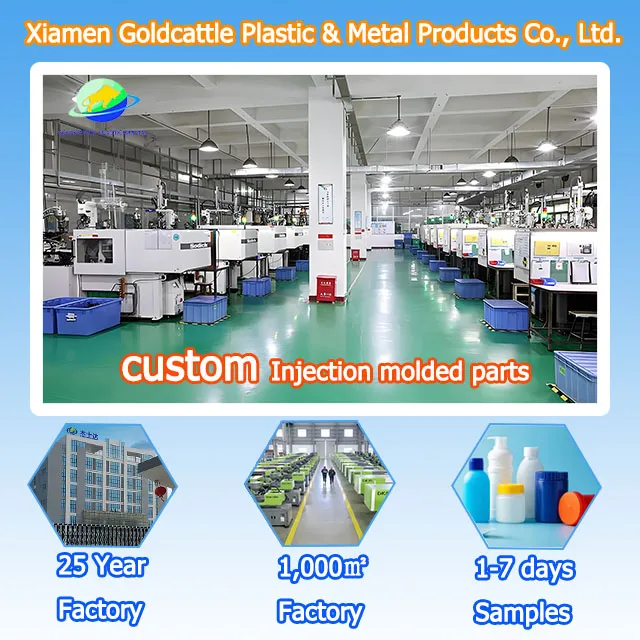
Xiamen Goldcattle Industrial Co., Ltd. specializes in custom injection-molded and machined components for fluid control, chemical processing and industrial equipment. With over 15 years of export experience serving European and North American OEM customers, our engineering team provides full-cycle support from DFM review through volume production.
| Established | 1998 |
| Export Markets | Europe, North America, Asia-Pacific |
| Quality System | ISO9001 Certified |
| Molding Capacity | 50–2000T clamp force, 1–32 cavities |
| Valve Component Materials | PVC • CPVC • PP • PVDF • POM • ABS |
| OEM Customization | Drawing-based • NDA protected • Full mold ownership options |
Plastic Ball Valve Component Summary
| Product | OEM Plastic Ball Valve Components |
| Components | Body • Ball Core • Stem • Seat Ring • Sealing Ring • Handle |
| Materials | PVC • CPVC • PP • PVDF • POM |
| Process | Injection Molding + Precision Machining + Assembly |
| OEM Service | Supported — Drawing-based, NDA Protected |
| Applications | Chemical Processing • Water Treatment • Food • Semiconductor |
| Production | Prototype to Mass Production • MOQ 100 Pieces |
| Quality Control | CMM Dimensional + Functional Leak Test + Visual Inspection |
| Manufacturer | Xiamen Goldcattle Industrial Co., Ltd. — ISO9001 Certified |