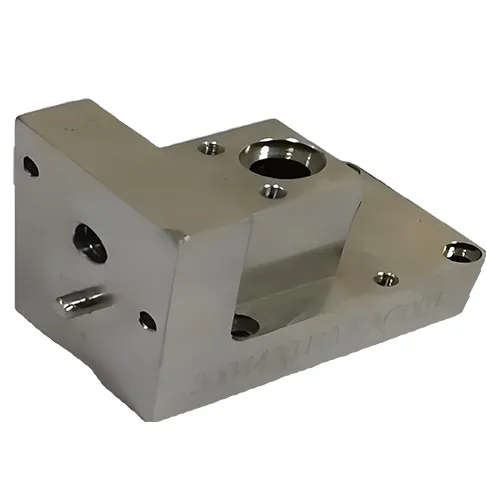


Stainless Steel Linear Guideway Rail
Place of Origin : XiaMen, China
Core Components : Slide Rail + Slide Block
Brand Name : JSD
materail : bearing steel
Sample : Availble
Package : Plastic Bag + Carton Box
Material : Aluminum+stainless Steel
Type : Linear Motion Guideway
Performance : Smooth Linear Guide Rail
Color : Customized Color
Usage : Auto-mation System
Description
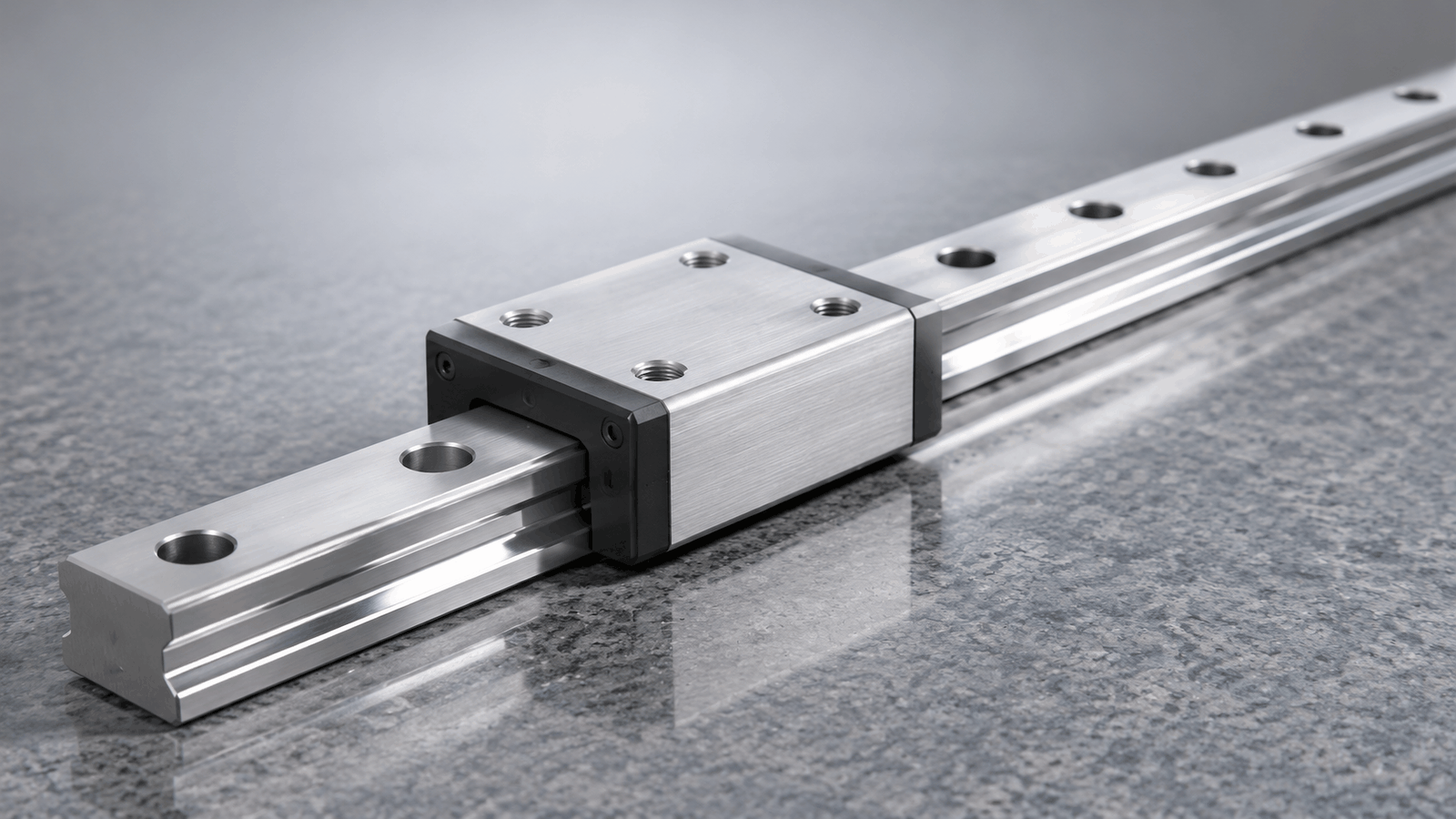
Linear Motion Components · Stainless Steel · OEM Custom
Custom Stainless Steel Linear Guideways with Long-Term Lubrication
A rail and carriage assembly made to your mounting dimensions, load direction and lubrication interval. The guideway is a matched pair, so the rail, the block and the lubrication unit are built together and inspected as a set, not as three separate parts.
- Core components Guide rail + guide block
- Product type Linear motion guideway
- Material Stainless steel, aluminium, bearing steel
- Lubrication Integrated unit, extended interval
- Brand JSD
- Sample Available
- Origin Xiamen, China
- Packing Protective film, foam, carton or crate
An integrated assembly, not two catalogue parts
A guideway is sold as a pair for a reason: the clearance inside the block is set by the size of the rolling elements, not by a screw. Once the block has been matched to its rail, a block from another set will not reproduce the same preload or the same running height on that rail.
What the assembly contains
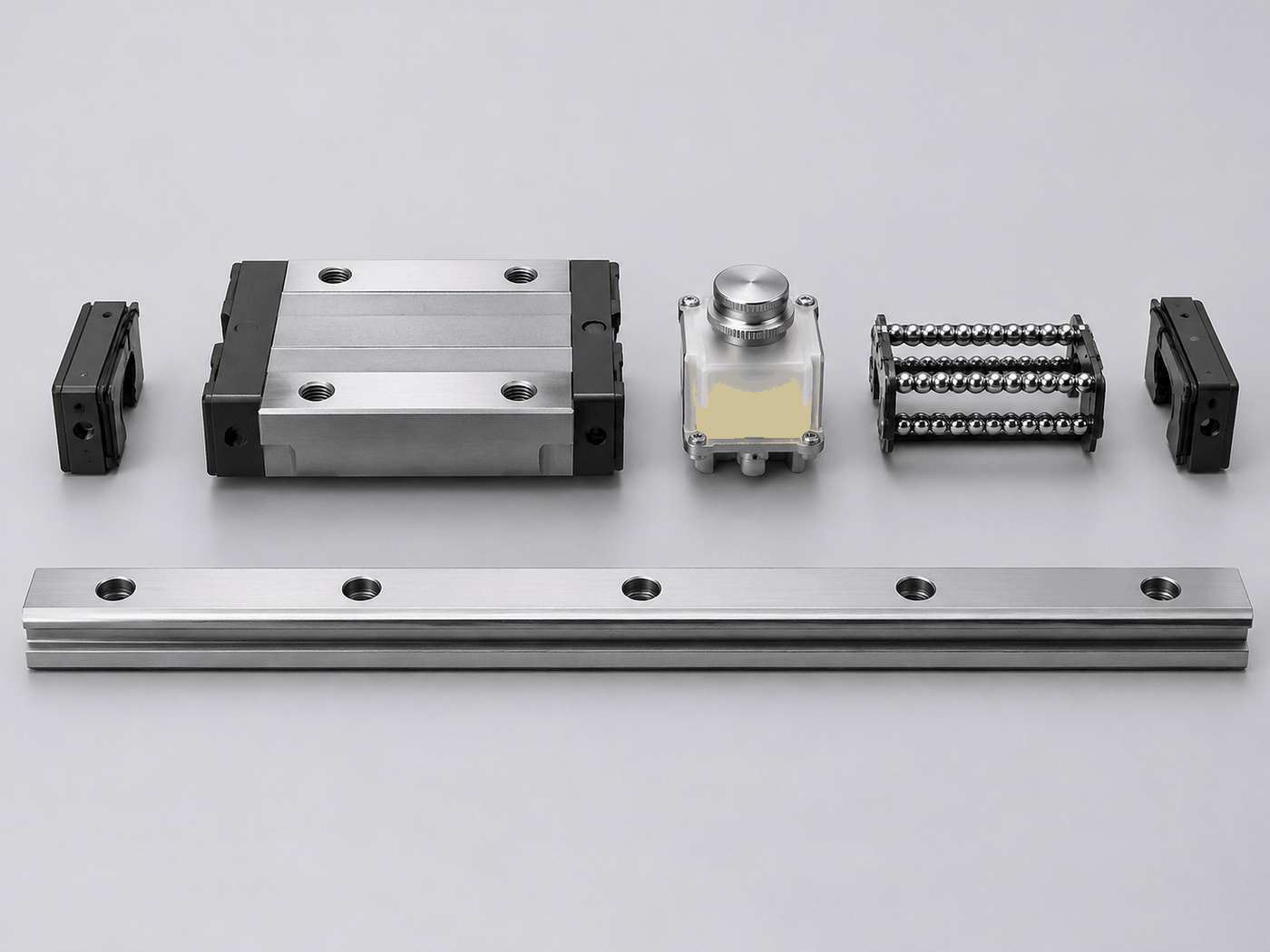
The reference assembly shown on this page uses a recirculating ball element inside the block. Roller and track-roller versions of the same product family follow the same component logic — rail, carriage, rolling element, retainer, lubrication unit, seals — with a different rolling element and raceway form. The element type is fixed on the drawing before the tool is cut, because it changes the load rating, the stiffness and the price.
| Component | Job in the assembly | What the drawing has to fix |
|---|---|---|
| Guide rail | Carries the raceway and locates the whole axis | Section width and height, raceway form, hole pitch, length, datum face, straightness |
| Guide block (carriage) | Rides the rail and carries the moving load | Body size, mounting face, bolt pattern, thread depth, reference shoulder |
| Rolling elements | Transfer load between block and rail with low friction | Ball or roller, diameter, grade, material, preload by size selection |
| Retainer / cage | Keeps the elements spaced and recirculating | Material, clearance, recirculation path |
| Lubrication unit | Stores lubricant and releases it to the raceway | Type, capacity, position, fill point, replacement interval |
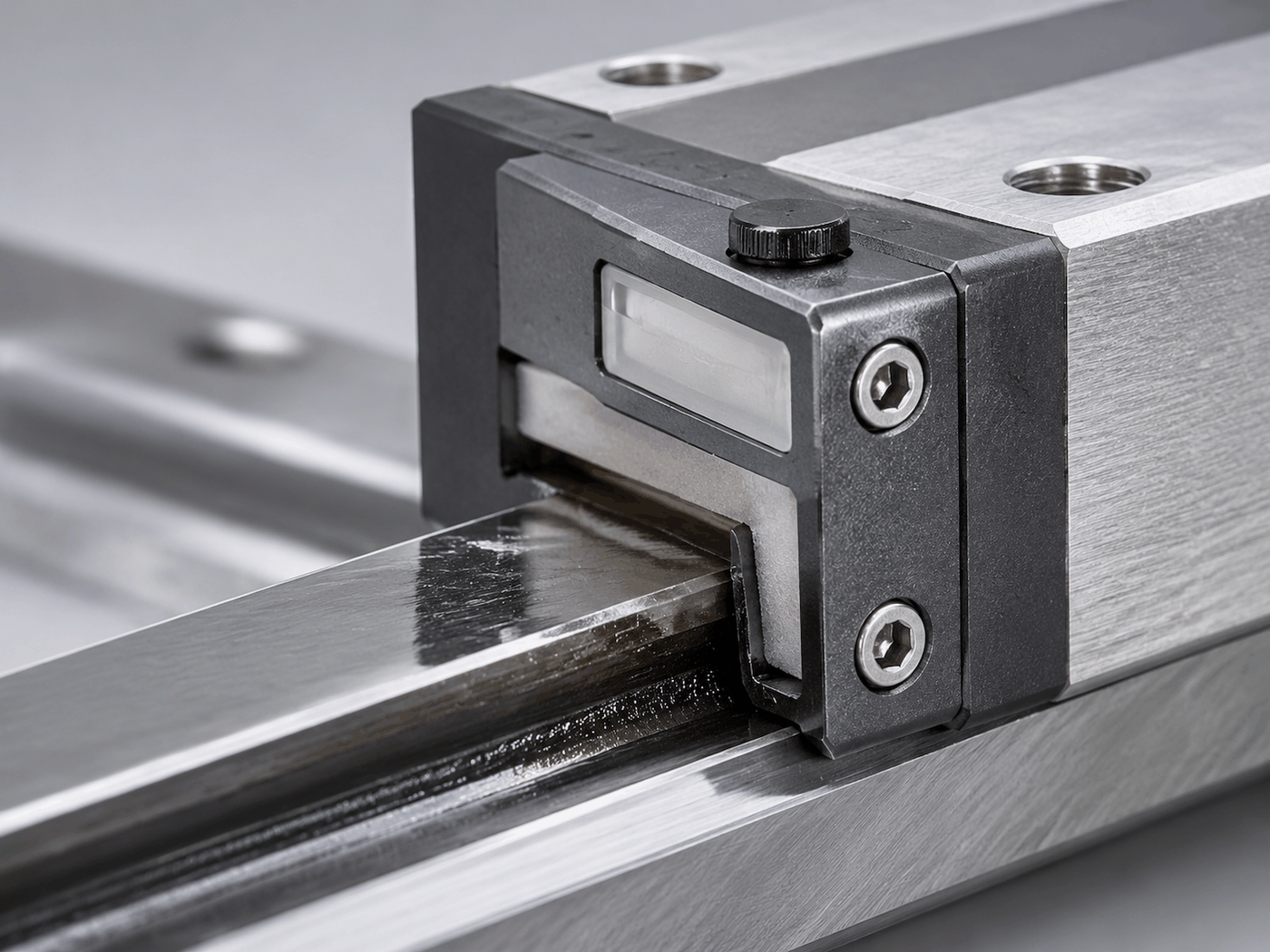
| End seal and wiper | Keeps dust out and lubricant in | Lip material, interference, wiping edge, backing plate |
Why the pair is matched, and why preload is not a screw
Preload in a ball guideway is created by selecting slightly larger balls for that particular block and rail. The block is assembled around the rail with the elements in place, so the four raceways are preloaded against each other at the same time. That is why the running height and the running resistance belong to the pair, and why swapping a block between rails of the same nominal size changes both.
For a buyer this has one practical consequence: when a block is ordered as a replacement for an existing machine, the rail section and the block series must both match, and the preload class must be the one the machine was built with. A heavier preload raises stiffness and reduces clearance, but it also raises friction, heat and the accuracy demanded of the mounting surfaces.
Four faces decide whether it mounts correctly
- Rail bottom face — sits on the machine bed; flatness here is transferred into the rail.
- Rail datum side face — pushed against a shoulder so the rail runs straight; this is the face the straightness and parallelism are referenced to.
- Block mounting face — the four-bolt top face that carries the moving part.
- Block reference shoulder — the machined side of the block that locates the moving part square to the rail.
If the bed has no shoulder for the rail, the rail can be adjusted against a straight edge, but the parallelism then depends on the assembly, not on the part. Both approaches work; they need to be chosen before the rail length and hole pattern are fixed.
The figures below are our standard values for the standard section and block, chosen so they are usable at the enquiry stage rather than after a design freeze. A longer block, a heavier preload or a different environment moves them, so each one is confirmed on the quotation against the drawing.
What the lubrication unit actually does
Lubrication is the reason this product exists, so it is worth describing as a mechanism rather than an adjective. A guideway fails from the raceway outward: once the oil film between ball and raceway breaks down, wear starts, clearance grows, and the block begins to run unevenly long before anything looks broken.
Lubricant is held in the block
A reservoir in the unit holds the lubricant so it does not have to be applied to the rail from outside. Capacity, not pressure, is what sets the interval.
It reaches the raceway by contact
A porous element or a metered release face touches the raceway as the block travels, laying down a thin film on every pass instead of a thick layer once.
The film is what protects
The film separates ball from raceway. Too little and metal touches metal; too much and the block drags, runs warm and collects dust at the seal.
Interval is measured, not assumed
Travel distance to a defined wear limit, recorded at a stated load, speed and orientation. Without those three, a distance figure means nothing.
Three ways a long interval is actually achieved
Reservoir plus metered release. A grease or oil chamber inside the unit feeds the raceway through a controlled gap. Simple, and the interval tracks the chamber volume.
Porous element with capillary feed. An oil-soaked porous body releases oil only as the block moves, so supply follows use. This is the mechanism that supports long intervals without a large housing.
Wiper that returns oil. A lip behind the seal pushes lubricant back onto the raceway instead of wiping it off at the ends. Without it, a reservoir only lubricates the middle of the stroke.
Which of these is inside a given block is a question a buyer should ask with a drawing in hand. The word "long-term" alone does not answer it.
The numbers a lubrication claim needs
A travel distance without test conditions is a marketing figure. The values below are for the standard assembly with its lubrication unit fitted, tested in the horizontal orientation; a vertical axis, dust or a short stroke moves them in, which is why the interval is written as a rule a maintenance planner can use rather than a record.
| Item | What is reported | Source |
|---|---|---|
| Lubrication type | Reservoir unit with porous contact release and wiper return | Assembly drawing |
| Lubricant | Lithium-soap grease, NLGI 2 (low-viscosity oil for high-speed axes) | Supplier data sheet |
| Reservoir capacity | 3 ml | Assembly drawing |
| Relubrication interval | 10,000 km of travel or 12 months, whichever comes first | Bench test plus duty cycle |
| Endurance travel | 1,000 km at 50% of C, where an endurance run is in scope | Bench test record |
| Test conditions | 50% of C, 0.8 m/s, 500 mm stroke, horizontal, 23 °C | Bench test record |
No guideway is lubricated for life in the sense of never needing attention. Even with seals in good condition, lubricant is consumed, migrates and degrades; the interval has to be set from the duty cycle and checked in service. This page therefore uses extended relubrication interval and reduced maintenance frequency, and does not use "maintenance-free", "zero maintenance" or "lifetime lubrication". Figures published by other manufacturers belong to their product and their test conditions, and are not transferred here.
What changes the interval
Five variables move it in practice: load relative to the rating, speed and how often the block is in motion, stroke length (a short stroke keeps the balls in the same track and wears it faster), orientation (a vertical or inclined axis drains differently from a horizontal one), and contamination. Humidity and temperature come on top of that for a stainless assembly used in wash-down areas.
Give us those five and the interval can be quoted with a basis. Without them, the honest answer is a range and a recommendation to inspect at the first service.
Which part is stainless, and which part is not
Material lists for guideways go wrong in a predictable way: three different values end up describing three different components, and the reader cannot tell which is which. The matrix below is the one we work to, with the grade fixed on the drawing rather than in a headline.
| Component | Typical material | Why this part uses it |
|---|---|---|
| Guide rail | 440C-type martensitic stainless, or a case-hardening bearing steel such as SCM420H | The raceway has to reach a hardness the balls cannot indent. Austenitic stainless such as 304 cannot be hardened to that level. |
| Carriage body | Stainless steel, or aluminium alloy where mass matters | Carries the mounting face and the recirculation channels; it does not form the running raceway on most designs. |
| Rolling elements | Bearing steel, or stainless for wet and clean applications | Stainless elements cost more and rate slightly lower, but they survive wash-down and humid storage. |
| Retainer / cage | POM or PA | Low friction against steel, and it has to flex without taking a permanent set. |
| End seals and wipers | NBR, or TPU for abrasive dust | TPU resists tearing at the lip; NBR is better in oil and at moderate temperature. |
| Lubrication element | Porous POM or PE body with the specified lubricant | The porosity is the metering device, so it is a specified part, not a generic sponge. |
| Fasteners | Stainless, matched to the rail grade | Mixing carbon screws into a stainless assembly puts a corrosion cell at every hole. |
Stainless is a family, not a grade
Two products can both be described as stainless and behave nothing alike. A 440C-type martensitic stainless can be hardened for a raceway and will hold a load rating. A 304 austenitic stainless resists corrosion beautifully and cannot be hardened to raceway hardness, so it belongs on covers, brackets and guards — not on the running surface of a guideway.
This matters when a buyer compares quotations. A price that looks low usually means a different grade, a different hardening route, or a rail that is stainless on the outside and bearing steel at the raceway. None of those are wrong; they are different products, and the drawing should say which one is being bought.
Aluminium has exactly one job here
When aluminium appears in a guideway specification it is normally the block body, a spacer, or a mounting plate — chosen to reduce moving mass on a fast axis. It is not the raceway and it is not the rail. If a listing shows aluminium and stainless together without saying which part is which, that is the question to ask before ordering.
Hardening is part of the tolerance chain
A rail is machined, hardened, and then finished, in that order. Hardening moves the part: a long rail can bow, a section can twist, and the raceway can shift by more than the straightness tolerance the drawing asks for. Finishing after hardening is what brings it back, which is why a hardened rail costs more than a machined one and why the straightness figure has to be stated at the finished condition.
The same logic applies to the block. Its mounting face is finished after heat treatment, so the face and the raceway stay parallel.
The grade, or the application conditions that decide it: whether the axis sees wash-down, coolant, humidity, or only dry workshop air. That single answer usually settles stainless versus bearing steel, and it changes both the price and the maintenance interval.
A guideway is selected by load direction, not by rail width
Buyers often start from the rail width because it is the number on the drawing they already have. But two guideways of the same width can carry very different loads, and the same guideway carries very different loads depending on which way the force arrives. The four directions below are what the rating has to cover.
| Parameter | Symbol | The question it answers |
|---|---|---|
| Dynamic load rating | C | How much load the assembly can carry for a defined rating life while moving. |
| Static load rating | C0 | How much load it can take standing still, or in a shock, without permanent indentation of the raceway. |
| Static moment rating | Mx / My / Mz | How much tipping, rolling or yawing moment the block can take before the balls at one end are overloaded. |
| Equivalent load | P | The single value that combines radial, reverse and lateral load for the life calculation. |
| Static safety factor | fs | The margin against permanent damage; it matters most on a vertical axis or where a crash load is possible. |
| Rating life | L10 | The travel distance reached by 90 percent of a population under the stated conditions. |
The definitions behind these symbols come from the linear rolling bearing standards: ISO 14728-1 covers dynamic load ratings and rating life, and ISO 14728-2 covers static load ratings, static equivalent load and the static load safety factor. They apply to linear rolling bearings within their scope — a plain sliding guide is a different structure and is not rated by them.
What the size classes carry
Ratings rise faster than rail width, because the raceway grows in both depth and length. The figures below are for the standard block on each rail size, and they are enough to pick a size from a load figure before a drawing exists. A longer block rates higher on the same rail; 35 mm and above are quoted on request rather than held as standard.
| Size class | Rail width | Dynamic C | Static C0 | Where it usually goes |
|---|---|---|---|---|
| 15 | 15 mm | 10 kN | 15 kN | Light pick-and-place, laboratory and inspection axes |
| 20 | 20 mm | 17 kN | 24 kN | General automation, packaging heads, small gantries |
| 25 | 25 mm | 24 kN | 33 kN | Machine axes of moderate length; the common choice |
| 30 | 30 mm | 36 kN | 47 kN | Heavier transfer units and short machine-tool axes |
Each figure is for the standard block on that rail size, at standard preload, and it moves with both: a longer block carries more, a heavier preload carries more but runs hotter. On a quotation the exact C, C0 and moment ratings for the section you are buying are stated next to the drawing, so the number can be checked against the part rather than against a brochure.
Accuracy class, preload and smoothness are three different things
A buyer asking for "high precision" is usually asking for three separate properties at once. They are set separately, they cost separately, and improving one does not improve the others.
| Property | What it controls |
|---|---|
| Accuracy class | The allowed error in running height and running width along the rail — how much the carriage rises or shifts as it travels. |
| Preload class | The clearance inside the block: stiffness and backlash, at the cost of friction and heat. |
| Running parallelism | How closely two rails on the same bed stay parallel; decides whether two blocks bind when they are tied together. |
| Rail straightness | The rail's own error before mounting; combined with the bed's flatness once installed. |
| Height variation | Block-to-block difference in running height — the number that matters when two blocks share one plate. |
| Friction variation | Change in resistance along the stroke; a short-stroke axis develops this first. |
| Running noise | A practical proxy for recirculation condition and film quality, and a real criterion in laboratory and medical equipment. |
The grade letter is not a shared language
Accuracy grades on profiled rail guides are written with letters, and those letters are not harmonised between manufacturers: one maker's H can sit where another maker's P sits, and some ranges use N for normal where others use C. A buyer comparing two suppliers on the letter alone is comparing two different questions.
The way to compare is to ask for the tolerance table behind the letter: the allowed running parallelism over a stated rail length, the allowed running height and running width variation, and the length the tolerance is quoted over. Those three figures travel with the quotation and can be put side by side.
Our standard supply is H grade accuracy with Z1 light preload. P grade and Z2 medium preload are quoted on request, and both are confirmed on the drawing rather than in a conversation.
Preload is a trade, not an upgrade
Increasing preload removes clearance and raises stiffness, which is what a machining axis or a pick-and-place head usually wants. It also raises running resistance and heat, demands flatter mounting surfaces, and shortens life if the load is already close to the rating. On a light, fast axis the same preload that suits a machine tool can make the drive motor work visibly harder.
The honest way to choose is from the requirement: what deflection is acceptable at the tool or the gripper, and what friction can the drive absorb. Preload class then follows from those two numbers, not from a preference for "tight".
What a drawing should carry, and what a report should show
The drawing carries the accuracy class, the preload class, the mounting face and shoulder dimensions, and the parallelism between them. The inspection report then shows the measured running height and running width variation, the rail straightness over its length, and the parallelism between paired rails. Both documents are needed — a class letter on its own does not tell a buyer what was measured or over what length.
Stainless is a starting point, not the answer to the environment
Corrosion in a guideway shows up first at the raceway, because that is where the protective film is thinnest and where the balls keep wiping it away. Choosing a stainless grade raises the threshold; it does not remove the need to match seals, lubricant and wiper to what the machine actually sees.
| Environment | What attacks the guideway | What we would change |
|---|---|---|
| General industrial | Airborne dust, ordinary wear debris | Standard seals; interval set from duty cycle |
| Humid or condensing | Flash rust on bearing steel raceways between shifts | Stainless rail and elements; corrosion-inhibiting lubricant |
| Wash-down and food areas | Water, cleaning chemistry, food-grade lubricant requirement | Stainless throughout, TPU wipers, lubricant selected for the cleaning regime |
| Cleanroom | Particle generation and outgassing from grease | Low-outgassing lubricant, sealed recirculation, clean and bagged before entry |
| Machine tool | Coolant mist, chips, fine cast iron dust | Double wiper or protective bellows, larger reservoir, shorter interval |
| Outdoor equipment | Temperature swing, condensation, grit | Stainless, sealed ends, bellows over the exposed rail |
Two points are worth stating plainly. First, a sealed block is not a waterproof block: seals slow ingress, they do not stop it, and a machine that is sprayed daily needs the sealing designed around the spray, not just a better lip. Second, food-grade lubricant is a lubricant specification, not a certification of the machine. If a line has to meet a specific hygiene standard, the lubricant, the seals and the cleaning chemistry are checked together, and the paperwork comes from the lubricant supplier.
What can be changed, and what has to stay fixed
A custom guideway is not a shape cut to order. Most of the assembly is fixed by the section and the block series, and the customization happens at the ends: length, hole pattern, mounting features, material and lubrication. Knowing which is which saves a round of drawings.
| Parameter | Unit | What we need from you |
|---|---|---|
| Rail width / height | mm | Section, or the existing rail it replaces |
| Rail length | mm | Overall length plus the end allowance you can accept |
| Mounting hole pitch | mm | Pitch and the distance from each end to the first hole |
| Block size | mm | Length, width, height, and the mounting face bolt pattern |
| Number of rails and blocks | — | Per axis, and whether they must be supplied as a matched set |
| Stroke and speed | mm, m/s | Working stroke, maximum speed, acceleration |
| Load case | N, N·m | Payload, centre of gravity offset, load direction |
| Accuracy and preload | class | The class required, or the deflection the application can tolerate |
| Lubrication | — | Standard, extended interval, or a lubricant you have already standardized on |
Rail length is not just a number
The hole pattern runs on a fixed pitch, so a rail length has to land on that pitch plus an end allowance at both ends. Ask for an arbitrary length and what you get is either a longer rail than the machine needs or a hole pattern that no longer matches the bed.
A single-piece rail runs to 3,000 mm as standard; past that it is supplied in sections and joined. That is normal for long travel, but the joint carries its own straightness allowance, so it has to be declared on the drawing rather than discovered at assembly.
Which parts we make, and which we buy in
Not every element of a guideway is machined in the same place, and pretending otherwise would be the easiest thing on this page to disprove. For each order the quotation states the split: which components are machined to drawing in-house, which are bought to specification, and whether we assemble and inspect the finished pair.
That split is not a detail. It decides who holds the tolerance on the matched pair, what the lead time is, and where a replacement block has to be ordered from in three years' time.
What travels with the parts
- 2D drawing (PDF) with the section, hole pattern and block mounting dimensions.
- 3D model (STEP) when the block has to fit into your own assembly.
- Inspection record for the set that shipped, keyed to the drawing dimensions.
- Lubrication note: what is inside the unit, what to top it up with, and the interval basis.
If the product is a proprietary design, the CAD is released under a simple written scope — what it may be used for and whether it may be shared with your own contract manufacturer. Everything else is standard.
Whether the rail and the block are bought as a matched pair from one source, or a block is being sourced to fit a rail that is already on the machine. The second case needs the rail section and preload class identified first, and it carries more risk on fit.
Five checks, and what each one can prove
A guideway can pass a dimensional inspection and still run badly. That is why the checks below are grouped by the question they answer rather than by the instrument used.
| Check | Method | What it proves |
|---|---|---|
| Rail and block dimensions | CMM and precision hand tools on the datum faces | The parts match the drawing, including mounting faces and shoulder positions |
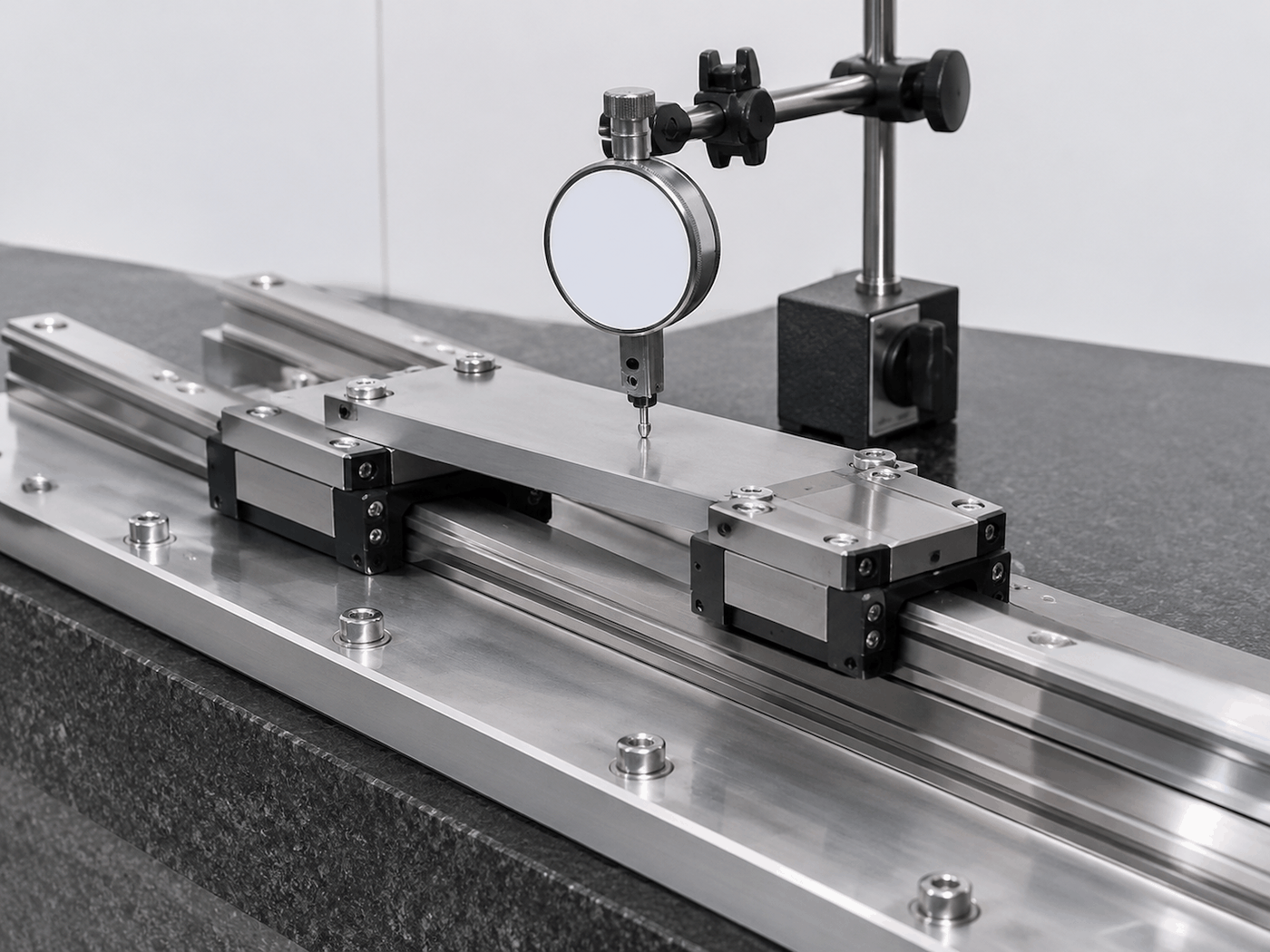
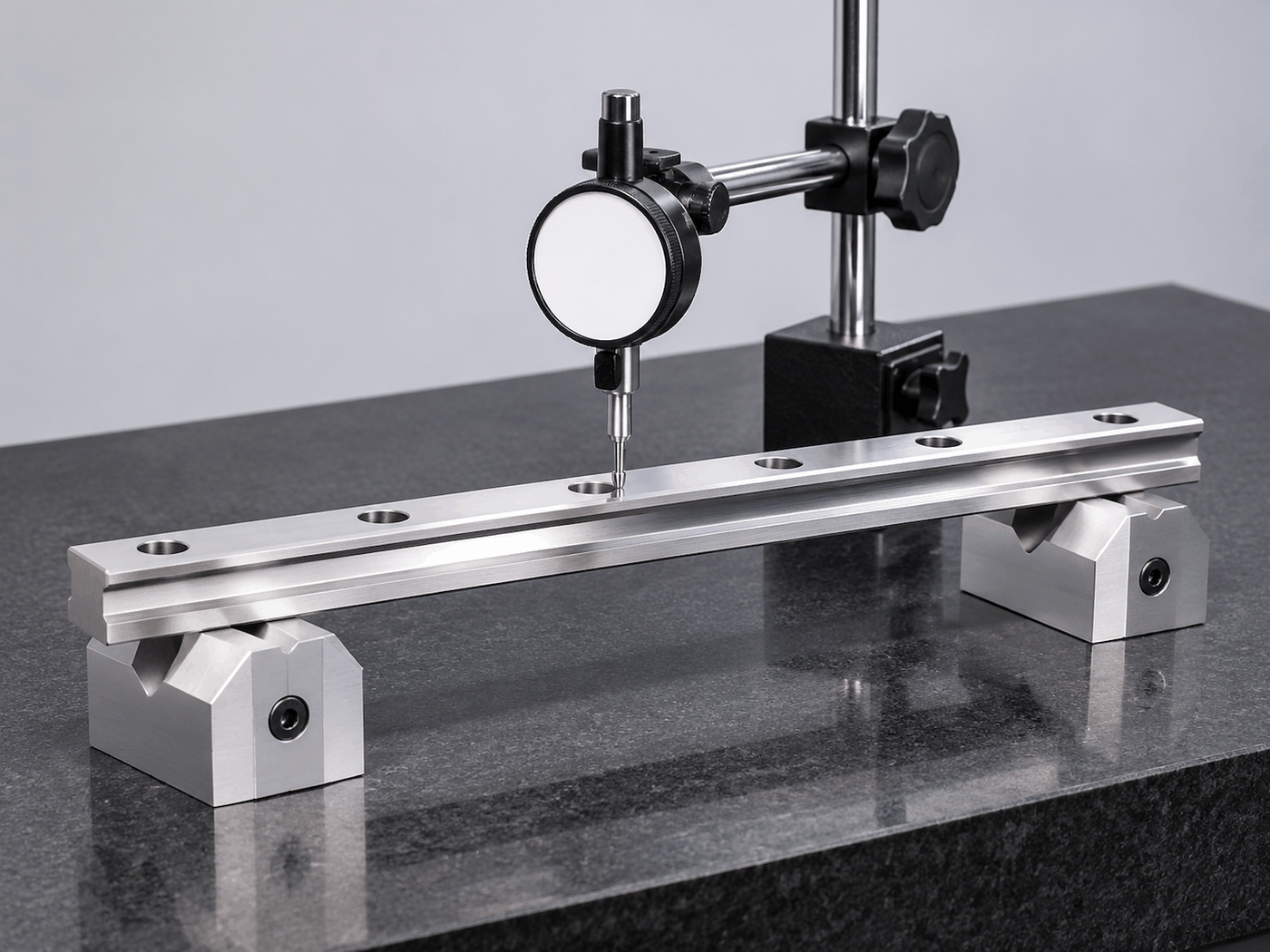
| Rail straightness | Dial indicator on V-blocks over the finished rail | The rail is straight before it is bolted down |
| Running parallelism | Paired rails on a reference bed, indicator along the bridge | The pair will not bind when the moving plate is fitted |
| Running resistance | Push-pull measurement along the stroke | The preload is what was specified, and friction is even end to end |
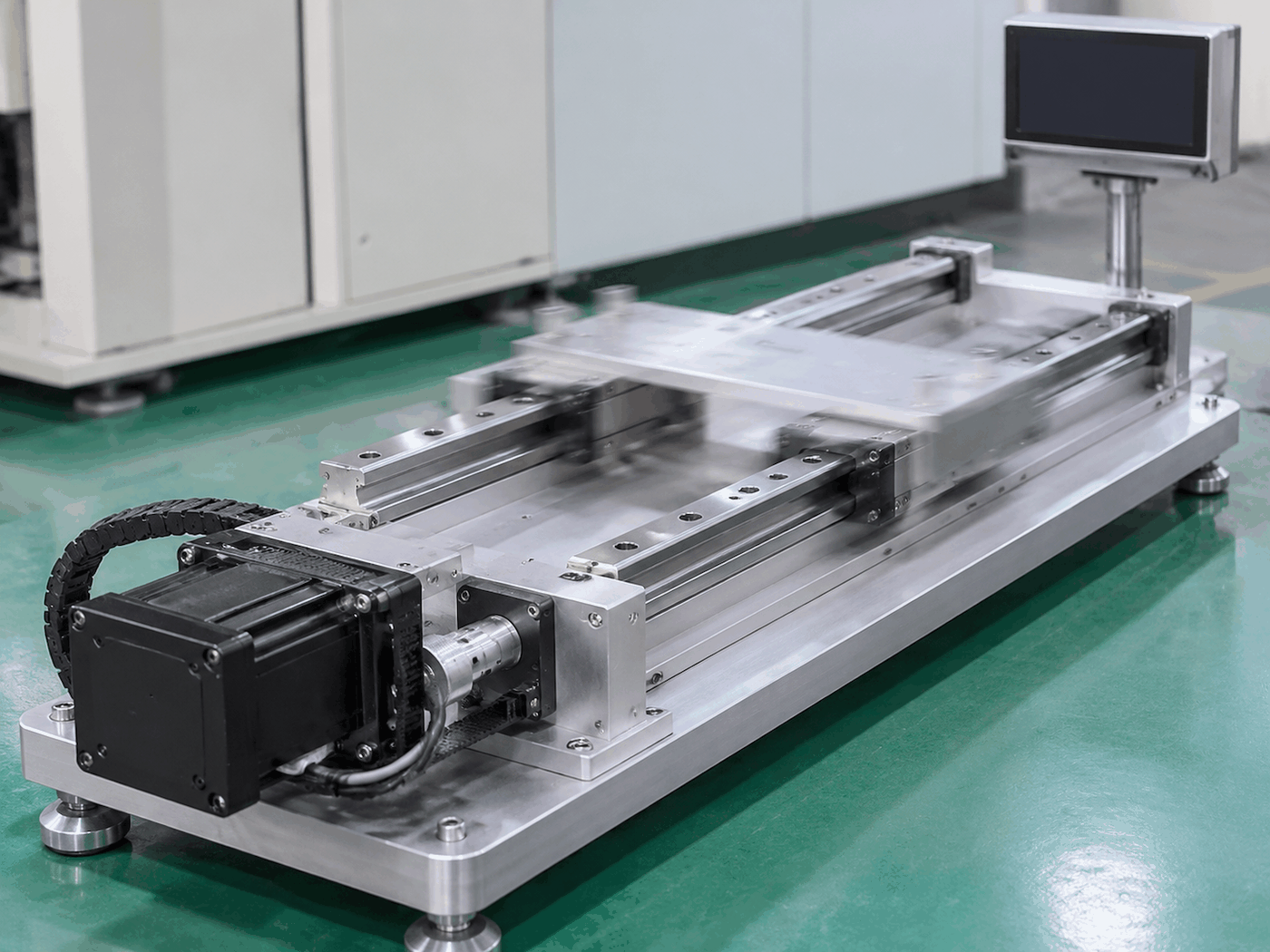
| Endurance run | Reciprocating rig at stated load, speed and stroke | The assembly reaches the stated travel before wear limit, under those conditions |

What an endurance result means, and what it does not
A travel figure is only comparable when the load, the speed, the stroke and the mounting orientation are stated with it. Change the stroke and the balls stop re-circulating over fresh track; change the orientation and the lubricant drains differently. Both move the result.
For that reason we report an endurance figure together with the conditions, and we do not convert it into a promise for a different application. If your duty cycle is heavier than the test, the interval moves in; if it is lighter, it may move out, but that is a decision for a service interval, not a marketing number.
Where a project has no test record yet, the honest position is that the interval is set from the lubricant supplier's guidance and confirmed at the first service inspection. That is a weaker answer than a test number, and it is still better than a figure with no basis.
Supporting checks on the material
Alongside the five functional checks, a stainless assembly usually calls for hardness on the raceway, material confirmation against the certificate, surface roughness on the raceway, and a corrosion check appropriate to the environment. These are specified per project rather than applied to everything, because each one adds cost and time.
Where a stainless guideway earns its cost
Stainless is chosen for a reason — wash-down, humidity, cleanroom, or a long service interval in a machine nobody wants to open. The applications below are the ones where that reason exists; each has a different failure mode, and so a different specification.
Factory automation and assembly
Pick-and-place heads and transfer units. The binding question is usually running parallelism between two rails, and the lifecycle is measured in cycles per shift.
Packaging machinery
High cycle rate, short strokes, frequent stops. Short stroke concentrates wear in one track, which is where the lubrication interval matters most.
Semiconductor and electronics equipment
Cleanroom particle limits and low outgassing restrict the lubricant, and the seals have to keep that lubricant where it belongs.
Laboratory automation
Smooth, quiet, repeatable motion at low load. Running noise and friction variation are the practical criteria, not load rating.
Medical equipment mechanisms
Low load, tight envelope, and a service life that has to be predictable. Material and lubricant documentation matter as much as the guideway itself.
Food processing machinery
Wash-down, cleaning chemistry and a specified lubricant. The sealing strategy decides the maintenance interval more than the rail grade does.
Machine tools and test equipment
Stiffness and preload lead; the guideway is part of the accuracy chain, so the mounting surfaces have to be machined to match.
Replacement and retrofit
An existing rail section is identified and a block supplied to it, or a pair replaced as a set when the original is worn beyond adjustment.
These are the industries this product is built for and quoted into. They are not a claim that we have delivered a validated project in every one of them, and where a specific application depends on a lubricant approval or a hygiene standard, that approval comes from the material supplier and is checked per project.
What arrives in the crate, and what should be filmed
A guideway is a part you cannot judge from a photograph of its outside. The evidence that helps a buyer is the assembly running, the set packed with its own inspection record, and the numbers that came with it.
Packing is part of the accuracy
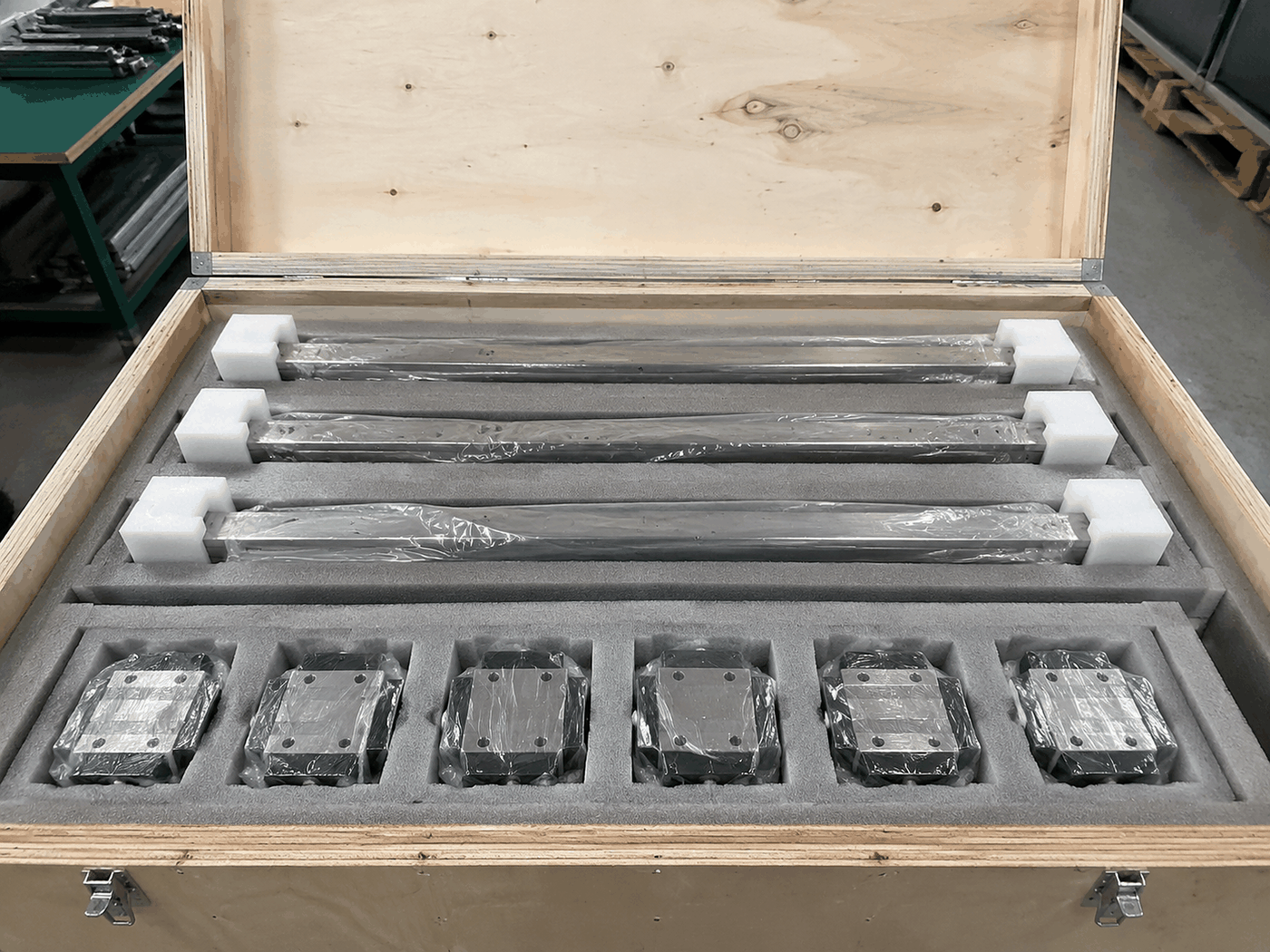
A hardened rail that arrives bent is a scrap part, however good the machining was. Blocks and short rails travel in a protective bag inside a carton, each block seated in its own recess so it is not knocked against its neighbours. Long rails go in a crate, because a bag will not protect a three-metre rail. A matched set always stays together with its inspection record, because a block separated from its rail loses the preload it was built with.
If the application needs it, the crate is marked for orientation and the ends are protected against humidity with a desiccant.
What a useful sample video shows
- The block running on the rail, at working speed, with the sound audible — recirculation noise tells an engineer more than a still image.
- The lubrication unit with the cover off, so the reservoir and the release face are visible.
- The seals and wipers lifted, so the lip can be seen against the raceway.
- An inspection in progress — indicator on the rail, reading taken along the length.
- The packed set, opened on the bench before closing.
A rotating product on a turntable answers none of these questions. If you need a video for a tender, ask for these five shots; any supplier with a real assembly can film them in an afternoon.
Questions buyers ask before ordering
What determines the service life of a linear guideway?
Service life depends on the applied load, operating speed, acceleration, stroke length, mounting accuracy, preload, lubrication condition and the operating environment. An integrated lubrication unit can extend the relubrication interval, but its performance has to be evaluated under defined conditions. For that reason the travel figure we report is always published with the load, speed, stroke and orientation used in the test.
What is a long-term lubrication linear guide?
It is a guideway whose carriage carries a lubricant reservoir and a release element, so the raceway is re-oiled as the block travels instead of being greased from outside at short intervals. The result is a longer relubrication interval and less maintenance access. It is not a permanently lubricated part: the lubricant is consumed and the interval still depends on load, speed and environment.
How does an integrated lubrication unit work?
A reservoir inside or on the end face of the block holds lubricant. A porous element or a metered release face contacts the raceway on every pass, laying a thin film on the track as the block travels. A wiper behind the seal pushes surplus lubricant back onto the raceway rather than wiping it off at the ends. Supply therefore follows movement instead of time.
What is the difference between ball and roller linear guides?
A ball guideway recirculates balls on four raceways and gives low friction with high accuracy; a roller guideway uses cylindrical rollers and carries more load and stiffness for the same size, at higher friction. Both are linear rolling bearings and are rated under ISO 14728, but the numbers are not interchangeable. The element type has to be fixed before the block and rail are machined.
How do I select a guide block for my load?
Start from load direction and magnitude, the distance from the load to the block face (which creates the moment), the stroke, the speed and the mounting orientation. Those give the equivalent load and the static safety factor; from them the section and block length are chosen. Rail width alone does not decide it, and a larger block does not always solve a moment problem.
What materials are used in stainless steel linear guides?
The rail and rolling elements are normally a hardenable martensitic stainless such as a 440C type, with the raceway hardened and finished after heat treatment. The carriage body may be stainless or aluminium where mass matters, the retainer is POM or PA, and the seals are NBR or TPU. Grades are named on the drawing, not inferred from the word stainless.
How long can a linear guide run before relubrication?
Ten thousand kilometres of travel or twelve months, whichever comes first, for the standard assembly on a horizontal axis in clean industrial air. Dust, coolant, wash-down, a vertical axis or a short stroke all move that in, so it is a starting interval rather than a guarantee, and the first service inspection sets the real one.
Are stainless steel linear guides suitable for food machinery?
They can be, when the stainless grade, the seal material and the lubricant are chosen together for the cleaning regime the line uses. Stainless resists corrosion but does not by itself make an assembly wash-down proof, and food-grade lubricant is a lubricant specification rather than a certification of the machine. The approval paperwork comes from the lubricant supplier.
Can guide rails and blocks be customised?
Yes, within limits. Length, hole pitch, mounting features, material, accuracy class, preload and lubrication are all specified per project. The section and the block series are fixed by the design, because the raceways are machined around the rolling element. Customization is therefore mostly at the ends and at the interfaces, not in the running geometry.
What information is needed for a custom linear guideway quote?
The rail section or the part it replaces, rail length and hole pitch, block mounting dimensions, the load and its direction, stroke, speed and acceleration, mounting orientation, the environment, and the accuracy and preload you need. A drawing or a photo of the existing part shortens this considerably. Without the load case the quote is a price for a shape.
Send the drawing and the load case
A guideway is quoted from three things: the geometry, the load, and the environment. Send those and the answer comes back as a section, a block, a preload class and an interval — not a price for a picture.