Process decision guide · plastic parts
When Should You Switch from CNC Machining to Injection Molding?
There is no piece count at which a plastic part automatically becomes a molding job. The switch is worth making when three things are true at once: the design has stopped moving, the repeat demand is credible, and the saving per part recovers the tooling investment inside the production horizon you actually expect. This page shows how to test those three conditions on your own part — and how to stage the move so supply is not interrupted.
At a Glance
Which Parts This Guide Applies To
Short answer: this guide is about a plastic part currently machined from plastic stock that may move to thermoplastic injection molding. It is not about converting a metal part into a plastic one.
- In scope: a part machined from plastic rod, sheet or block — typically ABS, PC, POM, PA, PEEK or similar — where the question is whether accumulated demand now justifies a mold. The material system stays the same; only the forming method changes.
- Out of scope — metal parts: an aluminium, stainless steel or titanium CNC part cannot be “switched” to plastic injection molding. Changing the material changes strength, stiffness, thermal behaviour, wear resistance, weight and frequently the entire product design. That is a re-engineering project, and it may point toward die casting, metal injection molding, powder metallurgy or fabrication instead.
- Out of scope — form-driven processes: if the part is a large hollow body or a one-piece shell, the forming route may be blow molding, rotational molding or thermoforming for geometric reasons that a cost comparison will not change.
- Adjacent but different: if your part is already molded and you are now choosing which factory should run it, that is a supplier-selection question rather than a process-transition one.
Why There Is No Universal Switch Quantity
Short answer: because the number you are looking for is the result of a calculation that depends on your part. Any published figure is the output of somebody else’s inputs.
Search for this question and you will find thresholds ranging from a few hundred parts to tens of thousands. They are not all wrong, and they are not evidence that the industry disagrees about physics. They disagree because they assume different tool routes, part sizes, cavity counts, materials, cycle times, labour rates, freight and inspection burdens — and because some of them answer a different question than the one being asked.
The two thresholds are not the same question
The single most common error is to treat “when does molding become possible” and “when does a production tool pay for itself” as one number. They are two.
| Threshold | What it really answers | What has to be true |
|---|---|---|
| Bridge / rapid tooling becomes relevant | Can I produce molded parts now, while the design or the annual volume is still settling? | Repeat demand looks credible, but the design or the forecast is not yet frozen — so you want molded parts without committing to a production tool. |
| A production steel tool becomes economic | Does the tool’s fixed cost get amortised by the per-part saving? | The design is frozen, the demand forecast is credible, and the projected saving recovers the investment inside your expected production horizon. |
Because these answer different questions, the part counts attached to them differ — and comparing one against the other produces a contradiction that does not really exist. Our own published guidance sets out a tool-route ladder from prototype quantities through rapid and bridge tooling to volume production; read it on the injection molding services page, where each band is tied to the tool route it describes rather than to a universal switch point.
The principle worth keeping: do not let a quantity make the decision for you. Let the calculation below tell you whether the tooling recovers, and let the maturity checks tell you whether the design is ready to be frozen. If either fails, staying on CNC is a legitimate answer rather than a delay.
Cost is not the only input, and it is not the first one
Even a favourable break-even is not sufficient. Three conditions have to hold together:
- The design has stopped moving. Every change after the tool is cut becomes a tool modification with its own lead time, cost and re-validation. If the critical features are still being revised, the tool is premature regardless of volume.
- The repeat demand is credible. A forecast is not an order. The break-even calculation uses accumulated quantity, so it is only as reliable as the volume assumption inside it.
- The saving recovers the investment inside your horizon. A payback that arrives after the programme has ended is not a saving. The horizon matters as much as the quantity.
For the full cost picture — what belongs in tooling, per-part price, secondary operations, inspection, packaging and freight — see the total cost of ownership section on our injection molding quote page. That breakdown is not repeated here.
Calculate the Break-Even Point for Your Part
Short answer: compare accumulated cost, not unit price. The mold is a fixed cost; the per-part saving is what pays it back, and the quantity at which the two accumulated totals meet is your break-even point.
The model
Over a quantity Q of good parts, the two routes accumulate cost like this:
CCNC(Q) = FCNC + Q × VCNC

      Cmolding(Q) = Fmold + Fvalidation + Fmaintenance + Q × Vmolding
- Q — the number of good parts you expect to take from the new route, not the number you hope to sell.
- FCNC — one-time CNC side cost: programming, fixtures, first-article work.
- Fmold — mold cost. Fvalidation — trial rounds, sample measurement, approval. Fmaintenance — expected maintenance or revision budget over the programme.
- VCNC — your current CNC unit cost at the same quality and scope. Vmolding — the quoted molded unit cost.
Where the molded unit cost is lower, the quantity at which the two accumulated totals meet is:
QBE = ( Fmold + Fvalidation + Fmaintenance − FCNC ) ÷ ( VCNC − Vmolding )
The conditions that make it valid. The two unit costs must be quoted on the same scope — same material, same tolerance, same inspection, same finish, same packaging. The denominator must be positive; if molding is not cheaper per part, no quantity recovers the tooling. And the model covers only the items you put into it: it does not yet price tool life, scrap rate, freight, duty, inventory or the risk of a design change. Where those are material to your programme, they belong in the calculation rather than outside it.
A worked example
The following assumptions are illustrative. They exist to demonstrate the arithmetic, not to describe a real quotation, and the resulting quantity is not an industry threshold.
| Assumption | Value |
|---|---|
| Mold cost | US$12,000 |
| Trial and validation cost | US$1,500 |
| CNC unit cost | US$22.00 per part |
| Molded unit cost | US$4.50 per part |
| Saving per part | US$17.50 |
With no CNC setup cost and no maintenance budget assumed, the break-even quantity is US$13,500 ÷ US$17.50 ≈ 772 parts. At an expected demand of 5,000 parts the accumulated totals are US$110,000 on CNC against US$36,000 on molding — which is why the same two unit prices can look decisive at one volume and premature at another.
Put your own numbers in
The estimator uses the model above. Change any field and recalculate; the default values are the worked example, so you can see the arithmetic behave before you trust it with your own figures.
CNC vs. injection molding: break-even estimator
Compare one-time investment against production cost at your expected volume. All amounts in USD. The result is an estimate, not a quotation.
This comparison covers only the cost items you entered. Design-change risk, tool life, quality validation, freight, duties and demand uncertainty can reverse it.
Where the break-even quantity exceeds your expected demand, the tool has not recovered at that volume. Where it does not, the cumulative cost is lower on molding — but that is a statement about your inputs, not a recommendation, and it is not a quotation.
What the model deliberately leaves out
Treat a favourable result as a reason to proceed to a proper quotation, not as the quotation itself. The following materially change the answer and are not in the four fields above:
- Quantity price breaks. Both unit costs usually step down at volume tiers, so a single pair of unit prices will be wrong above and below the tier you assumed.
- The probability that the forecast happens. A break-even built on an optimistic volume is an optimistic break-even.
- Design-change cost after the tool is cut. This is the item most often omitted and most often expensive.
- Yield and scrap. A molded part that fails inspection costs more than its quoted unit price, and a new process normally has a learning curve.
- Tool life and maintenance against your real total demand, not the assumed one.
- Freight, duty, inventory and cash-flow timing once parts cross a border and sit in stock.
- The cost of carrying both routes at once during the transition, which is covered further down this page.
The Four-Stage Transition Path
Short answer: the move from CNC to molding is not one decision with one date. It is a sequence of four stages, each with its own exit condition. Most expensive transitions are projects where a later stage was started before the previous gate had actually been passed.
| Stage | What you are doing | Evidence needed to leave the stage |
|---|---|---|
| 1. Stay on CNC | Producing sellable parts while the design is still being revised and the annual volume is not yet credible. | Critical dimensions, interfaces and cosmetic expectations have stopped changing between revisions. |
| 2. Prove it with bridge tooling | Getting real molded parts — and real molded-part data — without committing to a production tool. Frequently aluminum or a soft steel, quoted with a shorter build and a higher per-part cost. | Trial samples meet the drawing; shrinkage, warp, gate and parting-line witness are understood and accepted; the process repeats across the run. |
| 3. Commit to a production mold | Building the tool that will carry the programme, sized for the real demand rather than the pilot. | The break-even from the previous section falls inside your production horizon, and the design is frozen in writing. |
| 4. Validate and ramp | Approving the tool, qualifying the parts and transferring volume across without stopping existing deliveries. | Agreed acceptance criteria are met on production samples, and the ramp plan is confirmed in writing. |
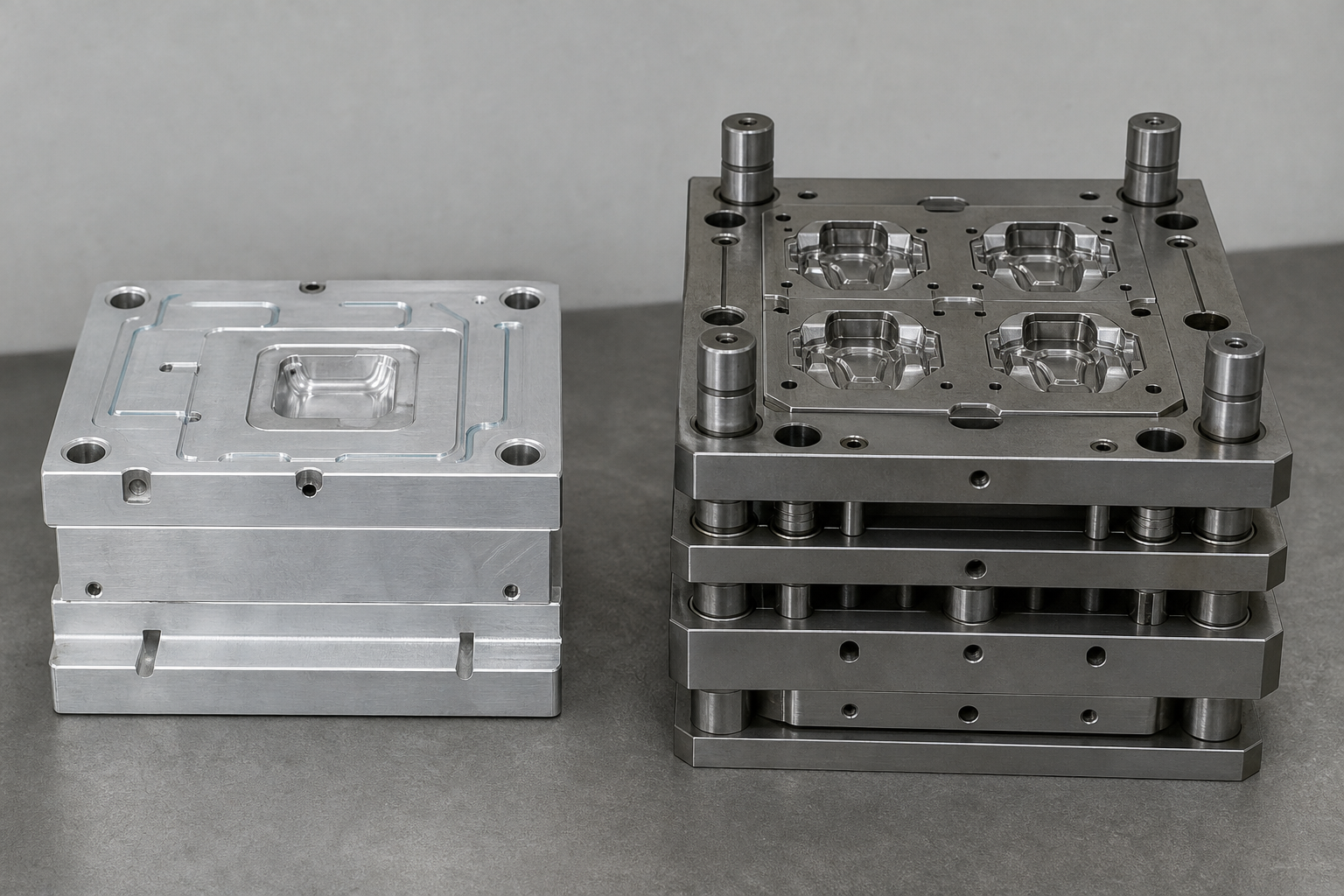
Our injection molding services page describes the tool routes and the molding stages themselves, including what each route is for; this page does not repeat them, because the question here is which stage you are in and what has to be true before you leave it.
What Has to Be True Before You Cut a Production Mold
Short answer: the features the tool will lock in must have stopped changing, and the part must have been re-reviewed as a molding design rather than as a machined one. Those are two separate checks, and passing the first does not imply the second.
The part has to be re-designed for molding, not just re-quoted
A part machined from plastic stock and a part molded from the same resin are not the same part. Machining imposes almost none of the constraints that molding imposes, so the geometry that was optimal for the mill is rarely the geometry that molds well.
| Item | How CNC left it | What molding requires you to settle |
|---|---|---|
| Wall thickness and ribs | Chosen for what can be cut from stock. | Sections uniform enough to fill and cool without sink marks or warp; ribs and bosses resized so they do not locally thicken the wall. |
| Draft | Not needed — vertical walls machine perfectly well. | A release angle on every face that runs in the direction of draw, or the part cannot be ejected. |
| Undercuts and side holes | Drilled or milled directly, no constraint beyond reach. | Side actions, lifters or a design change. Each one adds tooling complexity, cost and maintenance. |
| Internal corners | As sharp as the cutter allows. | A radius the tool can cut and the melt can flow around; very tight corners concentrate stress and can starve the far side of the cavity. |
| Tolerances and datums | Held by the machine, feature by feature. | Held by molding plus a datum scheme. Check whether the same critical dimensions are achievable, or whether some must be molded oversize and finished by CNC. |
| Resin specification | A machinable stock grade, often uncoloured. | A molding grade with a defined colour, filler content and shrinkage behaviour, recorded on the drawing. |
| Appearance | Tool marks, or a brushed or as-machined finish. | Cavity texture, gate witness and parting line all become visible features of the product and must be agreed up front. |
| Shrinkage and warp | Not a consideration. | Predicted from the resin and wall design, then verified on trial samples against the datum scheme. |
The dimensions that mattered most are the ones to re-check first. The critical quality characteristics that the machined part held — a bore, an interface, a flatness, a concentricity — are exactly where a process change is most likely to fail. Identify them before the tool is designed, not after the first samples arrive.
Design maturity checklist
- The drawing revision has not changed across at least one full review cycle.
- The critical quality characteristics are identified, and each has an agreed inspection method and acceptance limit.
- The cosmetic faces, texture and permitted gate and parting-line locations are agreed in writing.
- The resin grade, colour and any filler or flame-retardant requirement are fixed on the drawing.
- The volume forecast is signed off by the buyer, not only by engineering — and the basis of the forecast is recorded.
- If the part serves a customer, that customer has accepted the change of process, along with any re-approval it triggers on their side.
If any of these is open, the tool is premature, and stage 2 exists precisely so that you do not have to gamble on them.
When You Should Stay with CNC
Short answer: staying on CNC is a decision, not a failure to make one. Several conditions make machining the better route even at volumes that would normally justify a tool.
| Situation | Why CNC stays the better route |
|---|---|
| The design is still being revised | Every revision after the tool is cut is a tool modification with its own cost, lead time and re-validation. Machining absorbs revisions that a mold cannot. |
| The volume is real but the timing is not | If the demand is expected in two years rather than two quarters, the tool sits idle while you carry its cost. Waiting can be the cheaper decision. |
| The part needs a property the resin cannot deliver in a mold | Machining from a high-performance stock grade, a filled compound or a composite can reach combinations of stiffness, temperature resistance and precision that a molding grade of the same family may not. |
| The required tolerances are tighter than the process | Where a critical feature has to hold a tolerance that molding cannot hold repeatably, the molded part may still need a CNC finishing operation — which changes the economics. |
| The part is large or very thick-walled | Slow cooling, sink and warp can make molding either impractical or unstable; machining may simply be the honest answer. |
| Total demand is small | Below the break-even, the tooling is a cost you never recover. Machining has no such fixed commitment. |
| Supply continuity matters more than unit cost | An established machining route is a known quantity. If the programme cannot tolerate a qualification period, the saving may not be worth the disruption. |
A useful test: ask what would have to change for the answer to flip. If the honest answer is “a much larger forecast”, and nobody can put a date or a buyer against that forecast, you have your answer for this year — keep machining and re-run the calculation when the demand becomes contractual.
What Must Be Validated Before You Switch
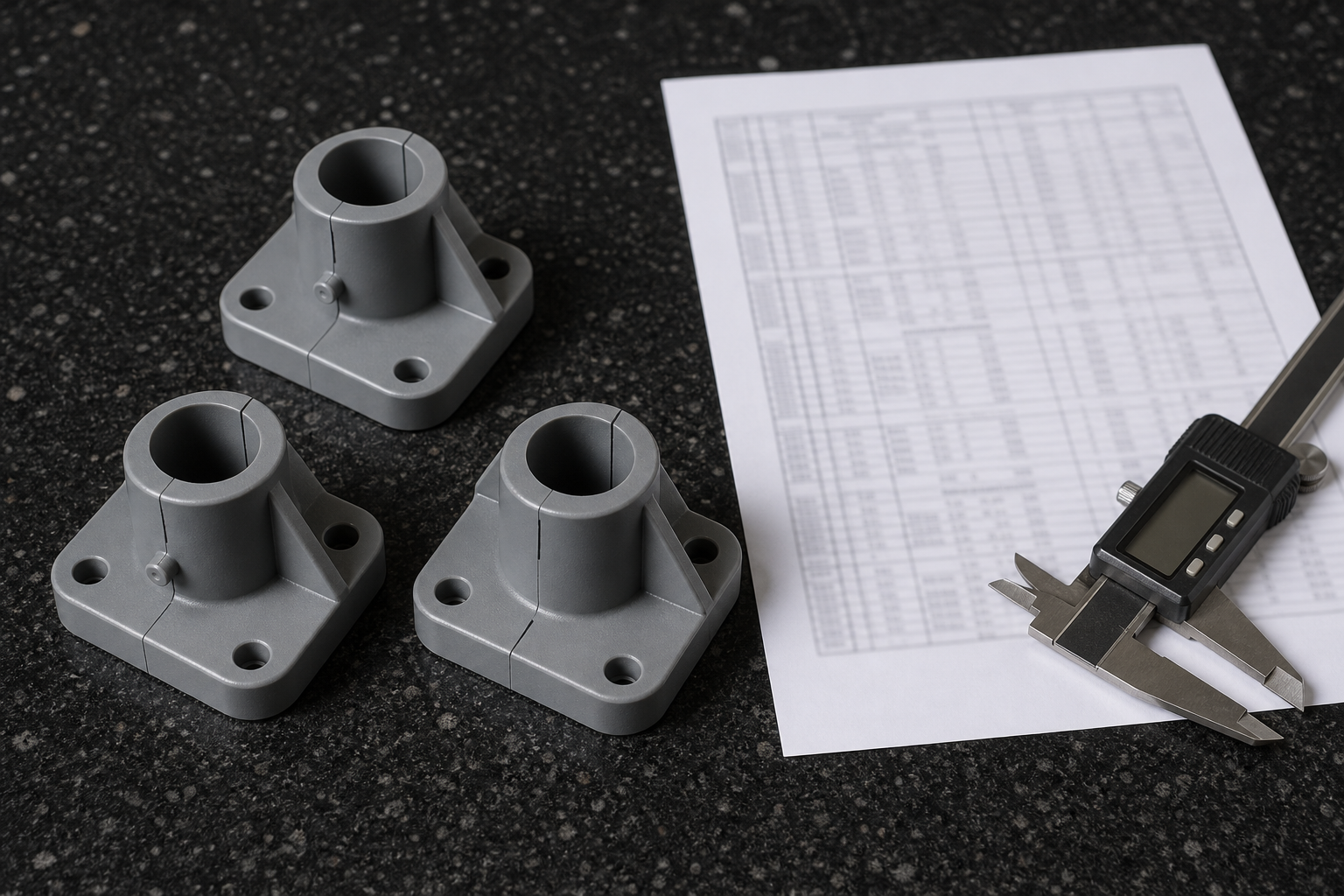
Short answer: validate the characteristics that the machined part used to guarantee for free. Molding changes how they are produced, so each one has to be re-established on real molded samples before volume transfers.
| What to validate | What you are actually checking |
|---|---|
| Mounting and interface dimensions | That the part still assembles with what it has to assemble with. These are usually the true critical characteristics, and the ones a process change threatens first. |
| Warpage against the datum scheme | That flatness, parallelism and position hold across the part and across the run, not just on the sample that was measured. |
| Assembly fit | That the molded part functions in the assembly, ideally by building a few units rather than by comparing dimensions alone. |
| Appearance and cosmetic faces | Gate witness, parting-line position, flow and weld lines, sink and texture, measured against what was agreed rather than against what looks acceptable on the day. |
| Material confirmation | That the resin actually used matches the grade, colour and filler specified, with the certificate or batch record to support it. |
| Process stability | That the samples at the end of the run look like the samples at the start. A single good shot proves nothing about the process. |
| Secondary operations | That any trimming, machining, drilling, marking or assembly step after molding achieves its tolerance on molded, not machined, blanks. |
Agree the acceptance criteria and the number of permitted trial rounds before the tool is built. If the criteria are written after the samples arrive, they will be written around whatever the samples happen to be.
Planning the Transition Without Disrupting Supply
Short answer: run the two routes in parallel until the new one has proved itself, and budget for that overlap. The most common transition failure is not a bad tool — it is a gap in deliveries while the tool is being fixed.
- Do not dismantle the CNC route on the day the mold arrives. Keep it capable of covering at least the first production batches, and keep the fixtures and programming intact until molding is stable.
- Build a buffer before you switch. Stock built on the known route is cheaper than an air shipment after a delayed tool.
- Change one variable at a time. If the supplier, the material or the drawing changes at the same moment as the process, a problem in the samples cannot be attributed to anything.
- Phase the part number, not the whole programme. Transfer the lowest-risk part first, and let it prove the route before the critical ones follow.
- Agree who releases the switch. Someone on the buying side has to be able to say “not yet” without it being read as obstruction.
- Secure the tool asset early. Ownership, custody, maintenance and transfer terms of the mold should be settled before the tool is cut, because they determine how easily you can ever move the work.
Carry the overlap cost into the business case. For one or two quarters you are paying for both routes at once — the machining hours you have not yet released and the molding cost you have started paying. It is a real cost, it belongs in the calculation, and it is small compared with the cost of missing a delivery.
What to Send for a Cost Review
Short answer: send the part, the current cost, and the forecast — and say when you would need to switch. A cost review without a horizon can only produce a range, not a recommendation.
| Item | What to include |
|---|---|
| Part definition | 3D CAD and 2D drawing with the current revision clearly identified. |
| Current process | How the part is made today, on what equipment, and the material and stock form you buy. |
| Current cost | Your present CNC unit cost or an actual quote. Without it, there is nothing to compare the molded cost against. |
| Volume | Annual demand, expected total demand over the programme, and how firm each figure is — contracted, forecast or speculative. |
| Timing | The date you would need molded parts in your hands, and whether an interim or bridge quantity is acceptable. |
| Critical characteristics | The dimensions and interfaces that must not fail, with their tolerances and inspection methods. |
| Cosmetic requirements | Visible faces, permitted gate and parting-line locations, texture and colour. |
| Documentation | Any customer, industry or market documentation the part must satisfy, and who is responsible for it. |
| Commercial terms | Expected order pattern, delivery location, packaging requirement and Incoterms. |
If you have already been quoted for tooling elsewhere, include it. Comparing two tooling quotations is far more useful than comparing one against nothing — and if the scope behind them differs, that is exactly what the review should surface.
Frequently Asked Questions
When should I switch from CNC machining to injection molding?
Switch when three conditions hold at the same time: the design has stopped changing, repeat demand is credible rather than hoped for, and the saving per part recovers the tooling investment inside the production horizon you actually expect. There is no piece count that decides this on its own.
Is there a break-even quantity for switching to injection molding?
There is a break-even point for your part, but not one for the industry. It depends on your tooling cost, your current CNC unit cost, the molded unit cost you are quoted and your accumulated volume. Published switch quantities range widely because they assume different tool routes, part sizes and cost structures.
How do I calculate the break-even point for a mold?
Break-even quantity equals total one-time molding cost — mold, trial and validation, and expected maintenance — minus any one-time CNC setup cost, divided by the difference between the CNC unit cost and the molded unit cost. It is only meaningful when the two unit costs are quoted on the same scope and the denominator is positive. The estimator above runs exactly this calculation.
What is bridge tooling and when does it make sense?
Bridge tooling is a lower-investment tool, often aluminum, used to produce molded parts before a production tool is justified. It makes sense when repeat demand looks credible but the design or annual volume is not yet frozen, or when you need real molded samples for validation. It is a separate route from a production tool and is normally quoted with a shorter build and a higher per-part cost.
Can a metal CNC part be switched to plastic injection molding?
No. A metal part cannot simply be switched to plastic injection molding. Moving from aluminum, stainless steel or titanium to a thermoplastic changes strength, stiffness, thermal behaviour, wear resistance and often the product design itself, so it is a re-engineering project rather than a process change — and it may instead point to die casting, metal injection molding or powder metallurgy.
What has to be validated before I switch to molding?
Validate the critical characteristics on molded samples from the trial tool: mounting and interface dimensions, warpage against the datum scheme, assembly fit, appearance against the cosmetic requirement, material confirmation and process stability across the run. Agree the acceptance criteria and the permitted number of trial rounds before the tool is cut, not after.
How do I compare a CNC quote with an injection molding quote?
Normalize both to the same scope first, then compare accumulated cost over the same quantity. Include tooling, trial and validation, secondary operations, inspection, packaging, freight and the cost of a design change. Comparing a CNC unit price against a molded unit price directly is what makes tooling look unaffordable when it is not.
What information do you need for a CNC-to-molding cost review?
Send the 3D CAD and 2D drawing with revision, the current material and process, your present CNC unit cost or quote, the annual and total forecast volumes, the date you would need to switch, the critical quality characteristics, the cosmetic and material requirements, and any customer or market documentation you must satisfy.
Where Each Subject Lives on This Site
This page covers the decision to switch. The subjects below are covered in depth elsewhere, and are linked rather than restated here.
| Subject | Where to read it |
|---|---|
| Comparing machining, molding and 3D printing as processes | CNC Machining vs Injection Molding vs 3D Printing |
| When injection molding is the right choice, and the tool routes | When Should You Choose Injection Molding? |
| Machining capability, materials and tolerances | CNC Machining Services |
| The full cost breakdown behind a molded part price | Total Cost of Ownership |
| Mold construction, steel selection and trial stages | Injection mold manufacturing |
| Resin and metal data sheets | Materials |
| Certification and quality system status | Quality Certifications |
Send the part, the current cost and the forecast
If you already machine the part and want to know whether a mold is justified, send the drawing with your present CNC unit cost and your volume forecast. We will run the break-even against your numbers and tell you if staying on CNC is the better answer.
What this page does and does not claim
- This is a decision framework, not an offer. The worked example uses the stated illustrative assumptions and is labelled as such; it is not a quotation for any part.
- No switch quantity is presented as a universal threshold, because the result depends on your inputs. Where you see a quantity anywhere, check the tool route and the cost assumptions behind it before you use it.
- The estimator returns an estimate from the fields you enter. It excludes the items listed beneath it, and it is not a substitute for a quotation against a real part.
- Where this page touches a subject our other pages own in depth — tool routes, molding stages, the full cost breakdown — it links to them rather than restating them, so that both pages give one answer.
- Content is reviewed before publication and carries a revision date below.