Family Mold vs. Separate Molds: Which Is Better for Your Project?
A decision guide for B2B buyers: when a family mold (one tool, several different parts) beats separate molds (one tool per part), what each approach does to total program cost, and the engineering realities that decide the answer.
At a glance
Neither approach wins universally. A family mold consolidates several different parts into one tool, which lowers the number of tools you buy and can reduce one-time tooling cost. Separate molds cost more per tool but keep volumes, schedules, revisions and downtime independent. The right choice is the one with the lower total program cost for your volumes — and that is decided by volume match, schedule independence, revision likelihood and the engineering feasibility of runner balance and cooling, not by the tooling price alone. The practical move: ask your supplier to quote both configurations on identical scope, then compare the full program, not the tooling line.
Three tooling approaches that get confused
Buyers often use “family mold” and “multi-cavity mold” as if they were the same thing. They are not. The distinction matters because the two tools solve different problems and carry different risks — and the family-vs-separate question only makes sense once the terms are apart.
One tool, different parts
Cavities for several different parts sit in one tool. Each cycle produces one of every part, so the parts are always molded together and consumed in matched ratios.
One tool, the same part
Several cavities of the same part sit in one tool. Each cycle produces multiple identical parts. This is the classic volume play — a separate decision from family tooling.
One tool per part
Each part gets a dedicated tool. Every part is produced, scheduled, revised and maintained independently of the others.
Family mold vs. separate molds, head to head
The honest comparison does not run on the tooling invoice. It runs on the dimensions below — because a lower tooling number can still be the more expensive program once ratios, downtime and revisions are counted.
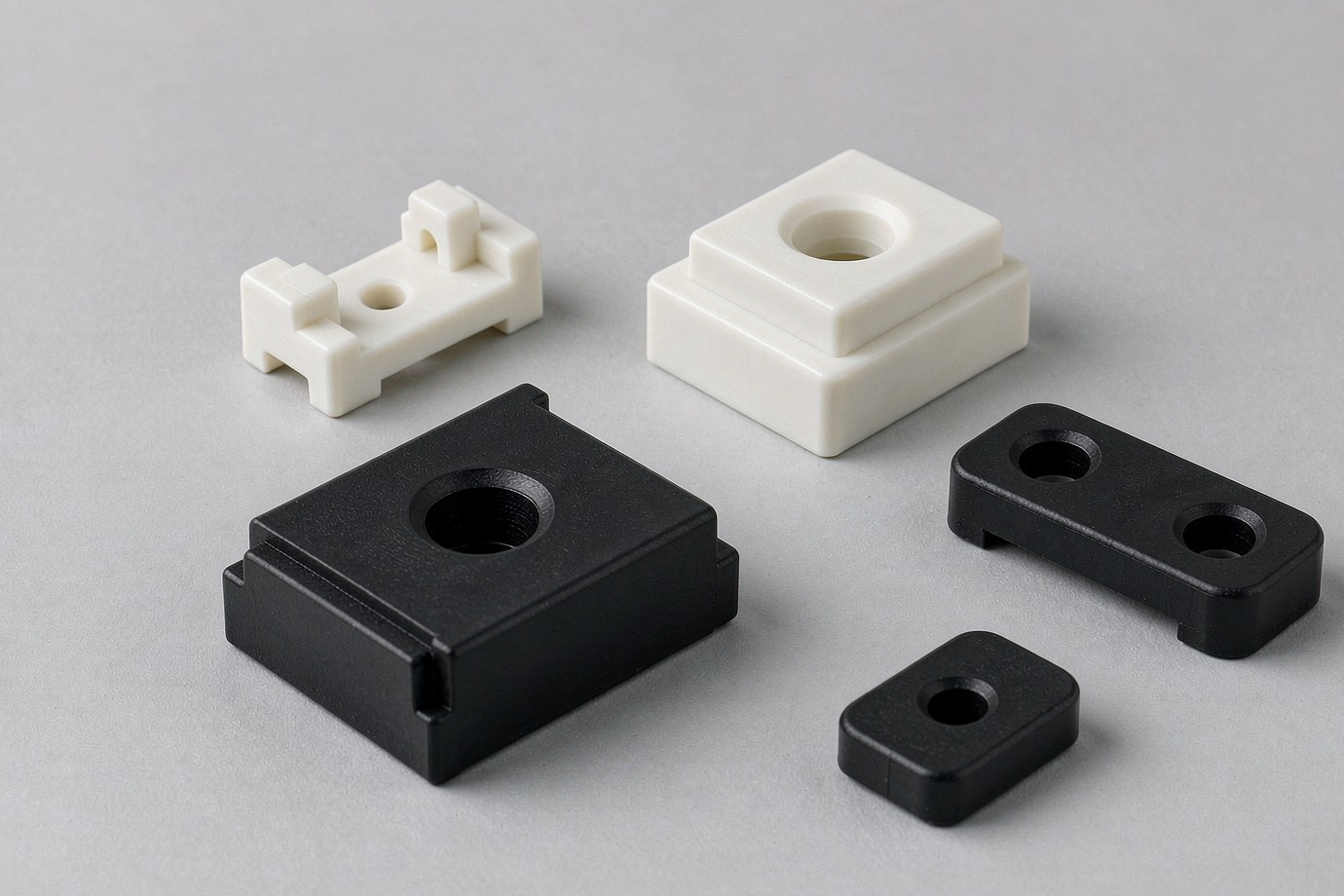
A family tool is also the harder tool to build. Balanced runners, uniform cooling and matched cavity geometry all have to be solved inside one block of steel, and the result is proven at trial. For how that work is done, see our mold making process in China.
Compare total program cost, not the tooling price
Tooling is a one-time line. The program runs for years. The worked example below uses invented numbers to show the shape of the calculation — the point is the structure of the comparison, not the figures.
The tooling difference is banked once. The coupling effects repeat every year the program runs. Which side wins depends on your program, not on the tooling price alone.
Two further points belong in the same comparison. First, per-part molding cost is broadly similar between the approaches for small parts on the same press, so the recurring side of the program rarely reverses a large tooling difference on its own — the coupling effects above do the reversing. Second, inventory behaves differently: a family tool produces its parts in fixed ratios, so any demand drift turns into stock, while separate tools produce to order. For the tooling price side of this comparison — steel, cavity count, runner systems — our injection mold cost guide breaks down what a quote includes and how to compare quotes on the same basis.
The engineering realities of family molds
A family tool is one tool solving several parts’ problems at the same time. Five issues decide whether it can do that well — and all five are visible at the design stage, before steel is cut.
Runner balance
Every cavity must fill at the same moment under the same pressure. Different part shapes mean different fill requirements, so an unbalanced runner leaves some parts short while others flash — and the problem often appears only at higher cycle speeds, not at first trial.
Cooling uniformity
Different geometries need different cooling. One cooling circuit serves every cavity in the tool, so thick sections and thin sections in the same family can end up with different cycle times, different shrinkage and different dimensional results.
Cavity-to-cavity variation
Parts molded in the same tool can still differ from cavity to cavity. A family tool needs the dimensional spread between parts controlled, not just the spread within one part — which raises the inspection scope at first article and in production.
Shared tool life and downtime
The shot count governs all cavities at once, so a high-wear part shortens service life for the whole set. And because all parts share one tool, a single cavity problem — a blocked gate, a damaged insert — stops every part, not one.
Revision coupling
A design change to one part means rework or a re-cut of that cavity, re-balancing of the runner, and re-validation of every part molded from the tool. Early-stage programs with likely revisions carry this cost repeatedly.
What good looks like
A feasible family tool shows balanced fill at simulation and at trial, controlled cavity-to-cavity dimensions in the first-article report, a cooling design matched to the part mix, and written revision terms before production starts.
When a family mold fits — and when separate molds do
Most programs land clearly on one side once volumes, schedules and revision risk are written down. The lists below are the pattern that experience supports, not a rule that overrides your program data.
A family mold tends to fit when
- Parts are small relative to the tool size, so cavities pack efficiently
- Annual volumes are similar and stable, consumed in matched ratios
- Parts ship together in one assembly or kit
- The design is frozen or close to it
- Launch volume is low and the tooling budget is the constraint
- Storing and maintaining many tools would be a burden
Separate molds tend to fit when
- Volumes differ widely, or grow at different rates
- Parts ship on independent schedules or to different lines
- Revisions are likely during the first year
- Parts need different resins, colors or additives
- One part is high-volume and dominates demand
- A quality issue must be isolated to a single part
A middle path is common. Bridge or soft tools can carry launch validation, with production family or separate tools committed once volumes and schedules are proven; some programs start separate and consolidate later, others do the reverse. Both moves re-quote the tooling, so treat the tooling plan as a staged decision rather than a one-time bet. For the tooling options behind each path — cavity layouts, steel choices, runner systems — see our custom plastic injection mold capabilities.
A decision method you can run before you request quotes
Six steps put the family-vs-separate question on data instead of preference. Run them before you request formal quotes, so the quotes you receive are comparable.
- List every part with its annual volume, resin and shipping schedule. Matched ratios and synchronized schedules are the raw material of the family case.
- Group the parts that must ship together and share a resin. Flag any part whose volume, schedule or resin differs — each flag is an argument for a separate tool.
- Ask shortlisted suppliers to quote both configurations on identical scope: mold design, steel grade, runner system, trial rounds, correction rounds, inspection and reports.
- Compare total program cost — tooling plus molding plus inventory plus downtime plus revision risk — not the tooling line alone.
- Confirm engineering feasibility with the supplier: runner balance, cooling design, ratio match, tool size and press fit. A family tool that cannot be balanced is not a saving.
- Decide, then write the terms — revision handling, downtime response, mold ownership and storage — into the contract before payment.
What to send your supplier
The package below lets a supplier return both configurations with reasoning, not just two prices. The same list appears in request form on our injection molding quote page.
- 3D CAD for each part (STEP preferred) and 2D drawings with critical dimensions and tolerances marked.
- Resin grade, color and additives per part — different resins in one family tool are usually a separate-tool signal.
- Annual volume per part, plus the first-order quantity and whether volumes are expected to diverge.
- Schedule independence — do the parts ship together, or on separate orders to separate lines?
- Design freeze status and expected revision likelihood during the first year.
- Target tool life, surface requirements and any industry documentation you need (for example first-article inspection reports).
- Delivery location or Incoterms, so tooling and molding can be quoted on the same commercial basis.
FAQ
What is a family mold?
What is the difference between a family mold and a multi-cavity mold?
Are family molds cheaper than separate molds?
When should I use a family mold?
When should I use separate molds?
What is runner balance and why does it matter in a family mold?
Do family molds affect part quality?
What happens if one part in a family mold needs a design change?
Can I start with separate molds and consolidate into a family mold later?
What information does a supplier need to advise on family vs. separate molds?
How we approach the family-vs-separate question
We have no interest in selling you the larger tool. When buyers ask us to compare the two configurations:
- We quote both configurations on request, on identical scope — mold design, steel grade, runner system, trial and correction rounds, inspection and reports — so the comparison is apples-to-apples.
- We state the assumptions behind every tooling number: cavity count, steel, runner system, tool life and surface scope.
- We check runner balance, cooling and ratio match before recommending a family tool — a family tool that cannot be balanced is not a saving.
- Mold design, machining, assembly and trial are performed in-house under one ISO 9001:2015 system; some surface finishing is handled by qualified partners under our quality control.
Send the part list, resins and annual volumes, and we will return both configurations with the reasoning — including a plain recommendation when separate tools are the lower-risk choice.
Get a tooling strategy review for your part set
Send your 3D CAD files, resin grades and expected annual volumes. We will review whether your parts suit a family tool or separate tools — and quote the recommended configuration against the agreed specifications.
Get a Tooling Strategy ReviewDesign not final yet? Share the current geometry and volumes, and we will flag what still needs confirmation before a fixed tooling price is possible.