Custom plastic components for home organization and storage products, manufactured from drawings or samples — container components, lids, drawer dividers, trays and modular connection parts. Each project is evaluated against its dimensional interfaces, material requirements, part geometry and production volume, with particular attention to repeatable fit, stackability and dimensional consistency across production runs.
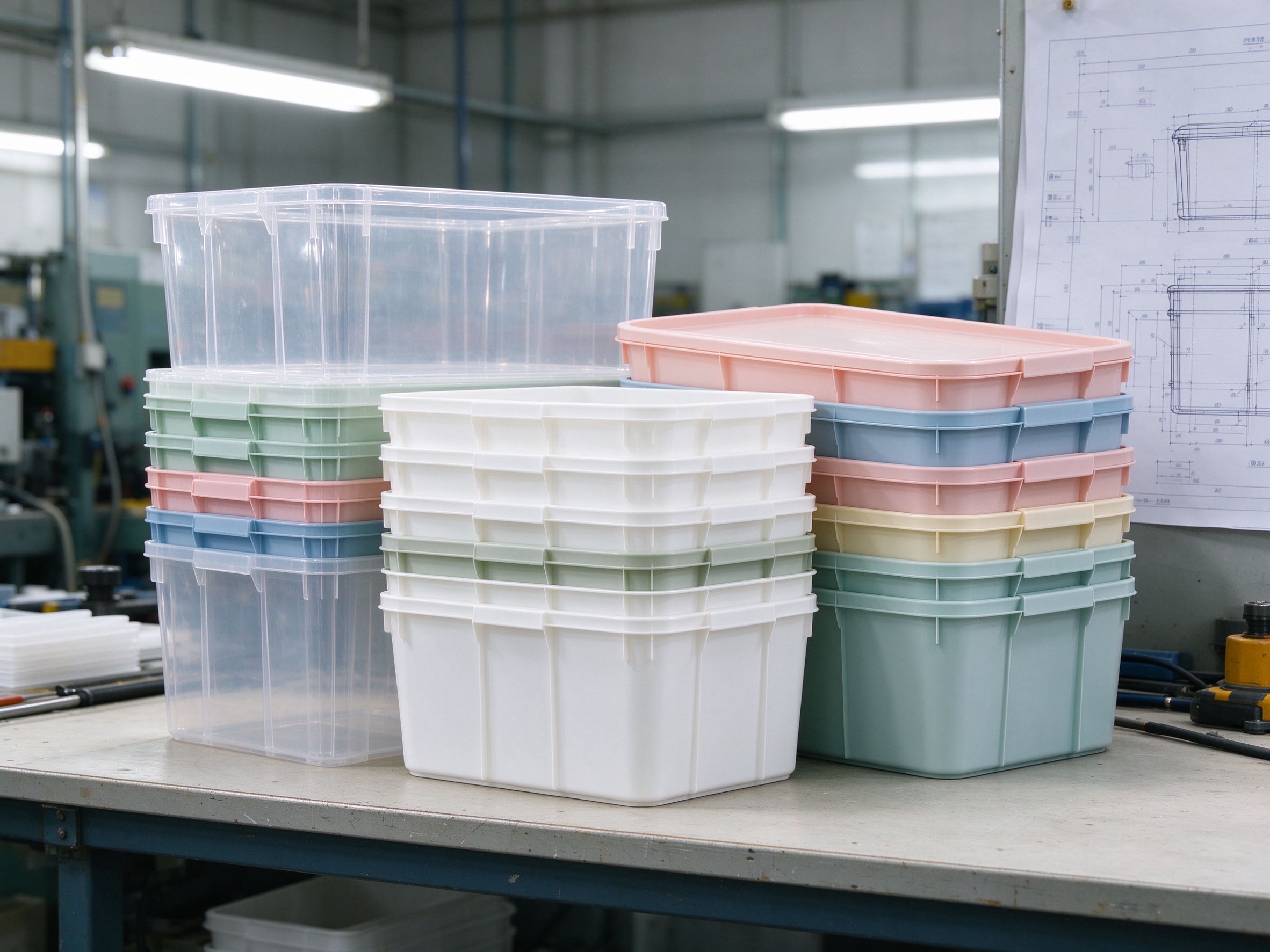
Goldcattle manufactures plastic components for home organization products to your drawings or samples — bins, lids, dividers, trays and modular connection parts — with engineering review centered on stackability, lid fit, modular interfaces and batch-to-batch dimensional consistency. Material choice, wall thickness, draft, shrinkage and tooling strategy are assessed per project, and inspection covers the dimensions that make assembled products work. This is a custom component page for OEM projects, not a retail catalog of finished organizers.
Home Organization Components We Can Evaluate
Storage bins & container components
Stacking ribs, side-wall geometry, handles and base features. Wall thickness and stiffness are balanced against material use.
Lids & closures
Seal and snap geometry, hinge details where applicable, and fit against the container rim under shrinkage and batch variation.
Drawer dividers & inserts
Slot and rail interfaces, dividers with controlled fit, dimensional stability for repeated insertion and removal.
Modular organizer components
Connection features, alignment bosses, clip or snap joints that keep modules aligned across a product series.
Clips, handles & connection parts
Snap-fit clips, handles, hinge pins and fastening features, with deflection and retention assessed per geometry.
Each category is evaluated against the actual project. Finished retail products, retail packaging and consumer sales are outside the scope of this page — the service is drawing- and sample-based component manufacturing.
Designed for Stackability, Fit and Repeatability
Home organization parts fail in use most often through stacking instability, lid mismatch or drifting dimensions between batches. These five areas are the review focus:
| Technical concern | What is confirmed |
|---|---|
| Stacking & modularity | Stacking structure, mating dimensions, key interfaces and tolerance approach for stable stacking and side-by-side connection |
| Lid & assembly fit | Clearance, shrinkage effect, snap geometry and sample verification — not first-shot fit only |
| Stiffness & material use | Material selection, wall thickness and rib layout to hold stiffness without excess weight |
| Appearance & color | Cosmetic surface definition, color panel confirmation, mold texture and acceptance standard for sink marks, warpage and color difference |
| Production stability | Material batch control, mold maintenance, first-article inspection, dimensional records and drawing revision management |
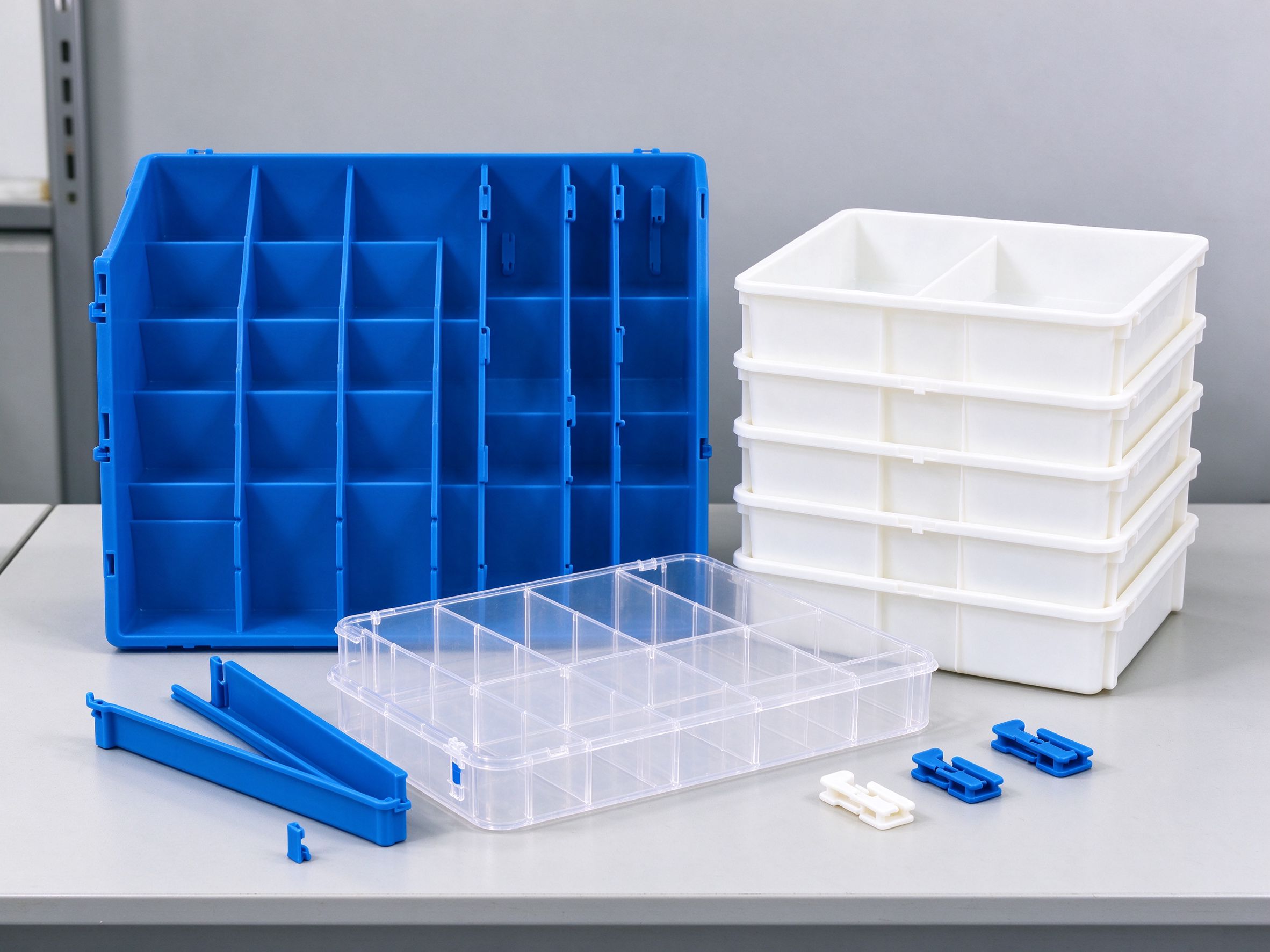
Material Options for Home Organization Parts
Resin choice follows stiffness, impact, transparency, detergent resistance, cost and the molding route. The table is a starting direction, not a confirmed supply list for every grade.
| Material | Considered use | Factors to check |
|---|---|---|
| PP | Bins, lids, selected clips, drawer dividers | Stiffness, shrinkage, warpage, dimensional stability, service temperature |
| ABS | Components needing good stiffness and appearance, handles, structural parts | Material cost, impact requirement, surface quality, chemical contact |
| PS | Rigid storage parts where appearance or transparency matters | Specific grade, brittleness, impact, crack risk |
| PET / other transparent resins | Transparent or see-through storage components | Transparency, impact, molding route, surface defects, actual processability |
| TPE / TPU | Non-slip, flexible cushioning, soft-touch or partial overmold | Hardness, wear, deformation, bond to the substrate, secondary molding need |
Transparent storage parts are not assumed to fit injection molding in every geometry. Large, thin-wall or fully transparent products may need thermoforming or another route — the capability boundary is confirmed against equipment, structure and material before quoting.
Mold Design and DFM Considerations
- Wall thickness & ribs — transitions and rib layout influence stiffness, sink marks and warpage.
- Draft & deep cavities — side-wall geometry affects ejection, appearance and production stability.
- Lid-to-body fit — shrinkage, assembly clearance and batch consistency are reviewed together, not first-article only.
- Family molds — matching lids and containers can run in one family mold where the project allows, with cavity balance, maintenance and matched production quantities evaluated.
- Inserts & connection parts — metal clips, fasteners or added parts are reviewed for insert molding, post-mold assembly or another suitable route.
Dimensional Inspection and Repeat Production
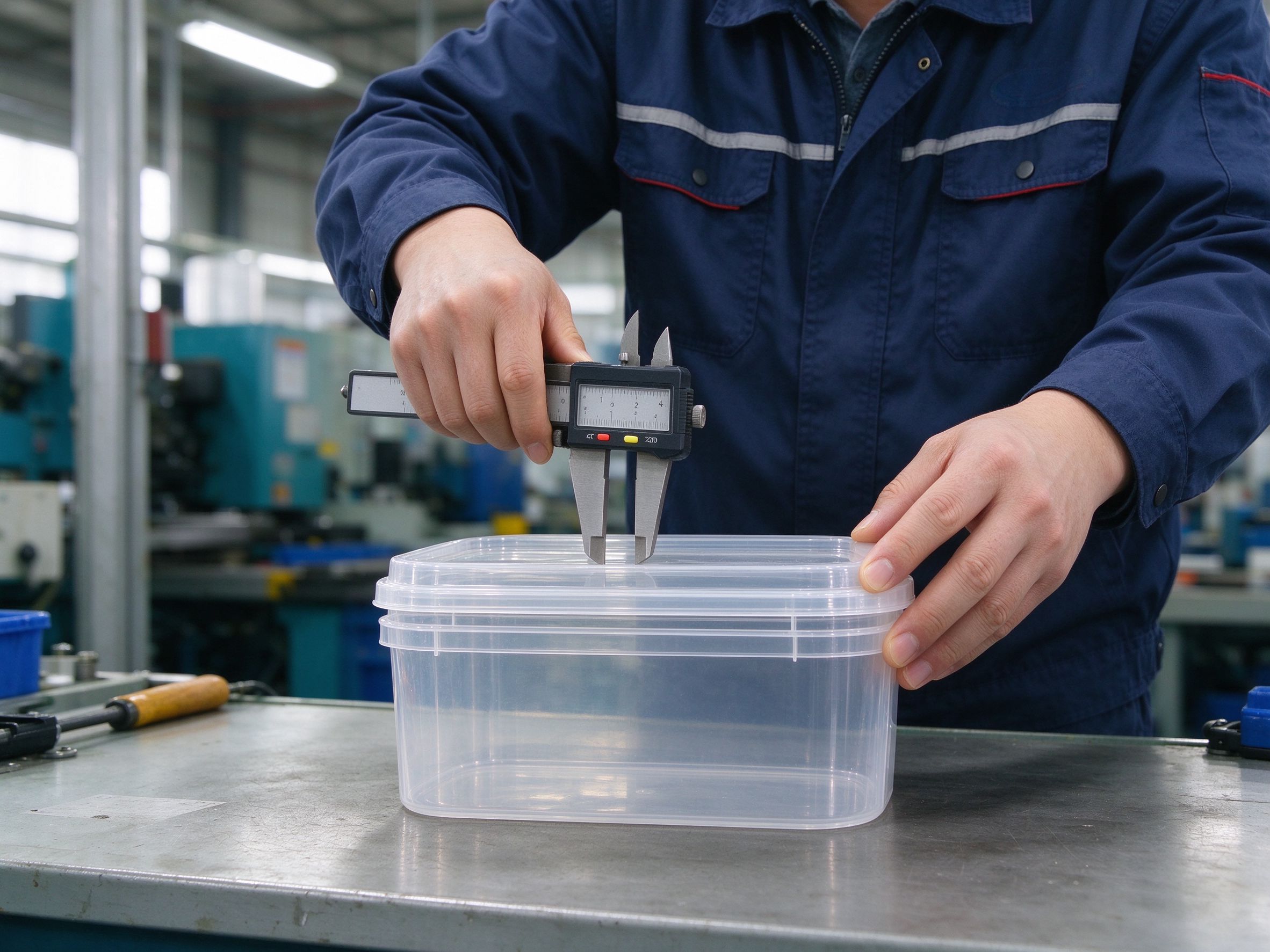
- Critical-dimension checks per the agreed inspection plan — fit, stacking interfaces and lid geometry first
- First-article confirmation on approved samples, material identity and appearance
- Mold maintenance and drawing revision management for repeat orders
- Material and color batch records so later orders match the approved state
- Segregated packaging, set assembly and scratch protection per order agreement
Only inspection items the company can actually execute and record are promised. For nested or stackable products, packaging volume and shipping efficiency are evaluated as part of the order, not as a fixed saving claim.
What to Include in Your RFQ
| Information | Why it matters |
|---|---|
| 3D CAD / 2D drawing or sample | Geometry, interfaces, critical dimensions |
| Key dimensions & assembly requirements | Lid fit, stacking interfaces, modular connections |
| Material & color | Resin grade, color panel and surface requirement |
| Quantity / annual volume / SKU count | Single-cavity, multi-cavity or family mold decision |
| Appearance & cosmetic standard | Visible-surface defects, texture and color acceptance |
| Packaging & set configuration | Divided packing, set assembly, scratch protection |
| Special test requirements | Food-contact or other designated testing scoped per project |
| Target delivery date | Project schedule |
Food-contact components are only claimed where the material and documentation basis actually exists — EU food-contact rules (such as Regulation (EC) No 1935/2004 and, for plastic food-contact materials, Regulation (EU) No 10/2011) are applied per end use and sales market, not as a blanket statement for all parts.
Frequently Asked Questions
Can you manufacture custom plastic components for home organization products?
What information is needed to quote injection-molded storage components?
How do you control the fit between storage containers and lids?
Which plastic material is suitable for stackable storage bins?
How do wall thickness and draft affect storage product quality?
Can family molds be used for matching lids and containers?
How do you maintain dimensional consistency across repeat orders?
What should buyers specify for colors, surface finish and packaging?

Request a Home Organization Components Quote
Send the drawing or sample, key dimensions, material and color, quantity and SKU count, cosmetic standard and packaging requirements. The review covers stackability, lid fit, mold strategy, inspection scope and repeat-order consistency.
Xiamen Goldcattle · Manufacturing since 1998 · Injection mold making and custom injection molding · Related: custom plastic components →