
PEEK is subtractively machined by milling, turning, drilling and boring. But PEEK is not just "plastic you cut like metal."
Its low thermal conductivity, residual stress, material cost and sensitivity to fixturing mean successful PEEK machining depends on controlling heat, stress, tooling and dimensional stability — not on simply running a cutter.
Quick AnswerCan PEEK Be CNC Machined?
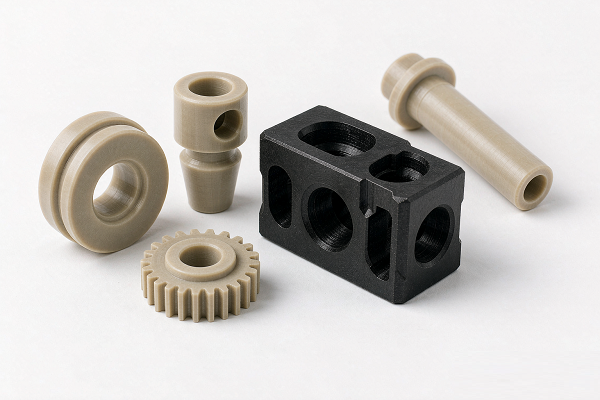
Yes. PEEK (polyetheretherketone) is CNC machined from rod, plate and tube stock using milling, turning, drilling, boring and related subtractive processes. It is a high-performance semi-crystalline thermoplastic, so it machines cleanly when the process is controlled.
The reason this page exists is the second half of the question: can PEEK hold my tolerance, stay dimensionally stable, and be made cost-effectively? Those depend on grade, geometry, fixturing, heat management and inspection — not on a single "yes/no" about the material.
* Confirm against Goldcattle's actual production capability for your part and grade.
OverviewPEEK CNC Machining at a Glance
What a buyer needs to know before requesting a PEEK quote.
| Requirement | What Buyers Need to Know |
|---|---|
| Can PEEK be CNC machined? | Yes — by milling, turning, drilling, boring |
| CNC axes | 3 / 4 / 5-axis, depending on geometry* |
| Typical tolerance | Drawing-specific; quoted per feature |
| Tight tolerance | Up to ±0.005 mm on qualified features*, subject to grade, size, strategy, fixturing and inspection |
| Materials | Virgin / carbon-filled / glass-filled / modified PEEK* |
| Surface finish | Machined / polished / application-specific |
| Inspection | Dimensional inspection / CMM where required* |
| Production | Prototype → low volume → production* |
FeasibilityWhy Can PEEK Be CNC Machined?
PEEK is a semi-crystalline high-performance thermoplastic that can be cut from solid stock into finished geometry. Four properties make it a viable, and often necessary, CNC material:
High Mechanical Strength
PEEK carries loads that defeat common engineering plastics, which is why it is specified for structural, sealing and wear components.
High Temperature Performance
Continuous-use temperature around 250 °C is a common reference for unfilled PEEK, but the exact value depends on grade and duty. Always confirm against the material supplier's data sheet for your application.
Chemical Resistance
Suitable for chemical equipment, semiconductor handling, fluid systems and demanding industrial environments where many plastics degrade.
Dimensional Stability
PEEK can be machined to high precision — but "can be precision-machined" does not mean "every PEEK part is naturally stable." Stability is the result of grade selection, stock conditioning and process control.
The real challengeWhy Is PEEK Difficult to CNC Machine?
This is the professional core of the page. PEEK is machinable, but five factors separate a good PEEK part from a warped one.
Heat Buildup
Low thermal conductivity traps cutting heat at the tool edge, raising smear and melt risk if not controlled.
Residual Stress
Stress inside the stock can release as material is removed, causing movement after machining.
Thermal Expansion
Dimensions shift with temperature, so a stable process and measurement conditions matter.
Fixturing
PEEK is softer than metal; clamping force and support must prevent deflection without marking.
Tool Wear
Carbon-filled and glass-filled PEEK are abrasive and increase tool wear versus virgin stock.
Material selectionWhich PEEK Grade Should You CNC Machine?
Specifying "PEEK" is not enough. The grade, filler and intended application change machinability, cost and performance. ISO 23153-1:2020 defines a designation system for PEEK moulding and extrusion materials covering unmodified, filled and reinforced variants — so always state the exact grade and filler.
Virgin PEEK
UnfilledEasiest to machine. Best for chemical resistance, electrical insulation and general precision parts.
Carbon-Filled PEEK
e.g. CF30Higher stiffness and wear resistance, better dimensional stability — but more abrasive, so tool wear rises.
Glass-Filled PEEK
e.g. GF30Added stiffness and dimensional stability. Also more abrasive than virgin PEEK; tooling must suit.
Bearing-Grade PEEK
Self-lubricatingLow friction and wear for bushings, wear rings and sliding components.
Medical / App-Specific
Documented onlyOnly where a certified grade and evidence exist. Ordinary PEEK is not automatically "medical-grade."
PEEK Grade Comparison
| Grade | Main Advantage | CNC Consideration | Typical Applications |
|---|---|---|---|
| Virgin PEEK | Balanced performance | Easier machining | Insulators, precision parts |
| CF30 PEEK | High stiffness / strength | More abrasive | Structural parts |
| GF30 PEEK | Stiffness / stability | Higher tool wear | Fixtures, mechanical parts |
| Bearing-grade | Low friction / wear | Grade-specific parameters | Bushings, wear rings |
| Medical-grade | Application-specific compliance | Documentation critical | Medical devices* |
ProcessHow Is PEEK CNC Machined?
A controlled sequence reduces residual-stress movement and heat-related defects. Whether annealing or a rest period is needed depends on grade, stock condition, geometry and tolerance.
* Annealing temperature and time follow the specific material supplier's recommendation — not a single fixed formula applied to all PEEK.
PEEK CNC Milling
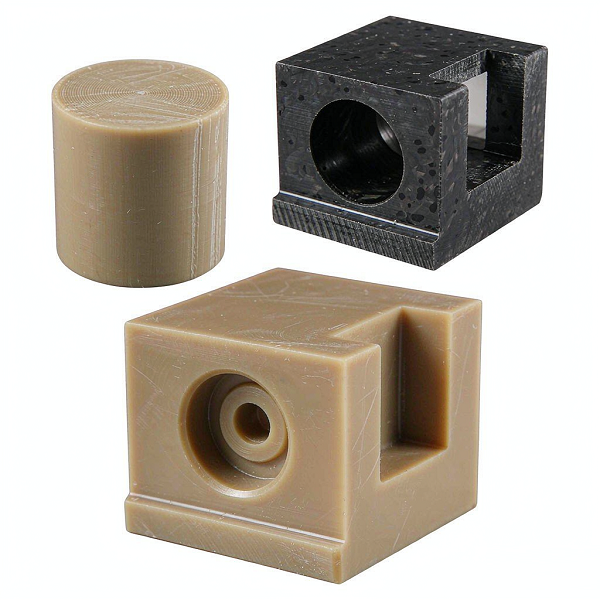
Sharp tooling, heat control, chip evacuation, controlled clamping and a finishing pass are the keys to clean walls and good surfaces.
PEEK CNC Turning
Ideal for shafts, bushings, rings, sealing components and cylindrical precision parts on bar or tube stock.
PEEK Drilling and Threading
Heat evacuation and chip clearance protect bore quality and thread integrity; controlled drilling avoids cracking in filled grades.
Stress controlDoes PEEK Need Annealing Before CNC Machining?
Annealing or a rest period can reduce residual-stress movement, especially in thick sections or tight-tolerance parts. Whether it is needed depends on grade, stock condition, geometry and tolerance. When used, follow the material supplier's recommended temperature and time rather than a generic rule.
PrecisionCan PEEK Be CNC Machined to Tight Tolerances?
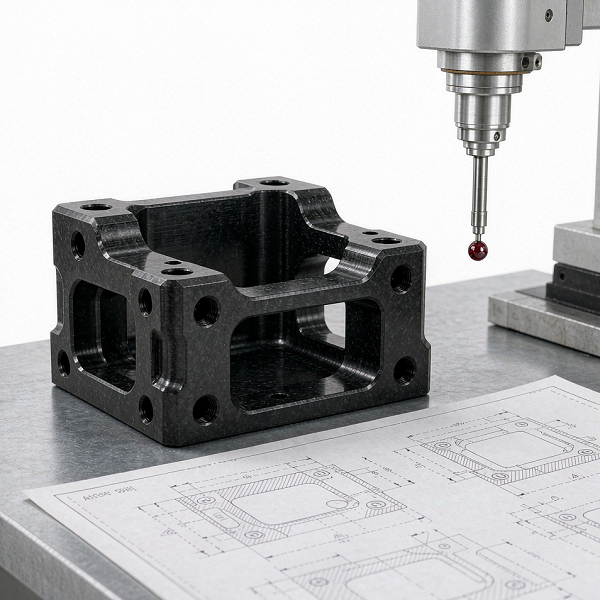
Yes — PEEK can be machined to tight dimensional tolerances. But achievable tolerance must be evaluated by feature, material grade, geometry, size, wall thickness, machining sequence and inspection method. There is no PEEK grade that guarantees ±0.005 mm on its own.
What Determines PEEK CNC Machining Accuracy?
| Feature | Key Risk |
|---|---|
| Thin wall | Deformation |
| Large flat part | Thermal / residual-stress movement |
| Deep bore | Heat / tool deflection |
| Small hole | Heat / chip evacuation |
| Bearing fit | Dimensional stability |
| Sealing surface | Flatness + surface finish |
| Multi-side feature | Setup alignment |
Related: Tight-Tolerance CNC Machining covers how tolerance is quoted and held across materials.
ComparisonPEEK vs Metal: When Does PEEK Make Sense?
| Requirement | PEEK | Metal |
|---|---|---|
| Low weight | ✓ | △ |
| Corrosion resistance | ✓ | Depends |
| Electrical insulation | ✓ | ✗ |
| High temperature | ✓ | ✓ |
| High stiffness | △ | ✓ |
| High strength | △ | ✓ |
| Chemical resistance | ✓ | Depends |
| Wear resistance | ✓ | Depends |
ComparisonPEEK vs POM vs Nylon vs PTFE
Before specifying PEEK, confirm a lower-cost engineering plastic would not meet the requirement. PEEK is rarely the cheapest option.
| Property | PEEK | POM | Nylon | PTFE |
|---|---|---|---|---|
| Temperature capability | Very high | Moderate | Moderate | High |
| Chemical resistance | Excellent | Good | Moderate | Excellent |
| Stiffness | High | High | Moderate | Low |
| Wear performance | Excellent | Good | Good | Excellent |
| Cost | High | Low | Low–Moderate | Moderate–High |
| CNC machinability | Good with control | Good | Good | Challenging |
Right-sizingDo You Really Need PEEK?
If the part sees low temperature, a simple chemical environment, low load and no special electrical or wear demand, a common engineering plastic such as POM, Nylon, PC or PPS may be more economical.
Process choiceCNC Machining vs Injection Molding PEEK
| Factor | CNC Machining | Injection Molding |
|---|---|---|
| Prototype | ✓ | △ |
| Low volume | ✓ | △ |
| No dedicated mold | ✓ | ✗ |
| Design changes | ✓ | ✗ |
| High volume | △ | ✓ |
| Tooling cost | Low | High |
| Material utilization | Lower | Higher |
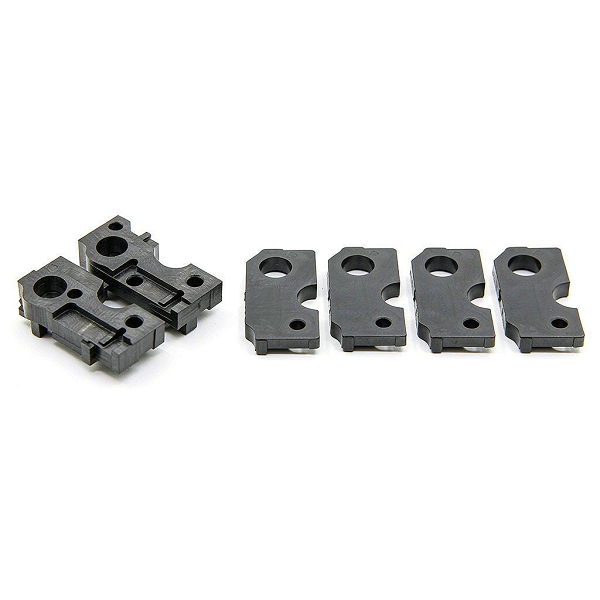
For low-volume or frequently changing PEEK parts, CNC avoids a dedicated mold. At high stable volume, molding can become cheaper. See also CNC vs 3D Printing and PEEK Injection Molding.
Process choiceCNC vs Injection Molding vs 3D Printing for PEEK
| Requirement | CNC | Injection | 3D Printing |
|---|---|---|---|
| 1–10 pcs | ✓ | ✗ | ✓ |
| 10–100 pcs | ✓ | △ | ✓ |
| 100–1,000 pcs | ✓ | ✓ | △ |
| Tight tolerance | ✓ | △ | △ |
| Complex geometry | ✓ | ✓ | ✓ |
| Design changes | ✓ | ✗ | ✓ |
| Mold investment | None | High | None |
| Material traceability | Strong | Strong | Process-dependent |
Where it's usedWhere Is CNC-Machined PEEK Used?
* Medical, implant-grade, biocompatibility or sterilization claims must be supported by the specific material grade and certification evidence, not assumed from "PEEK."
Part typesPEEK CNC Machined Parts
DefectsCommon PEEK CNC Machining Problems
| Problem | Why It Happens | Prevention |
|---|---|---|
| Warping | Residual stress / heat | Conditioning + controlled machining |
| Melting / smearing | Excess heat | Tool + cutting control |
| Burrs | Tool condition | Sharp tooling |
| Cracking | Stress / drilling | Controlled drilling |
| Dimensional drift | Thermal effects | Stable process + inspection |
| Fiber exposure | Filled-grade machining | Proper tooling |
| Poor surface finish | Tool wear / heat | Tool and parameter control |
DesignDesign Tips for CNC-Machined PEEK Parts
- Avoid unnecessary thin walls; they amplify residual-stress movement.
- Identify critical dimensions so tolerance effort goes where it matters.
- Avoid excessive deep pockets that trap heat and chips.
- Use appropriate radii to reduce stress concentration and tool load.
- Consider thermal movement in the design and measurement plan.
- Allow enough stock for a finishing pass after roughing.
- Specify material grade, filler content, surface finish and inspection requirements on the drawing.
QualityPEEK Material Certification and Traceability
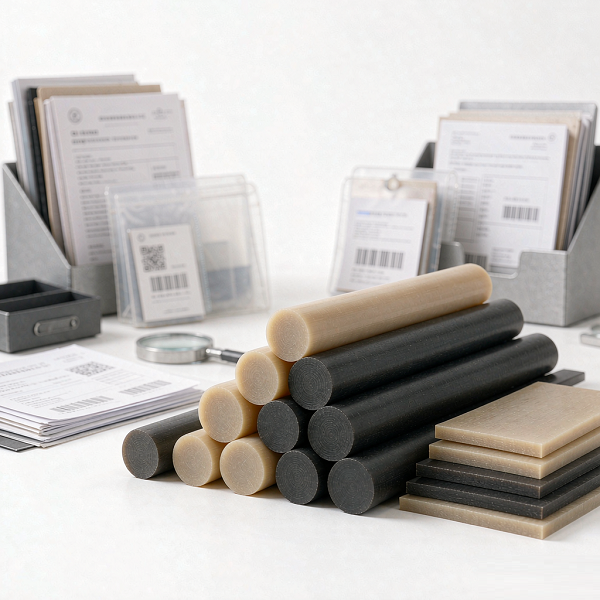
For medical, semiconductor and aerospace buyers, traceability matters more than "we use premium PEEK." The chain runs:
Because ISO 23153-1:2020 covers unmodified, filled and reinforced PEEK designations, the drawing should state grade, filler and application requirements — not a generic "PEEK."
QualityPEEK CNC Quality Control
PEEK is not treated as ordinary plastic. A documented control chain protects grade, dimension and finish:
| Stage | What is checked |
|---|---|
| Material Verification | Grade, filler, batch, certificate |
| Incoming Inspection | Stock condition vs spec |
| Machining Inspection | In-process critical features |
| CMM (where appropriate) | 3D dimensional verification |
| Surface Finish | Per drawing requirement |
| Final & Traceability | Full record to batch |
EvidencePEEK CNC Machining Case Studies
Generic capability examples — final values are confirmed against the actual project, drawing and inspection report.
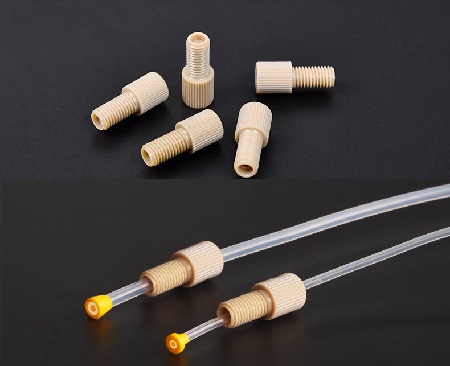
Case 01 — Precision PEEK Bushing
- Grade
- Virgin PEEK
- Process
- CNC Turning
- Critical
- Bore / OD
- Tolerance
- Quoted per feature
- Inspection
- Dimensional + cert
- Application
- Industrial wear part
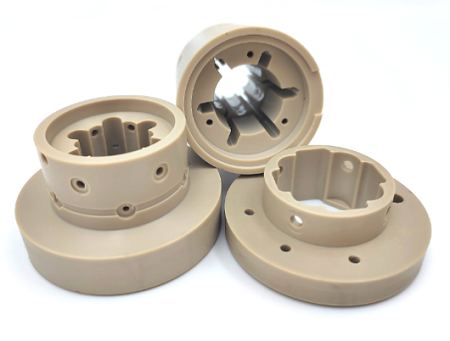
Case 02 — CF30 PEEK Structural Part
- Grade
- CF30 PEEK
- Process
- 5-axis CNC
- Challenge
- Abrasive grade + complex geometry
- Control
- Tooling + finishing strategy
- Inspection
- CMM where required
- Application
- Structural component
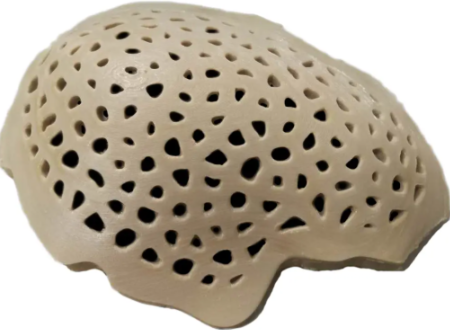
Case 03 — Application-Specific PEEK Part
- Grade
- Per requirement*
- Process
- Milling / turning
- Requirement
- Confirmed vs spec
- Surface
- Per drawing
- Inspection
- Documented
- Application
- Medical / semiconductor*
* Medical / semiconductor claims are included only where the grade and certification evidence support them.
CommercialHow Much Does PEEK CNC Machining Cost?
PEEK raw material is substantially more expensive than common engineering plastics, so total cost is driven by more than the unit price of stock. Main cost drivers:
| Cost Driver | What affects it |
|---|---|
| PEEK Material | Grade, filler, stock form, cert level |
| Machining Time | Geometry, wall thickness, feature count |
| Tool Wear | Filled grades increase consumption |
| Programming | Complexity, setups, 5-axis paths |
| Annealing / Conditioning | Required for stress control |
| Inspection | CMM, critical-dimension checks |
| Surface Finishing | Polishing, application-specific |
DecisionShould You CNC Machine Your PEEK Part?
SupplierWhy Choose Goldcattle for PEEK CNC Machining?
| Capability | Goldcattle |
|---|---|
| PEEK grades | Virgin / carbon-filled / glass-filled / modified* |
| CNC milling | 3 / 4 / 5-axis |
| CNC turning | Available |
| Tight tolerance | Up to ±0.005 mm on qualified features* |
| Surface finish | Machined / polished / application-specific* |
| Material traceability | Grade / batch / certificate* |
| Inspection | Dimensional / CMM where required* |
| One-stop | CNC + injection + 3D printing + finishing |
* Each capability is confirmed against the specific part, grade and project scope — not assumed across all PEEK parts.
FAQFrequently Asked Questions
Can PEEK be CNC machined?
Yes. PEEK is machined by milling, turning, drilling and boring from rod, plate or tube stock. Success depends on controlling heat, residual stress, fixturing and tooling.
Is PEEK difficult to machine?
It is machinable but more demanding than common plastics: low thermal conductivity traps heat, residual stress can cause movement, and filled grades wear tools faster.
Can PEEK be milled and turned?
Yes. Milling handles complex geometry and pockets; turning suits shafts, bushings, rings and cylindrical precision parts.
Can PEEK be drilled?
Yes, with attention to heat evacuation, chip clearance and controlled feed to avoid cracking in filled grades and to protect bore quality.
What tools are used to machine PEEK?
Sharp carbide tooling with appropriate geometry and cutting control is typical; filled grades need tooling suited to abrasiveness. Exact parameters are grade- and part-specific.
Why does PEEK warp during machining?
Residual stress released during stock removal and heat accumulation are the usual causes. Conditioning and a controlled rough/finish strategy reduce it.
Can PEEK be machined to ±0.01 mm or ±0.005 mm?
Tight tolerances are achievable on qualified features, evaluated by grade, geometry, size, wall thickness, strategy and inspection — not guaranteed by the material alone. See Tight-Tolerance CNC Machining.
Which PEEK grade is best for CNC machining?
Virgin PEEK is easiest and suits most precision/electrical/chemical parts. CF30/GF30 add stiffness and wear resistance but are more abrasive. Choose by function and spec.
Is carbon-filled PEEK harder to machine?
Yes — fillers increase abrasiveness and tool wear, so tool selection and parameters are adjusted accordingly.
Is CNC machining cheaper than PEEK injection molding?
For low volume or changing designs, CNC usually wins because there is no mold. At high stable volume, molding can become cheaper.
When should PEEK be CNC machined instead of injection molded?
When volume is low, the design changes, lead time matters, or tight machined features are required without a dedicated mold.
Is PEEK suitable for medical components?
Only where a certified grade and evidence support the claim. Ordinary PEEK is not automatically medical- or implant-grade; confirm the specific material and documentation.
Can PEEK be used for semiconductor components?
Yes — PEEK's chemical resistance, dimensional stability and insulation make it common for wafer-handling and vacuum fixtures, subject to grade and cleanliness requirements.
Can you provide PEEK material certificates and CMM reports?
Grade, batch/lot and material certificate can be traced through production, and dimensional inspection including CMM is provided where applicable. Confirm specifics per project.
ClusterRelated Guides
Request a PEEK CNC Machining Review
Send your PEEK grade, drawing, quantity and critical tolerances. We can review whether CNC machining, injection molding or another route is the most appropriate for your part.
One-stop OEM/ODM since 1998 — CNC, injection molding, 3D printing and finishing.