Injection Molding · Chemical Duty
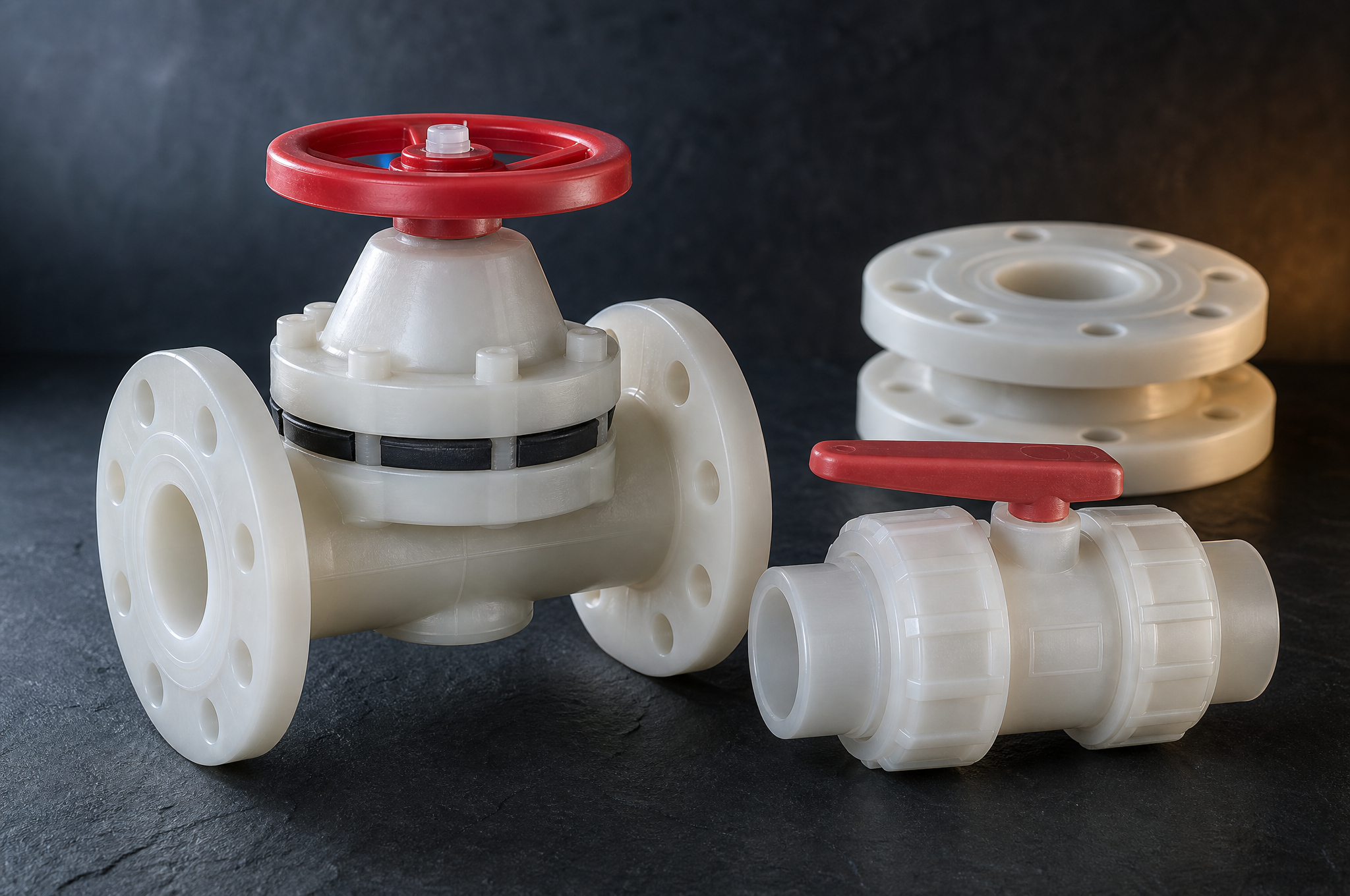
Chemical-Resistant Plastic Injection Molding
Chemical resistance is not a property of a plastic. It is the result of one medium at one concentration, at one temperature, in one contact mode, under one level of stress, for one length of time — and it stops being true when any of those five moves. A part specified by material name alone has been specified by habit.
This page covers how a chemical-duty part is defined, molded and accepted. It does not publish a compatibility matrix, and it does not repeat the process envelope, tolerance bands or tooling workflow that already sit on the injection molding services page.
What This Page Decides, and What It Refuses To
Short answer
There is no such thing as a chemical-resistant plastic. There is a part, a medium, a temperature and a stress, and a result that holds for that combination for as long as it was tested. Everything useful about this subject follows from taking that sentence seriously.
The question buyers usually send is which plastic resists sulfuric acid? It cannot be answered as asked, and any supplier who answers it in one line has answered a different question. The answerable version is narrower and much more useful: will this part, in this geometry and this resin, hold its dimensions, its seal and its strength for the service life required, at this concentration and temperature, while carrying this load?
That version has a real answer, and it can be reached in a defined order: define the exposure, screen the resin families against it, design the part so the weak points are not in the medium, mold it inside a window that produces the properties the resin was chosen for, and then prove the result at the level the risk justifies. This page is that order, chapter by chapter.
It deliberately does not cover the process envelope — clamp range, wall range, published tolerance bands, tooling lead times — because those are the same for a chemical-duty part as for any other and they already live on their own page. It does not repeat the electronic-housing material discussion, the thin-wall packaging interfaces or the prototype-to-production gates, all of which have pages of their own and are linked at the end.
Why there is no compatibility matrix on this page. A matrix borrowed from a resin supplier is untraceable: the buyer cannot see which grade, which specimen, which temperature or which pass criterion produced the cell. A matrix of our own would imply we had tested every cell, which would not be true. Neither is worth publishing. What is worth publishing is how to read someone else's matrix honestly, which resin families are worth screening first, and what a part-level test has to contain to mean anything.
What a Compatibility Chart Actually Tells You
Short answer
Each cell is the outcome of one test, on one specimen, at one set of conditions. If those conditions are not printed next to the cell, the cell is a rumour with a color on it.
Chemical resistance tables circulate freely, and they are not dishonest — they are just compressed. The compression removes exactly the information a part designer needs. Several things vary between one published table and the next, and each of them changes the answer.
| What the table shows | What the test behind it usually was | What it does not tell you |
|---|---|---|
| An "A" or "resistant" cell | An unstressed specimen held in the medium for a stated period, then checked for mass change, dimension change, appearance or retained strength | Which of those four was measured, what the pass limit was, and whether the specimen was under any load |
| A "B" or "limited" cell | Some measurable change, judged acceptable for some uses and not others | Which property degraded, by how much, and over what period the change continued |
| A "C" or "not recommended" cell | Visible attack, or a property loss large enough to fail the tester's criterion | Whether the limit is a hard chemical limit or an economic one — the difference decides whether a different grade of the same family would pass |
| A blank cell | Usually untested, not incompatible | Anything. A blank is an absence of data, and treating it as a "no" is as wrong as treating it as a "yes" |
| A cell with a footnote | Often a caveat such as stress cracking, discoloration or a concentration limit | Whether the caveat applies to your temperature and your stress. Usually it does |
The immersion standards behind most of these tables — ISO 175 and ASTM D543 are the two common families — allow the tester to choose the duration and the property measured. A 24-hour test, a one-week test and a four-week test are all legitimate outcomes of the same standard, and they do not produce the same rating. This is why two suppliers can send you two charts that disagree about the same polymer and the same chemical, and both be correct.
The second discount is more important than the first. Those specimens are unstressed. A molded part is almost never unstressed: it carries frozen-in orientation from filling, tensile stress from ejection, hoop stress around an insert, preload from a bolt, and pressure from the medium. Environmental stress cracking is the failure mode that lives in exactly that gap, and it is the mode a compatibility chart is least able to predict. The chapter on stress cracking below takes it apart.
How to use a chart without being misled. Use it to generate a shortlist and nothing else. Then ask the resin supplier for the grade-specific data and the test conditions in writing — medium, concentration, temperature, duration, specimen stress state and pass criterion. A supplier who cannot produce those conditions for their own cell has published a color, not a result. Treat every cell without conditions as unknown, and put the unknown into the test plan rather than into the quotation.
The Five Numbers That Define the Exposure
Short answer
Chemical identity with concentration, temperature, contact mode, duration and mechanical stress. Change one of them and the answer can change; leave one of them out and the answer is a guess with a material name attached.
Almost every failed chemical-duty project can be traced to one of these five being vague in the enquiry, and the vagueness surviving into the drawing. What each one has to be pinned down to is not complicated, but it has to be written down. A sixth input — the cleaning regime — is treated separately in the next chapter but one, because it is missed so often that it deserves its own chapter.
| Parameter | What to state | What goes wrong when it is vague |
|---|---|---|
| Chemical identity and concentration | The chemical name, the concentration in % or g/L, and whether the fluid is a mixture, a formulation or a process stream whose composition changes | "Acid" covers a pH 3 rinse and a 30% oxidising acid, which are not the same exposure at all |
| Temperature | Operating temperature, maximum temperature, and whether the part sees thermal cycling or a hot start-up | Data taken at room temperature is applied to a line running at 70 °C, where attack and stress relaxation both run faster |
| Contact mode | Continuous immersion, intermittent splash, washdown spray, vapor, condensate, or a sealed space where vapor collects | The part is tested immersed and installed where it only ever sees vapor — or the reverse |
| Duration and duty cycle | Continuous hours per year, and the number of cleaning or empty-and-refill cycles over the service life | A 24-hour test is used to justify a ten-year life, with nothing in between |
| Mechanical stress | Internal pressure, bolt preload, insert hoop stress, press fits, spring loads, and whether the part carries load while wet | The chemical suitability is checked and the stress state is not, which is the combination that cracks parts |
On temperature, be careful with extrapolation. Chemical attack is a rate process, so it speeds up as temperature rises, and the factor is specific to the polymer, the medium and the mechanism. That is why a rating at 23 °C cannot be scaled to 60 °C by intuition, and why a supplier quoting a room-temperature result for a hot line has told you something true but not useful. Thermal cycling adds a second effect: absorption on the hot side and desorption on the cool side pump the medium in and out of the surface, and each cycle leaves a little more residual strain behind.
On concentration, do not assume a straight line. A 5% solution and a 50% solution are two different exposures, not one exposure at ten times the strength. The direction of the change depends on the polymer and the chemical: dilution can reduce attack, leave it roughly unchanged, or in some pairs make it worse by changing which phase or which additive is being attacked. The only safe statement is the one tied to a test condition.
On mixtures, expect the unexpected. A surfactant lowers surface tension and wets cracks and interfaces that water alone would not enter, so a detergent blend can be harder on a part than either of its components. A solvent plus water can be more aggressive than the solvent alone where the solvent carries the water into the polymer. Formulated products should be specified as the formulation, not reduced to their main ingredient.
Contact Mode: Immersion, Splash, Vapor and the Sealed Enclosure
Short answer
Immersion is the easiest condition to specify and often not the real one. The cases that get missed are the ones where the part is not in the liquid: vapor inside a sealed housing, condensate on the coolest surface, and permeation through a thin wall to whatever is on the other side.
| Contact mode | What it demands of the part | The mistake it invites |
|---|---|---|
| Continuous immersion | Resin, wall, seal and permeation all matter; the part is at the medium's temperature, not the room's | Specifying from an immersion test and then installing the part where it also sees vapor and air, which is a different exposure |
| Intermittent splash and washdown | Cyclic wetting and drying, and thermal shock on each cycle | Testing only in the bath. As the liquid evaporates, residue concentrates on the surface, so the dried film can be more aggressive than the bath it came from |
| Vapor inside a sealed space | Vapor migration, then condensation on the coolest internal surface — often a window, a lid or a metal part | Assuming the part in the liquid is the part at risk. The part that fails is usually elsewhere in the same enclosure |
| Permeation through a wall | Wall thickness as a membrane property, and compatibility of whatever sits behind the wall | Checking the resin against the medium and not checking the adhesive, label, gasket or second plastic that the medium reaches next |
| High-pressure spray or steam | Mechanical erosion plus thermal load plus chemical attack at the same time | Treating it as a chemical question when the surface is also being physically removed |
The neighbouring-material problem. In an assembly, attack sometimes comes from a material rather than from the process. Plasticiser or antioxidant migrating out of a soft gasket, a PVC cable jacket or a foam seal can craze a rigid transparent part that never touched the process chemical. A solvent-based adhesive can attack the substrate it was used to bond. A release agent or a mold cleaner left on the surface can do the same thing. If a part fails and the medium checks out, the next question is what else is in the box.
A practical instruction for the drawing. Write the contact mode on the drawing as a note, not only in the email. “Wetted surfaces: continuous immersion, 30% H2SO4, 55 °C, 6 bar. Non-wetted surfaces: acid vapor in sealed enclosure.” Two sentences do more for the part than a page of material data, because they tell the molder which faces are allowed to be different.
The Exposure Nobody Writes Down
Short answer
In a large share of chemical-duty projects the medium that eventually fails the part is not the process chemical. It is the cleaner. Cleaning agents are frequently hotter, more concentrated and applied more often than the product itself, and they are almost never in the enquiry.
A CIP loop is a chemical process that runs on a schedule. Caustic at one or two percent and 70–80 °C circulates for twenty or thirty minutes, then an acid descaler, then a rinse, and it repeats every night for the life of the plant. That is not a secondary condition — over ten years it is several thousand cycles of hot alkali, thermal shock and mechanical load, and it will find a stress-cracked boss long before the process fluid does.
The list of exposures usually missing from an enquiry looks like this: the CIP caustic and its temperature; an acidic descaler; a sodium hypochlorite sanitiser; alcohol or ketone wipes; an adhesive or label-removal solvent; an ultrasonic bath with an alkaline detergent; steam sterilization. Each is a different chemistry at a different temperature, and several of them attack polymers that the process fluid does not touch.
The SDS describes the product being made. The cleaning procedure describes what the part actually meets. Where the SOP does not exist in writing, the four questions that recover it are: which agent, at what concentration, at what temperature, and how often. Those four answers change resin shortlists more often than the medium does.
A part that is compatible with the product and not with the cleaning regime is a part that will pass commissioning and fail within a year. That failure is usually expensive, because it arrives after the plant is running.
The Shortlist, and What Each Candidate Costs You
Short answer
Five melt-processable families cover most chemical duty. Choosing between them is not a ranking — it is a trade of chemical breadth against temperature, toughness, tolerance and price, and the trade is usually decided by whichever requirement is tightest.
| Family | Screen it first when | Where it usually stops | What it asks of the tool and the cycle |
|---|---|---|---|
| PP Polypropylene | The medium is aqueous — dilute acids, bases, salts, many polar solvents — the temperature is moderate and cost matters | Hydrocarbons and chlorinated solvents, which swell it; strong oxidising acids; sustained load at elevated temperature, where creep rather than chemistry sets the limit | Easy to mold and cheap to tool; high and anisotropic shrinkage in filled grades, so dimensions need planning; low mold temperature |
| PE Polyethylene | The same chemistry as PP at lower temperature and lower load: liners, tanks, low-friction parts, covers | Temperature and stiffness. It is softer and creeps earlier than PP, so it is rarely the choice for a threaded or sealing part | Very easy to mold; high shrinkage; poor resistance to tight tolerance |
| PVDF Polyvinylidene fluoride | The medium includes halogens, oxidisers, chlorinated solvents or high-purity fluid, and the part must also hold a dimension | Hot caustic and amines, particularly under sustained stress, where it stress-cracks; ketones and esters, which swell it | Corrosion-resistant barrel and screw, a narrow window, high melt temperature, annealing on stressed parts |
| PPS Polyphenylene sulfide | Temperature is high as well as the chemistry aggressive, and the part needs dimensional stability and low moisture uptake | Strong oxidisers. Unfilled PPS is brittle, so it is normally specified glass or mineral filled, and the filler changes the surface behavior | Hot mold for crystallinity, wear-resistant tool steel for the filled compound, generous venting |
| PEEK Polyether ether ketone | The temperature and the chemistry are both demanding, or steam and repeated sterilization are involved, and the budget allows it | Concentrated oxidising acids and some halogenated solvents; and cost, which is an order of magnitude above commodity resin | A very hot tool, high clamp, tight drying, and a process window that has to be held per lot — the PEEK page publishes the numbers |
Two conclusions from this table are counter-intuitive enough to state plainly. Cheaper is not less capable at the low end: for a dilute aqueous duty at moderate temperature, filled or unfilled PP often outperforms a fluoropolymer on cost per part and equals it on function, because the fluoropolymer's advantage is in chemistries PP never meets. And the more capable family is not automatically the safer choice: PVDF is the broadest of the easily molded fluoropolymers and is also the one with the best-documented stress-cracking failure in hot caustic under load. Capability and margin are different things, and a part that is over-specified in resin but under-designed in geometry can fail where a cheaper, better-designed part would not.
The grade matters more than the family. A 40% glass-filled PPS and an unfilled PPS are different materials for chemical duty: different surface, different toughness, different weld-line behavior, different data. The same is true of a flame-retardant package, a UV stabiliser, a colorant or an impact modifier — each is a chemical added to the compound, and each can be the thing the medium attacks. When a grade is quoted, quote the full designation, not the family name.
What Reinforcement Changes
Short answer
Glass and mineral fill raise stiffness, cut shrinkage and stabilise dimensions. They also change the failure mode rather than simply improving it, and in chemical duty three of those changes work against you.
- Fiber ends at the surface become wicking paths. A molded surface over a filled compound is not a continuous skin; fiber ends sit at or just below it, and the interface between fiber and matrix is a route the medium can follow into the wall. That is why a filled grade can absorb faster than the unfilled grade of the same polymer even when its bulk chemical rating is identical.
- Weld lines get worse, not better. At a weld line, fibers orient along the interface and the matrix between them is thin. The line is both weaker and more permeable than the bulk, which is the worst combination in a chemical environment.
- Anisotropy becomes a stress source. Differential shrinkage along and across the flow direction warps the part and leaves frozen-in stress, and frozen-in stress is the raw material of stress cracking.
- Toughness falls. A part that would deform under an impact load instead cracks, and a crack in a chemical environment does not close again.
Two further effects are worth knowing because they are specific to chemical duty. In strong alkali, the sizing and coupling chemistry on a glass filler can itself be attacked, so the composite loses integrity in a medium that the base polymer handles. And on the machine side, a filled compound is abrasive: screw, check ring and hot-runner tips wear, and worn hardware produces inconsistent shot weight, which shows up as dimensional scatter and as weld lines of variable quality.
The rule that saves arguments. Never carry a chemical rating across from an unfilled grade to a filled one, or between two suppliers' "PPS". The base polymer may be the same molecule; the compound is not the same material.
What Cannot Be Molded, and What to Do Instead
Short answer
PTFE is the case that comes up most often. It is close to chemically universal and it is not melt-processable, so it is machined, compression molded or sintered — not injection molded. The melt-processable fluoropolymers are a different specification with different limits, and the difference matters commercially.
A request for “a PTFE part” in a chemical duty usually means one of three things, and they lead to three different routes. If the requirement is inertness with low load and the geometry is simple, PTFE itself is the right answer and the route is machining or compression molding. If the requirement is inertness with a complex molded geometry, the candidate is a melt-processable fluoropolymer, and the substitution has to be reviewed against the medium rather than assumed equivalent. If the requirement is really about temperature or purity and the chemical list is moderate, PPS or PEEK may be the better answer at a fraction of the cost.
Two practical consequences. First, the geometry of a machined PTFE part is not constrained by draft and wall rules, so a design that was drawn for machining may need rework before it can be molded at all — and a molded part that is a direct copy of a machined one often carries a wall that is too thick for the cycle. Second, PTFE creeps under sustained load even at room temperature, so a sealing face designed on the assumption of a stiff polymer will lose its preload; that is a design consequence of the material, not a molding defect.
If your part is currently machined from PTFE or from a PTFE-based compound and you are considering molding it for volume, the review has three questions: does the medium accept a melt-processable substitute, does the geometry survive molding rules, and does the volume justify the tool. Two out of three is usually not enough, and the answer is sometimes to keep machining.
How a Chemical Part Actually Fails
Short answer
It rarely dissolves. It swells, softens, crazes, cracks at a stress raiser or loses a critical dimension — and the first four often look like nothing at all until the fifth one lets go.
| Mechanism | What you see | Where it starts on a molded part | What prevents it |
|---|---|---|---|
| Absorption and swelling | Weight gain, dimensional growth, a seal that begins to weep, a press fit that loosens | Thin walls, seal grooves and anywhere the medium can pool and stay | Wall and groove design that tolerates swell; a mass-change measurement in the test plan; a resin with lower uptake |
| Softening and plasticisation | Hardness and modulus fall, creep accelerates, a loaded boss leans | Loaded bosses, snap fits, screw threads, anywhere a sustained load sits on warm wet plastic | Lower sustained stress, ribs instead of thickness, a less plasticised grade |
| Environmental stress cracking | A brittle crack from a smooth surface, with no visible attack around it, usually weeks or months after installation | Boss roots, ejector marks, gate areas, sharp internal corners, insert boundaries | Radii, lower residual stress, annealing, keeping the stressed feature out of the wetted zone |
| Weld-line separation | A crack exactly along the weld line, often on the face opposite the gate | Opposite a single gate, around core pins, behind a pin or a rib, across a sealing face | Gate position, higher melt and mold temperature, venting, and keeping weld lines off seal faces |
| Surface attack | Chalky bloom, loss of gloss, color shift, etched or fibrous surface, a smell that was not there before | Hot, concentrated or oxidising duty; surfaces left at over-temperature during molding | Grade selection with the right stabiliser, process window discipline, and removing residence-time dead spots |
| Extraction of the additive package | The part becomes brittle; the medium becomes contaminated; a downstream filter clogs | High-purity duty: semiconductors, pharmaceuticals, potable water, food contact | A low-extractable grade, and a test that looks at the medium as well as the part |
Timing is part of the diagnosis. Failures of this kind cluster in a window that starts months after commissioning, not days. A 24-hour immersion result cannot reproduce a mechanism that needs a thousand load cycles and a thousand thermal cycles to open a crack, which is why an accelerated test has to be designed around the mechanism rather than around the calendar. The chapter on evidence covers how that is done and where acceleration stops being honest.
The one measurement worth adding to any test plan. Mass. A balance can see absorption and extraction long before anything is visible, and it can see it on a part that looks perfect. Record the mass before exposure, after exposure and after a defined drying period, and you have separated absorbed medium from extracted additive — two different problems with two different fixes, and a single final weight cannot tell them apart.
Stress Cracking Is a Joint Failure
Short answer
Environmental stress cracking happens when chemistry and stress act together. Remove either one and it stops. It is the mechanism a molder can influence most, because half of the cause is in the tool and the cycle.
The mechanism is crack growth under a sustained stress that is below the level that would fail the part in air, with a medium present. The medium does not have to corrode the polymer in any conventional sense: it plasticises the surface, lowers the energy needed to open a craze, and lets a crack that would otherwise arrest keep going. Amorphous resins are the classic victims, but semi-crystalline resins are exposed too, at weld lines, at notches and at fiber interfaces, where the local structure is not the bulk structure.
That gives an uncomfortable practical consequence: a part can pass a chemical compatibility test and still crack, because the test specimen carried no stress. And it gives a useful one: the cure is usually geometric, not chemical. A radius at a boss root often does more for a part than a more expensive resin.
| Where the stress comes from | Signature on the part | Design or molding fix |
|---|---|---|
| Packing pressure and gate freeze | Cracks radiating from the gate, or a ring of crazing around it; the gate area is over-packed while the far end is under-packed | Gate size and location, a packing profile, and accepting that the gate is a design feature rather than a point on the drawing |
| Ejection | Fine cracks or whitening at ejector marks, on the side away from the core | More ejector area, slower ejection, better draft, and enough mold temperature that the part is not ejected cold and stiff |
| Inserts | A ring crack around the insert, or a split boss | Wall thickness around the insert, a lower interference, warming the insert, and annealing after molding |
| Assembly | Cracks at press fits, self-tapping screws and clip seats, appearing days after assembly | Boss diameter and pilot hole sized for the resin, controlled torque, and no assembly load on a wet part |
| Service load | Cracks at flange roots and around bolt holes, growing from the wetted side | Thicker section at the load path, washers and load spreaders, and a bolt sequence that does not bend the flange |
| Thermal expansion against a constraint | Deformation or cracking at the fixing points after a temperature cycle | Slotted or oversized fixing holes, and a design that lets the part move relative to the frame |
Weld Lines and Gates: Chemical Resistance Is a Tooling Decision
Short answer
Gate position decides where weld lines form, and the weld line is the weakest plane in a molded part. That makes gate position a chemical-resistance decision, not only a cosmetic one.
A weld line is the seam where two flow fronts met. The polymer chains on either side do not fully diffuse across the interface before the melt freezes, so the bond is mechanical rather than molecular. In an unfilled resin that shows up as a strength loss; in a filled resin, fibers lie along the interface and the matrix between them is thin. Either way, the weld line is a plane of lower strength, higher permeability and, if venting is poor, a small V-notch — which is a stress raiser sitting exactly where the medium can reach it.
| Gate arrangement | Where the weld line lands | What that means in chemical duty |
|---|---|---|
| Single gate on a ring or tube | Directly opposite the gate, running along the wall | Acceptable if it lands on a low-stress wall; unacceptable if it lands on the sealing face or on a loaded boss |
| Multiple gates or hot drops on a cover | One or more weld lines across the flat, often near the center | On a gasketed cover this is a potential leak path, and it is where a solvent-wet cover cracks first |
| Gate feeding a boss | The flow wraps the core pin and welds down the boss wall | The worst case: the boss is the loaded feature and the weld line runs through it |
| Gate on a flange | The weld line crosses the flange face or the seal groove | A leak path in the one place the part cannot afford one |
The process has levers that improve weld quality — higher melt temperature, higher mold temperature, faster fill, better venting, no cold slug — and each of them costs cycle time or tool life. The design has a better lever: put the weld line somewhere it does not matter. On a chemical-duty part that usually means away from the seal, away from the load path, and on a wall that is not thin.
Published strength losses for weld lines in reinforced grades are large and vary with material, filler, wall, gate and process. Any single percentage quoted as a design factor is a guess dressed as data. Plan the geometry so the weld line is not in the seal and not in the load path, then verify it on a sectioned witness part rather than on a data sheet.
Residual Stress, Annealing, and What Annealing Costs
Short answer
Annealing raises resistance to stress cracking by relieving molded-in stress. It also moves the part. That second half is why annealing belongs before final inspection and before any machining, not after.
Residual stress is built in during filling, packing and ejection, and it stays in the part for its whole life unless something relieves it. A controlled heat soak below the point where the part loses its shape lets the chains relax, and the part that comes out is measurably less likely to stress-crack. On parts with inserts, thick sections, tight packing or a geometry that forces flow through a thin gate, it is often the difference between a part that lasts and one that does not.
The cost is not only the furnace time. Annealing relaxes the frozen-in orientation, so the part changes dimension slightly — it may grow, it may shrink, and it may move out of flat. A part that was measured before annealing and shipped after it can be out of tolerance without anyone touching it. Hence the sequencing rule: anneal, then measure, then machine if machining is needed, then measure again.
Annealing buys margin, not correctness. It does not rescue a resin that is wrong for the medium, a gate that puts a weld line through a seal, or a boss with a sharp root. It is the last few percent of resistance on a part that was already designed properly — and it has to be stated in the process plan rather than applied by habit, because it adds a handling step and a dimensional risk of its own.
Inserts, Threads and Seals: The Three Joints That Leak
Short answer
A metal insert in a chemical environment is a crevice with a pump attached. Threads are a crevice with a stress concentration. And the seal is usually the weakest material in the assembly, whichever polymer the body is made from.
Inserts. The interface between a molded-in insert and the polymer is a gap measured in micrometers, and it behaves like a capillary. Medium wets into it, thermal cycling pumps it in and out, and the fluid inside becomes a small stagnant cell with a different chemistry from the bulk — which is the definition of a crevice corrosion site for the metal and a concentration cell for the plastic. Meanwhile the insert hoop-stresses the boss in tension, which is precisely the stress state that environmental stress cracking needs. Four options, in order of preference: keep the insert out of the wetted zone; seal the insert with a shoulder or an O-ring so the crevice cannot fill; mold the thread instead of inserting it; or install the insert after molding with a sealant, accepting that it is now a service item.
Threads. A molded thread concentrates stress at every root, and a metal screw in a plastic thread adds installation stress on top. On a chemical-duty part the consequence is a thread that strips or cracks months later, when the medium has had time to act on the stressed roots. Coarse threads in a tough resin, generous thread depth, and a boss wall thick enough to carry the hoop stress matter more here than the thread class. Where the joint has to seal as well as fasten, separate the two functions: a thread to hold and a face to seal.
Seals. The elastomer is very often the first thing in the assembly to fail, and it is chosen last. It is worth choosing deliberately:
| Seal material | Usually specified for | Where it should not be used |
|---|---|---|
| EPDM | Water, steam, dilute acids and bases, many aqueous cleaning agents | Mineral oils, fuels and many hydrocarbons, where it swells badly |
| FKM | Many acids, oils, fuels and hydrocarbons, at higher temperature than EPDM allows | Amines, ketones, esters, and hot water or steam, which attack or degrade it |
| FFKM | The cases where neither EPDM nor FKM survives: aggressive solvents plus high temperature | Cost-driven projects where a lower-cost elastomer would do; and it is not a universal answer either — the medium still has to be checked |
| Silicone | Wide temperature range, dry heat, some food-contact applications | Most solvents and fuels, where it swells severely; and it has poor compression set under sustained load |
| PTFE (as a gasket or envelope) | Near-universal chemical inertness, low load | Anything that needs elasticity: PTFE creeps and takes a set, so it seals by compression, not by recovery |
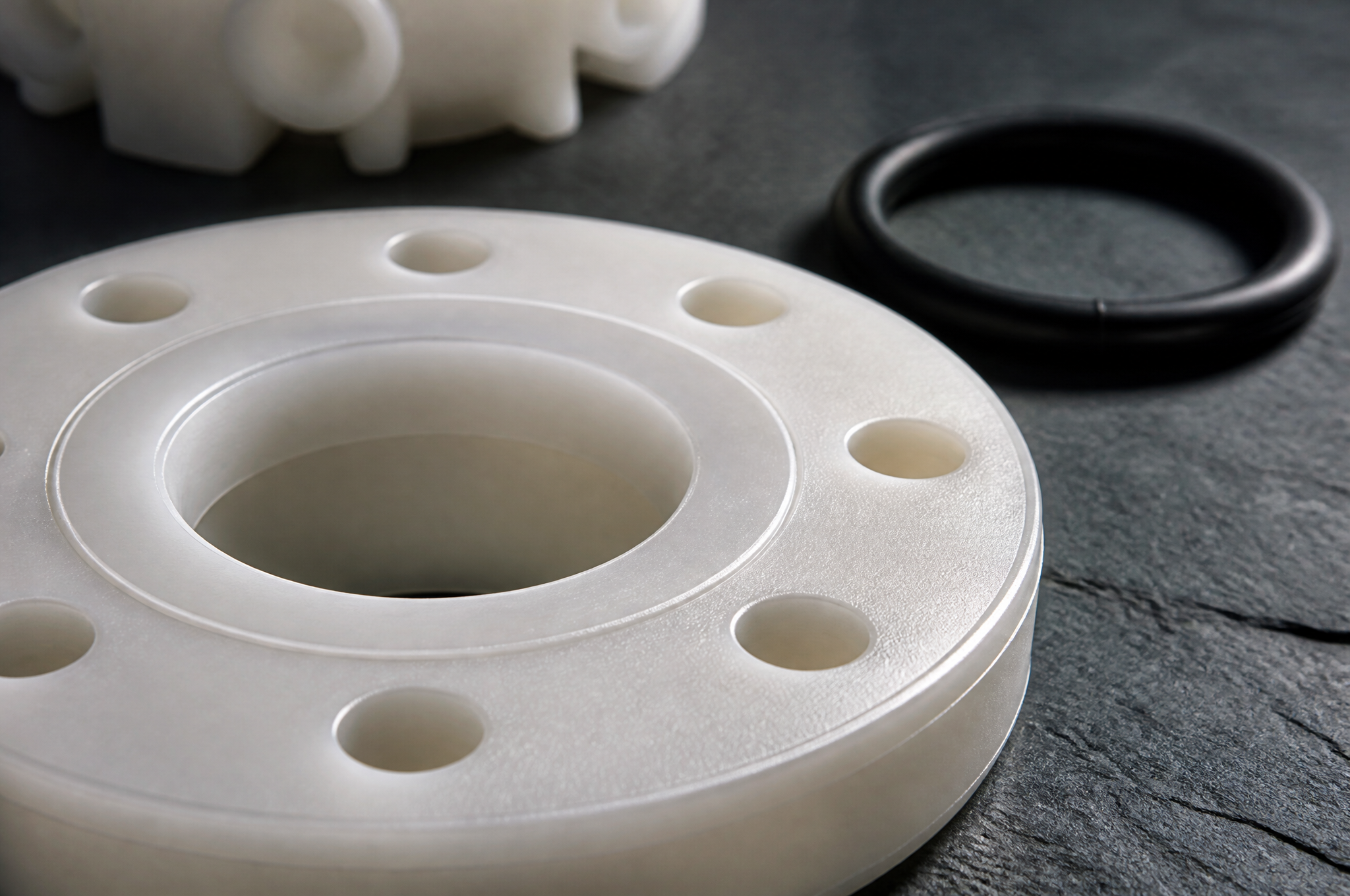
Two design points follow. The groove has to be in the chemical-resistant resin, not in a cheaper housing material that happens to be easier to mold — a perfect seal onto a softening groove is not a seal. And compression set matters as much as chemical compatibility: an elastomer that survives the chemistry but takes a permanent set at temperature will leak on the first cool-down, which reads in the field as a chemical failure and is not one.
Processing the Resin Is Part of the Chemical Resistance
Short answer
A part molded outside its window can have the right resin and the wrong chemical resistance, and nothing on the dimensional inspection sheet will show it. The properties that resist a medium are set on the machine.
This is the part of the subject that is genuinely a molder's responsibility rather than a buyer's, and it is worth knowing what to ask about, because it is invisible on the delivered part.
- Drying. Hygroscopic resins — PPS, PEEK, PA, PBT — hydrolyse if they are molded wet. The visible result may be nothing at all, or a little silver streaking; the invisible result is a drop in molecular weight, which shows up as reduced impact strength and reduced resistance to stress cracking. Under-dried resin is the most common invisible defect in chemical duty, because the part passes every dimensional check.
- Crystallinity. Semi-crystalline resins need a hot mold to develop it. A cold tool freezes an amorphous skin, and amorphous regions absorb and are attacked first, creep more, and are the places a crack starts. On PPS, PEEK and PVDF this makes mold temperature a chemical-resistance parameter, not a productivity one.
- Residence time and degradation. Halogenated resins release acidic by-products when they are overheated or held too long. That attacks the barrel, screw and check ring, and it puts degraded material into the part, where it becomes the weak layer that fails first. A corrosion-resistant barrel and screw, correct purge discipline, and no dead spots in the flow path are the countermeasures.
- Hot runners at low volume. Chemical-duty parts are often low volume, which means the manifold sits hot for a long time between shots. A manifold with a dead spot holds degraded material and delivers it into the next part. On short runs a hot-drop manifold can be a liability rather than a convenience, and a cold runner with a regrind policy may be the better choice.
- Mold steel and surface. Corrosive melts and acidic by-products make corrosion-resistant, polished cavity steel worth the cost: a corroded cavity leaves a surface that is a crack initiator, and no amount of resin selection fixes it.
- Contamination after molding. On high-purity duty, silicone release sprays, talc, cardboard dust and bare-hand handling are all contamination paths that a cleaning step may not remove. Packaging and handling belong in the specification.

What this means for documentation. The dimensional report proves the shape. It cannot prove that the resin was dry, that the mold was hot, or that the residence time was under control. That is why a material certificate plus a process record — melt temperature, mold temperature, drying record, cycle — is worth more on a chemical-duty part than an extra page of dimensional data.
Three Levels of Evidence, and Which One the Project Needs
Short answer
A chart screens a family, a specimen test qualifies a compound, a part test qualifies your part. Only the third one answers the question you actually asked, and it is the only one that can find a weld line.
| Level | What it is | What it proves | What it costs | When it is needed |
|---|---|---|---|---|
| 1. Published grade data | The resin supplier's chart or datasheet for the specific grade | That the compound is worth screening. Nothing about your geometry | Time to read it | Always, as the first filter |
| 2. Specimen immersion | Coupons of the actual grade in the actual medium, to a defined standard, with mass, dimension and strength measured before and after | The compound, under the conditions tested. Not the weld line, not the stress state, not the seal | Coupons plus laboratory time; days to weeks | When the shortlist is close, the medium is aggressive, or the grade is being changed |
| 3. Part-level exposure | Real molded parts, in their real fixtures or under their real load, in the medium at a defined temperature, for a defined period, measured against agreed criteria | The part: its weld lines, its stress state, its seal, its dimensions | Parts, a jig, calendar time; weeks to months | When a failure is expensive, the duty is hot or concentrated, or the part carries sustained load |
| 4. Line trial | The part installed in the actual equipment, run through the actual cycle | The system, including everything the previous levels cannot model | The most expensive, and the last | Before a full release on a critical duty |
Define the pass criterion before the test starts. A test without one produces an opinion. For a chemical-duty part the criteria are usually some combination of: mass change within a limit, dimensional change within the drawing, no cracking or crazing at a stated magnification, seal integrity retained, and a stated fraction of original strength or burst pressure retained. Writing them down first is what turns an experiment into evidence, and it is also what stops a result being argued about afterwards.
Acceleration has a limit. Raising temperature is the standard way to compress months into weeks, and it is legitimate as long as the mechanism stays the same. Push it too far and the failure mode changes — a test that would have produced slow stress cracking produces instead a bulk softening, or attacks a different phase of the polymer, or drives off an additive that would have stayed in service. The rule is to use the mildest acceleration that produces a measurable effect, and to keep a reference sample at service conditions so the two can be compared.
We do not publish compatibility claims for a medium we have not tested, and we do not quote a service life from a chart. Where a project needs part-level evidence, the test is scoped and quoted as a line item, with the protocol agreed in writing — medium, concentration, temperature, load, duration, sample count and pass criterion — before it starts.
Inspection: What Is Checked, and What It Proves
Short answer
No single check proves a chemical-duty part. Each one covers a different failure mode and has a blind spot, and the cheapest of them — mass — is usually the most sensitive.
| Check | Method | What it proves, and what it misses |
|---|---|---|
| Mass change | Balance before and after exposure, with a defined drying step in between | Proves absorption or extraction, and sees it before anything is visible. Misses where in the part it happened |
| Dimensions | The same marked points, at the same temperature, before and after | Proves swelling and stress relaxation at those points. Misses distortion between them unless the fixture is defined |
| Appearance | Defined illumination and magnification, against a stated cosmetic class | Proves crazing, bloom or etching exist. Without a cosmetic class, “looks fine” is not a result |
| Hardness or a simple load test | Durometer, or a defined deflection under a known load | Proves softening, coarsely. Misses a brittle surface layer that has not changed bulk hardness |
| Seal and leak | Pressure decay, or bubble immersion, on the assembled joint | Proves the joint, not the resin. A pass means the seal worked on that day |
| Material identity | FTIR or DSC on a molded part | Proves the grade molded is the grade specified, and detects contamination or a mixed lot. Misses degradation that leaves the chemistry unchanged |
| Weld-line integrity | Sectioning and microscopy on a witness part | Proves where the weld line is and whether it is a notch. Destructive, so it is done on a sample |
First article on a chemical part should record the process, not only the dimensions. A first-article report that lists measurements but not the melt temperature, mold temperature and drying record describes a shape and leaves the properties undocumented. On a part whose whole purpose is to survive a medium, that is the wrong half of the information.
Cost Drivers, and the Alternatives
Short answer
The resin price is the visible cost and rarely the largest one. Tool steel, yield, annealing, testing and the cost of being wrong all sit on top of it, and the last one is the only one that can be avoided for free.
| Driver | What it does to the price | Where it is worth spending |
|---|---|---|
| Resin | PP is the cheapest; PVDF a multiple of it; PPS higher again; PEEK an order of magnitude above PP | Spend here only when the chemistry demands it. Over-specifying the resin is the most common way to lose money on a part that would have passed in PP |
| Tool steel and surface | Corrosion-resistant, polished cavity steel and proper venting cost more up front | Worth it whenever the melt is corrosive or the surface is a crack initiator. A cheap cavity that corrodes produces scrap for the life of the tool |
| Cycle and thermal control | A hot mold, a long cooling time and an annealing step all add time and energy | Worth it where crystallinity and residual stress decide whether the part survives. Not worth it on a thin, low-stress part in PP |
| Yield and scrap | Chemical-duty parts are often low volume, so a high reject rate has nowhere to hide | Worth spending on the tool that makes a stable part rather than the tool that makes a cheap first shot |
| Testing | A specimen test is a modest line item; a part-level exposure test is a project | Worth it on any duty where a field failure would cost more than the test, which is most of them |
| Secondary operations | Annealing, machining of sealing faces, insert installation, cleaning and packaging | Worth stating in the quote rather than discovering at the first shipment |
The comparison that matters is over the whole quantity, not the piece price at the minimum order. A tool that costs more and produces a stable part usually wins on a two-year programme, because the expensive scenario in this category is not a high piece price — it is a line that stops, a batch that has to be replaced, or a part that has to be redesigned after the tool exists. Put the test in the quotation; it is cheaper there than in the argument afterwards.
Four Duty Profiles, and What Decides Each
Short answer
Chemical-duty enquiries arrive in four recognizable shapes. In every one of them the deciding factor turns out to be something other than the material name.
| Profile | What the review has to establish | Where it usually goes wrong |
|---|---|---|
| A. Acid transfer line Continuous, warm, pressurised, flanged | The oxidising strength and concentration of the acid; the temperature; the hoop stress in the wall; the thread and seal arrangement; permeation through the wall over the life | The seal elastomer and the thread engagement are chosen by habit rather than by chemistry, so the polymer outlasts everything holding it |
| B. Hot caustic cleaning Intermittent, cyclic, then rinsed | The cleaning agent, its concentration, its temperature and its frequency; the stress state at flanges and bosses during the hot phase | Only the process chemical is tested. Hot caustic under sustained stress is where fluoropolymer stress cracking is best documented, and it arrives through the cleaning loop |
| C. Solvent vapor in a sealed enclosure Warm, low stress, tight tolerance | Vapor concentration, the coolest internal surface, gasket and adhesive compatibility, and dimensional stability of the housing itself | Every sample is tested immersed and none is tested in vapor. The failure appears on a window or a lid, not on the part that was specified |
| D. Oxidiser at ambient temperature Cost-driven, frequent replacement | The oxidiser and its concentration, the actual temperature, the mechanical load, and how the part is replaced | A cheap resin is chosen, then the sanitiser concentration or the temperature is raised in service, and the part is now outside the assumption it was bought on |
They describe the shape of the decision, not a customer's result. We do not publish customer parts, media or test outcomes, so no project result is claimed here. What the table shows is the order in which the questions get asked, which is the part that can be generalised without inventing anything.
Where the Scope Stops
Short answer
A page that implies it can do everything is answered with silence by an experienced buyer. This is what a standard order does not include, and what has to be arranged if it is needed.
| Not included by default | Arranged when specified |
|---|---|
| A compatibility guarantee for a medium | Specimen immersion on the specified grade, to a named standard, with a written report |
| A predicted service life | A part-level exposure test to an agreed protocol, with a defined pass criterion |
| A pressure rating for the part on its own | Burst or pressure-hold testing on the assembled joint, at a stated temperature |
| Food-contact, potable-water or medical approval | Material declarations and whatever scheme documentation the project nominates, confirmed at quotation |
| Any test result we did not produce | Third-party testing, arranged and reported by the laboratory that ran it |
| PTFE molding | PTFE parts by machining or compression molding, or a melt-processable fluoropolymer reviewed against the medium |
| Assembly, welding and leak testing of the finished unit | Secondary operations scoped as line items, with their own acceptance criteria |
The value of stating this is not modesty. It lets a buyer see which requirements have to be on the enquiry rather than assumed, and it means a quotation can be built that does not quietly leave one of them out. The most common gap is the second row: a service life is expected, no test is commissioned, and the expectation travels into the purchase order unspoken.
The Chemical Exposure RFQ
Short answer
A quotation can only be as good as the exposure statement behind it. Twelve items turn a request into a review, and two of them are almost always missing.
| What to send | Why it changes the answer |
|---|---|
| 2D drawing with tolerances and a 3D model | Geometry sets the gate, the weld-line position and where the stress will sit |
| Chemical name, concentration, and whether it is a mixture | The medium is the first filter, and a formulation is not its main ingredient |
| Operating temperature, maximum temperature, cycling | Decides which resin families are still candidates, and whether acceleration is even meaningful |
| Contact mode for each surface | Wetted and non-wetted faces can be specified differently, which sometimes halves the cost |
| Cleaning regime: agent, concentration, temperature, frequency | The exposure most often left out, and the one that fails parts after commissioning |
| Pressure, bolt preload, insert type, press fits | Stress is half of stress cracking; without it the chemical answer is only half the answer |
| Required service life, and the acceptable failure mode | “Must not leak” and “must not crack” lead to different designs, and the second one is stricter |
| Resin, if already specified, with the full grade designation | An unfilled and a filled grade of the same polymer are different materials for this purpose |
| Critical dimensions, seal faces, cosmetic class | Decides the inspection plan, the polishing, and where the weld line is not allowed to be |
| Prototype quantity, annual volume, expected tool life | Cavity count, tool steel and whether a hot runner is justified |
| Acceptance: which test, which criterion, which report | Turns a sample into evidence, and prices the testing instead of arguing about it later |
| Documentation required | Material certificate, process record, FTIR identity, dimensional report, or a supplier declaration |
If the resin has not been chosen yet, say so. A review can start from the medium, the temperature and the load and produce a shortlist plus the two or three questions that would settle it, before any tooling is committed. That is a cheaper conversation than the one that happens after a part has failed in a medium nobody wrote down.
Where Each Question Is Answered
Short answer
This page holds the exposure, the failure modes and the design decisions that follow from them. Five other pages hold the detail behind it, and the split is deliberate.
The published process envelope: clamp range, wall range, tolerance bands, tooling lead time and volume bands
Mold structure, steel selection, gate types, T0 and T1 definitions and mold ownership terms
The high-temperature end of this shortlist: grade windows, crystallinity control, drying and tooling demands
The other side of the material question: transparency, flame retardancy and the solvents that attack polycarbonate
Process selection across molding, machining and printing when the volume or the geometry points elsewhere
Frequently Asked Questions
Which plastic is best for chemical-resistant injection molding?
There is no single best plastic, because chemical resistance is a result rather than a property. Selection starts with the medium, its concentration, the service temperature, the contact mode and the mechanical stress on the part, and it is confirmed against grade data before any tooling is committed. PP, PVDF, PPS and PEEK cover most of the range, and the order in which they are considered depends on which of those five conditions is the tightest.
Is PP or PVDF better for chemical-resistant parts?
Neither is better in general. PP is cheaper and handles many aqueous acids, bases and salts, but it swells in hydrocarbons and chlorinated solvents and creeps under sustained load at elevated temperature. PVDF covers a wider chemical range, including oxidisers and chlorinated solvents, and holds tighter dimensions, at several times the resin cost and with a narrower processing window. The medium, the temperature and the budget decide between them.
Can PPS or PEEK resist aggressive chemicals?
Both are strong candidates for aggressive duty, usually when temperature is also high. PPS is the lower-cost option and is normally specified glass or mineral filled, which changes its surface behavior and means the unfilled grade's data does not transfer. PEEK has the widest combined temperature and chemical envelope of the melt-processable engineering resins but is the most expensive and needs a hot tool. In both cases the grade, not the family name, is what has to be checked.
What causes chemical stress cracking in molded plastic parts?
A sustained tensile stress and a medium acting together. The medium plasticises the surface and lowers the energy needed for a crack to grow, so a part that would survive either the load or the chemical alone fails when it sees both. On a molded part the stress usually comes from packing and ejection, from an insert, from a press fit or from bolt preload, and the crack starts at a stress raiser such as a boss root, a sharp corner, an ejector mark or a weld line.
Can every chemical-resistant plastic be injection molded?
No. PTFE is the common case: it is close to chemically universal but is not melt-processable, so it is machined, compression molded or sintered rather than injection molded. Where PTFE-level inertness is needed in a molded part, the melt-processable fluoropolymers are the candidates, and they are a different specification with different limits. Everything else on a shortlist for chemical duty — PP, PE, PVDF, PPS, PEEK — is routinely injection molded.
What information is needed for a chemical-resistant plastic quote?
The drawing and model, the chemical name and concentration, the operating and maximum temperature, the contact mode, the cleaning regime with its agent, concentration and temperature, the pressure and mechanical load, the expected service life, the volume and the acceptance criteria. The cleaning regime and the acceptable failure mode are the two items most often left out, and both change the answer.
Does a compatibility chart prove a part will work?
No. A chart cell is one test on one specimen at one set of conditions, usually unstressed and often at room temperature. It cannot show what happens at a weld line, under bolt preload or after a thousand cleaning cycles. A chart is useful for building a shortlist; the qualification of a part needs either a specimen test on the actual grade or an exposure test on the actual parts.
Why do chemical-duty parts fail at weld lines?
A weld line is where two flow fronts met and the polymer chains did not fully diffuse across the interface, so it is the weakest plane in the part and, in filled grades, a place where fibers lie along the interface. In a chemical environment it becomes both a stress concentration and a path for the medium. Gate position decides where the weld line lands, which is why it is a chemical-resistance decision and not only a cosmetic one.
Does annealing improve chemical resistance?
It improves resistance to stress cracking by relieving molded-in stress, and that is a real gain on parts with inserts, thick sections or tight packing. It is not a substitute for a suitable resin or a good gate and wall design, and it changes dimensions slightly, so it has to happen before final inspection and before any machining. Whether it is needed is a decision for the part, not a default.
Can you guarantee a service life in a specific chemical?
No, and a supplier who does so without a test on your parts is guessing. Service life depends on the medium, its concentration, the temperature, the stress, the wall thickness and the cleaning cycle, and it is established by an exposure test with an agreed pass criterion. What can be stated is which resin family is worth screening, what the part has to avoid, and what test would answer the question.
Next step
Send the drawing, the medium and the cleaning regime
The medium alone does not settle the resin — the temperature, the contact mode, the load and the cleaning cycle all move the answer. Send those with the drawing and the reply will name the resin families worth screening, the features that need their own decision, and the test that would close the question.
Request a Chemical Duty ReviewDrawing and model · medium and concentration · temperature range · contact mode · cleaning regime · load and volume
How this page was written. The material families, failure mechanisms and molding consequences described here follow the standard immersion and environmental-stress-cracking test practice published by the standards bodies named in the text (ISO 175, ISO 22088 and ASTM D543 families), and the process statements are consistent with the windows published for these resins on the site's PEEK molding page and with the process envelope on the injection molding services page. No compatibility rating, service life, pressure rating or test result is asserted for any specific medium or part: those depend on the grade, the concentration, the temperature, the geometry and the load, and they are established by testing rather than by description. Where a figure would have had to be invented to make a point, the point was made without it.