"Can You Take This From Prototype to Repeat Production Without Re-Qualifying Everything?"
How We Bridge First Article to Stable Volume Supply
The hard part of CNC sourcing is rarely the first part — it is the 1,000th part coming out the same. Buyers lose money when a shop delivers beautiful prototypes and then stumbles on process validation, capability studies or certification continuity. This page explains exactly how we move a 5-axis part from first article to stable serial supply, what evidence we produce at each gate, and how your quality team can verify it before committing.
The Short Answer
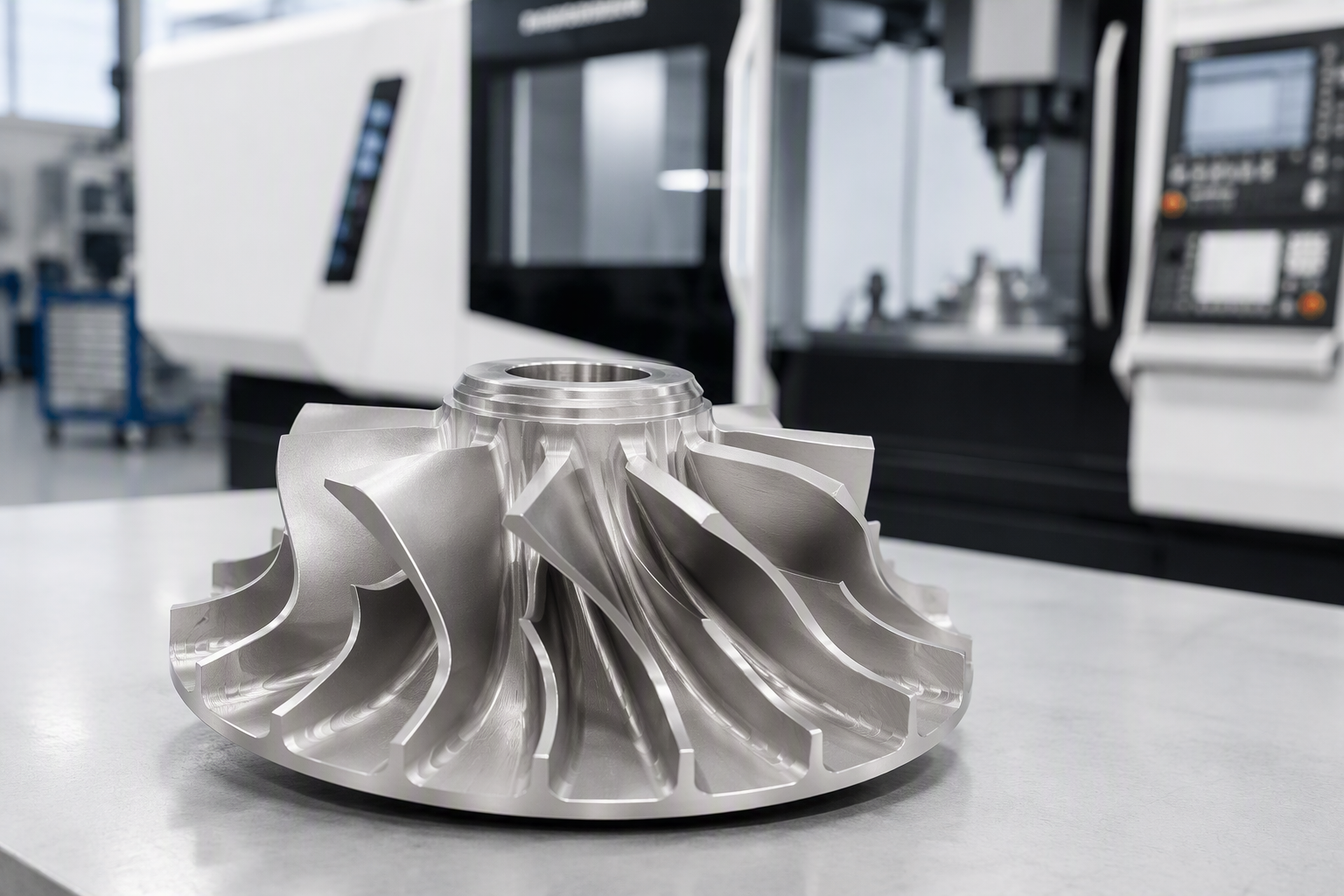
Yes — but only if the prototype was made the way the production part will be made. We treat the bridge from prototype to volume as a managed, gated process with four checkpoints, and we produce the documentation your quality team expects:
- First Article Inspection (FAI) — full dimensional layout of production-representative parts, not best-case samples.
- Process validation — process flow, PFMEA and control plan built around the real shop process, not a generic template.
- Capability evidence — Cpk ≥ 1.33 on significant characteristics (Ppk ≥ 1.67 on critical/safety) from a valid statistical sample.
- Certification continuity — ISO 9001:2015 baseline, with PPAP / AS9102 / material-traceability packages supplied on request per program.
The most common failure mode is a prototype made on a one-off setup that is never translated into a repeatable process. We design the production process during the prototype phase so there is no "re-qualification wall" later.
Four Gates Between Prototype and Volume
We do not treat "prototype" and "production" as two separate jobs. We run them as one phased program with explicit exit criteria at each gate. Your team can audit any gate independently.
First Article (FAI)
Production-representative parts measured feature-by-feature. In aerospace this is AS9102 (Forms 1/2/3, ballooned drawing). In automotive it is embedded in PPAP. We supply measured values, not pass/fail stamps.
Exit: all characteristics within tolerance on full-layout report
Process Validation
Process flow diagram, Process FMEA and Control Plan written for the actual fixtures, tools and machines. Special characteristics traced PFMEA → Control Plan → work instruction → inspection record.
Exit: control plan matches FMEA; reaction plans defined
Capability Study
A valid statistical sample (minimum 25–30 parts; 300 consecutive parts for PPAP Ppk) measured on calibrated CMM. Cpk ≥ 1.33 significant, ≥ 1.67 critical. MSA Gage R&R < 10% on critical features.
Exit: capability indices above customer threshold; MSA acceptable
Volume Ramp & Monitoring
Serial production launches with SPC monitoring, defined AQL sampling, and a 90-day stability watch. Engineering changes trigger re-qualification before they reach the floor.
Exit: stable process; documented change-control discipline
FAI, PPAP and What Each One Proves
Buyers often conflate these. They are different documents with different scopes — and knowing which one your program needs prevents both over- and under-documentation.
| Document | What it proves | Typical scope | When you need it |
|---|---|---|---|
| FAI (AS9102) | The first article matches the drawing — every measured characteristic, full traceability | 1–5 production-representative parts; ballooned drawing; forms 1/2/3 | Aerospace, medical, any program requiring first-article sign-off |
| PPAP (AIAG) | The process is capable and controlled, not just one good part | Up to 18 elements; Level 3 default; Ppk + MSA + control plan | Automotive / IATF 16949 supply chains |
| Internal FAI | Our own verification before your FAI, catching issues early | Full layout on CMM; same standard as customer FAI | Every new part, regardless of industry |
The Capability Numbers Your SQE Will Check
Capability indices are the most objective element of any production approval — and the easiest for your supplier-quality engineer to reject. Here are the thresholds we design to, drawn from AIAG and IATF 16949 practice.
| Characteristic class | Initial Ppk (PPAP run) | Ongoing Cpk (serial) | If below threshold |
|---|---|---|---|
| Critical / Safety | ≥ 1.67 | ≥ 1.33 | 100% inspection until capable |
| Significant | ≥ 1.33 | ≥ 1.33 | Increased sampling + root cause |
| Standard | ≥ 1.33 | ≥ 1.00 | Monitor with control chart |
Sample size matters
Cpk needs a minimum statistical sample of 25–30 parts. AIAG default for Ppk is 300 consecutive parts; some OEMs demand 500–1,000 before accepting the number as meaningful.
Normality matters
A non-normal distribution makes the standard formula misleading. We check distribution shape; if non-normal, we apply appropriate capability indices rather than forcing a bad number.
Measurement system matters
Gage R&R below 10% is acceptable for all characteristics; 10–30% is conditional; above 30% the gauge is rejected. We default to CMM on features tighter than ±0.020 mm to remove operator variation.
Certification Continuity — What Carries Across the Bridge
A prototype supplier and a production supplier are the same legal entity here. That means your certification review does not restart at volume. These are the credentials we hold and can evidence on request.
Capacity Planning — What We Need From You
Accurate capacity and lead-time quotes depend on volume profile, not just part geometry. Sharing the following lets us commit to a realistic ramp rather than a hopeful number.
Volume & cadence
- Annual volume and lot sizes (e.g. 500/yr in 4 lots of 125)
- Prototype → pilot → volume timeline
- Forecast confidence and flexibility needs
- Peak vs steady-state demand pattern
Quality & logistics
- Required approval standard (FAI / PPAP / internal)
- AQL level and inspection intensity expected
- Packaging, labeling and shipping terms
- Documentation / CoC requirements per shipment
Frequently Asked Questions
Will my prototype setup be the same as production?
What Cpk do you target before volume launch?
Do you re-qualify if we change the drawing?
Can you supply PPAP if you are not IATF 16949 registered?
Planning a Prototype-to-Volume Program?
Tell us your volume profile and required approval standard at RFQ. We will design the production-capable process from the first part and hand you a documentation set your quality team can audit at every gate.
FAI / PPAP-format packages available. ISO 9001:2015 certified. EU market documentation supported.