Custom Injection-Molded Cosmetic Caps & Lids
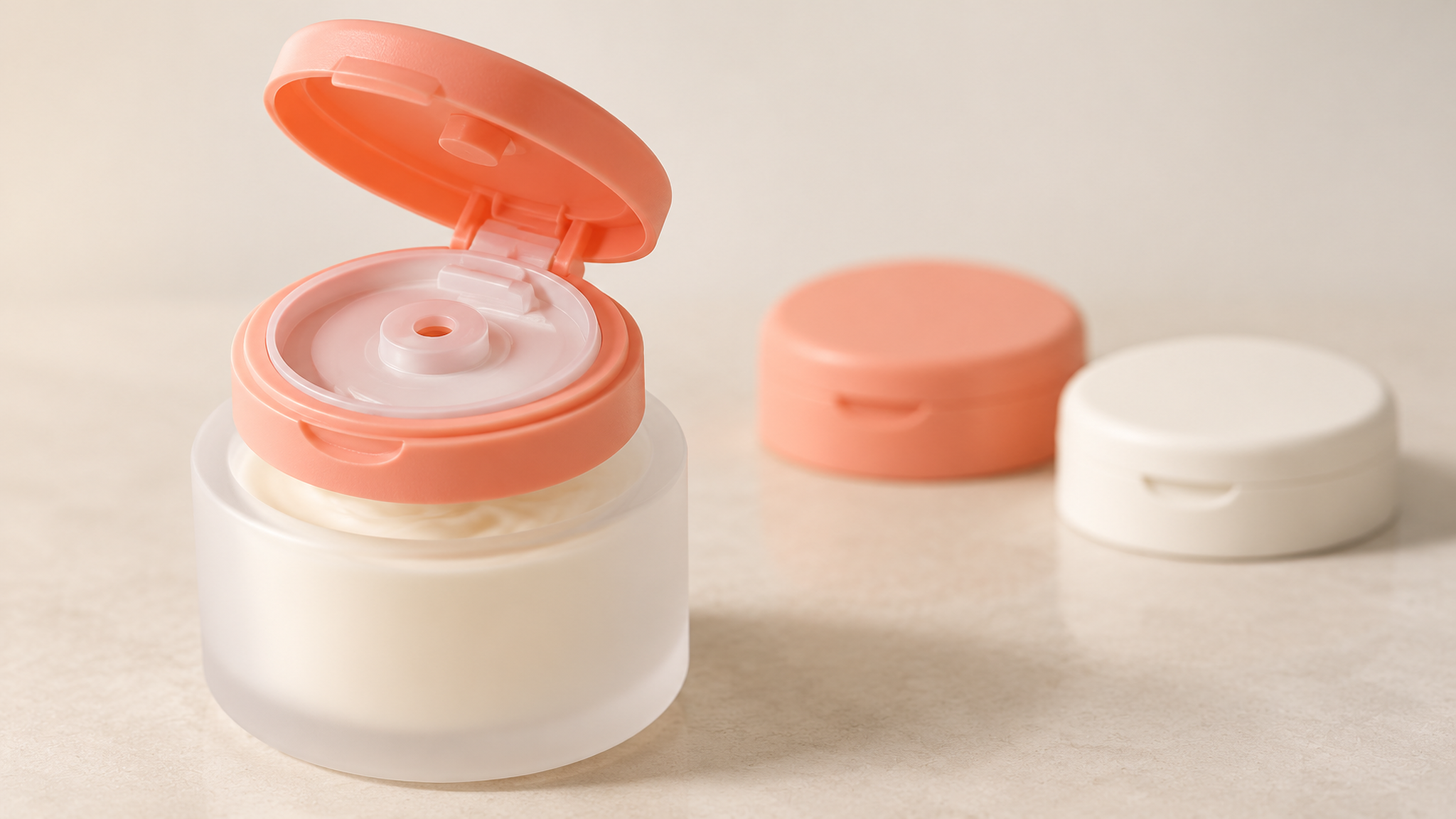
A closure is not bought as a plastic part. It is bought as a fit on someone else’s jar, an opening and closing feel, a surface a brand will put its name on, and the same four things again in month eight. This case follows one flip-top closure from mold design through molding and validation, and shows where each of those requirements is actually decided.
- Fit
- Function
- Appearance
- Repeatability
One closure, four requirements, and the order they fail in
Closure projects rarely come back because the lid was the wrong colour. They come back because the cap was right and the jar was not, or because the hinge was right on the sample and stiff in the third batch. This case is written in the order the work actually happens: the interface first, the mechanism second, the surface third, and the batch-to-batch question last — because that is the order in which a problem is cheapest to fix.
| Component | Cosmetic flip-top closure with a snap-in dispensing insertRepresentative product of a closure family; screw caps, jar lids and snap-fit closures are quoted on the same process route. |
|---|---|
| Application | Beauty & personal care / packaging |
| Manufacturing scope | In-house mold design & manufacturing + injection moldingAssembly, decoration and printing are in scope only where the project record says so. |
| Material | Specified PP grade [grade to be confirmed per project]Chosen for living-hinge fatigue, not from a material category. ABS is used where the requirement is appearance or rigidity rather than flexing. |
| Tooling | [Mold type and cavity count to be confirmed]Multi-cavity, single-cavity and family tools are all built in-house. |
| Critical features | Container fit, living hinge, snap-lock, dispensing orifice, insert retention |
| Tolerance | ±0.05 mm on specified critical fit featuresNot a blanket tolerance on the whole part. Each gauged feature is verified on the first-article report. |
| Surface | Matte tool texture; gate and parting-line placement to an agreed cosmetic standard |
| Inspection | Dimensional, fit and function, cosmetic against a golden sample |
| Production volume | [Project quantity to be confirmed] |
About the bracketed entries. Values in square brackets are project-specific. They are filled from the signed drawing, the tool record and the first-article report before this page is published, and they are never replaced with an industry benchmark. A cavity count or cycle time borrowed from another moulder’s case study describes their tool, not this one.
Four words, four different owners inside the project
These are not four chapters of a brochure. They are four separate acceptance criteria that are decided at four different points in the work, and each one can only be fixed cheaply while it is still a drawing.
Fit
Does the closure locate, retain and seal on the container that already exists — not the one drawn at nominal?
Function
Does it open and close the way a person expects, and keep doing it after the pack has been in a bag, a bathroom and a handbag?
Appearance
Is the surface a brand can put its name on — measured against a sample, not described in adjectives?
Repeatability
Will the part in month eight be the part that was approved, cavity to cavity and batch to batch?
A closure family shares a process route, not a specification. A flip-top is judged on hinge life and snap feel, a screw cap on torque and retention, a jar lid on rim seal and stacking. This page uses the flip-top as the worked example and says where the other types diverge.
Fit
Does it fit the container we already have — not the one on the drawing?
A closure is the only component in a pack that is defined by another component’s geometry. The jar or bottle comes from a different supplier, in a different material, made by a different process, with its own tolerance and its own tool wear. So the first question in this project was not about the cap at all. It was about the neck.
The four numbers that decide whether a closure fits
A neck drawing carries more than a diameter, and buyers often send only the diameter. The four numbers that actually govern the fit are the diameter the closure locates on, the diameter the seal lands on, the height the skirt drops over, and the position of the bead or thread start that sets where the closure sits when it is closed or turned. Get the fourth one wrong and the closure fits but sits high, leaving a gap a brand will notice before a consumer does.
Retention and sealing are two separate features
They are usually described as one thing — “a tight cap” — and they are built by two unrelated pieces of geometry with two unrelated failure modes.
Retention is what keeps the closure on. On a snap closure it is an inward bead on the skirt riding over a bead on the neck; the holding force comes from the interference plus the hoop stiffness of the skirt, so a thinner skirt gives a lighter feel in exactly the way a shorter spring does. On a screw closure it is thread engagement, and the relevant numbers are how many turns are engaged and how the thread flanks load.
Sealing is what keeps the contents in, and it is one of three designs, each failing differently: a plug that enters the bore (fails by splitting the neck if it is too large, or by leaking if it is too small); a land ring that presses on the neck rim (fails when the rim is not flat or the neck is oval); or a separate liner (fails when compression is uneven because the liner thickness varies or the application torque is inconsistent).
| Feature | What it controls | Fails as |
|---|---|---|
| Skirt inner diameter | Grip on the neck, and the force needed to remove the closure | Loose cap, or one that will not come off without a tool |
| Snap bead position | How far the skirt drops — and therefore the gap at the lid seam | Closure sits high, visible gap, or bead never engages |
| Bore at the seal | Interference of the plug seal against the neck bore | Leak at the seal, or a neck that splits |
| Neck rim flatness | Whether a land seal has anything to land on | Weeping at the rim that looks like a material problem |
| Orifice boss | Dispensing rate and where the product lands | Product that squirts, dribbles or hangs on the orifice |
| Insert groove | Retention of the snap-in dispensing insert | Insert that pushes out when the lid closes, or spins |

A closure cannot be quoted properly from the cap drawing alone. The single most useful input is the container drawing — or, failing that, two containers from the current production lot. It costs a buyer nothing to send and it removes the most expensive class of error in the project.
Where the tolerance actually goes
Shrinkage in a moulded closure is not one number. The same shot contains a thin skirt, a heavier hinge area and a thin web, and each of those sections packs and cools differently, so different features on the same part move by different amounts. That is why a blanket tolerance on a moulded closure is a sentence that cannot be kept, and why the figure belongs on the features that close the assembly: the bore at the seal, the bead position, the skirt inner diameter.
On this project the drawing carries ±0.05 mm on the specified critical fit features, and each of those features is on the first-article report. A number on a page is worth nothing next to a number on a report.
“It fits the drawing, not the bottle”
This is the failure that generates most rework, and it is arithmetic rather than bad moulding. The container carries its own tolerance, the closure carries its own, and the two add. A closure made at nominal on a neck at the top of its tolerance is already an interference fit; the same closure on a neck at the bottom of its tolerance is loose, and both parts passed their own inspection.
So the verification is done on assembled packs, not on loose caps. That is also why fit is checked again after tool maintenance: a polished core comes back a few microns smaller, and the closure that was tuned to the neck is now tuned to nothing.
Function
Does it open and close the way a person expects — and keep doing it after the pack has been in a bag?
A flip-top has two mechanisms that a buyer judges in about four seconds in a meeting: the hinge that lets the lid stand open, and the snap that tells the hand it is closed. Both are geometry decisions, and both are usually discussed as if the resin decided them.
The living hinge is a designed thin section, not a thin part
A living hinge works because a controlled thin web of a polyolefin folds instead of breaking. The web has to be thin enough to flex without whitening and thick enough not to crack, and it needs shoulder geometry on both sides to spread the fold instead of concentrating it on one line. Thickness is the parameter that matters most, and it cannot be read off a data sheet — technical guidance from machine and material suppliers on living hinges says the same thing in different words: the thickness and the transition have to be validated on functional samples, not inferred from the resin name.
Two more things about this hinge are decided in the tool rather than in the drawing. The first is gate position: the melt front is arranged to cross the hinge, which orients the polymer chains across the fold. A gate that fills the closure along the hinge line instead gives a web with the chains running with the fold, and that web is weaker for the same thickness. The second is the strap layout: this closure uses two short straps with a gap between them rather than one continuous web. Splitting the fold localises bending to two defined points, which lowers the force needed to open and keeps the lid aligned as it comes down on the deck.

Closing force and opening force are set by two different angles
The snap is an undercut with two faces, and they are deliberately not symmetric. The lead-in face is the one the lid meets on the way down: a shallow angle cams the lid over the bead gently, and a steeper one makes it feel stiff and cheap. The retention face is the one that resists being opened: a sharper, more square face holds, and a shallow one lets the lid drift open in a bag.
That pair explains almost every “it does not feel right” conversation. A lid that is hard to open and easy to close, or easy to open and will not stay shut, is one undercut machined at the wrong pair of angles — not a resin problem, and not something a different grade will fix.
What is actually tested, and on what
A hinge cycle count is a claim about a specimen and a method, so both are named before the number is quoted:
- Repeated open and close to a defined angle, counted, then the web inspected for whitening, cracking or loss of snap. Testing to a shallower angle than a person uses flatters the part; the angle belongs in the test definition.
- Retention under load — the lid has to stay shut when the pack is squeezed in a bag or dropped, which is a different test from opening force.
- Keep-open behaviour where the design promises it. A lid that falls back onto the orifice while the user is dispensing is a consumer complaint that never shows up on a dimensional report.
- Temperature, if the pack ships warm or lives in a bathroom. PP softens gradually rather than at a single point, so the feel at 40 °C is a real acceptance criterion for some programmes.
Hinge cycle figures are project-specific and are published only with the customer’s written agreement. A page that quotes “millions of cycles” without naming the angle, the specimen and the fixture has not said anything a buyer can use.
Hinge geometry
Web thickness, shoulder radii and strap layout agreed at DFM, with the gate placed so the melt crosses the fold.
Snap engagement
Lead-in and retention angles set as a pair, so closing effort and holding force are two separate decisions.
Repeated cycling
Counted open and close cycles at a defined angle, then the web inspected for whitening and loss of snap.
If the closure is a screw cap instead
Threaded closures are judged differently, and the tests do not transfer. Closing effort is application torque; opening effort is removal torque; the useful number is how much of the application torque is still there after the pack has sat — torque retention. ASTM D7860 is a torque-retention test method written for specified continuous-thread closures; it is not a flip-top test, and a torque result on its own does not prove that a pack will not leak.
Whatever the closure type, the functional test is run on the assembled pack. A hinge tested on a loose cap, or a seal tested without the container it seals against, produces a number about the moulding and not about the product.
Appearance
Is the surface a brand can put its name on — measured against a sample, not described in adjectives?
Cosmetic packaging is the one branch of moulding where a surface can fail a product without affecting its function. A cap that clicks perfectly and leaks nothing is still a rejected batch if the gate mark lands on the lid dome. What makes appearance hard to discuss is that three different requirements are usually written as one line on a brief.
Three requirements, three different owners
Surface texture is the finish of the mould, the resin and the process together: a matte grain comes from the tool being textured, and it will read as matte only if the part fills and packs evenly. Gate and parting-line placement is pure tool design — it is decided on the mould drawing and cannot be moved afterwards without cutting steel. Flash control is a shut-off condition plus process control plus maintenance: it drifts as a tool wears.
Writing “matte, gate-hidden, flash-free” as one requirement hides that only the first is a finish, the second is a position, and the third is a limit. They are agreed separately because they are fixed separately.
Zoning the part: what is visible, and when
A closure has three kinds of surface, and buyers consistently forget the middle one.
- Always visible — the outer lid dome and outer skirt. This is what appears on a shelf, in a photograph and in a hand.
- Visible when open — the inside of the lid, the deck, the orifice boss and the insert. A consumer looks at this every single time they use the product, which makes it a cosmetic surface even though it is technically an “inside”.
- Hidden — the underside of the skirt, the inner wall below the deck, the runner witness. This is where process marks are allowed to live.
The drawing is zoned before the tool is cut, and each zone gets its own defect list. That is the difference between a cosmetic standard and an opinion.
Where the gate goes is a design decision, not a defect
Every moulded part has a gate witness. On a flip-top closure there are two sensible places for it — the inner face of the lid, or the lower edge of the skirt — and the choice is a trade, not a quality level.
A gate on the inner face of the lid is invisible while the cap is closed, and viewable every time it is opened: a small circular mark on the surface the consumer looks into. A gate at the skirt’s lower edge leaves a fine witness ring at the rim, where it reads as part of the edge rather than as a blemish. Both are acceptable; neither is “gate-hidden” in the absolute sense, and the customer should choose which compromise they are buying before the tool is cut.


The parting line is unavoidable; its position and its step are not
Where the lid meets the skirt there has to be a shut-off, and a shut-off leaves a line on every part that comes out of the tool. What is controlled is where the line runs, whether the two surfaces meet flush or one steps proud of the other, and whether material escapes between them. A line that runs along a natural edge is invisible; the same line a millimetre up the skirt is a visible seam. A step of a few hundredths reads as a fingernail catch and, on a pack that gets opened a hundred times, as a sharp edge.
The defects a buyer will actually see
| Defect | Where it comes from | How it is controlled |
|---|---|---|
| Flash or burr | Material escaping at a shut-off, typically as the tool wears or if clamp tonnage drops | Shut-off design and maintenance; flash held to an agreed limit per zone, never promised as zero |
| Gate witness | The gate itself; size and finish depend on gate type and how it is trimmed | Gate position chosen against the zone map; witness size agreed before the tool is cut |
| Sink marks | Heavy sections or ribs packing less than the surface around them | Wall and rib proportions at DFM; packing profile |
| Weld lines | Two melt fronts meeting, usually behind the orifice boss or around an insert | Gate position and fill balance; accepted by zone, not eliminated |
| Colour variation | Masterbatch dosing, lot-to-lot resin, or too much regrind | Dosing control, lot records, a stated regrind percentage |
| Gloss variation | Inconsistent mould temperature or packing across a textured surface | Mould temperature control per circuit; texture depth agreed with the toolmaker |
| Parting-line step | Mismatch between two mould halves or two inserts | Tool build and periodic shut-off check |
| Scratches | Handling after ejection, parts rubbing in a box | Take-out, tray design and packing method, not polishing at the end |
The standard is a sample, plus a written list
A cosmetic requirement becomes enforceable when it is three objects and one document: an approved part showing the accepted surface, a reject part showing the limit, a reference for colour and gloss, and a written list of which defects are not permitted in which zone. It is checked under a defined light at a defined distance, because the same part reads differently under a warm shop lamp and a cold retail one.
Two honest trade-offs belong in that document. A matte texture hides flow lines, fingerprints and handling shine, but it is harder to wipe clean and it scatters light in a way that makes colour slightly harder to match. A gloss surface shows texture-free clarity but exposes every sink mark and every scratch. Neither is better; each is a different set of rejects.
Repeatability
Will the part in month eight be the part that was approved?
This is the requirement buyers write down least often and lose the most money on. Everything above can be got right on a sample. The commercial question is whether the same four things are still true after forty production runs, a tool service and a resin lot change.
Cavity balance is a fit problem, not an efficiency problem
In a multi-cavity tool, if the fill is not balanced the cavities do not all fill at the same rate. Different fill rate means different packing, different packing means different shrinkage, and different shrinkage on a closure means caps that differ in skirt diameter by a few hundredths — which the hand reads as a difference in feel long before the gauge does. One cavity can be a loose cap while another is tight, from the same shot.
So balance is verified at trial by weighing and measuring across every cavity, not by looking at a short shot and declaring the runner balanced. A geometrically balanced runner is not automatically a balanced fill; the melt does not know about the drawing.
The process window, written down and then held
A thin-walled closure with a long flow path is sensitive to melt and mould temperature, because the melt has to stay fluid until the last of the skirt fills. That sensitivity is what makes a documented process window worth having: after approval, the settings that produced the approved part are recorded, and changing them is treated as a change to the product rather than as a production decision. Without that, the batch that ships in March is a different product that happens to share a drawing.
What is checked per batch, and what per year
| Control | Frequency | What it protects |
|---|---|---|
| Critical fit dimensions | At each production start, and after any tool service | The interface — the number that decides whether the pack assembles |
| Part weight | Per shift | A fast proxy for packing consistency across cavities |
| Closed height and lid gap | Per batch | The one fit dimension the customer sees without a gauge |
| Hinge cycle sample | Per lot | Whether the web still folds instead of cracking |
| Removal force | Per lot | The feel, which drifts as the tool wears |
| Colour and gloss against the standard | Per batch | Whether a shelf of packs reads as one product |
| Shut-off and flash check | At tool service | Flash control, which degrades quietly with wear |
| Dimensional capability review | Annually, or after any change | Whether the process is still centred, not just in tolerance |

The wear parts are the ones that set the fit
On a closure tool the surfaces that wear are small and specific: the core pin that forms the orifice, the pin that forms the plug, and the shut-off at the lid seam. All three sit on the features that define fit and appearance, which is why tool maintenance is a quality activity on this product rather than a workshop one. A polished core comes back marginally smaller; the closure it moulds is marginally looser; the pack that was approved is marginally not the pack that ships.
Ownership and maintenance of the tool
Three questions belong in the purchase order rather than in a conversation after the first complaint: who owns the tool, who maintains it and against what schedule, and what happens to it when the programme ends. A closure tool can outlive the product it was built for, and its records are what make a repeat order a repeat rather than a redevelopment.
Cavity count, part weight, cycle time and tool life are recorded per project. They are stated on this page only when the project record supports them, because a number copied from another moulder’s case study describes a different tool.
Where all four are decided
By the time the steel is cut, most of the outcome is already fixed.
A closure tool is a fit device, an appearance device and a production device at the same time, and the DFM review is the only moment when a change costs drawing time instead of steel time. The review is worked through in this order, because each item constrains the next.
| Review item | What gets decided | Consequence if deferred |
|---|---|---|
| Wall thickness | Section and transitions across skirt, lid and deck | Sink marks on the visible face, and shrinkage that varies feature to feature |
| Draft | Release angle on every vertical face, including textured areas | Scuffing on ejection, which reads as a cosmetic defect on the skirt |
| Living hinge | Web thickness, shoulder geometry, strap layout, gate orientation | Hinge that whitens early or cracks; unfixable without a new insert |
| Gate location | Where the witness sits and how the melt crosses the hinge | Gate mark on a visible surface, or a weak fold |
| Parting line | Where the line runs and which side carries the step | A visible seam up the skirt |
| Ejection | Pin positions and pad areas, away from cosmetic zones | Ejector marks on the inner face the consumer sees |
| Cooling | Circuit layout through cores and cavity inserts | Uneven gloss, warped deck, and a cycle time set by the hottest spot |
| Cavity layout | Cavity count, pitch and runner balance | Cavity-to-cavity dimensional spread that shows up as an inconsistent feel |
| Shut-offs | The lid-seam and insert shut-offs, and their venting | Flash at the seam and a step at the edge — the two things a hand finds first |
The sequence, and what each trial is for
DFM review happens on the model and produces a written list of changes with reasons. Tool design turns that list into a mould drawing, including the gate, the parting line and the zone map for appearance. T0 is the first shot: the tool is proven for filling, release and basic function, and the part is expected to need correction. T1 is the sample that goes for dimensional and cosmetic approval against the drawing and the golden sample.
T0 and T1 mean different things in different shops, so they are defined in writing on the order rather than assumed. A supplier who calls the first shot “T1” and sends it for approval is not being dishonest; the labels simply are not standardised, and the buyer’s approval gate should say what the part has to demonstrate.
One decision that is easy to miss: is the lid closed in the tool?
Some closure tools fold the lid shut inside the mould before ejection; others eject open and the lid is closed downstream, or the pack ships with the lid open. It is a tool cost decision with a downstream consequence: a part that leaves the tool closed is packed denser, handled less and arrives with fewer scratches, while an open part needs a closing step and more room in the box. It belongs in the DFM conversation, not in a packing discussion three months later.
Running a thin wall without losing the fit
A closure is a thin part with a long flow path, which is the hardest shape to run consistently.
Moulding a closure is not difficult in the way that moulding an engineering part is difficult. It is difficult in a narrower way: the part is thin, the flow path is long, and the tolerances that matter are on features that shrinkage moves. Almost every production decision is therefore about keeping fill and packing identical from shot to shot.
Resin, colour and regrind
PP is not hygroscopic, so the drying step does not dominate the way it does with PA or PC — but masterbatch, additives and any regrind still carry their own handling requirements, and the resin supplier’s sheet governs rather than habit. Regrind is the item buyers forget to ask about: a stated percentage, kept constant, is part of the specification. A batch with visibly more regrind than the approved one is a different material even when the grade on the box has not changed.
Colour is a dosing problem before it is a material problem
Consistency across a shelf comes from dosing control and lot records, not from a colour name. A masterbatch let down at a slightly different ratio, or a base resin from a new lot, moves colour a little; a matte texture then makes that little look different under a shop light. Where colour is critical, the standard is a physical reference part and a defined light, and the record is which masterbatch lot went into which batch.
Cycle time is a consequence, not a target
A closure’s cycle is set by how fast the thickest section can be cooled without sinking the visible face. Cooling circuits through the cores and the cavity inserts are where the time is won, and any attempt to shorten the cycle by lowering cooling shows up first as gloss variation and then as a deck that is not flat enough to seal. The honest way to shorten a closure cycle is to improve the cooling in the tool.

Eight checks, and what each can prove
A test only means something when the method and the specimen are named.
Closure validation is not one procedure applied to every part. Each check exists to answer one question, and most of them are meaningless if the specimen is a loose cap rather than an assembled pack.
| Check | Applies to | What it proves |
|---|---|---|
| Dimensional inspection | Every closure | That the gauged features meet the drawing — not that they will fit |
| Assembly fit test | Every closure | That the closure seats on the actual container, at the actual neck tolerance |
| Open and close test | Flip-top and snap closures | The motion the consumer performs, and whether the snap is felt |
| Hinge cycle test | Living-hinge closures | That the web survives repeated folding at a defined angle |
| Snap retention test | Snap-fit closures | That the lid stays shut under load — separate from opening force |
| Application and removal torque | Threaded closures | Closing and opening effort, and torque retained after settling |
| Leakage test | Sealing packs | That the assembled pack holds its contents, not that the cap is round |
| Cosmetic inspection | Visible zones | Conformance to the golden sample and the written defect list |
First: a leak test on a closure alone is not a leak test. It proves that a cap holds when nothing is underneath it.
Second: ASTM D7860 covers torque retention for specified continuous-thread closures. It does not apply to flip-tops and snap caps, and a passing torque result is not evidence that a pack will not leak — leakage is a property of the assembled seal.

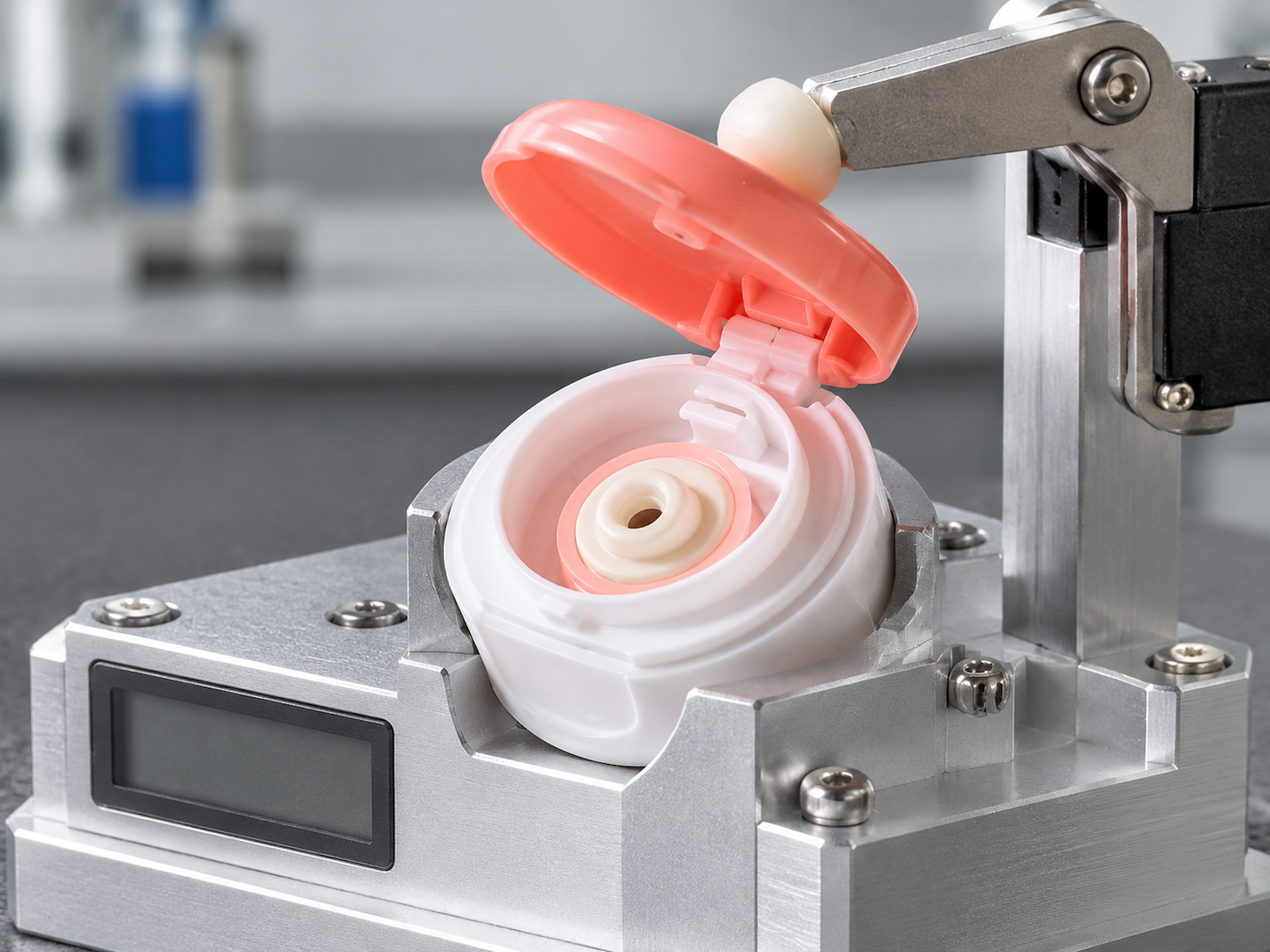
Where the first article stops and production control starts
The first-article report proves that the tool can make the part. It says nothing about the twenty-thousandth. What carries the promise from one to the other is the smaller, duller set of production checks in the previous chapter, plus a rule that any change to resin lot, masterbatch lot, regrind ratio or process window re-opens the approval rather than slipping through.
The numbers we publish, and the ones we do not
A cavity count borrowed from another moulder describes another tool.
Manufacturing data is the part of a case study buyers use most and trust most readily, which is exactly why it should be the part with the least invention in it. The fields below are the ones that make a closure project legible to a packaging engineer. Each is filled from the signed project record, and where the record is not yet available the field stays marked rather than being filled with a plausible figure.
| Mold type | [Single-cavity / multi-cavity / family tool — confirmed from the tool record] |
|---|---|
| Mold steel | [Actual cavity and core steel, with hardness and the surfaces it applies to] |
| Cavity count | [Actual number — verified at trial across all cavities, not assumed] |
| Part weight | [Measured part weight, closure complete with insert] |
| Cycle time | [Actual cycle, quoted with the cooling configuration it depends on] |
| Annual volume | [Project quantity and the order pattern it is supplied in] |
| Tool life | [Expected shot life with the maintenance interval it assumes] |
| First-article approval | [Trial rounds to approval, and what each round changed] |
| Assembly scope | [Insert fitting, lid closing, decoration or packing — in scope only where stated] |
Bracketed fields are completed before publication and removed from this note once they are. A case page with an honest gap is more useful to a buyer than one with a number that cannot be defended in a meeting — particularly when the buyer is the person who will be asked to explain the number upwards.
What we will and will not say about the resin
Two phrases that appear on a great many closure pages cannot be defended, and they are worth replacing rather than softening.
PP and ABS are not a “recyclable grade”
They are two different materials with different properties, different processing behaviour and different end-of-life routes, and neither carries a recyclability attribute by virtue of its name. On a hinged closure the grade is chosen for flex fatigue; on a rigid decorative lid it may be chosen for surface and stiffness. Writing “PP / ABS, recyclable grade” collapses both decisions into a claim that means nothing at the tool and nothing to a brand’s compliance team.
A closure cannot make a package recyclable
Regulation (EU) 2025/40, the Packaging and Packaging Waste Regulation, has applied since 12 August 2026, and it sets a 2030 objective for packaging placed on the EU market to be recyclable in an economically viable way. None of that makes an individual cap recyclable on its own. Recyclability is a property of the whole pack — body, closure, liner, label and any decoration — and of the sorting stream that pack enters. A mono-material body can be spoiled by an incompatible closure or a metallised liner, and a technically recyclable closure can still be lost by a pack that no stream will take.
What a moulder can honestly supply is the input to that assessment: the exact grade, the colour, the mass of each component, and — where recycled content is used — the percentage and the supplier’s documentation. If PCR is in the part, the figure and the traceability belong on the drawing.
Unqualified environmental language is a liability
In the United States the FTC Green Guides take the same position in different words: broad claims such as “eco-friendly” or “green” are difficult to substantiate, and “recyclable” depends on whether recycling facilities are available to the people receiving the package. So this is what a closure page should say instead.
| Instead of | Write |
|---|---|
| Molded in eco-friendly, recyclable-grade resin | Molded in a specified PP compound selected for living-hinge fatigue, with the grade, colour and any recycled content declared on the drawing |
| Matte, gate-hidden, flash-free | Matte tool texture; gate and parting-line position agreed against a zone map; flash controlled to agreed limits |
| ±0.05 mm everywhere | ±0.05 mm on specified critical fit features, each verified on the first-article report |
| Food / FDA grade | The grade actually specified, with the contact application stated — a cosmetic closure is not automatically a food-contact part |
| Millions of hinge cycles | The cycle count, the angle and the specimen, where the customer has agreed to their publication |
What this page does not claim. Goldcattle is a custom contract manufacturer of moulded, machined and cast components. It is not a packaging brand, a filler or a co-packer, and it does not certify a finished pack. Where a project needs food-contact, pharmaceutical or child-resistance documentation, that is a different material and a different route, and it is quoted as such.
What is covered elsewhere, so nothing is repeated here
This page is the case, not the capability statement. Machinery, materials and process range live on the injection molding page; mold design, DFM and tool approval live on the mold page. Each link below owns one subject.
Questions packaging buyers ask about closures
What should you consider when designing a custom cosmetic closure?
Four things decide the project, in this order: fit to the container neck, the opening and closing function, the appearance of the visible surfaces, and whether all of that repeats in month eight. Fit comes first because the closure is the only part in the pack defined by another part’s geometry. Practically, that means starting from the container drawing or a container sample rather than from the cap drawing alone, and agreeing which features carry a tolerance before the tool is cut.
Which plastic materials are suitable for cosmetic caps and lids?
Polypropylene is the usual choice where the closure has a living hinge, because polyolefins tolerate repeated flexing and the hinge can be moulded as a thin web in the same shot as the body. ABS is used where the requirement is appearance, rigidity or a decorative finish rather than flexing, and it is not a drop-in replacement for a hinged PP cap. Resin is specified by grade, not by category: two PP grades with the same name can behave differently at the hinge, so the grade, colour and any recycled content belong on the drawing.
How do you ensure a consistent fit between caps and bottles?
By treating the cap and the container as one tolerance stack. The container is moulded or blown by someone else and carries its own tolerance and tool wear, so a cap that measures at nominal on a neck at the upper limit is already an interference fit. We ask for the container drawing or a sample and check the closure against it, then verify the assembly on real containers rather than on a loose cap. The features that matter are the bead or thread position, the bore at the seal, the neck height and the rim flatness.
How are living hinges designed and tested in injection-molded caps?
A living hinge is a thin web that has to be thin enough to flex without tearing and thick enough not to crack, with shoulders on both sides that relieve the fold. The gate is placed so the melt front crosses the hinge, which orients the polymer chains across the fold instead of along it. None of that can be guaranteed by a resin name, so the hinge is proven on functional samples: repeated open and close cycles to a defined angle, then inspection of the web for whitening, cracking or loss of snap. Cycle counts are project-specific and published only with the customer’s agreement.
How do you control cosmetic surface defects in injection-molded parts?
By separating three requirements that are often written as one. Surface texture comes from the tool finish, the resin and the process. Gate and parting-line placement is a tool design decision, made against a zoning of the part into always visible, visible when open, and hidden. Flash control is a shut-off and process control, held to agreed limits rather than described as flash-free. The standard is then an approved golden sample plus a written defect list per zone, checked under a defined light.
What information is needed for a custom cosmetic cap manufacturing quote?
The 3D model and 2D drawing of the closure; the container drawing or a sample of the container it must fit, including the neck finish and any liner; the resin if it is already fixed, or the requirements that decide it; the annual and per-order quantity; the surface and cosmetic standard you will judge against; whether the lid must leave the tool closed or open; and whether any assembly, printing or decoration is in scope. A quote built on the cap drawing alone will be a price for a part, not for a fit.
Can a plastic closure make a package recyclable?
No. Recyclability is a property of the whole pack and of the sorting stream it enters, not of one component. Regulation (EU) 2025/40, the Packaging and Packaging Waste Regulation, has applied since 12 August 2026 and sets a 2030 objective for packaging placed on the EU market to be recyclable in an economically viable way; that does not make an individual cap recyclable in its own right. A mono-material pack can still be spoiled by an incompatible closure, liner or label. What we can do is declare the resin grade, the colour, any recycled content with the supplier’s documentation, and the mass of each component so your own assessment starts from real numbers.
What is the difference between ±0.05 mm on fit features and a general tolerance?
A general tolerance applied to a moulded closure would be a statement about every surface, including the ones that do not close an assembly, and it would not survive contact with shrinkage. Shrinkage varies with wall section and flow path, and a closure has a thin skirt, a heavier hinge area and a thin web in the same shot, so different features move by different amounts. The tight figure belongs on the features that consume the tolerance stack, such as the bore at the seal, the bead position and the skirt inner diameter, and each of those is verified on the first-article report.
Send the drawing, and the container
A closure cannot be quoted from the cap drawing alone. Send the closure model, the container drawing or a sample of the container, the resin if it is already fixed, the annual quantity and the surface standard you will judge against. You will get a DFM note on where the design meets the tool, not a price list.
Request a Closure Quote Reviewed against a drawing, a sample or a defined requirement. Customer-specific dimensions, cavity counts and test results are published only with written agreement.