
Custom precision stainless steel turned components manufactured from your drawings — shafts, pins, bushings, fittings, threaded components and other critical mechanical parts for industrial, automotive, medical, hydraulic, electronics and demanding applications.
Typical engineering response within 1–2 business days · NDA available on request
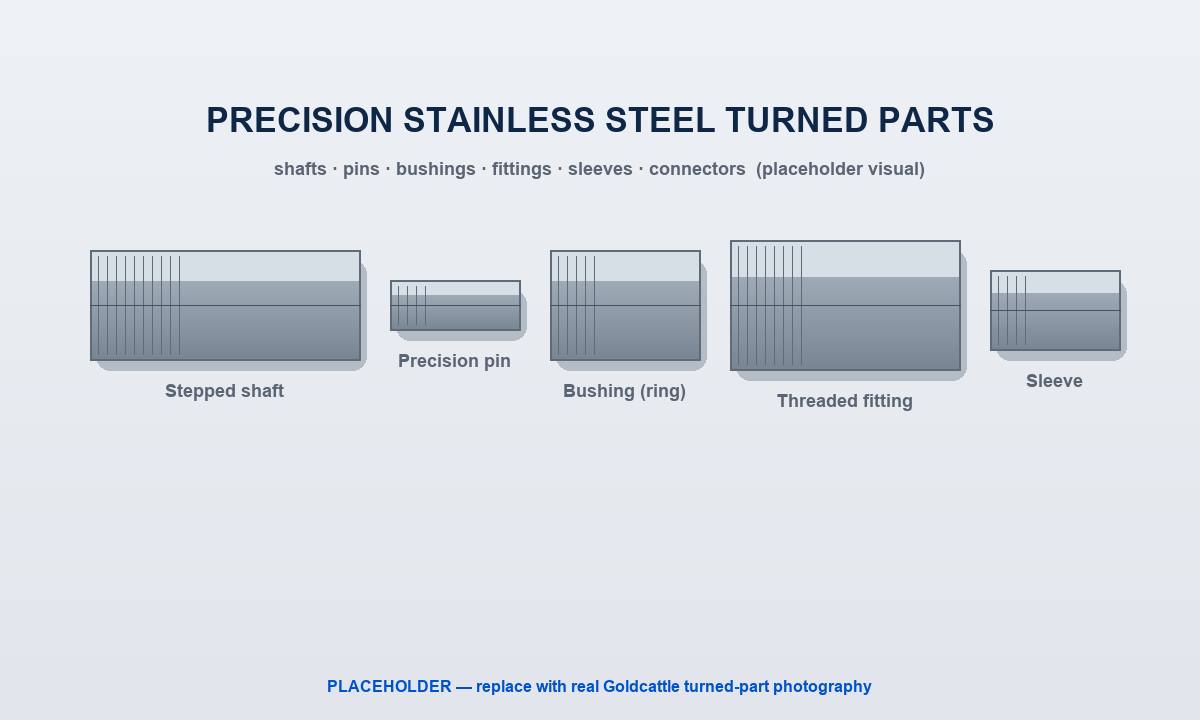
Custom Stainless Steel Turned Components from Prototype to Production
This page is about one specific thing: manufacturing precision stainless steel turned parts to your drawing. It is not a general CNC-turning introduction — it focuses on the stainless grades, the part types (shafts, pins, bushings, fittings, connectors), the features that matter (threads, concentricity, runout, bores, surface roughness) and the evidence that proves a part meets spec.
If you need the broader process page, see our CNC Turning Services or CNC Machining Services. This page stays on stainless turned parts.
Capability note: the ranges above are typical, industry medium-to-upper values. Actual limits depend on material, part geometry, feature size and inspection method. Confirm the exact envelope for your part at quotation.
What Are Precision Stainless Steel Turned Parts?
Precision stainless steel turned parts are components produced by CNC turning from stainless bar stock or similar raw material, with rotational features such as diameters, bores, threads, grooves, tapers and shoulders. Turning removes material around a rotating axis, which is why these parts are naturally round, tubular or stepped.
The features below are what make a turned part "precision" — and what we control during machining and inspection:
Rotational features
- OD / ID
- Threads
- Bores
- Grooves
- Shoulders
Geometry features
- Chamfers
- Tapers
- Knurling
- Cross holes
- Flats / slots
Precision controls
- Roundness
- Concentricity
- Runout
- Cylindricity
- Surface roughness
Custom Stainless Steel Turned Parts We Manufacture
We manufacture a wide range of stainless turned components. Listing the part types explicitly helps you confirm we make the specific component you need.
Stainless Steel Shafts
- Stepped shafts
- Precision shafts
- Drive shafts
- Actuator shafts
Stainless Steel Pins
- Locating pins
- Dowel pins
- Precision pins
- Hinge pins
Stainless Steel Bushings
- Sleeve bushings
- Flanged bushings
- Bearing bushings
- Spacers
Stainless Steel Fittings
- Threaded adapters
- Hydraulic fittings
- Pneumatic fittings
- Tube fittings
Sleeves · Collars · Spacers
- Precision sleeves
- Shaft collars
- Spacers / washers
- Standoffs
Plugs · Fasteners
- Plugs
- Nuts / special fasteners
- Threaded inserts
- Custom fasteners
Valve / Fluid-Control
- Valve stems
- Seats
- Needle components
- Manifold parts
Sensor / Connector
- Connector bodies
- Terminals
- Precision pins
- Housings
Rollers · Couplings
- Rollers
- Couplings
- Hubs
- Capstan parts
Don't see your exact part? Most stainless turned components are a combination of the features above. Send the drawing and we will quote it directly.
Stainless Steel Grades for CNC Turning
Stainless is not one material. Each grade machines differently and performs differently. We regularly turn the grades below; tell us your specified grade and we will confirm machinability and any special handling.
303 Stainless Steel free-machining
The easiest austenitic grade to machine, thanks to added sulfur. Good for high-volume turned parts where speed and tool life matter.
Typical parts: shafts, fittings, fasteners, pins, connectors.
304 Stainless Steel general purpose
The most common stainless grade — a balance of corrosion resistance, weldability and machinability for general industrial use.
Typical parts: hardware, enclosures, fittings, spacers, general components.
316 / 316L Stainless Steel corrosion resistant
Molybdenum-added grade with stronger corrosion resistance than 304, especially in chemical, marine and fluid-handling environments. 316L has lower carbon for better weldability.
Typical parts: hydraulic fittings, marine parts, fluid-handling, medical-related components where appropriate.
17-4 PH Stainless Steel precipitation hardening
A martensitic precipitation-hardening grade that reaches high strength after heat treatment. Used where mechanical strength is critical.
Typical parts: high-strength shafts, actuators, industrial components where qualified.
Other grades: 420 / 440C and similar hardenable stainless grades can be considered on request — confirm availability and heat-treatment handling at quotation. We do not claim every grade as standard stock.
303 vs 304 vs 316L vs 17-4PH
| Grade | Main advantage | Typical turned parts |
|---|---|---|
| 303 | Better machinability | Shafts, fittings, fasteners, pins |
| 304 | General corrosion resistance | General industrial components |
| 316L | Stronger corrosion resistance | Fluid / marine / medical-related |
| 17-4PH | High strength after heat treatment | High-strength precision components |
| 420 | Hardenability / wear | Valves, shafts (on request) |
| 440C | High hardness / wear | Bearings, wear components (on request) |
Material selection depends on corrosion, strength, wear, temperature, machining requirements and application. "316L is the best stainless" is never true — the right grade is the one that matches your service condition.
How to Select the Right Stainless Steel Grade
Need easy machining?
303 is often preferable to 316L for general high-volume turning where machinability drives cost.
Need corrosion resistance?
Consider 316 / 316L for chemical, marine or fluid environments.
Need higher strength?
17-4PH may be considered where strength after heat treatment is required.
Need wear resistance?
Hardenable grades (420 / 440C) may be more suitable — confirm on request.
Food / medical / hygienic?
Specify the appropriate certified grade and applicable requirements; not every grade suits every condition.
Unsure?
Send the service environment and we will recommend a grade and confirm machinability.
Precision CNC Turning Capabilities
Our turning operations cover the full set of rotational features needed for precision stainless components:
* Live tooling, secondary milling and sub-spindle backworking are supported on configured turning centers — confirm for your part. For slender, high length-to-diameter parts, our Swiss-Type CNC Turning service (sliding-headstock) is available as a separate capability.
Turned and Milled Stainless Steel Components
Many precision stainless parts are not pure turning. A shaft may need a flat, a cross hole, a keyway or a milled feature. We combine turning with milling in one setup where the machine is configured for it.
Combining operations reduces handling, improves concentricity between turned and milled features, and shortens lead time versus separate setups.
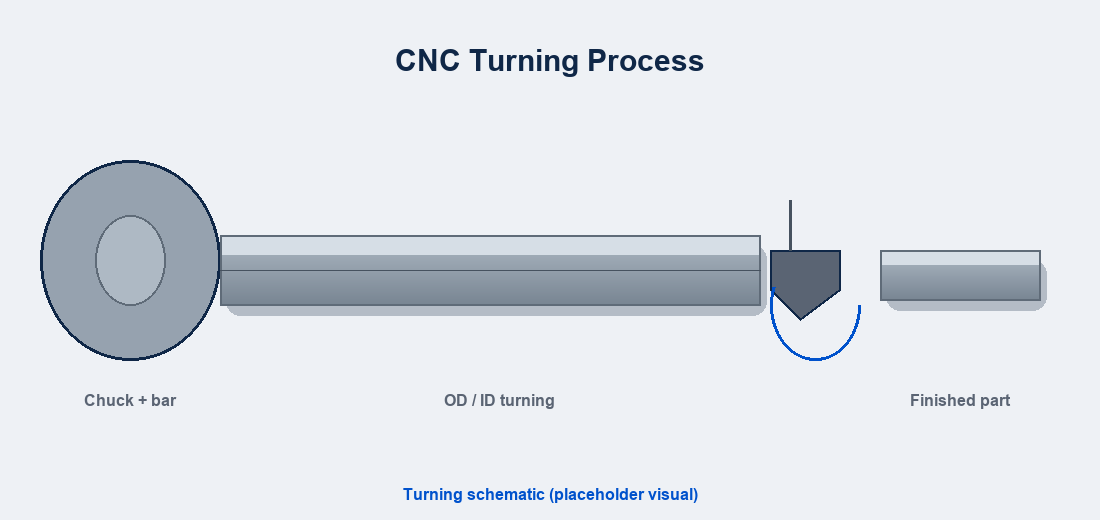
Stainless Steel Turning Size Capabilities
| Parameter | Typical Goldcattle capability |
|---|---|
| Maximum turning diameter | Up to Ø300 mm |
| Bar capacity (typical) | Up to Ø65 mm |
| Maximum part length | Up to ~1000 mm |
| Length / diameter ratio | Geometry-dependent |
| Minimum diameter | A few mm (confirm) |
| Thread size | M3 and up (per spec) |
| Bore size | Per drawing |
| Prototype quantity | 1+ piece |
| Production quantity | Low-volume to mass |
Size limits are not "up to X mm" in isolation. The achievable diameter, length and tolerance depend on the machine, the material and the part geometry. The numbers above are typical, industry medium-to-upper values — confirm the envelope for your specific part at quotation.
Tolerance, Roundness, Concentricity and Runout
For turned parts, a single "±0.005 mm" claim is rarely meaningful on its own. What matters is which feature, which dimension and which measurement method. We control the characteristics below and report them against your drawing.
Diameter tolerance
Typical ±0.01 mm; ±0.005 mm on qualified features. Stated per feature, not blanket.
Length tolerance
Controlled to drawing; tighter where the feature is functional.
Concentricity
Between OD, ID and shoulder — critical for shafts and bushings.
Roundness
Radial deviation of a circular element from a true circle.
Cylindricity
Combined form control for precision bores and journals.
Runout
Total indicator reading (TIR) at specified diameter — typically ~0.01 mm where required.
Flatness
For faced/shoulder surfaces that seat or seal.
Position / threads
Thread class and position per specification.
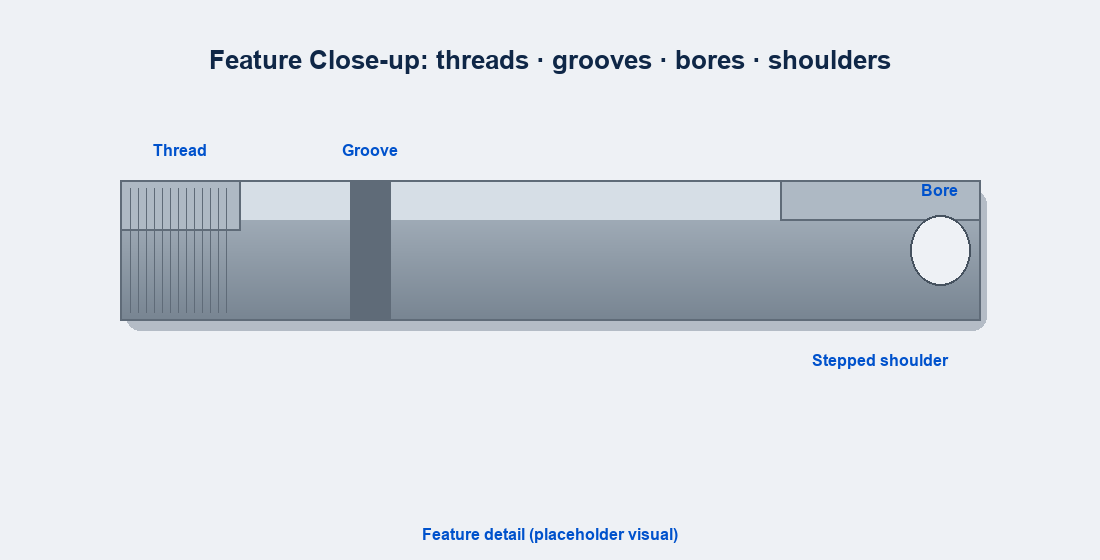
Tolerance depends on function
- Running shaft: shaft diameter, roundness, runout, surface finish.
- Bushing: ID, OD, concentricity, clearance.
- Threaded fitting: thread class, sealing surface, concentricity.
- Bearing seat: diameter, roundness, roughness, runout.
We quote tolerance against the function of each feature — not a single advertised micron number.
Custom Stainless Steel Threads and Sealing Features
We machine a range of internal and external threads to common standards. Every thread is specified by size, pitch, class/tolerance and direction (internal or external) — this is especially important for hydraulic and pneumatic fittings.
Metric
- M3, M4, M5, M6 and up
- Coarse / fine pitch
UNC / UNF
- Unified coarse / fine
- Per drawing class
BSP / NPT
- Pipe threads
- Sealing-critical
Sealing features
- O-ring grooves
- Sealing faces
- Tapered / straight threads
- Shoulder faces
Thread specification must define size, pitch, class/tolerance and whether internal or external. For fittings, the sealing surface and concentricity often matter more than the thread itself.
Surface Finish and Roughness
Stainless turned parts often have strict surface requirements, especially for sealing, sliding or cosmetic interfaces.
Common finishes
- As-machined
- Brushed
- Polished
- Bead blasted
- Pickled
Passivation
- Removes free iron / contamination
- Improves corrosion resistance
- Considered per application
On request
- Electropolished
- Electroplated *
- Other per spec
| Application | Typical surface requirement |
|---|---|
| General turned part | Machined finish |
| Sliding interface | Controlled roughness |
| Sealing surface | Tighter roughness requirement |
| Cosmetic part | Polished / specified finish |
| Hydraulic fitting | Defined sealing surface |
| Medical-related part | Application-specific specification |
We avoid quoting an absolute roughness number (e.g. "Ra 0.2 µm") unless it is the specified, verified requirement for your part. Roughness is matched to function, not to a marketing claim. *Not every stainless project needs plating — confirm applicability.
Deburring and Edge Control
Small turned parts are prone to burrs at threads, cross holes and parting lines. Edge control is part of our standard finishing, not an afterthought.
Manual deburring
For accessible edges and threads.
Mechanical / tumbling
For batches and consistent edges.
Brushing
For cosmetic and handling edges.
Edge break
Specified radius where needed.
Heat Treatment for Stainless Steel Turned Parts
For precipitation-hardening grades such as 17-4PH, heat treatment strongly affects final strength and hardness. We manage heat treatment (in-house or through qualified partners) where the material and specification require it.
Precipitation hardening
17-4PH strength development.
Solution treatment
Per grade specification.
Stress relief
Where dimensional stability matters.
Hardening
For hardenable grades on request.
Heat-treatment requirements should be defined by the material grade / specification and application. We do not treat all stainless as if it requires heat treatment.
Stainless Steel Material Traceability
For medical, hydraulic, fluid, automotive and similar projects, knowing the material is genuine matters. Our traceability follows the material from mill to shipment.
We provide material certificates and batch identification on request. Whether a project qualifies as "medical" or "aerospace" depends on the specific quality system, material specification and project certification — we do not automatically claim such qualification.
Quality Control for Precision Turned Parts
Incoming material
Grade verification, heat / lot number and material certificate review before production.
In-process inspection
Diameter, ID, length, thread, groove and concentricity checked during runs.
Final inspection
Dimensional check, visual, surface roughness, thread gauge and runout / roundness as required.
Documentation
Inspection report, material certificate, CMM report, FAI, COC and passivation certificate where applicable.
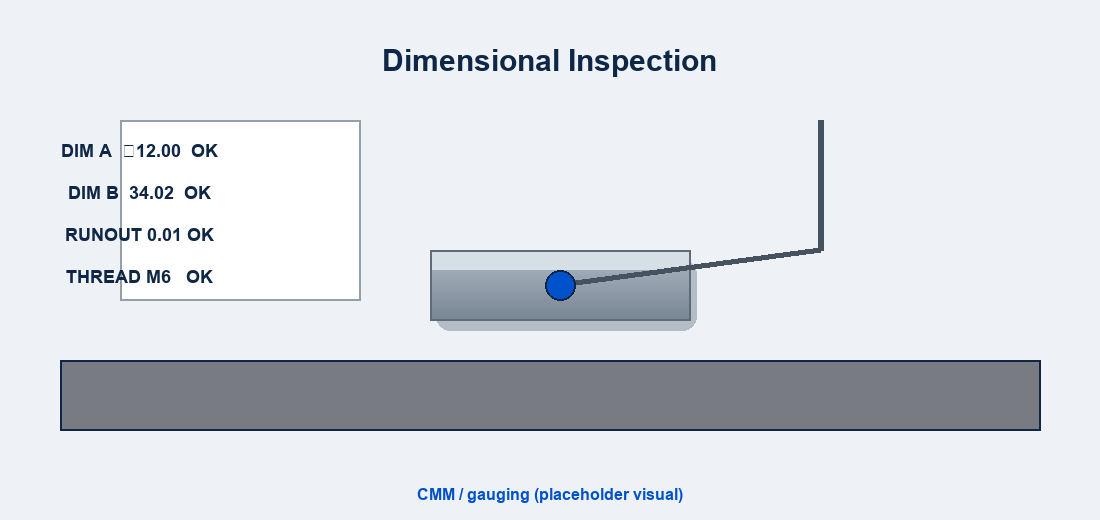
Inspection depth scales with the part's function and your requirements. A simple pin may need a basic dimensional check; a hydraulic fitting may need thread gauging, runout control and a full report.
All inspection is performed with calibrated equipment. Documentation is provided to the level your order specifies.
Prototype, Low-Volume and Mass Production
The same part can be needed as a one-off sample, a small batch or a production run. We support all three stages under one roof.
| Stage | Typical |
|---|---|
| Prototype | 1+ piece · 3–7 working days |
| Low-volume | 7–20 working days |
| Mass production | 15–25 working days |
| Minimum order | 1 piece |
Lead times are typical and depend on material availability, part complexity, quantity, tolerance, finishing and certification. MOQ is 1 piece (sample accepted).
Applications of Stainless Steel Turned Components
We organize applications by industry and the part type used — more useful than a generic industry list.
Hydraulic & Pneumatic
Fittings, valve components, shafts, adapters.
Automotive
Shafts, sensors, fasteners, connectors.
Medical / Laboratory
Instrument components, fittings, device parts — where materials and quality requirements are met.
Electronics
Connectors, terminals, precision pins, threaded components.
Industrial Machinery
Shafts, bushings, rollers, couplings.
Pumps & Valves
Valve stems, seats, fittings, precision sleeves.
Food / Beverage
Hygienic components, shafts, connectors — appropriate grade per spec.
Fluid Handling
316L fittings, manifolds, sealed components.
Precision Stainless Steel Turned Parts Case Studies
Illustrative examples of stainless turned parts we manufacture. Specific tolerances and documentation are confirmed per project.
316L Hydraulic Fitting
17-4PH Precision Shaft
303 Bushing
303 Connector
Mini matrix — part / grade / process / feature / application. This structure is what helps confirm we make your part type.
| Part | Grade | Process | Feature | Application |
|---|---|---|---|---|
| Shaft | 17-4PH | Turning | Tight OD / runout | Automation |
| Fitting | 316L | Turning | Threads / sealing | Hydraulic |
| Bushing | 303 | Turning | ID / OD | Mechanical |
| Connector | 303 | Turning + milling | Threads / flats | Electronics |
What Affects Stainless Steel Turned Part Cost?
Cost is driven by far more than "complexity." Understanding the drivers helps explain why two similar-looking shafts can price differently.
Material grade
303 vs 316L differ in raw cost and machinability.
Raw diameter
Larger bar stock lowers material utilization efficiency.
Part length
Longer parts use more material and cycle time.
Material removal
More stock removal = longer cycle.
Operations
Threads, cross holes, secondary milling add steps.
Finish
Passivation, polishing, plating add processes.
Inspection
CMM, FAI and certification add cost at scale.
Quantity
Volume spreads setup and improves unit cost.
How to Reduce Stainless Steel Turning Cost
Right grade
Don't over-specify; match grade to service condition.
Avoid needless tight tol.
Only tolerance features that are functional.
Standard threads
Use standard sizes/pitches where possible.
Group parts
Similar parts in one batch reduce setup.
Right finish
Specify finish only where required.
Volume order
Production volume improves unit economics.
For a full cost breakdown methodology, see our CNC Machining Cost Guide.
Precision Stainless Steel Turning Lead Time
| Stage | Typical time |
|---|---|
| Engineering review | 1–2 business days |
| Material sourcing | Per stock / grade |
| Prototype machining | 3–7 working days |
| Inspection | Per requirement |
| Surface treatment | Per finish |
| Production | 15–25 working days |
Lead time depends on material availability, part complexity, quantity, tolerance, finishing and certification requirements. Confirmed at quotation.
What Do We Need for Your Turning Quote?
A 3D model alone rarely defines every manufacturing requirement for a precision turned part. The more of the following you provide, the faster and more accurate the quote.
Information to include with your inquiry
- 3D CAD model (STEP / STP / IGES / X_T)
- 2D drawing with critical tolerances
- Stainless steel grade
- Quantity & annual volume
- Critical tolerances
- Roundness / concentricity requirement
- Thread specification (size, pitch, class)
- Surface roughness
- Surface finish (passivation, polish…)
- Heat treatment (if required)
- Inspection requirement
- Material certificate need
Tip: a 2D drawing still matters for precision turned parts — it defines tolerances, threads and inspection that a 3D model may not. Upload both when you request a quote.
How to Choose a Stainless Steel Turned Parts Manufacturer
Questions worth asking before you commit:
1 · Grade
Do they machine the stainless grade you need (303/304/316L/17-4PH)?
2 · Size
What diameter and length can they actually handle?
3 · Tolerance
What is their real, evidenced standard tolerance?
4 · Runout
Can they control runout / concentricity?
5 · Threads
Can they provide thread inspection?
6 · Certs
Can they provide material certificates?
7 · Trace
Can they provide traceability?
8 · Finish
What finishing can they handle (passivation…)?
9 · Volume
Prototype and production under one roof?
10 · Evidence
Inspection documentation available?
Key advice: do not choose a supplier only from its advertised micron-level tolerance. Ask for evidence on parts similar to your application.
Why Work With a Stainless Steel Turned Parts Manufacturer
Xiamen Goldcattle manufactures custom CNC-turned metal components for international B2B customers — not a trading intermediary. Our CNC capability includes turning, milling and multi-axis machining where applicable, supported by in-house inspection and engineering.
Manufacturing facility
Manufactured in Xiamen, China, with in-house production.
100+ machines
In-house equipment across CNC, molding, tooling, 3D printing, die casting and sheet metal — no outsourcing of core work.
Engineering team
DFM review and process engineering before cutting metal.
Quality inspection
CMM, gauging and documented inspection.
Material traceability
Mill cert → lot ID → batch → shipment.
Prototype → production
One supplier from sample to volume.
Export experience
Regular shipments to international B2B customers.
Case evidence
Real part types documented above.
Since 1998
Long-standing precision manufacturing operation.
Frequently Asked Questions
What are precision stainless steel turned parts?
Components produced by CNC turning from stainless bar stock, with rotational features such as diameters, bores, threads, grooves and shoulders — made to a customer drawing.
Which stainless steel grades can be CNC turned?
We regularly turn 303, 304, 316L and 17-4PH. Other grades such as 420 / 440C can be considered on request. Confirm your specified grade at quotation.
What is the difference between 303, 304 and 316L?
303 machines easiest; 304 is the general-purpose grade; 316L adds stronger corrosion resistance for chemical, marine and fluid use. Selection depends on the service condition.
Can you CNC turn 17-4PH stainless steel?
Yes. 17-4PH is a precipitation-hardening grade we turn and can manage heat treatment for where strength is required.
What diameter range can you machine?
Typical maximum turning diameter up to Ø300 mm with bar capacity up to Ø65 mm; larger on request. Actual limits depend on material and geometry — confirm at quotation.
What tolerance can stainless steel turning achieve?
Typical diameter tolerance ±0.01 mm, with ±0.005 mm on qualified features. We quote tolerance per functional feature, not as a single blanket number.
Can you machine internal and external threads?
Yes — metric, UNC/UNF, BSP and NPT, specified by size, pitch, class and direction. Thread gauging is available.
Can you make hydraulic fittings?
Yes. Stainless hydraulic fittings with threads and sealing surfaces are a core part type, with concentricity and thread inspection as needed.
Can you manufacture stainless steel shafts?
Yes — stepped shafts, precision shafts, drive shafts and actuator shafts, with runout and concentricity control.
Can you manufacture stainless steel bushings?
Yes — sleeve, flanged and bearing bushings with ID/OD concentricity control.
Can you control concentricity and runout?
Yes. Concentricity, roundness and runout (TIR) are controlled and reported against the drawing where specified.
Can you provide material certificates?
Yes. Material certificates and batch/heat identification are available on request, with traceability from mill to shipment.
Can stainless steel turned parts be passivated?
Yes. Passivation can be considered per application to improve corrosion resistance after machining.
Can you provide prototypes?
Yes. Prototypes from 1 piece, typically 3–7 working days, with the same process path to production.
Can you handle high-volume production?
Yes. We support low-volume through mass production, with MOQ of 1 piece for samples.
What is the minimum order quantity?
1 piece — samples are accepted.
How long does stainless steel CNC turning take?
Prototype machining typically 3–7 working days; production 15–25 working days. Final lead time depends on material, complexity, quantity and finishing.
How much do precision stainless steel turned parts cost?
Cost depends on grade, size, operations, finish, inspection and volume. Send the drawing for a breakdown — see our CNC Machining Cost Guide.
What files are required for a quote?
3D CAD (STEP/IGES) plus a 2D drawing with tolerances, grade, quantity, critical tolerances, thread spec and finish. A 2D drawing still matters for precision turned parts.
Request a Stainless Steel Turned Parts Quote
Send your drawing and stainless grade. We return a quote with capability confirmation, typical tolerance and lead time — no generic promise, just the facts for your part.
Planned cluster expansion: 316L Stainless Steel CNC Parts · 17-4PH CNC Machining · Stainless Steel Shafts · Stainless Steel Bushings · Stainless Steel Fittings (coming soon).